Ars Est Celare Artem

Japanese Film Director Yasujiro Ozu (1903-1963)

It was Horace in his “Ars Poetica” who wrote ars est celare artem, meaning that true art conceals the means by which it is achieved.

The film medium has an unusually rich variety of tools that can be used in movies, including zooms in and out, pans, wipes, tracking and dolly shots, tilts, and crane shots. And these do not include the complex technically-assisted tools such as are involved in computer generated imagery (CGI).

In Vertigo (1958), Alfred Hitchcock created a stunning visual effect by combining zooming out with tracking in. Some directors like Sergei Eisenstein, Max Ophuls, Jean-Luc Godard, and Andrey Tarkovsky have used the language of film in new and exciting ways.

Just as there are writers like Ernest Hemingway who employ a simple style. There are others, such as James Joyce, Marcel Proust, and Georges Perec who used all the bells and whistles of literature to achieve their aims.

If there is an equivalent to the Hemingway style in film, I would have to say it is in the films of Yasujiro Ozu. In the dozen or so films I have seen, I remember only one camera movement, a slight pan in his Tokyo Story (1953), in which we follow an elderly couple as they walk alongside a wall at a seaside resort. With Ozu, there is, for the most part, only a succession of simple shots, most frequently at the level of a Japanese person seated on a tatami mat.

Intercut with these shots are others that are almost like stills. In the sound pictures, the music wells up, and the audience is meant to absorb what has just happened. This is referred to in Japanese as mono no aware. literally: the pathos of things. There is, for instance, this recurring shot in Floating Weeds (1959):

As one American writer put it in The Other Journal:

When I reflect on Japanese cinema, I find that one of the things that continually draws me back to it is a sort of gentle melancholy and pensive longing. Granted, this isn’t true of all Japanese films — I don’t know if you’d find it much in violent yakuza films or over-the-top kaiju films — but the ones that have stuck with me over the years are typified by this emotion and seem to contain it in large amounts.

There’s a Japanese phrase that sums up this feeling I’m describing: “mono no aware.” Roughly translated into English, it means “the sadness of things”. It’s not sadness in the sense of depression or angst, but rather, it refers to an awareness of the fragility of existence, of the transient and bittersweet nature of life, which, I’ve found, can make for incredibly beautiful and poignant cinema.

That feeling is present in all the Ozu films I have seen, which is why I regard him as one of the greatest of all film artists and perhaps the preeminent artist in the Japanese cinema.

this and That

No, the lower-case “t“ in the above title is not an error. It is explained by Polish/Ukrainian philosopher and author Sigizmund Krzhizhanovsky (1887-1950) in a 1918 essay entitled “Argo and Ergo.”

All the things in my world I divide into these and Those.

These have worn out my eyes; they have rubbed my hands sore; they are covered with layers of my touches; they surround me, chafing my very eyes, my skin, they are all right here and here. I know them to the finest flexure—point—mark; they have all been counted and recounted.

Whereas Those things: are not within my grasp, my eye cannot reach, but I believe: they are the essence: beyond all distances, outside all tangencies, where lines of sight have come to an end and colors faded away.

To think is to transpose things: from these into Those, from Those into these.

Some people rejoice if, having taken this thing right here at hand, they can remove it to That: we shall call them this-into-Thaters. This sort of person is usually drawn to poetry, music, and so on. People who would rather, on reaching for Those distant things, bring them as close as possible to eye and brain, we shall call That-into-thisers: their minds, attracted by science, by the exactitude of definitions, like to “reveal”mysteries and “discover” secrets,

“It Is Bells Within”

Like me, Emily Dickinson loved reading. (Unlike me, she had the talent to show for it.) Today, I present one of her untitled poems on the joys of books.

Unto my books so good to turn
Far ends of tired days;
It half endears the abstinence,
And pain is missed in praise.

As flavors cheer retarded guests
With banquetings to be,
So spices stimulate the time
Till my small library.

It may be wilderness without,
Far feet of failing men,
But holiday excludes the night,
And it is bells within.

I thank these kinsmen of the shelf;
Their countenances bland
Enamour in prospective,
And satisfy, obtained.

Floating Weeds

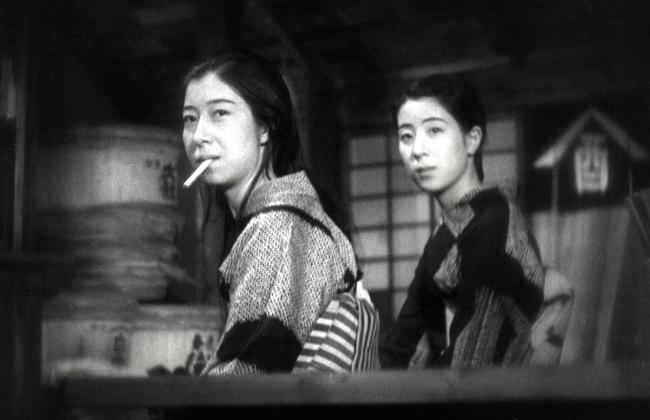
Rieko Yagumo and Yoshiko Tsubouchi in Story of Floating Weeds (1934)

Over the last two days, I have had the good fortune to see two great films by Japanese director Yasujiro Ozu, one the remake of the other. Although the technology to make sound films existed in Japan, Ozu deliberately made only silent films until 1936.

His A Story of Floating Weeds (1934) is about a traveling Kabuki player troupe that visits a small town. On a previous visit to that same town, the head of the troupe, played by Takashi Sakamoto, had an affair with a local woman who ran a small restaurant/bar and had a son by her. In the intervening years, he sent money for his education and begged the mother to say that he was the boy’s uncle instead of his “deceased” father.

Sakamoto loves spending time with his son, and that arouses the envy of Rieko Yagumo, his mistress on the road. She bribes her fellow actress Yoshiko Tsubouchi to seduce the boy, but they fall in love with each other. Furious, Sakamoto dissolves the acting troupe.

Like all of his films, A Story of Floating Weeds shows a group of people at odds with one another coming together in the end with an enhanced respect and gentleness.

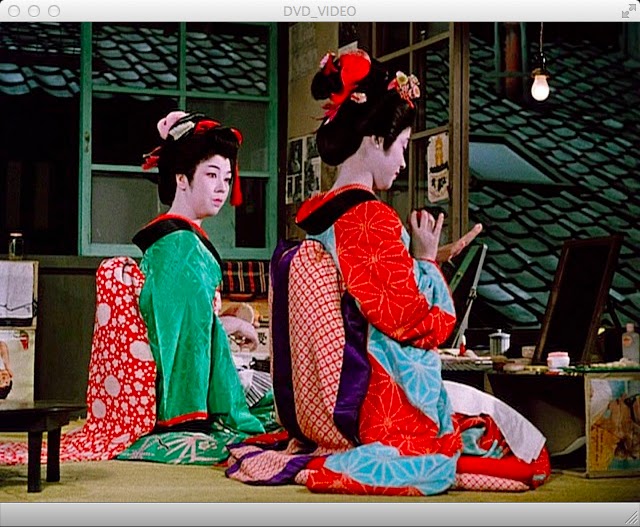
It is no surprise that Ozu remade the film in 1959 as Floating Weeds. It is the same basic story, but with sound and color.

The Same Two Roles a Quarter Century Later

I actually prefer the original silent 1934 version. It was a better story and had better actors (even though the 1959 version had Machiko Kyo in the role of the mistress in the troupe). It was so good, in fact, that I plan to buy the recent Criterion release of both versions on DVD.

Yasujiro Ozu was one of the five or ten greatest film directors who ever lived. Over the years, I have seen over a dozen of his films, and there was not a clinker in the bunch. Even John Ford, Jean Renoir, and Carl Dreyer made some stinkers. But not Ozu. The world lost a magnificent artist when he died in Tokyo in 1963. I plan on discussing his film style in a later post this week.

The Mobs of St. Pat’s

Robert Burns had it right when he wrote his poem “To a Mouse”:

 But Mousie, thou art no thy-lane,
In proving foresight may be vain:
The best laid schemes o’ Mice an’ Men
Gang aft agley,
An’ lea’e us nought but grief an’ pain,
For promis’d joy!

Today was St. Patrick’s day, supposedly a low-key holiday. Martine and I had a sudden yearning for corned beef, cabbage, and potatoes, so we decided to go to the Original Farmers’ Market at 3rd Street and Fairfax. We did not anticipate any hitches. More fool us!

It started with the trip to the restaurant we had picked, Magee’s, which was founded in 1917. We took the 10 Freeway to the Fairfax exit and slowly worked our way through heavy traffic which wiped out any advantage to taking the freeway.

Then, at the Farmers’ Market, there was a huge mob scene at Magee’s, with a long line waiting a place an order and an even longer line waiting for pickup. Most of the crowd were decked in various shades of green, while Martine and I were not. After waiting for the line to inch forward, we made the one good decision of the day, which was to get our corned beef and cabbage at DuPar’s.

There wasn’t even a big line at DuPar’s, which was strange as I think it is a better restaurant. Maybe it doesn’t sound Irish enough. In any case, we had a delicious meal.

If that was all that happened, I would have counted it as a good day. But then there was the trip home. Apparently, today was the day of the Los Angeles Marathon. Every year around this time, they take over the streets in a crescent-shaped swath from downtown to Santa Monica, forcing traffic from normally busy streets onto such parallel roads as Sunset, Olympic, and Pico. I had decided to take LaCienega to Olympic and head due west.

With me were thousands of other motorists. Inching forward and madly changing lanes every few feet. It took us an hour to get home. I did not entertain any kind wishes toward the marathoners. In fact, I was on the edge of cursing them with an old Hungarian anathema. Wisely, I refrained. They didn’t know I was going to venture into their bailiwick for corned beef and cabbage.

Sanctuary

Immigration: Becoming More of an Issue As Time Passes

When it comes to immigration, the United States has been lucky. That is mostly because most of the migrants to our country were not at odds with our civilization. I think of the problems with Pakistanis in Britain and Burmese Rohingya in Thailand, and I see the American prejudice against Mexicans and Central Americans as solvable over time. We were just plain lucky that the peoples of the North and South American continents are not substantially different from us, and that we are separated from Europe, Africa, and Asia by two large and formidable oceans.

Within historic times, there have been long periods of migration that contributed to the destruction of the Western Roman Empire. On my bookshelves is an eight-volume study by Thomas Hodgkin entitled The Barbarian Invasions of the Roman Empire. They tell a long tale of ravages wrought by the Visigoths, Ostrogoths, Huns, Vandals, Lombards, and Franks. They are not the only reason for the fall of Rome, but they certainly contributed.

We may soon be seeing hordes of migrants that dwarf anything from the past. The reasons for this are two-fold:

  • Because of the acceleration of climate change, many island, equatorial, and desert regions are becoming uninhabitable
  • More and more countries are turning into failed states, the worst being Somalia, Sudan, Myanmar, Afghanistan, Syria, Haiti, Venezuela, Honduras, Mali, Libya, Albania, and DR Congo

In the years to come, the United States will be sen more and more as a sanctuary from the world’s climatic and political ills, even though we see ourselves as having climatic and political ills aplenty. It will be like the migrants of over a century ago who thought the streets of America were paved with gold. Even when they were not.

I don’t think that building a wall along our southern border will accomplish much: the Mexican cartels have discovered that fences could be climbed over or tunneled under. They are now in charge of the coyotes guiding most migrants over the border. In the end, controlling access to the border will probably be more profitable for them than smuggling drugs ever was.

Will the oceans still protect us when the pressure to migrate grows tenfold? I think not. Even now, many migrants crossing over from Mexico are from China and Africa.

What a Coincidence!

I’m Sure Orange Jesus Knew This

I was watching the National Geographic Channel last night when suddenly I sat bolt upright. On her show entitled “Trafficked,” Mariana van Zeller investigates a man who flew to Mozambique to claim an inheritance, only to find himself in jail for attempting to travel with heroin in his luggage—heroin disguised as candy that was given to him by a man from South Africa to give to someone in Nigeria.

Nigeria? Oh oh! Can anything legitimate have anything to do with Nigeria? Apparently, there is a term in Nigerian Pidgin describing the types who are so imprudent as to turn up in Africa for their “inheritance”: that term is maga, which means “easily fooled idiot.” On the show, Van Zeller interviews a masked Nigerian baddy (no doubt a Prince) who points out that the man imprisoned in Mozambique is nothing more than a maga for actually showing up to claim his non-existent inheritance.

Ha ha, it is to laugh!

So when all those flyover country chuckleheads show up at Trump rallies wearing their MAGA hats, is it merely a case of self-identification? “I’m an easily fooled idiot. Lie to me!”

Bumpf

Giving a Boost to the Classics

According to the Oxford dictionaries, bumpf is defined as “written information, especially advertisements, official documents, forms, etc., that seem boring or unnecessary.” That certainly seems to be the case in Amazon Kindle’s store, where one can find the following “titles”:

  • Casino Girl: A Totally Addictive Crime Thriller
  • The Good Husband: A Totally Gripping and Heart-Pounding Thriller Novel for 2024
  • The Orphan’s Homecoming: Experience the Heart-Wrenching Tale of Love and Loss in 20924 with This Gripping … [the rest is missing]
  • A Guilty Secret: The New Twisty, Gripping Psychological Thriller About Friendship and Lies from the … [the rest is missing]

It seems that some of these titles just needed a little help. I think that Jeff Bezos could probably make more money by applying the same principle to literary classics:

  • Romeo & Juliet: Hot Twisty Teenage Love Capped by a Double Suicide
  • Finnegan’s Wake: A Commodious Vicus of Forbidden Love and Obscure Wordplay
  • Pride & Prejudice: She Gave Herself to Her Lover and Somehow Maintained Her Purity
  • Don Quixote: Why Was Dulcinea Shunted Off to the Sidelines?
  • Moby Dick: The White Whale Took a Big Bite Out of His … [the rest is missing]

Let’s face it: People would read more if what we learned from Madison Avenue were put to good use.

Jack Sprat

Hatch Chiles Being Roasted on a Grill

You have no doubt heard the old nursery rhyme:

Jack Sprat could eat no fat,
His wife could eat no lean.
And so between them both, you see,
They licked the platter clean.

Martine and I are similarly a study in contrasts. She’s a Republican; I’m an independent Libtard. She has irritable bowel syndrome (IBS), so she pretty much cannot eat anything that has a vowel in its name. I, on the other hand, love highly spiced foods, preferably including my favorite vegetable: hot chile peppers. Somehow we manage to get by despite the differences.

I think it all started with my childhood: My father was a member of the American Independent Party and a staunch supporter of George C. Wallace and his racist platform. I was originally a Democrat, but got tired of the whole circular firing squad thing. So I tend to vote Democratic—but not always on the local level and always as an Independent (No Party Affiliation)..

Somehow I think the contrasts help maintain our relationship, which has been going fairly steady for the last three decades or so. I won’t say it’s been going strong, but steady will do just fine, and I will accept it.

Taking a Bite Out of Heimaey

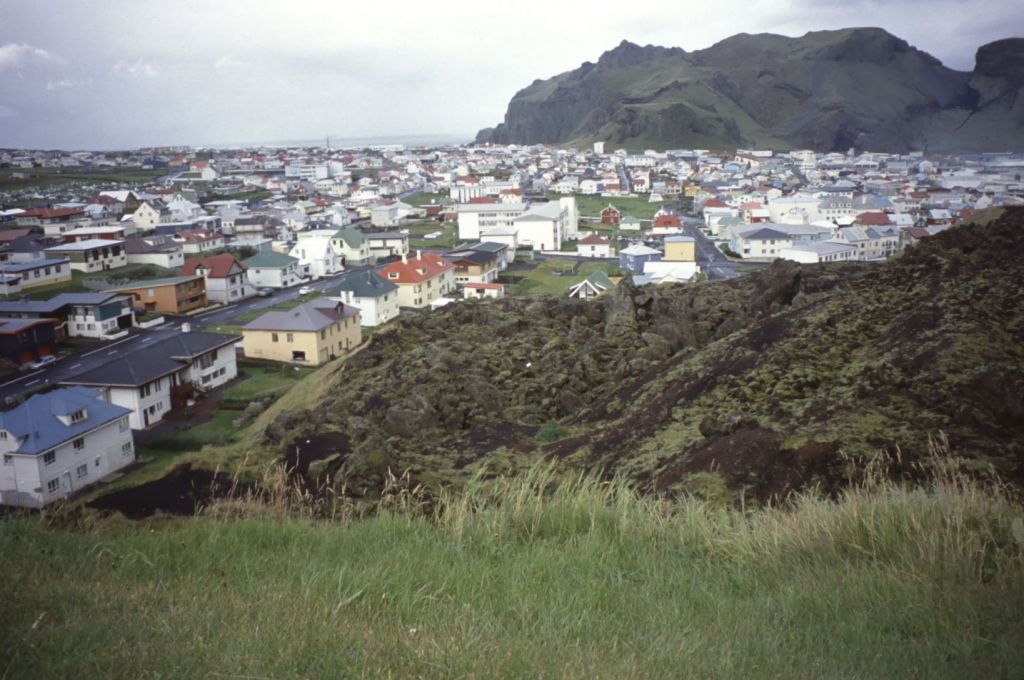
What the Volcano Eldfell Left of Heimaey (2001)

On January 21, 1973 the volcano Eldfell in Iceland’s Westman Islands began a sustained eruption that destroyed a large part of the town of Heimaey. I visited the island twice, in 2001 and 2013. During the second visit, I hiked around the massive lava flow that ate up some 400 buildings and several entire streets.

If you are interested in reading about the heroic fight to save Heimaey, I urge you to read John McPhee’s book, The Control of Nature (1989), which contains an essay entitled “Cooling the Lava.” The Icelanders saved most of the town by spraying sea water at the lava to cool it. Never before had this method been used against this type of disaster. Of course, there are not many towns of any size so close to an active volcano.

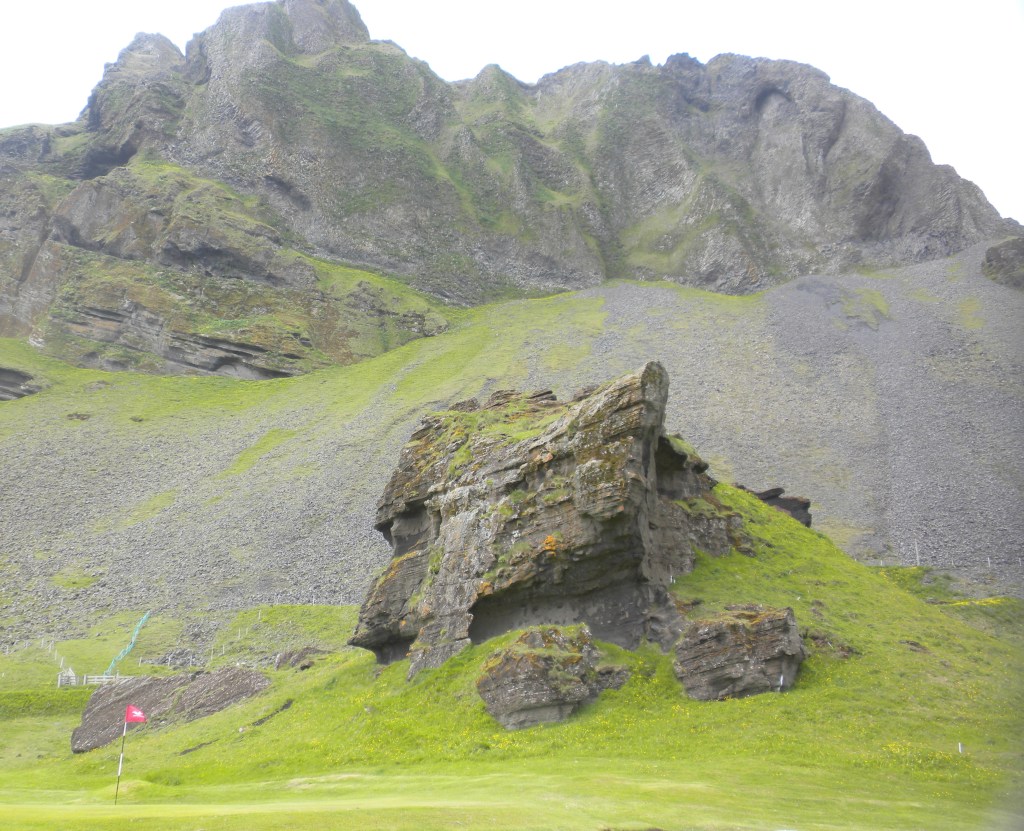
The Summit of Eldfell in 2013

As one hikes atop the lava that buried so many homes, one can still see signs indicating the streets that were lost. One such can be seen in the lower left-hand corner of the above photograph. In 2013, work was under way on a museum called Eldheimar for which several houses covered by the lava were excavated.

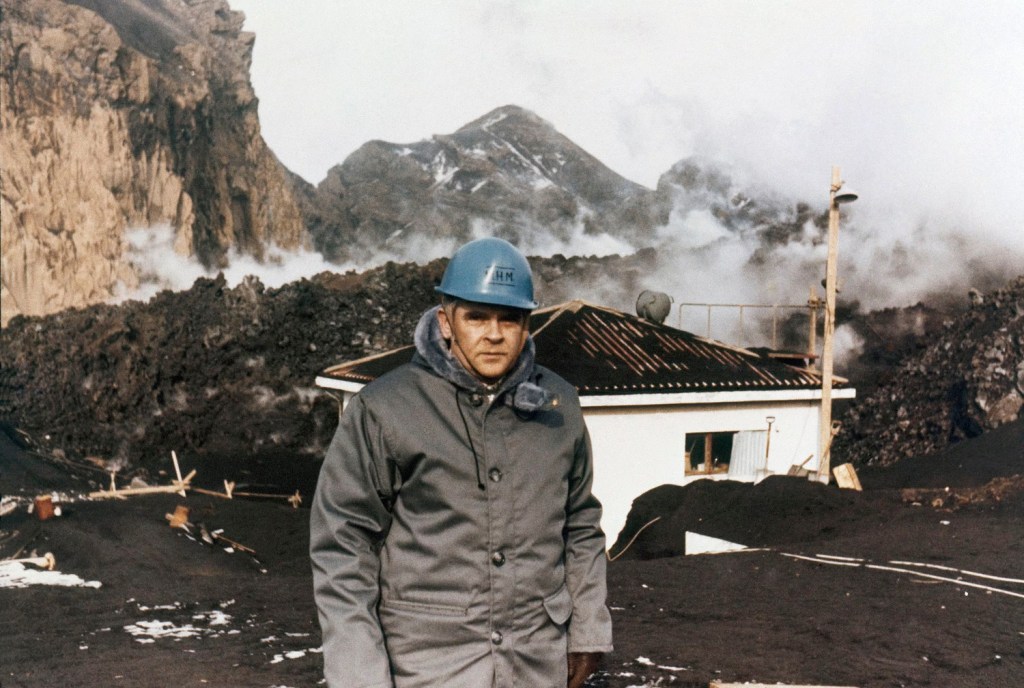
Just to give you an idea of the horror faced by the Icelanders, here is a picture taken during the eruption:

Pictured here is Mayor Magnus Magnusson of the finishing port of Heimaey, Iceland, who has been fighting to save the harbor from a relentlessly advancing wave of lava from the volcano Eldfell, March 3, 1973. (AP Photo)