I am finally back online. Although I have some sixty years of computer experience, I am not much of a do-it-yourself systems man. My friends who are spend great gobs of time in frustrating attempts to make their computers work. I find it easier to hire a professional, who also happens to be my friend.
The reason my blog was down so long was that my friend was in high demand by his big clients. But in the end, he came through with a new computer that was custom configured to use Microsoft Windows 11 as if it were an earlier version of the system, so I wouldn¹t have to spend so much time reacting to every new major release.
In the end, it would have taken twice as long—amid great frustration—to do it all myself. In the end, it may well even have cost more, as I could take advantage of his professional discounts.
I will be without a computer this weekend, so I will not be posting. On Tuesday or Wednesday, I will have my new Dell Desktop running and will have several days worth of info to post. In the meantime, have a great Memorial Day weekend!
Things were starting to get serious. I was running out of Hungarian paprika, and my supplier of füstölt kolbász (smoked Hungarian sausage) had gone out of business months ago. Normally, I am not a big fan of what I call Eurochow, but in the case of Hungarian cuisine I make an exception.
On Saturday, Martine and I drove out to Burbank, where, in the middle of a residential block, sits Otto’s Hungarian Import Store and Deli. We used to go there more frequently, but lately Martine has been reluctant to go on long drives due to a pinched nerve in her back.
Fortunately, Otto’s had some good kolbász and big jars of Szegedi and Kalocsai sweet Hungarian paprika. And since Martine had been such a good sport about coming along, I got her some dobos torte and dios baigli.
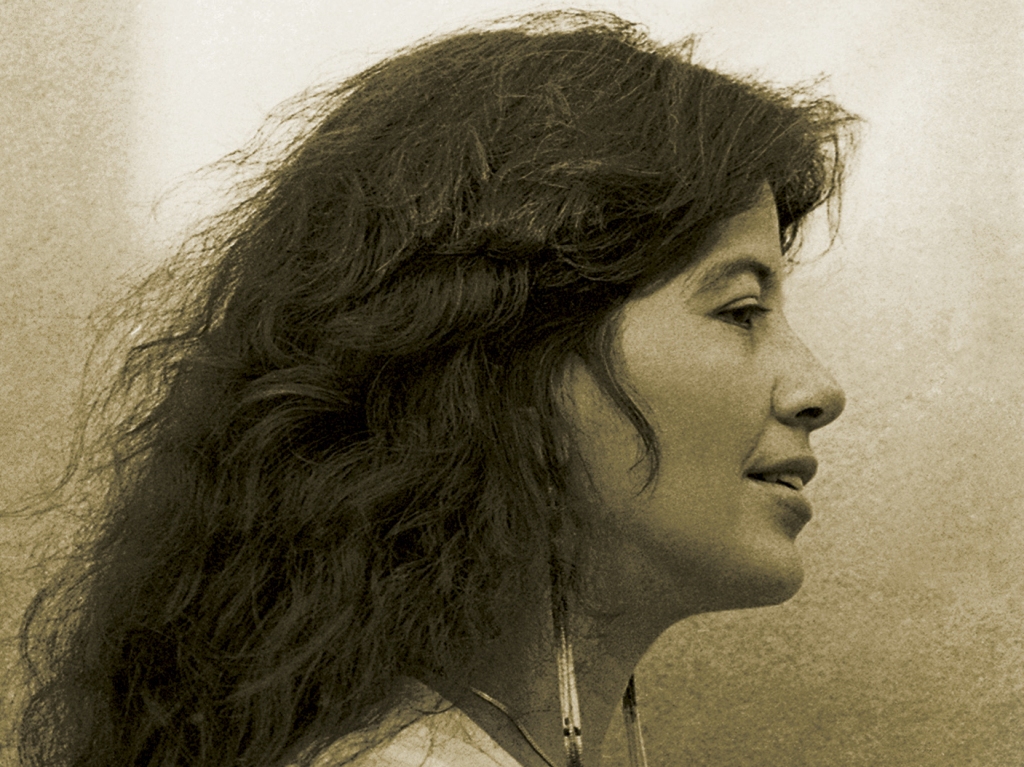
Born in 1951, Joy Harjo is a member of the Muscogee (Creek) Native American Nation, who has served three terms as poet laureate of the United States. Her poetry is simply magical, as the following sample shows:
Rabbit Is Up to Tricks
In a world long before this one, there was enough for everyone, Until somebody got out of line. We heard it was Rabbit, fooling around with clay and the wind. Everybody was tired of his tricks and no one would play with him; He was lonely in this world. So Rabbit thought to make a person. And when he blew into the mouth of that crude figure to see What would happen, The clay man stood up. Rabbit showed the clay man how to steal a chicken. The clay man obeyed. Then Rabbit showed him how to steal corn. The clay man obeyed. Then he showed him how to steal someone else’s wife. The clay man obeyed. Rabbit felt important and powerful. The clay man felt important and powerful. And once that clay man started he could not stop. Once he took that chicken he wanted all the chickens. And once he took that corn he wanted all the corn. And once he took that wife, he wanted all the wives. He was insatiable. Then he had a taste of gold and he wanted all the gold. Then it was land and anything else he saw. His wanting only made him want more. Soon it was countries, and then it was trade. The wanting infected the earth. We lost track of the purpose and reason for life. We began to forget our songs. We forgot our stories. We could no longer see or hear our ancestors, Or talk with each other across the kitchen table. Forests were being mowed down all over the world. And Rabbit had no place to play. Rabbit’s trick had backfired. Rabbit tried to call the clay man back, But when the clay man wouldn’t listen Rabbit realized he’d made a clay man with no ears.
Wait a Sec! Pre-Columbian Warriors Had No Iron or Steel
I have been reading (and enjoying) Hugh Thomson’s A Sacred Landscape: The Search for Ancient Peru. In it, he discusses the nature of warfare during the Sechin culture (1800-1300 BC).
Before coming to Sechin I had talked to Henning Bischof, the distinguished German archaeologist now in his late sixties who had done pioneering work at Cerro Sechin between 1979 and 1984. Together with Peruvian colleagues, he had been the first to establish an accurate radiocarbon figure for the site, when they had found a wooden post supporting one wall and dated it around 1500 BC. I asked him about the intense debate on the meaning of the frieze [depicting human sacrifice].
What you have to remember,” said Henning in slightly accented but perfectly grammatical English, “is what was happening to Peru when all these different interpretations were being made.” He argued that Peruvian archaeology reflected political events far more than has ever been acknowledged. While the military governments of the sixties and seventies held sway, they welcomed a purely military interpretation of the frieze—Peru’s great military past, so to speak, which they were inheriting—“and that interpretation is precisely what the archaeologists gave them.”
But as Henning pointed out, there was a real problem with any interpretation of the frieze as military: without iron, the weapons available for actual warfare to the people of Sechin would never have been able to achieve such clean-cut savagery, Speaking in his precise German accent, Henning said: “It would have been impossible to cut off limbs in combat. You must remember that it is time-consuming work to disassemble a human body.” Any warfare would have been a far cruder process of slings and battering stones.
Sam Riley and Garrett Hedlund in Walter Salles’ Movie On the Road
This month I read two classical “road novels.” The first was Jean Giono’s The Open Road (Grands Chemins) about two down-at-heel pals walking through the countryside of Southern France around 1950 looking to pick up cash from work or gambling. Conceived of around the same time was Jack Kerouac’s On the Road about two down-at-heel pals crossing the continent at high speed looking to pick up enough cash for gas to get to their destination. Curiously, neither writer was aware of the other, even though Kerouac came from a French-Canadian family.
Both books are well worth reading, especially as I feel that Kerouac and Giono would have admired each other’s work.
Jean Giono (1895-1970)
I had read the Kerouac decades earlier, but upon finishing Giono’s book, I thought I wanted to get on the road again, so I re-read On the Road. They were two very different authors. Giono was in love with the land of his birth as was Kerouac. Unfortunately, Kerouac’s love was so heavily suffused with alcohol that he only lasted to the age of 47. His later books, such as Big Sur, showed him to be headed down the road to liver failure.
Still, I love reading Kerouac’s books. He had such a vital enthusiasm for his friends and for mid-century America that, even in his experiments in bop prosody, something splendid shines through. Perhaps it was a never ending sense of youthfulness. Giono’s France is centuries old, but Kerouac’s America was bottled in bond in the years right after the Second World War.
Times have changed since the reliable old rotary telephone joined the Model T and the locomotive cowcatcher. It used to be that people generally answered the telephone and cooperated with pollsters. Then the world of telephony changed. Nowadays it is not unusual for robocalls selling gonzo vacation packages, suspicious medical insurance, and such to outnumber the calls to which we actually like to respond. Moreover, with Caller ID “Spam Risk” notification, it has become downright difficult for pollsters to get a live respondent.
What happens when one gets through to me? I just say “I don’t respond to polls or surveys” and hang up before the caller can inhale.
Then, too, the multiplication of cell phones has made it chancy to poll a household with no landline and multiple cell phones. I have both a landline and a cell phone. The latter is off most of the time because I was annoyed by receiving numerous robocalls in Mandarin Chinese; so I just use my cell phone to call out when traveling.
There is an interesting PBS website called “The Problem with Polls” that gives you an idea of the problems faced by research organizations.
What surprises me is how polls that wildly contradict one another continue to be news. My assumption is that instead of a one-digit margin of error, it is probably closer to ±25% or more.
Enroute to Mexico with Neal Cassady in On The Road, Jack Kerouac falls for a young woman he sees briefly in Michigan. Considering Kerouac’s dismal track record with women, maybe it was a good thing she didn’t join him.
I took up a conversation with a gorgeous country girl wearing a low-cut cotton blouse that displayed the beautiful sun-tan on her breast tops. She was dull. She spoke of evenings in the country making popcorn on the porch. Once this would have gladdened my heart but because her heart was not glad when she said it I knew there was nothing in it but the idea of what one should do. “And what else do you do for fun?” I tried to bring up boy friends and sex. Her great dark eyes surveyed me with emptiness and a kind of chagrin that reached back generations and generations in her blood from not having done what was crying to be done—whatever it was, and everybody knows what it was. “What do you want out of life?” I wanted to take her and wring it out of her. She didn’t have the slightest idea what she wanted. She mumbled of jobs, movies, going to her grandmother’s for the summer, wishing she could go to New York and visit the Roxy, what kind of outfit she would wear—something like the one she wore last Easter, white bonnet, roses, rose pumps, and lavender gabardine coat. “What do you do on Sunday afternoons?” I asked. She sat on her porch. The boys went by on bicycles and stopped to chat. She read the funny papers, she reclined on the hammock. “What do you do on a warm summer’s night?” She sat on the porch, she watched the cars in the road. She and her mother made popcorn. “What does your father do on a summer’s night?” He works, he has an all-night shift at the boiler factory, he’s spent his whole life supporting a woman and her outpoppings and no credit or adoration. “What is he aching to do? What are we all aching to do? What do we want?” She didn’t know. She yawned. She was sleepy. It was too much. Nobody could tell. Nobody would ever tell. It was all over. She was eighteen and most lovely, and lost.
What with all the campus protests of Israel’s attacks on the Palestinians of Gaza, I am reminded of Hamlet watching the murderous King Claudius tear up at ancient Greek tragedy:
What’s Hecuba to him or he to Hecuba That he should weep for her? What would he do Had he the motive and the cue for passion That I have? He would drown the stage with tears And cleave the general ear with horrid speech, Make mad the guilty and appall the free, Confound the ignorant, and amaze indeed The very faculties of eyes and ears. Yet I, A dull and muddy-mettled rascal, peak Like John-a-dreams, unpregnant of my cause, And can say nothing—no, not for a king, Upon whose property and most dear life A damned defeat was made. Am I a coward? Who calls me “villain”? Breaks my pate across? Plucks off my beard and blows it in my face? Tweaks me by the nose? Gives me the lie i’ th’ throat As deep as to the lungs? Who does me this?
I am somewhat amused by all the campus protests. It’s not at all like the anti-Vietnam War protests of the 1960s, because American college students, for the most part, have nothing to gain or lose by doing so. In all likelihood, they will not be drafted and shipped off to Rafah to confront the Israeli Defense Forces in Gaza.
No doubt, Bibi Netanyahu is a villain, as are the West Bank settlers depriving the Palestinians of their land. But then, there’s plenty of villainy to spread around, when one considers the horrors of Hamas’s October 7 attack on innocent Israeli citizens.
Have there been any campus protests on behalf of the Rohingya? the Chechens? the Ukrainians? Granted, the United States supplies Israel with arms, but we are not participating in or even encouraging what looks like genocide to me. It does not look to me as if the protesting students had any skin in the game.
Perhaps the protests erupted because it’s spring, and “dull and muddy-mettled rascals” like to kick up a row from time to time.
This is a reprint of a blog posting from May 17, 2016. Martine and I were dismayed to hear of the passing of Roger Corman, who died in Santa Monica at the age of 98 on May 9 of this year. It never ceased to amaze me that one could produce and direct so many interesting films while working in what the film industry has called “poverty row.”
The first time I ever heard of him was when I was a student at Dartmouth. At that time (the mid 1960s) I subscribed to Films and Filming. One issue contained an article entitled “The Crown Prince of Z Films,” referring, of course, to Roger Corman. I was intrigued by what I was hearing of the cheapster director who made so many interesting films for American International Pictures. What I liked most were the Edgar Allan Poe adaptations, usually starring Vincent Price.
Perhaps my favorite was The Masque of the Red Death (1964), about the attempt by a group of dissipated nobles to escape the plague. There were others in the series, including House of Usher (1960), The Pit and the Pendulum (1961), Premature Burial (1962), The Raven (1963), and The Tomb of Ligeia (1964).
When I first met Martine in the late 1980s, I discovered that she was a hard-core Corman addict, liking such films as Attack of the Crab Monsters (1957) and the original The Little Shop of Horrors (1960), which was shot in under a week on a shoestring budget. There are in all about a dozen films he directed that are worth seeing and hold up well over the years. (He also made not a few clinkers, but that’s showbiz!) After he stopped directing around 1970 he continued to produce films and was responsible for some 300+ films over his half century career.
Roger Corman (1926-2024)
Other than the Poe features, I also enjoyed I, Mobster (1958), A Bucket of Blood (1959), The Intruder (1962) starring William Shatner, Tales of Terror (1962), X: The Man with the X-Ray Eyes (1963) starring Ray Milland, The Wild Angels (1966), The Trip (1967), and Bloody Mama (1970).
Corman introduced us to Jack Nicholson, Peter Fonda, Dennis Hopper, and Bruce Dern, to name just a few. In his films were such stars as Boris Karloff and Peter Lorre.
Perhaps I had a misspent youth, but I sure enjoyed it—and continue to do so….








You must be logged in to post a comment.