Jacob van Hulsdonck’s “Still Life with Lemons, Oranges, and a Pomegranate”
I have always found classical Dutch still life paintings to be interesting. In many of them, one can find insects devouring the fruits and flowers depicted. But even if insects are not present, as in Jacob van Hulsdonck’s fruit bowl above, there is an implied message that the fruits depicted will be only around for a while.
The still life attests to the fragile and fleeting properties of the natural world. The dimpled skin of the lemons and oranges; the juicy, glistening insides of the pomegranate held gently together by the thin white tissue of the pulp; the leaves and blooms still attached to fruit; and the shiny droplets of water in the foreground are all brilliant, short-lived effects captured on panel.
Ever since I first noticed this tendency, I have always spent extra time viewing Dutch still life paintings. Even if it’s not a Rembrandt, it is a message to us from four centuries ago that tempus fugit. The message is underlined by the fact that the fruit sits in a Ming dynasty bowl of the sort that could be found in a prosperous merchant’s house.
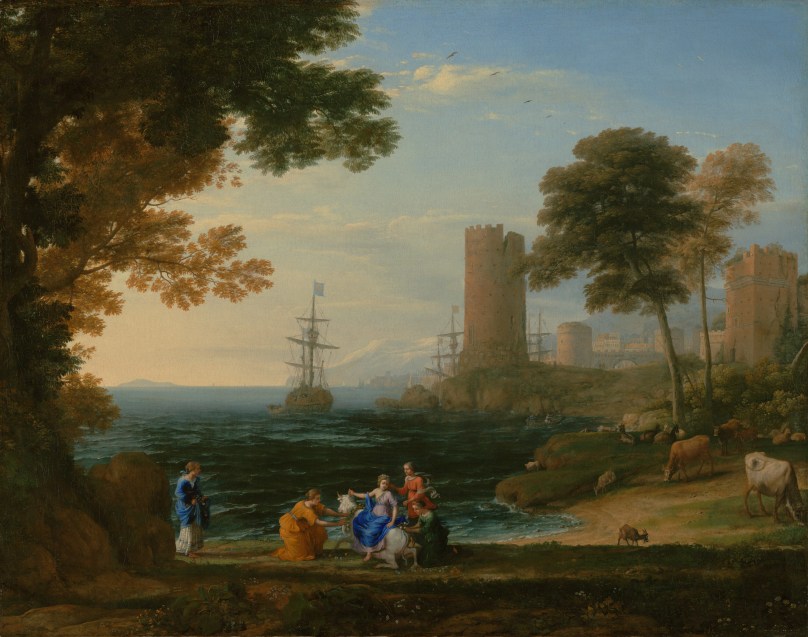
Claude Lorrain’s “Coast View with the Abduction of Europa”
Goethe perhaps said it best: “Claude Lorrain knew the real world by heart, down to the minute details. He used it as a means of expressing the harmonious universe of his soul.”
Both Lorrain (1604-1682) and Nicolas Poussin (1594-1665) made a career of creating peaceful canvases that draw the viewer’s eye in and leave him or her in a meditative state. That is the case even though the subject matter of the above painting is of a violent rape:
The Abduction of Europa is a classical myth from Ovid’s Metamorphoses, in which Zeus transforms himself into a white bull to abduct the Phoenician princess Europa. He lures her onto his back and carries her across the sea to the island of Crete, where they have children, including Minos, who become the first king of Crete and one of the divine judges of the underworld.
Rembrandt also painted the scene in a much more dramatic fashion, but in Lorrain’s painting, it is almost an afterthought—as if it could have been replaced by dancing Naiads or a shepherd with his flock with no loss in overall effect.
Every time I visit the Getty Center in the Santa Monica Mountains, I feel a frisson of excitement as I take a fresh look at the museum’s incredible collection.
“The Musicians’ Brawl” by Georges de la Tour (1593-1652)
This afternoon, I dropped in to the Getty Center to refresh my store of images. The one that stuck in my mind the most was a 17th century canvas entitled “The Musicians’ Brawl” by French painter Georges de la Tour.
There’s a lot happening in this picture. There are five figures depicted, all very nearly on the same plane. From left to right, we begin with an old woman who is appalled by the fracas. Moving rightward, we have a bearded blind musician with a knife in one hand and a hurdy-gurdy slung on his shoulder. He is being confronted by another bearded musician with a shawm (a predecessor to the oboe) in his left hand and a wedge of lemon in his right, which he is squeezing in the eyes of the hurdy-gurdy player not entirely believing he is blind.
Continuing to the right, we have two musicians who are spectators. The bearded one is barely paying attention, while his mustachioed companion stares drunkenly out at us while clutching his instrument. That rightmost figure is, to me, the most memorable one in the painting. He is clearly chuckling and looking at us with slightly glazed eyes.
I will never forget that drunken facial expression. It is the painterly version of an earworm.
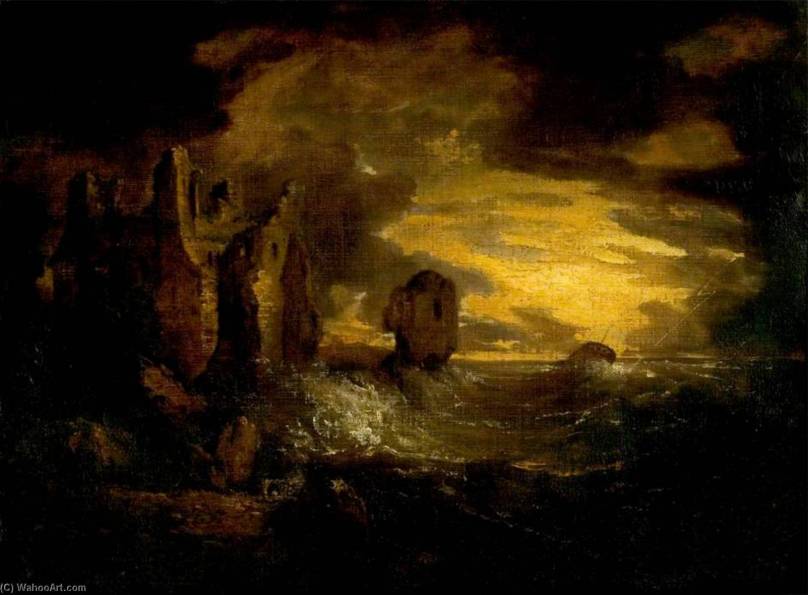
George Howland Beaumont: “Peele Castle in a Storm, Cumbria, 1800”
William Wordsworth is and always has been one of my favorite poets. The Beaumont named in the poem is the painter George Howland Beaumont (1753-1827), creator of the above painting.
Elegiac Stanzas Suggested by a Picture of Peele Castle in a Storm, Painted by Sir George Beaumont
I was thy neighbour once, thou rugged Pile! Four summer weeks I dwelt in sight of thee: I saw thee every day; and all the while Thy Form was sleeping on a glassy sea.
So pure the sky, so quiet was the air! So like, so very like, was day to day! Whene’er I looked, thy Image still was there; It trembled, but it never passed away.
How perfect was the calm! it seemed no sleep; No mood, which season takes away, or brings: I could have fancied that the mighty Deep Was even the gentlest of all gentle things.
Ah! then, if mine had been the Painter’s hand, To express what then I saw; and add the gleam, The light that never was, on sea or land, The consecration, and the Poet’s dream;
I would have planted thee, thou hoary Pile mid a world how different from this! Beside a sea that could not cease to smile; On tranquil land, beneath a sky of bliss.
Thou shouldst have seemed a treasure-house divine Of peaceful years; a chronicle of heaven;— Of all the sunbeams that did ever shine The very sweetest had to thee been given.
A Picture had it been of lasting ease, Elysian quiet, without toil or strife; No motion but the moving tide, a breeze, Or merely silent Nature’s breathing life.
Such, in the fond illusion of my heart, Such Picture would I at that time have made: And seen the soul of truth in every part, A steadfast peace that might not be betrayed.
So once it would have been,—’tis so no more; I have submitted to a new control: A power is gone, which nothing can restore; A deep distress hath humanised my Soul.
Not for a moment could I now behold A smiling sea, and be what I have been: The feeling of my loss will ne’er be old; This, which I know, I speak with mind serene.
Then, Beaumont, Friend! who would have been the Friend, If he had lived, of Him whom I deplore, This work of thine I blame not, but commend; This sea in anger, and that dismal shore.
O ’tis a passionate Work!—yet wise and well, Well chosen is the spirit that is here; That Hulk which labours in the deadly swell, This rueful sky, this pageantry of fear!
And this huge Castle, standing here sublime, I love to see the look with which it braves, Cased in the unfeeling armour of old time, The lightning, the fierce wind, the trampling waves.
Farewell, farewell the heart that lives alone, Housed in a dream, at distance from the Kind! Such happiness, wherever it be known, Is to be pitied; for ’tis surely blind.
But welcome fortitude, and patient cheer, And frequent sights of what is to be borne! Such sights, or worse, as are before me here.— Not without hope we suffer and we mourn.
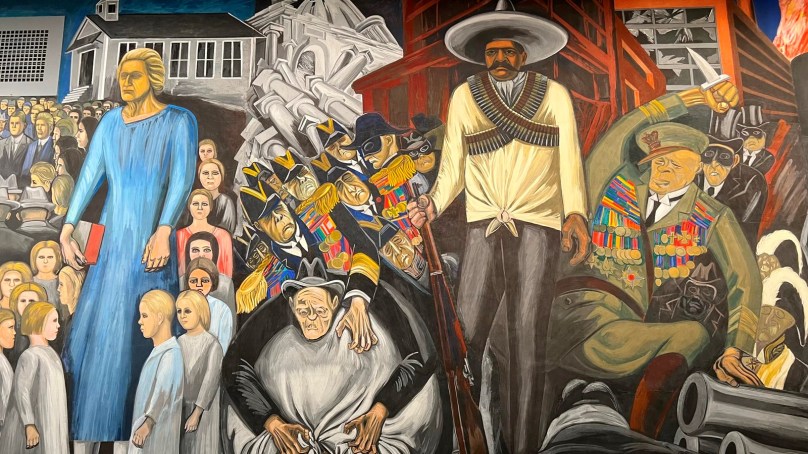
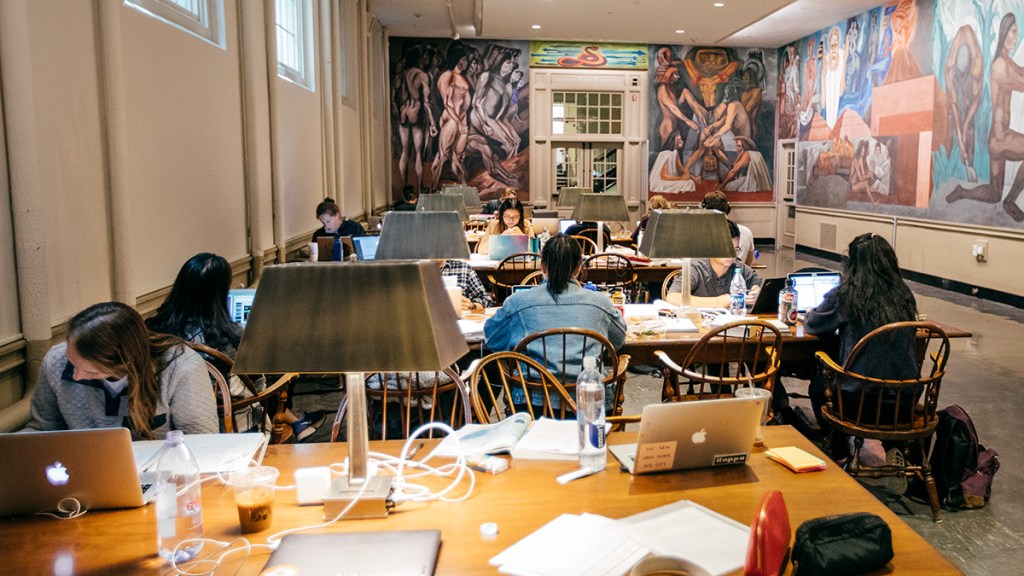
One of the things I most loved about my years at Dartmouth College was studying in the Baker Library’s Reserve Room, as it was then called. The Mexican artist José Clemente Orozco (1883-1949). Between 1932 and 1934, he painted a series of murals entitled “The Epic of American Civilization” in the college’s Baker Library.
There is a detailed discussion of Orozco’s mural put out by Dartmouth’s Hood Museum describing all the panels.
The Reserve Room
Sometimes I think it is those murals which first got me interested in going to Mexico. Nine years after I graduated, I finally made it to Yucatán and visited the ruins at Uxmal, Chichén Itzá, Mayapan, and Kabah during a two-week trip in November 1975.
Until I saw Orozco’s work, Mexico and the Pre-Columbian civilizations of the Americas just weren’t on my radar. Afterwards, they became a major preoccupation.
Quetzalcoatl in a Panel of the Orozco Murals
Little did I know in my college years that my interest in the murals would eventually lead me not only to Mexico, but also Argentina, Guatemala, Honduras, Uruguay, Chile, Peru, and Ecuador.
I returned today from a long weekend visiting my brother Dan in the Coachella Valley. Saturday began on a dubious note: We visited an installation of the Desert X 2025 art show at Summerlands in Rancho Mirage. Since the artist was the Hungarian-born Dénes Ágnes, we expected great things, being self-professed Hungarians ourselves.
What we saw was a plywood pyramid painted white, planted with native desert plants, that is on view at Summerlands until May 11, 2025. Ah, well, I guess not all Hungarian art works are great.
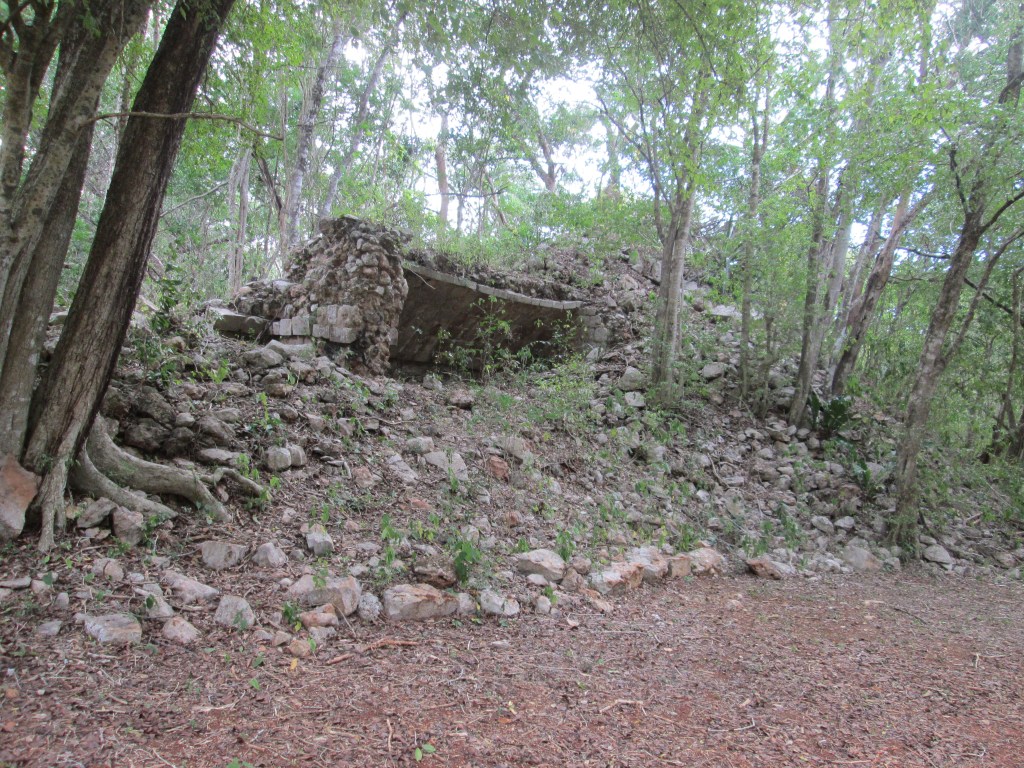
I was reminded of Maya pyramids in Yucatán that were not rebuilt by archeologists, such as this pyramid I photographed at Sayil in the Puuc Highlands in January 2020:
Maya Pyramid at Sayil
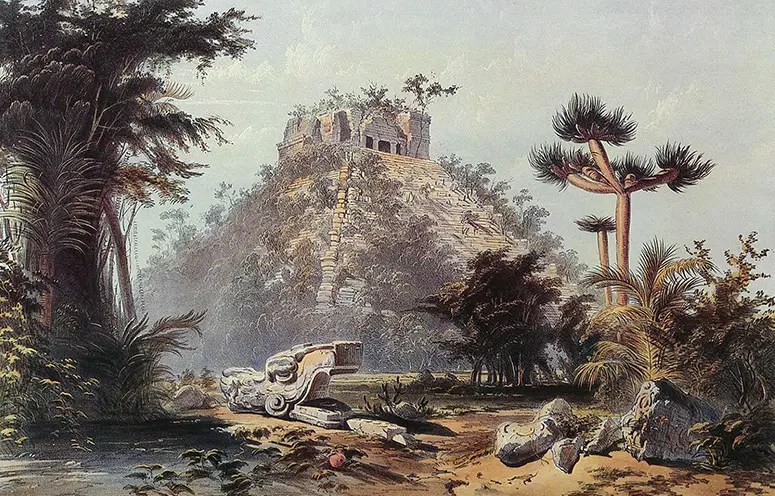
Another point of comparison is one of English artist Frederick Catherwood’s engravings in the 1841 classic by John Lloyd Stephens, Incidents of Travel in Central America, Chiapas and Yucatán:
The Castillo at Chichén Itzá Engraved by Frederick Catherwood
I guess I’m too much in love with the impressive Maya ruins in Mexico and Central America to accept Dénes’s “The Living Pyramid” with anything other than a shrug. Nice try, but no cigar.
Porcelain Tiles Decorate the Outer Wall of a Hungarian Building
In 1853, a Hungarian businessman named Miklós Zsolnay founded the Zsolnay (ZHOAL-nah-ee) Porcelánmanufaktúra Zrt (Zsolnay Porcelain Manufactory Private Limited) in the town of Pécs near the border with what is now Croatia.
Before long, the products of his factory started turning up in the most interesting places, such as the roof of the Matthias Church in Budapest’s Castle District:
Not to mention interestingly designed and wildly colored porcelain vases and figurines:
In a way, one can’t go to Hungary without encountering the works of the Zsolnay Manufactory. Their work has become one of the most characteristic looks in Hungarian architecture, furnishings, and knickknacks.
This is the first of several posts I will write about famous Hungarian painters. IO begin with Mihály Munkácsy (1844-1900), known primarily for his genre paintings and Biblical scenes. Although of Bavarian origin, he changed his name to reflect the town of his birth: Munkács. He traveled extensively in Europe and worked with a number of well-known artists of the time.
According to Andrienn Szentesi, writing in The Essential Guide to Being Hungarian, edited by István Bori:
Mihály Munkácsy’s first masterpiece was Siralomház (Cell of the Condemned). Fifteen human figures can be seen in this painting, people to whom, it is safe to presume, something terrible has just happened. Dark hues, not least various shades of brown and black, have the run of this painting, too; and of course this serves to reinforce the work’s depressing theme. Also discernible, however, is just ba bit of white and red; for example, a little girl calls attention to herself as she stands in a corner in a red skirt. What has she just been through? What fate awaits her?
Mihály Munkácsy’s “Paris Interior”
Somewhat lighter is Munkácsy’s Paris Interior (above). A young woman sits reading while a small child plays on the floor behind her.
Mihály Munkácsy’s “Christ Before Pilate” (1882)
Above is one of three Biblical subjects painted in a series that also included Golgotha and Ecce Homo.
Munkácsy dies in a Bonn mental hospital in 1900. As the Wikipedia article on him says, “Neither 19th century visual art nor the historical developments of Hungarian art can be discussed without considering Munkácsy’s contributions. His works are considered the apogee of national painting. He was a standard-setter, an oeuvre of reference value.”
Today, I met my brother at the Japan House in Hollywood. He drove in from Palm Desert, where he is a builder whose specialty over the years has been working with wood. On display at the Japan House through January 22, 2025 is an exhibit entitled “Masters of Carpentry: Melding Forest, Skill and Spirit.” It was an awesome display of the beauty and intricate detail that is the art of Japanese carpentry.
According to the handout describing the exhibit:
The exhibit is structured around 5 pillars of daiku [Japanese woodworking masters] culture: a reverence for nature and the Japanese forest, the master carpenters’ refined tools, the practice of dōmiya daiku—the temple and shrine carpenters, kigumi— the strength and beauty of Japanese joinery, and the work of the sukiya daiku—the skillful carpenters employing natural materials to detail and finish teahouses.
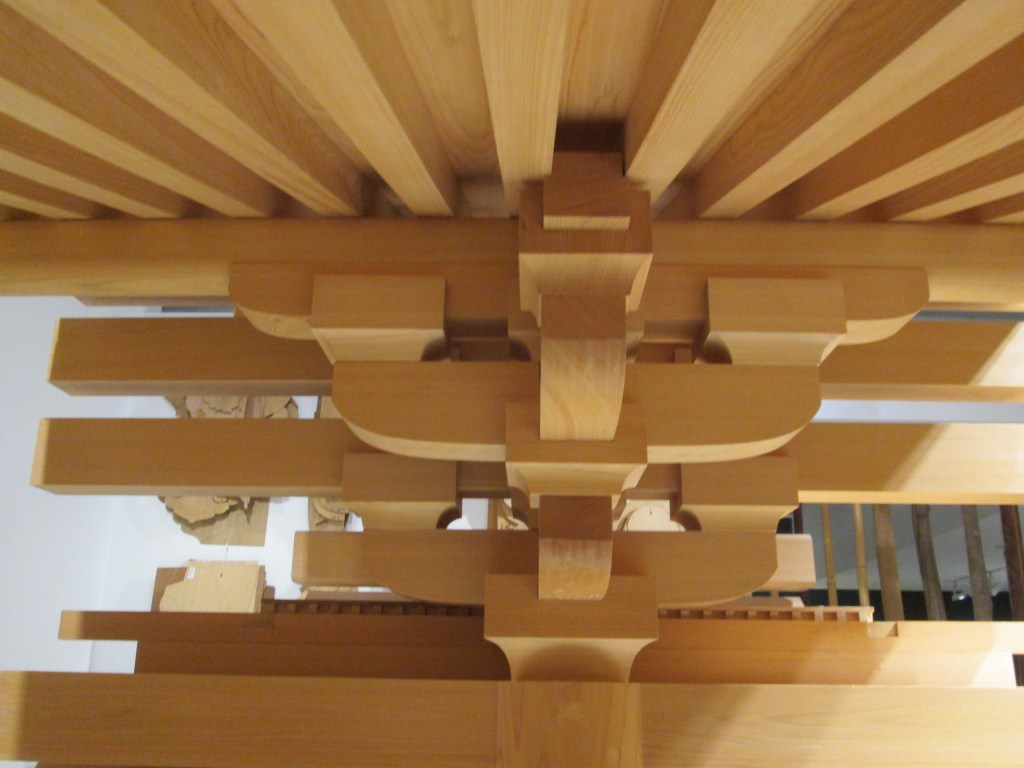
What impressed me the most were the exhibits of the intricate joinery linking the boards, posts, and beams using careful measurement and relying as little as possible on nails and other iron and steel fasteners. The result is aesthetically pleasing and built to last. And because it is carefully selected from a large variety of native woods, it even smells beautiful.
According to the exhibit, the islands that constitute Japan are 67% forested. Even such exotic woods as persimmon fruit trees are used because of the striated grain of the wood.
Intricate and Ultimately Pleasing
Although, unlike my brother, I have no skill in woodworking, I quickly became aware that this was high art and a labor of love. This is an exhibit with broad appeal to anyone with an artistic frame of mind. The two hours we spent at the Japan House Masters of Carpentry Exhibit was well worth it.
Japan House Los Angeles Gallery Level 2 6801 Hollywood Blvd Los Angeles, CA 90028
Here’s a post from ten years ago this month. I’ve always meant to read up on the Etruscans, as I admire what I know of their view of life—even though I’m not known for smiling.
The whole world of the smiling girl in he above photo is long gone, but her smile still speaks to us. It tells us that, even in Ancient Rome, there was something to laugh about. When I took the picture on Friday, I did not note the provenance of the figurine, but I wonder if it was Etruscan. This ancient people is the only one that has allowed itself to be depicted as wreathed in smiles—very contrary to the picture we have of the dour Romans.
Below is a hollow funerary urn from the Banditaccia Necropolis showing a married couple, whose ashes are presumably commingled therein:
I guess my little figurine is not Etruscan.Their images always show them as having sharp features and almond eyes. The girl above is definitely Roman.
Not to change the subject, but it reminds me somewhat of the following poem by Robert Browning:
My Last Duchess
That’s my last Duchess painted on the wall, Looking as if she were alive. I call That piece a wonder, now: Frà Pandolf’s hands Worked busily a day, and there she stands. Will ‘t please you sit and look at her? I said ‘Frà Pandolf’ by design, for never read Strangers like you that pictured countenance, The depth and passion of its earnest glance, But to myself they turned (since none puts by The curtain I have drawn for you, but I) And seemed as they would ask me, if they durst, How such a glance came there; so, not the first Are you to turn and ask thus. Sir, ‘t was not Her husband’s presence only, called that spot Of joy into the Duchess’ cheek: perhaps Frà Pandolf chanced to say, ‘Her mantle laps Over my lady’s wrist too much,’ or ‘Paint Must never hope to reproduce the faint Half-flush that dies along her throat:’ such stuff Was courtesy, she thought, and cause enough For calling up that spot of joy. She had A heart—how shall I say?—too soon made glad, Too easily impressed; she liked whate’er She looked on, and her looks went everywhere. Sir, ‘t was all one! My favour at her breast, The dropping of the daylight in the West, The bough of cherries some officious fool Broke in the orchard for her, the white mule She rode with round the terrace—all and each Would draw from her alike the approving speech, Or blush, at least. She thanked men,—good! but thanked Somehow—I know not how—as if she ranked My gift of a nine-hundred-years-old name With anybody’s gift. Who’d stoop to blame This sort of trifling? Even had you skill In speech—(which I have not)—to make your will Quite clear to such an one, and say, ‘Just this Or that in you disgusts me; here you miss, Or there exceed the mark’—and if she let Herself be lessened so, nor plainly set Her wits to yours, forsooth, and made excuse, —E’en then would be some stooping; and I choose Never to stoop. Oh, sir, she smiled, no doubt, Whene’er I passed her; but who passed without Much the same smile? This grew; I gave commands; Then all smiles stopped together. There she stands As if alive. Will ‘t please you rise? We’ll meet The company below then. I repeat, The Count your master’s known munificence Is ample warrant that no just pretence Of mine for dowry will be disallowed; Though his fair daughter’s self, as I avowed At starting, is my object. Nay, we’ll go Together down, sir. Notice Neptune, though, Taming a sea-horse, thought a rarity, Which Claus of Innsbruck cast in bronze for me!
That line about “all smiles stopped together” is grimly humorous.
You must be logged in to post a comment.