Looking East

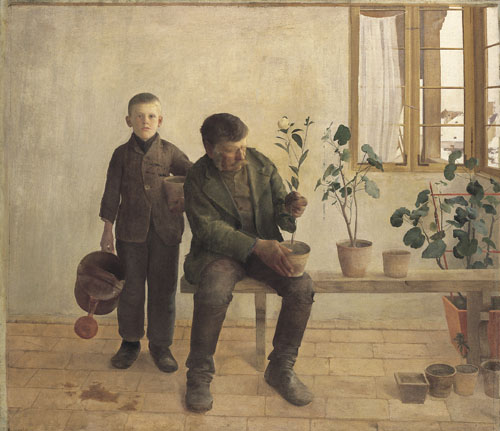
Károly Ferenczy’s “The Gardeners”

Károly Ferenczy’s “The Gardeners”

I know next to nothing about academic Hungarian art, but I would like to know more. Today I searched the website of the Hungarian National Gallery looking for paintings that caught my eye. The one above looks like a typical folk subject, a gardener and his son. The gardener works at potting what looks like a yellow rose while his son holds an empty pot and a watering can while blankly staring into the distance.

From my childhood, I know a bit about popular art, which consists of all sorts of peasant scenes, with picturesque cottages, rustic wells, and galloping Magyar cowboys (we called them csikosok). We had one such reproduction in our living room which actually scared me. If one stared at the shadows of branches and leaves against the wall of the cottage, it looked like a sinister face with a hand raised threateningly.

Here is another work that caught my eye:

Jenö Gyárfás’s “Youth and Age”

Jenö Gyárfás’s “Youth and Age”

From time to time I will return to this subject, hopefully becoming a little more learned in the process.

The Man from Martinique

Caribbean Painter Ernest Breleur (b. 1945)

Caribbean Painter Ernest Breleur (b. 1945)

I do not usually like modern art, but I make exceptions from time to time. Yesterday, I read Milan Kundera’s book of essays entitled Encounter in which he wrote about three artists from Martinique. There were two writers, Patrick Chamoiseau (whose novel Texaco I read and loved) and Aimé Césaire, and the painter Ernest Breleur.

When I think of Martinique, what comes to mind are the first Humphrey Bogart/Lauren Bacall film, To Have and Have Not (1944) directed by Howard Hawks, as well as a horrendous double volcanic eruption of Mont Peleé in 1902 that killed over twenty thousand people. Then I read Patrick Leigh Fermor’s only novel, The Violins of Saint Jacques (1953), which was later turned into an opera by Malcolm Williamson.

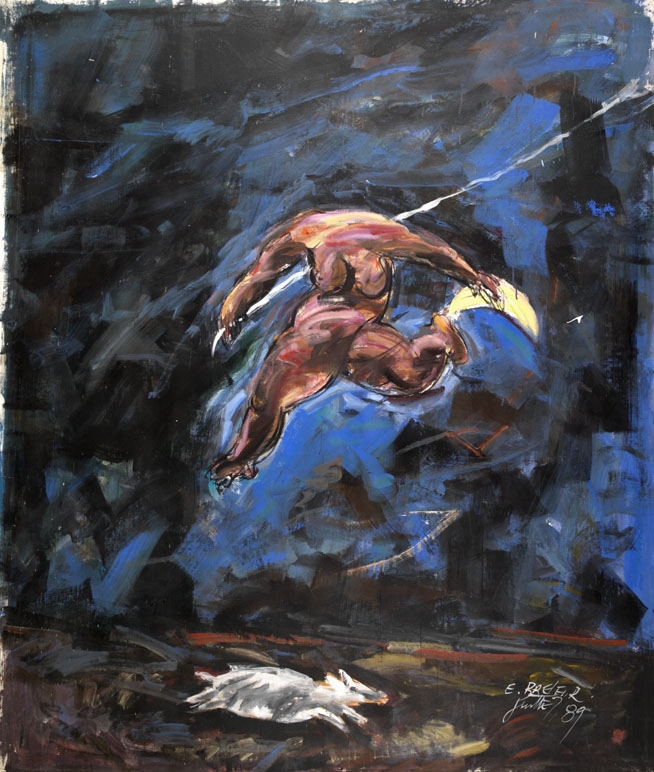
Then Kundera added the names of Breleur and Césaire to my list. Thanks to Google image, it was easy to find some of Breleur’s work:

PICg_FC10Breleur12

And:

PICBreleur-lune-89_0831

Breleur has something going with his dark blues, and his tortured human and animal figures. I’ll have to look for more of his work, and I’ll also have to search out Aimé Césaire.

Next on the list—I think you could see this coming couldn’t you?—I want to visit Martinique. I think I could talk Martine into it, even with her back pain. The sun seems to help her in some way. And, for me, Martinique is a growing nexus of interests, from the most powerful volcano in the Caribbean to the French culture to an interesting local culture.

Blake’s Milton

The Expulsion of Satan and His Angels from Heaven

The Expulsion of Satan and His Angels from Heaven

William Blake was not only a great poet, but he was also a great artist. When I was younger, I used to think that his art was a bit clunky—until I started reading his poetry. Then I saw that both the poetry and the art were all of a piece: they were like flames from a mind and heart on fire.

It was in his greatest poem, “The Marriage of Heaven & Hell,” that William Blake wrote this line:

The reason Milton wrote in fetters when he wrote of Angels and God, and at liberty when of Devils and Hell, is because he was a true Poet, and of the Devil’s party without knowing it.

Certainly, Book I of Paradise Lost shows a Satan who is unrepentant and verging on the magnificent:

What though the field be lost?
All is not lost; the unconquerable Will,
And study of revenge, immortal hate,
And courage never to submit or yield:
And what is else not to be overcome?
That Glory never shall his wrath or might
Extort from me.

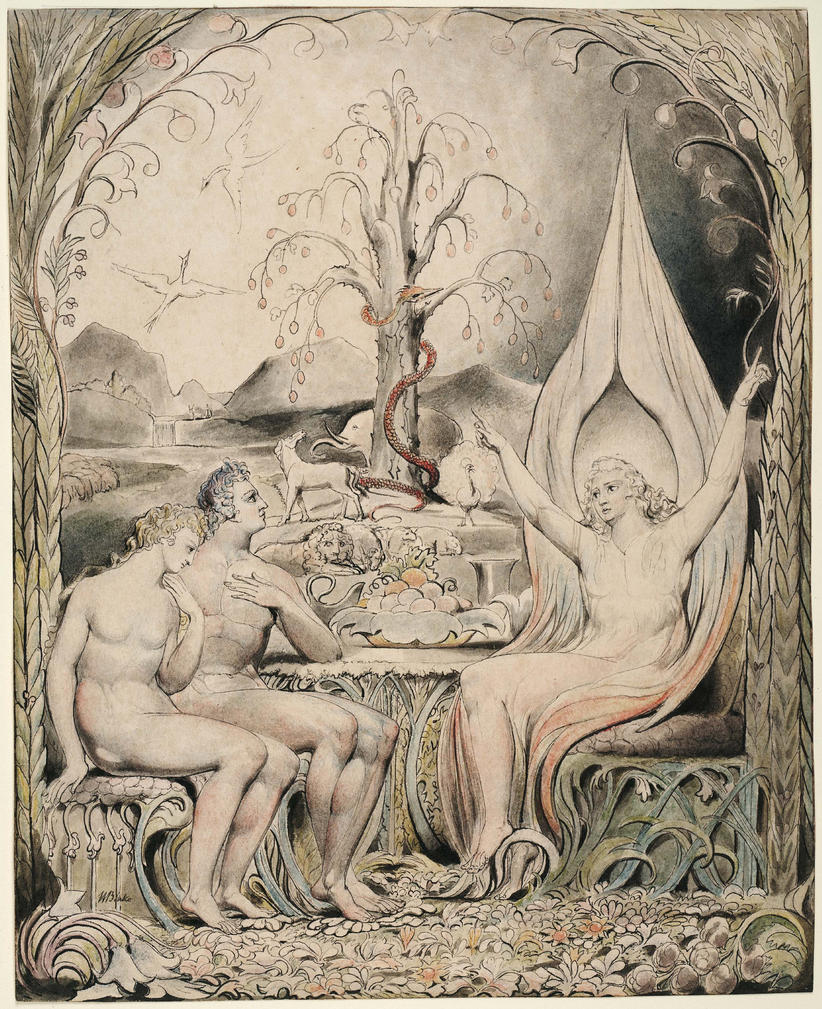
At the same time, Milton’s God is also splendid. When he hears that Satan is loose on Earth, he foresees what is to come and sends the Archangel Raphael to explain to Adam and Eve the story of the fall of Satan and his angel followers. Blake illustrates the scene thus:

Note the Snake Wrapped Around the Tree of the Knowledge of Good and Evil in the Background

Note the Snake Wrapped Around the Tree of the Knowledge of Good and Evil in the Background

In actuality, Milton has Eve fall into a sleep while Raphael talks with Adam.

Blake’s Eden is strangely desert-like, whereas Milton gives us a verdant creation in which Adam and Eve are early agronomists who take care of the plants as part of their daily tasks. No matter, Blake is an artist in his own right and has no compunctions about creating his own Paradise Lost in pictures.


“Where Words Fail…”


At Its Best, This Is What Music Does

At Its Best, This Is What Music Does

It was Hans Christian Andersen who wrote, “Where words fail, music speaks.”

Tonight, Martine and I attended the Torrance Civic Chorale’s annual Christmas concert. It was beautiful. Conductor David Burks enabled me to step outside my usual noisily conflicted self and into an ethereal place, one of joy and celebration.

I’m not going to try to talk about what music does for me, because how it acts on me is outside the world of words. I could tell you what kind of music I like the most, but I could not even begin to describe the mechanism by which my emotions are directly manipulated.

I regularly listen to KUSC-FM in Los Angeles, which plays classical music pretty much all day. When musicologist and KUSC announcer Jim Svejda—a man who for decades has influenced my taste in music—talks about music or interviews a musician, I wish he would shut up. I’ve even told the station that when phoning in my annual donation: “Please keep Jim Svejda on, but tell him not to talk so much.”

It’s not what Svejda says that influences me: It is his choices in the music he plays.

Over the years, I have been most moved by Gustave Mahler, Jean Sibelius, and Anton Bruckner. Last night, I read Vladimir Sorokin’s Day of the Oprichnik while listening to Bruckner’s Third Symphony. It was nothing short of sublime. Now that I have much of my favorite music on an MP3 player, I feel liberated. High in the Andes, I listened to Sibelius and Tchaikovsky and felt they were writing music about what I was seeing with my eyes even as I was seeing it..


Rainy Day Museum

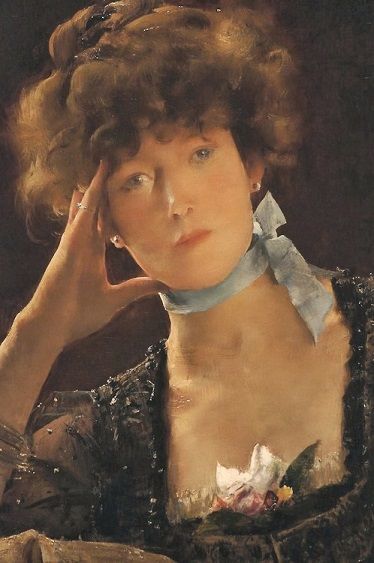
Alfred George Stevens’s “Portrait of Sarah Bernhardt” (1885)

Alfred Stevens’s “Portrait of Sarah Bernhardt” (1885)

We typically scoff when the weather forecasters tell us that rain is on the way. Well, today it finally happened. Not that the heavens opened up, but my windshield did get a bit dirty. So Martine and I decided to visit the Hammer Museum in Westwood, which is located only a few hundred paces from where I work. I knew from passing it many times that the focus was on modern art, but there are two galleries with European art from the 19th century and earlier.

The painting which most caught my eye was by the Belgian painter Alfred Émile Léopold Stevens (1823-1906). It was an 1885 portrait of actress Sarah Bernhardt (1844-1923). I was particularly impressed with the theatrical-style lighting from the left, including a striking glint around the model’s right eye. At the height of her career, Bernhardt looks like a commanding figure, even with the frilly ribbon around her neck. Her lips are pursed as if determined to get her way, yet she is delightfully feminine at the same time.

Also impressive was a Titian entitled “Portrait of a Man in Armor” and Rembrandt’s “Portrait of a Man Wearing a Black Hat” (both below).

Rembrandt’s “Portrait of a Man Holding a Black Hat”

Rembrandt’s “Portrait of a Man Holding a Black Hat”

Titian’s “Portrait of a Man in Armor”

Titian’s “Portrait of a Man in Armor”

It’s not that the museum’s holdings were all portraits: It’s just that it was the portraits that most held my attention.

What did not hold my attention was the museum’s substantial holdings of contemporary art. Call me a Philistine if you will, or even a Visigoth, but I prefer art that holds my attention. Stevens’s portrait of Bernhardt had me coming back several times. I did not even feel like entering the contemporary galleries after even the most cursory glances of their contents.

The Etruscan Smile

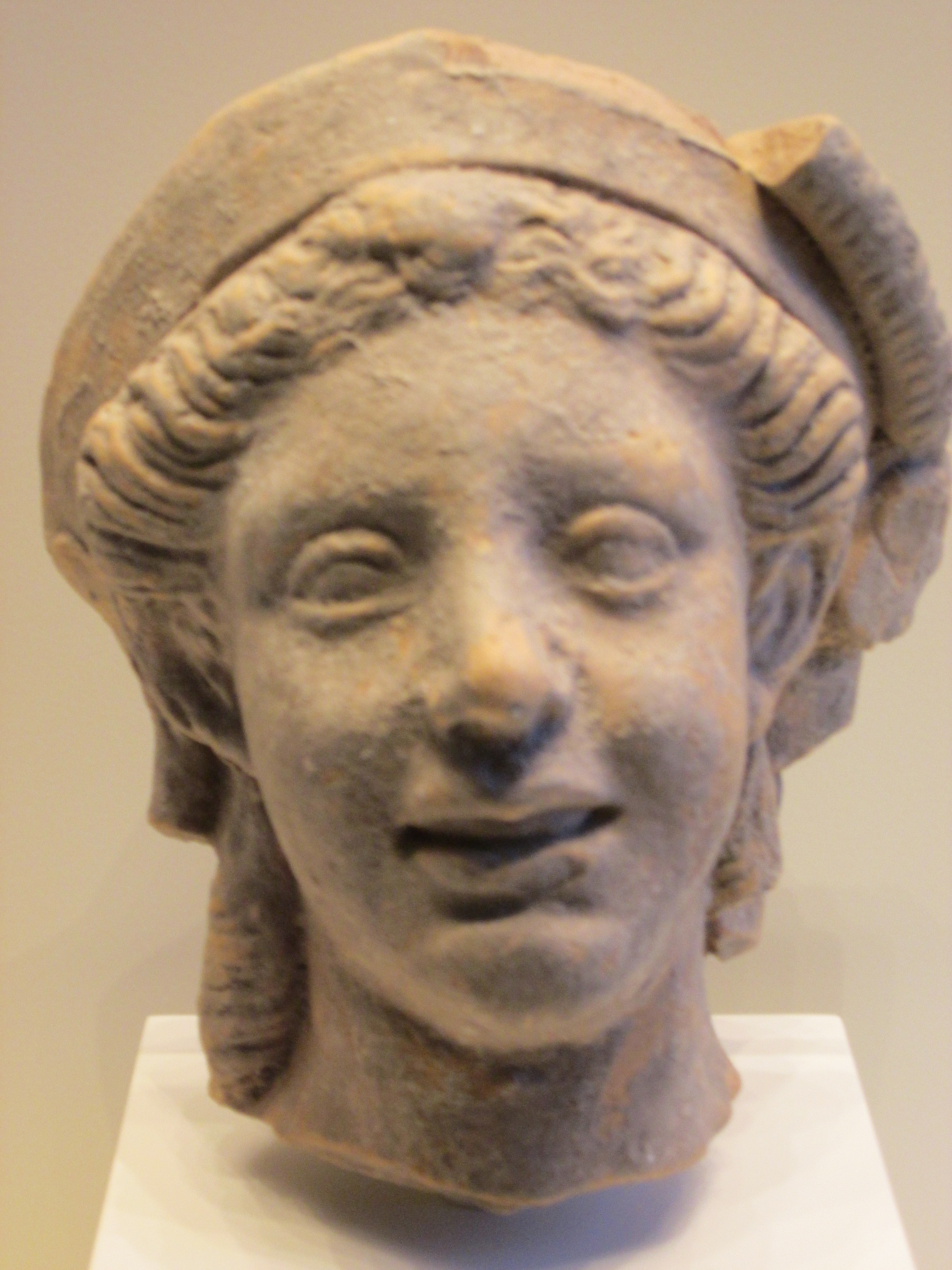
A Smile That Shines Across Millennia

A Smile That Shines Across Millennia

The whole world of the smiling girl in he above photo is long gone, but her smile still speaks to us. It tells us that, even in Ancient Rome, there was something to laugh about. When I took the picture on Friday, I did not note the provenance of the figurine, but I wonder if it was Etruscan. This ancient people is the only one that has allowed itself to be depicted as wreathed in smiles—very contrary to the picture we have of the dour Romans.

Below is a hollow cinerary urn from the Banditaccia Necropolis showing a married couple, whose ashes are presumably intermingled therein:
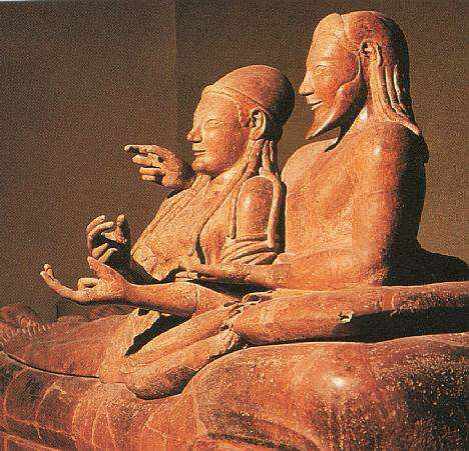
Hi, We’re Dead. Why Don’t You Come and Join Us?

Hi, We’re Dead. Why Don’t You Come and Join Us?

I guess my little figurine is not Etruscan.Their images always show them as having sharp features and almond eyes. The girl above is definitely Roman.

Not to change the subject, but it reminds me somewhat of the following poem by Robert Browning:

My Last Duchess

That’s my last Duchess painted on the wall,
Looking as if she were alive. I call
That piece a wonder, now: Frà Pandolf’s hands
Worked busily a day, and there she stands.
Will ‘t please you sit and look at her? I said
‘Frà Pandolf’ by design, for never read
Strangers like you that pictured countenance,
The depth and passion of its earnest glance,
But to myself they turned (since none puts by
The curtain I have drawn for you, but I)
And seemed as they would ask me, if they durst,
How such a glance came there; so, not the first
Are you to turn and ask thus. Sir, ‘t was not
Her husband’s presence only, called that spot
Of joy into the Duchess’ cheek: perhaps
Frà Pandolf chanced to say, ‘Her mantle laps
Over my lady’s wrist too much,’ or ‘Paint
Must never hope to reproduce the faint
Half-flush that dies along her throat:’ such stuff
Was courtesy, she thought, and cause enough
For calling up that spot of joy. She had
A heart—how shall I say?—too soon made glad,
Too easily impressed; she liked whate’er
She looked on, and her looks went everywhere.
Sir, ‘t was all one! My favour at her breast,
The dropping of the daylight in the West,
The bough of cherries some officious fool
Broke in the orchard for her, the white mule
She rode with round the terrace—all and each
Would draw from her alike the approving speech,
Or blush, at least. She thanked men,—good! but thanked
Somehow—I know not how—as if she ranked
My gift of a nine-hundred-years-old name
With anybody’s gift. Who’d stoop to blame
This sort of trifling? Even had you skill
In speech—(which I have not)—to make your will
Quite clear to such an one, and say, ‘Just this
Or that in you disgusts me; here you miss,
Or there exceed the mark’—and if she let
Herself be lessened so, nor plainly set
Her wits to yours, forsooth, and made excuse,
—E’en then would be some stooping; and I choose
Never to stoop. Oh, sir, she smiled, no doubt,
Whene’er I passed her; but who passed without
Much the same smile? This grew; I gave commands;
Then all smiles stopped together. There she stands
As if alive. Will ‘t please you rise? We’ll meet
The company below then. I repeat,
The Count your master’s known munificence
Is ample warrant that no just pretence
Of mine for dowry will be disallowed;
Though his fair daughter’s self, as I avowed
At starting, is my object. Nay, we’ll go
Together down, sir. Notice Neptune, though,
Taming a sea-horse, thought a rarity,
Which Claus of Innsbruck cast in bronze for me!

That line about “all smiles stopped together” is grimly humorous.


Death in Antonine Egypt


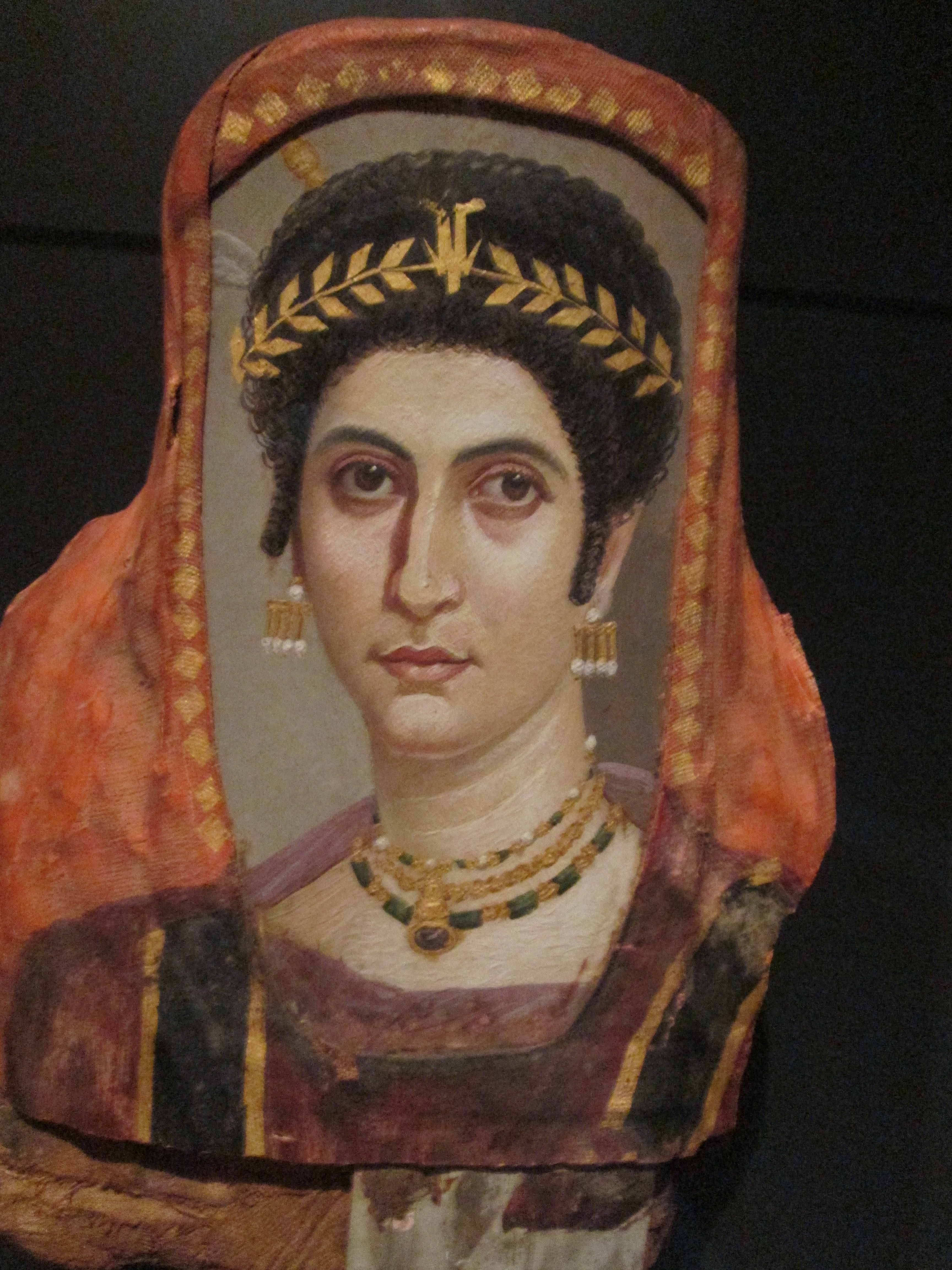
Faiyum Mummy Portrait of a Woman in Her Prime

Faiyum Mummy Portrait of a Woman in Her Prime

It is becoming a Black Friday tradition for Martine and I to go to—no, not a shopping center!—but the Getty Villa Museum in Pacific Palisades to view their Greek and Roman antiquities.

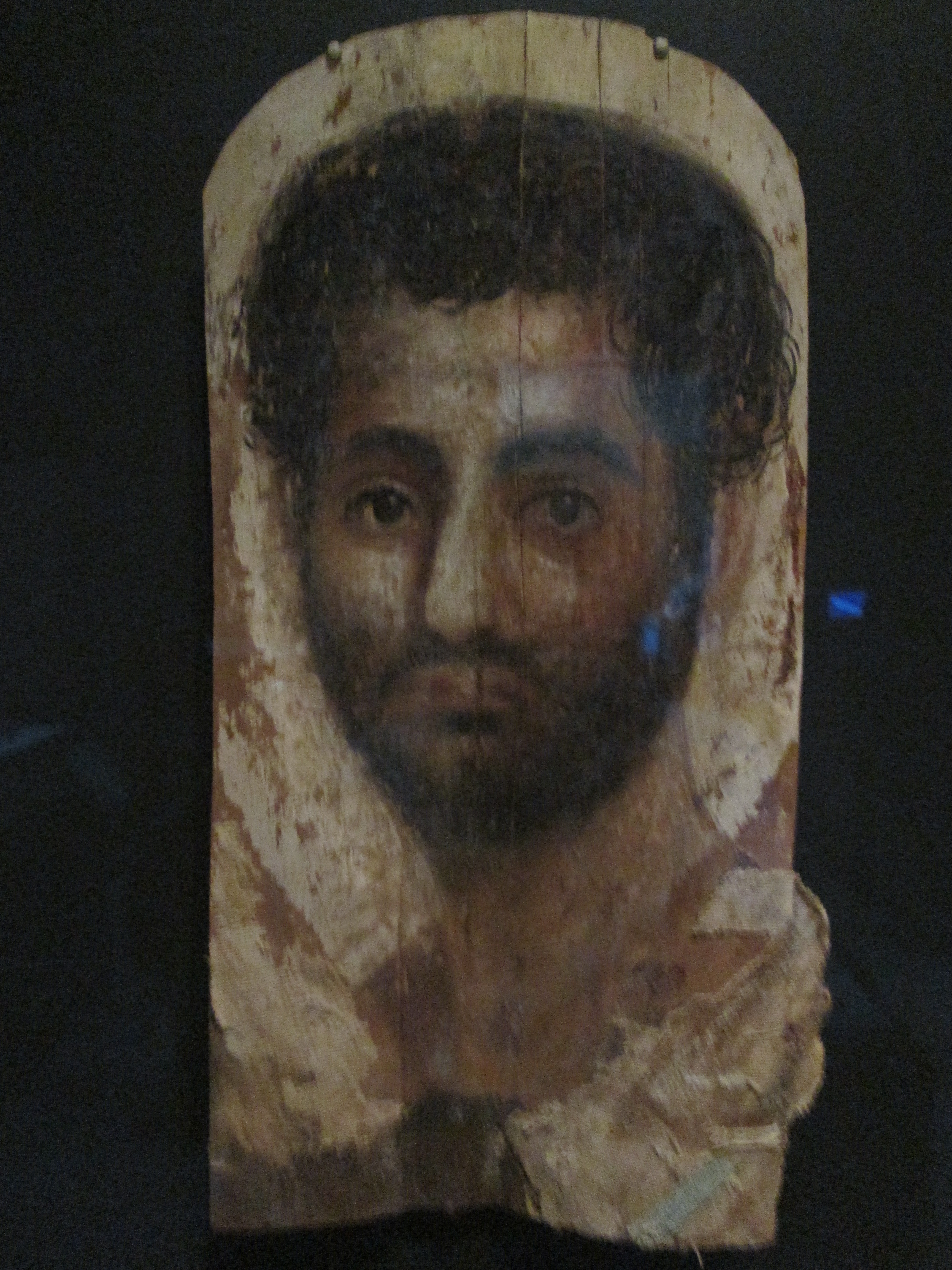
I have always been drawn to the late Egyptian mummies from around A.D. 200, roughly the period of Rome’s Antonine, or so-called “good”, emperors. There was an active Greek community at the time in Alexandria and other coastal areas near the mouth of the Nile, mostly consisting of civilian and military officials. Some were Pagan, others Coptic Christian. Especially around Faiyum, hundreds of mummies were found with painted portraits of the deceased. Strangely, most of them died in their childhood, youth, or the prime of their life. (C.A.T. scans of mummies found with intact painted portraits showed that the age of the body corresponded with the age of the painting.)

Below is an epitaph of one Krokodeilos, who died during this period:

O traveller, stop by me, and learn well who I was:
Besarion’s most loved son, by name Krokodeilos,
But two and twenty summers was my whole life’s span.
Entombed my body lies, beneath a mass of sand,
But my soul’s gone heav’nwards, to Oblivion’s land.
Some day all mortal men in Hades must reside;
This thought brings comfort to the shades of those who’ve died.

Mummy Portrait of a Young Man

Mummy Portrait of a Young Man

At the time these paintings were made, there was very little wall painting being done; whereas the art of mummy portraits was a highly regarded profession. Many of these mummy face paintings have survived with rich coloration intact. Since the Greeks constituted the upper classes of the communities in which they lived, they could usually well afford to commemorate their dead in this way.

The only question I have is: Why did they not produce face paintings for the dead who passed away at an elderly age?


A Hungarian Artist Goes to War

Painting by Béla Zombory-Moldován

Painting by Béla Zombory-Moldován

He was a twenty-nine-year-old artist who was taking a vacation at Novi Vinodolski on the Croatian Coast of the Adriatic Sea when the world suddenly erupted. He, and all the other young Hungarian men, were called to report to duty. It was almost a hundred years later that Béla Zombory-Moldován’s The Burning of the World: A Memoir of 1914 was translated by his son Peter and published by the New York Review of Books.

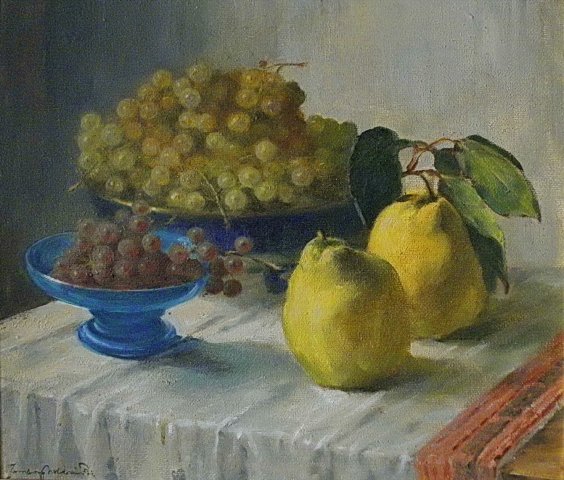
Reading of the horrible confusion on Eastern Front in Galicia, where the 31st Royal Hungarian Regiment was battling the Russians in Galicia, I decided to look for some of the painter’s work. Below is a still life from the 1950s:

A Still Life

A Still Life

Perhaps when I have finished Zombory-Moldován’s book, I will write about the young ensign’s experiences in the war. Like the Eastern Front in a later war, it was a campaign marked by confusion and carnage.

Archangels of the Andes

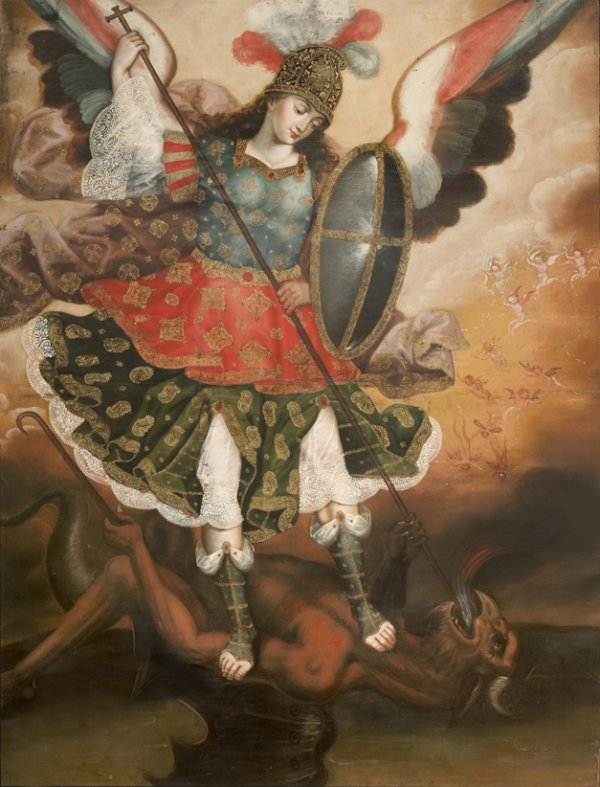
The Archangel Michael Vanquishing Satan

The Archangel Michael Vanquishing Satan

They are young, elegant, and handsome. Their wings are bi-colored, like the wings of mature condors. Yet they are all powerful and conquer their enemies with surpassing ease. They are the archangels depicted in paintings of the Cusco School of Art.

One has to imagine what it was like to be an Inca facing a compact phalanx of Spanish conquistadores mounted on horseback. At Cajamarca, many thousands were slaughtered by Pizarro and his hundred or so men. They barely even used their muskets, which were pretty useless in hand-to-hand combat in any case. No, it was Spanish steel and the strangeness of seeing warriors on horseback. Were they a single creature, man and horse? The Incas tried to kill the horses and display their corpses, thinking that now they would win with ease.

It was not to be so. The Incas were ultimately conquered, even though it took the better part of a century to complete the conquest. To the defeated, it didn’t look as if their gods were of much help to them. There must be something to this Christianity!

You can see it in the native painters’ depiction of angels, such as the one above. Michael defeats the demon without breaking a sweat or staining his doublet. He might just as easily be crocheting a doily or cleaning his nails. All throughout Peru, I saw hundreds of these archangels in the churches and archiepiscopal palaces, all with the same characteristics. The artists are usually indigenous Quechuans who painted multiple images of the same religious figures for distribution to churches all around the country.

When the Incans saw these angels, did they think of how easily they themselves were bested by the Spanish?


Two Christs for Modern Man

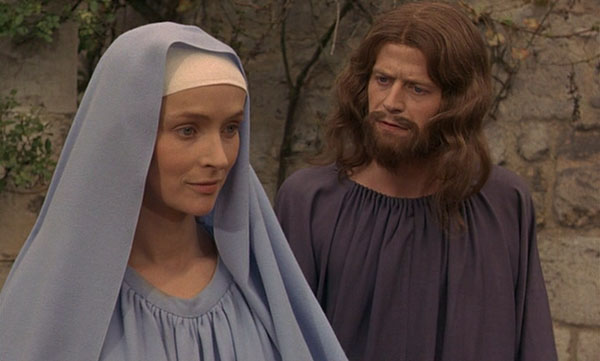
Bernard Verley as Christ and Edith Scob as Mary in Buñuel’s The Milky Way (1969)

Bernard Verley as Christ and Edith Scob as Mary in Luis Buñuel’s The Milky Way (1969)

After two centuries of Christian art,the West has produced thousands of images of Jesus Christ—almost none of which connects to people who are alive today. The Son of God is usually portrayed as a man who was born to be tortured to death on a cross, but not as a man who could gather around him twelve apostles and hundreds of followers.

One notable exception are the vignettes with Bernard Verley (above) as Christ in Luis Buñuel’s film The Milky Way (1969). The scene pictured above is at the marriage ceremony in Cana, when the Redeemer performed his first public miracle.

The other image is one I saw at the Getty Center today: It is the Italian painter Correggio’s “Head of Christ,” pictured below:

Correggio’s “The Head of Christ” (1530)

Correggio’s “The Head of Christ” (1530)

I like the look of consternation on Christ’s face as he contemplates what lies ahead while he is wearing the crown of thorns. This is the Christ who, the previous night at Gethsemani, had said: “My Father, if it be possible, let this cup pass from me; nevertheless, not as I will, but as you will.” He may be God, but the look on His face is 100% pure human.