Will China Overtake the U.S.?

Daniel Rohr of Morningstar Thinks Not

Daniel Rohr of Morningstar Thinks Not

The following article was published in March by Morningstar on the subject “What Will China Look Like in 2025?” I was rather surprised by its findings and would like to share it with you.

China’s faltering economy has sent shivers through the global markets in 2016, and for good reason. As the world’s second-largest economy and leading source of global growth for the past decade, China matters more than ever. Guessing what comes next for China and the implications for the rest of the world is an exercise fraught with uncertainty, but we believe China’s arrival at two major and near-certain inflection points will alleviate some of that uncertainty. First is China’s economic rebalancing. As we’ve argued for the past five years, excess capacity across broad swaths of the economy and mounting bad debt will force a transition to consumption-led growth. The second inflection point concerns China’s demographics. The country’s working-age population will shrink by 43 million by 2030, by which time China will have more seniors than the European Union, Japan, and the United States combined. These two inflection points shape much of our long-term outlook, which we’ve summarized here with 10 predictions for the next 10 years.

First, we expect China’s GDP growth to slow to less than half the pace of the past 10 years. The historical experience of economies making the transition from investment-led to consumption-led growth shapes much of this outlook. In every case, the rebalancing economy experiences not only a sharp deceleration in investment growth, but also weaker consumption growth. Historical precedent also suggests magnitude matters; the bigger the boom, the weaker the ensuing GDP growth. China’s boom has been greater in magnitude and duration than anything that has come before. In our view, consensus expectations, while moderated, remain too optimistic in the 5%-6% range. We expect GDP growth to average 1.5%-4.5% in the next 10 years. Attaining the upper end of that range would require major reforms to unleash household consumption, reallocate credit from the state to the private sector, and boost productivity at China’s bloated state-owned enterprises.

Second, we believe reforms are likely to disappoint, making even 4.5% GDP growth a challenge. Our skepticism is rooted in the inherent conflict between key reforms and Beijing’s two overriding political aims: control and stability. For example, we think it is unlikely Beijing will allow the major defaults that would be necessary to eliminate state-owned enterprises’ preferential credit access and reallocate credit to more productive borrowers. Doing so would risk massive social disruption and diminish the state’s control over capital allocation. For similar reasons, we doubt meaningful interest rate liberalization is a near-term prospect, as many state-owned borrowers would be unable to afford market-set interest rates. Consequently, the implicit wealth transfer from household savers to state-owned borrowers is likely to persist, hindering consumption growth.

Third, stimulus is likely to prove ineffective at best. Questions of whether Beijing will go back to its old growth playbook overlook evidence that the government has been trying to stimulate the economy since November 2014. Multiple interest rate cuts and reductions to the portion of deposits that banks must hold in reserve haven’t delivered the sort of boost they did in prior years. This is partly because of borrowers’ unwillingness to invest amid a deteriorating economic outlook, a reticence reflected in all-time low readings on the central bank’s loan demand survey. It’s also because of capital outflows from China, which we estimate at roughly $640 billion in 2015. The case against stimulus extends beyond doubts over its efficacy. Many of the problems China is dealing with today, from excess capacity to bad debt to falling prices, are the consequences of too much stimulus. At this point, stimulus is a shot of whiskey to cure a hangover.

Fourth, despite looser family-planning laws, we expect births to fall by 25 million versus the past 10 years. The female population of child-bearing age will fall by 50 million by 2025, with 41 million of that decline concentrated in women with the highest fertility rates: those ages 20-29. Assuming no change in age-specific fertility rates, births would decline 30% by 2025. A comparison of Chinese fertility rates versus those of neighboring countries at similar points in their economic development suggests economic and cultural factors account for China’s low birth rate, not government policy.

Fifth, China’s urban population growth will fall by nearly half. Over the past 10 years, as China urbanized roughly 200 million people, it traversed the steep portion of the urbanization-to-income curve we observe globally. Looking ahead, that curve will flatten considerably, with lower urbanization growth for each percentage point of GDP growth. Moreover, China will be moving along that curve at a slower pace because of weaker GDP growth. We forecast China will urbanize 115 million over the next 10 years. While this would mark a significant deceleration, it would nonetheless see China add the equivalent of Japan’s entire urban population.

Sixth, we believe the yuan will fall 20% against the U.S. dollar. Defending the de facto dollar peg amid massive capital outflows has cost the People’s Bank of China billions in foreign exchange. Unless the underlying causes of capital flight are addressed, including expectations of falling interest rates and a weaker yuan, we see little reason for those outflows to end. By devaluing the yuan to a level approximating market expectations, Beijing would reduce a major incentive for capital to leave China. A fair value estimate that draws on the global relationship between market exchange rates and purchasing power parity exchange rates across income levels suggests that level is roughly CNY 8 per $1.

Seventh, we expect China’s economic rebalancing to trigger another “Dark Age” for industrial commodities such as copper, coal, and steel. China is the dominant consumer of industrial commodities and has accounted for the overwhelming majority of global demand growth in the past decade. We forecast China’s industrial commodity demand to decline in the next several years as investment growth wanes. As a result, demand growth globally is likely to expand far more slowly than global GDP. Historically, sub-GDP demand growth has been associated with falling real commodities prices, a situation that prevailed in the decades before China’s investment boom.

Eighth, we doubt India will fill China’s shoes as far as commodity demand is concerned. India is the only country that can match China’s demographic heft. The fact that Indian GDP per capita now approximates that of Chinese GDP per capita 10 years ago has led many to suggest that Indian commodity demand is on the verge of takeoff. This line of thinking confuses the origins of China’s commodity demand growth. It wasn’t so much China’s level of development a decade ago nor the economic growth it registered in subsequent years that led to the country’s insatiable appetite for commodities. Rather, it was the heavy investment orientation of the Chinese economy. Unless India duplicates China’s growth model, India will not deliver the same boost to global commodity demand. Because of India’s pluralistic political structure and because New Delhi lacks Beijing’s tools to shape economywide capital allocation, we doubt India’s growth pattern is likely to follow that of China.

Ninth, we believe China’s health spending will more than double. We expect healthcare outlays to grow far faster than GDP for a couple of broad reasons. First is the tendency of healthcare to claim a larger share of total spending as incomes rise. This trend is evident globally and within China itself. Second is the fact that China is aging at an incredible pace. China’s population 65 and older will be 50% larger by 2025 and 130% larger by 2030, by which time it will have more seniors than the EU, U.S., and Japan combined. China will be an “old” country by middle-income standards, and we expect it to spend proportionately more on healthcare than the typical middle-income country.

Tenth, despite many high-profile predictions that China will overtake the U.S. as the world’s largest economy in the relatively near future, we don’t see that happening in the next decade. At prevailing exchange rates and assuming the U.S. musters 2.2% annual GDP growth (in line with the International Monetary Fund’s forecast) while China grows at 4.5% (the upper end of our 10-year forecast), the U.S. economy would be roughly 30% larger than China’s by 2025.


Kim Kardashian Flashes Reykjavík

If You’ve Got It, Flaunt It!

If You’ve Got It, Flaunt It!

And that’s exactly what Kim Kardashian did as she boogalooed down Laugavégur, the main shopping street of Iceland’s capital, Reykjavík. I’m sure that scores of Icelandic women (who for the most part look a whole lot cuter than our Kim) must have wondered what strange beast was stalking their city streets.

But then Kim is a celebrity, like Donald Trump or Paris Hilton. She is famous for … being famous. It’s like talking about the Donald’s career holding elective office or Paris Hilton’s contributions to Western Civilization. In other words: zip, zero, nil, zilch.


Why the Tax Deadline Is Next Monday

Talk About the Tail Wagging the Dog!

Talk About the Tail Wagging the Dog!

You may wonder why your taxes are due on April 18 instead of April 15 this year—even though April 15 falls on a Friday. You can blame it on (or otherwise, if you’re so inclined) the District of Columbia, a Federal District that is free of Congressional representation. (So lucky!)

They have a holiday each April 16 that commemorates President Lincoln’s Emancipation Proclamation. It is actually an international holiday and, in my opinion, probably better than most holidays. I mean, who gives a cracker about Columbus Day? The man didn’t discover America: the Icelander Leif Ericsson did. And both Memorial Day and Labor Day are a bit sketchy; but I am wholeheartedly for Emancipation Day. The freeing of the slaves is one of the few good things that have happened in world history during the last two centuries.

Because April 16 is on a Saturday this year, it is observed on Friday, April 15, where it is a widely observed public holiday. Consequently, taxes are not due until Monday, April 18. Due to this little quirk, together with an additional day for Leap Year, tax season is four days longer this year.


Idarat al-Tawahhush

The Republican Party’s Own Contribution to Beastliness

The Republican Party’s Own Contribution to Beastliness

Last week, I read an excellent article by Juan Cole of Truthdig.Com on the subject of our entering a new era of beastliness as exemplified by Daesh/ISIL/ISIS abroad and Donald J. Trump at home. In fact, the Arabs have a word for it: idarat al-tawahhush, or out and out viciousness.

As Cole writes about the so-called Islamic State:

Most Muslims are on the fence or perfectly happy in secular societies.  They are in a “gray zone.”  Drive them into the arms of extremism either by attracting them with spectacles of power or by scaring them or by scaring non-Muslims into attacking them.

The urgency of this strategy has increased as Daesh’s fortunes on the battlefield in the dusty hinterlands of Syria and Iraq have spiraled down.  Syrian troops are at the gates of Palmyra and on the cusp of driving Daesh out of it.  Russian aircraft are bombing Daesh convoys and positions in Palmyra and near Aleppo, cutting supply lines.  Syrian Kurdish troops allied with Arab fighters have taken vast territory from Daesh in al-Raqqa and left its capital exposed.  In Iraq, Tikrit and Ramadi have fallen.  Kurdish Peshmerga have retaken Sinjar and begun cutting supply lines between al-Raqqa and Mosul.  Local Arab tribes are revolting in Fallujah, and the Iraqi military has announced the beginning of a long campaign to take Mosul.

In America, beastliness is one of the main attributes of currently leading Republican contender Donald Trump. His minions attack women journalists; he broadly attacks wide spectra of our multicultural society; and he threatens to “punish” women who have had abortions. (Is he personally going to spank them?)

Cole’s article continues on the subject of the GOP candidate:

If you take out mass violence, moreover, it is fairly easy to see that Trump himself uses the tactic of “beastliness” just as Daesh does. Where there is already chaos or conflict, he hypes it, as with his promise to kill innocent children related to terrorists or to torture people.  Or he played on existing Islamophobia by proposing a Muslim exclusion act, which is both beastly and an attack on the gray zone.

He also throws verbal firebombs to stir up chaos where there was calm.  He boasts that immigration was not even an issue in the presidential race until he made it one.  But that is because immigration is not an issue.  More Mexicans have been returning to Mexico from the US in recent years than coming here. Most immigrants are unusually law-abiding.  Illegal immigration was a much bigger problem in the 1980s and 1990s and is now a relatively small one.  Most immigrants don’t take jobs away from Americans already here: they do jobs other people don’t want to do.  (Many small midwestern hamlets depending on ranching and small farming have become depopulated as the young people went off to Chicago, and some have only been kept going or revived by Mexican farm and ranch hands).  But Trump tried to tag Mexican-Americans as rapists and drug dealers.

But then, many American voters would be all too willing to fight beastliness with beastliness of their own. And so civilization becomes ever more tattered and frayed as time goes on.


The Brussels Airport Attack

Patrick Smith On the Brussels Airport Attack

Patrick Smith on the Brussels Airport Attack

I don’t do this very often, but I want to quote in its entirety Patrick Smith’s well reasoned attack on the “We Need More Security at Our Airports” argument from his website, Ask the Pilot:

I WAS AFRAID OF THIS. The minute I learned of the double bombing at the Brussels airport check-in lobby earlier today, I knew how the conversation would go. Sure enough, even before the morning was out, we were hearing calls for tighter security in airports.

First, a little history. Although airplanes themselves are historically the choicest target, attacks inside terminals are nothing new. For instance:

In 1972, the Japanese Red Army murdered 26 people in the arrivals lounge at Israel’s Lod Airport (today’s Ben Gurion International).

In 1985, the Abu Nidal group killed 20 in a pair of coordinated ticket counter assaults at Vienna and Rome.

In 2002, a gunman shot three people near the El Al airlines ticket counter at LAX.

And most recently, in January, 2011, a suicide bomber at Moscow’s busy Domodedovo airport killed 35 people.

“Aviation security experts have been warning” read an Associated Press story after the Moscow attack, “that the crowds at many airports present tempting targets to suicide bombers. Arrivals halls are usually open to anyone.”

Now, in the wake of Brussels, we’re hearing this again. The implication is that our airports aren’t yet secure enough, and that only more barricades and checkpoints and scanners and cameras and guards standing around with automatic weapons will make them so. There’s talk from supposed security experts asking if perhaps terminals need to be closed off to everybody except ticketed passengers and employees, with security checkpoints moved literally onto the sidewalk.

This is something I worried about years ago, when I was a columnist for Salon. Just wait, I wrote, until the next big attack takes place at the check-in counter or at baggage claim. They’ll be turning our airports into fortresses.

As, if by moving the fences, they can’t get us. The only thing moving security curbside would actually do, of course, is shift the perimeter — and the busy choke point of passengers — to a new location. This means nothing to an attacker, whose so-called “soft target” has simply been relocated from one spot to another, no less convenient one. But it would mean immense amounts of hassle for everybody else.

Thus, it’s precisely the wrong line of thinking. It’s reactionary in the purest sense, and it plays directly into the terrorist’s strategy — a strategy that encourages a response that is based on fear instead of reason, and that is ultimately self-defeating.

The reality is, we can never make our airports, or any other crowded places, impervious to attack. And while maybe you wouldn’t mind living in a society in which every terminal, shopping mall, sports venue and subway station has been militarized and strung with surveillance equipment, count me among those who would.

Not the Worst of Men

Hugo Chavez, the late President of Venezuela

Hugo Chavez, the late President of Venezuela

Not all dictators are uniformly bad. Okay, there were Hitler, Stalin, Pol Pot, and Mao—not to mention the horrendous Kim dynasty of North Korea. But think for a second: Would the world be in this ISIS/ISIL/Daesh mess if Saddam Hussein were still alive? We hanged him for being a bad dude, but worse dudes were to follow.

If there is any country in the Western Hemisphere that is an abysmal basket case, that country would be Haiti. After the 2010 earthquake that leveled half the country, all the NGOs moved in with their shiny SUVs and their air of moral superiority. One country, however, donated money to Haiti—admittedly much of which went into the wrong hands—but the recipients did not have to grovel for it. That was Venezuela, which at the time was basking in oil wealth. Through its Petrocaribe alliance with several other states, Hugo Chavez gave millions to the devastated country.

Now Venezuela is in dire straits and Hugo Chavez is dead of cancer. As much as his regime bad-mouthed the U.S., I salute Chavez for having a heart that was often in the right place.

Living With Bad Paper

A Ticket to Homelessness?

A Ticket to Homelessness?

Joining the military could be a kind of solution for young men and women who do not have great job prospects upon leaving high school. But what if the desire for “street cred” overrides good judgment, and the GI finds himself or herself with a discharge that is considered to be Other Than Honorable, or simply OTH? Another name for such a discharge is “Bad Paper.”

For over a million former soldiers, sailors, and airmen, Bad Paper is a ticket to homelessness without the possibilities of veterans’ benefits such as education, homelessness prevention, and disability or health care. That’s not even to mention the turned-down job applications and the loss of esteem that follows.

For those who leave the military with a trail of Bad Paper, it would have been better if they were merely felons in the civilian world: The military world is unforgiving and sometimes unduly punitive. When questioned about this, General Martin Dempsey replied:

I wouldn’t suggest that we should in any way reconsider the way we characterize discharges at the time of occurrence…. It is a complex issue and we all make choices in life that then we live with for the rest of our lives and I think we have to understand that as well.

Not much help there.

Ideally, there would be some kind of civilian post-discharge review that could rectify the vagaries of military justice, which varies widely from service to service and from one unit to another.


Serendipity: Two Armies

Russian Spetznaz Special Forces Troops in Camouflage

Russian Spetznaz Special Forces Troops in Camouflage

I saw this passage in an introduction by Robert D. Kaplan, who was quoting French military writer Jean Lartéguy’s The Centurions:

I’d like … two armies: one for display, with lovely guns, tanks, little soldiers, fanfares, staffs, distinguished and doddering generals, and dear little regimental officers … an army that would be shown for a modest fee on every fairground in the country.

The other would be the real one, composed entirely of young enthusiasts in camouflage battledress, who would not be put on display but from whom … all sorts of tricks would be taught. That’s the army in which I should like to fight.

The first army would be huddled in the Green Zone or Bagram AFB, eating pizzas and drinking Cokes. Whenever they would venture out in force, they would be blown to smithereens without ever having seen the face of their enemy.

The second army was the one that bagged Osama bin Laden at Abbottabad and that will defeat ISIS if ISIS is ever to be defeated.

By the way, do not underestimate the French military. They are not all “surrender monkeys,” as some Americans would have it. It was the first army—the parade ground army—that surrendered at Sedan and Dien Bien Phu.

A City That Is Set On A Hill

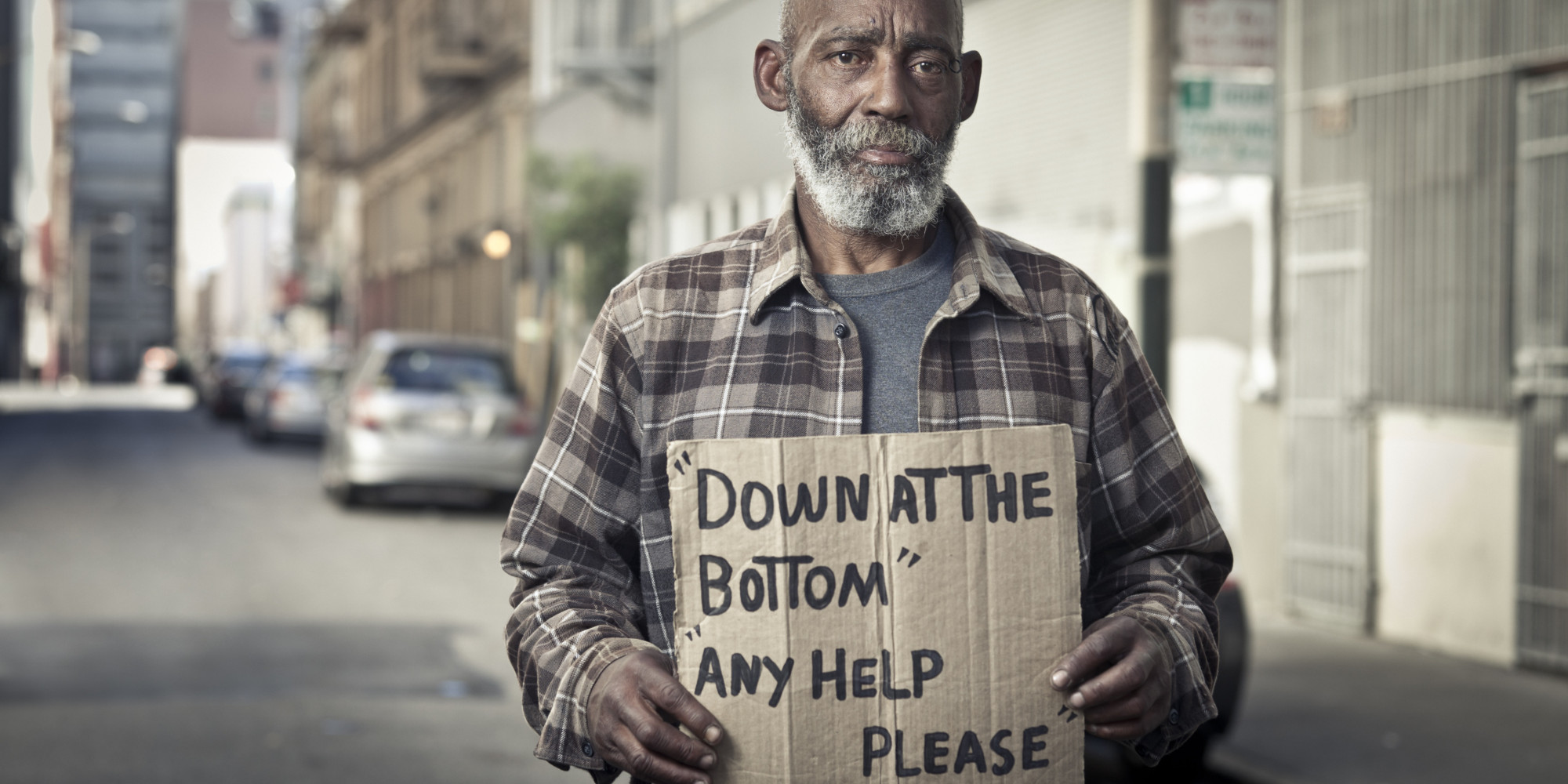
Homeless Man on the Street

Homeless Man on the Street

It all started in the 1980s, during the Presidency of Saint Ronald Reagan. Almost overnight, the homeless began appearing in the streets. Over the last thirty years, their numbers have increased to the point that I cannot step out for lunch without getting at least three solicitations for spare change. When I drive home on Ohio Avenue, the bridge under the I-405 is full of tents and cardboard “forts” covered with tarpaulins.

In Matthew 5:14, Christ says, “You are the light of the world. A city that is set on a hill cannot be hidden.” Reagan and other Republicans have been fond of seeing the United States in this light. Sometimes I wonder what foreign tourists think when they see raggedy men and women sprawled on the sidewalks and living under bridges. In my travels, I did not see such sights, not even in supposedly Third World countries such as Peru, Uruguay, Argentina, and Chile.

For whatever reason, our “city that is set on a hill” has become a festering garbage dump. Even in rural America, crystal meth, opiates, and alcohol have stranded untold thousands wandering the streets in search of a meal or a place to crash. Across the street from where I live, people appearing to be homeless have their own cigarettes and cell phones and are, I suspect, dealing in drugs—especially when they make an appearance at their “corner” only intermittently.

As much as I want to help them, I know that my best bet is to help the Salvation Army and the local rescue missions. They can weed out the clearly unworthy more readily than I can. But what of the mentally ill? It seems that they form more than half of the local homeless population. I get this feeling of hopelessness whenever I think of them.

Saint LaVoy, Martyr

Robert “LaVoy” Finicum, When He Walked Among Men

Robert “LaVoy” Finicum, When He Walked Among Men

It is the ultimate goal of all armed U.S. militia members to die in a blaze of glory. Or, anyway, to die. They know they can’t win, that most Americans regard them as dildos. Now that Robert Finicum was shot while grabbing for his loaded pistol, he is being touted as a patriot, hero, and—dare I say it?—martyr. He is forever frozen in time now that he has had his moment.

He can never go back to his eleven children in Colorado City, Arizona.

Wait a minute! Colorado City, Arizona. Isn’t that the isolated town in Northwestern Arizona that is run by the FLDS, the Fundamentalist Church of Latter Day Saints? Isn’t that the town ruled by Warren Jeffs, its patriarch, now serving time in prison for child sexual assault?

Is the late LaVoy a polygamist? Eleven children, but how many wives? How was that association missed by the national press?