Fifty Years in Hollywood

A Film Director for 50 Years, His Work Shows Signs of High Quality Throughout His Career

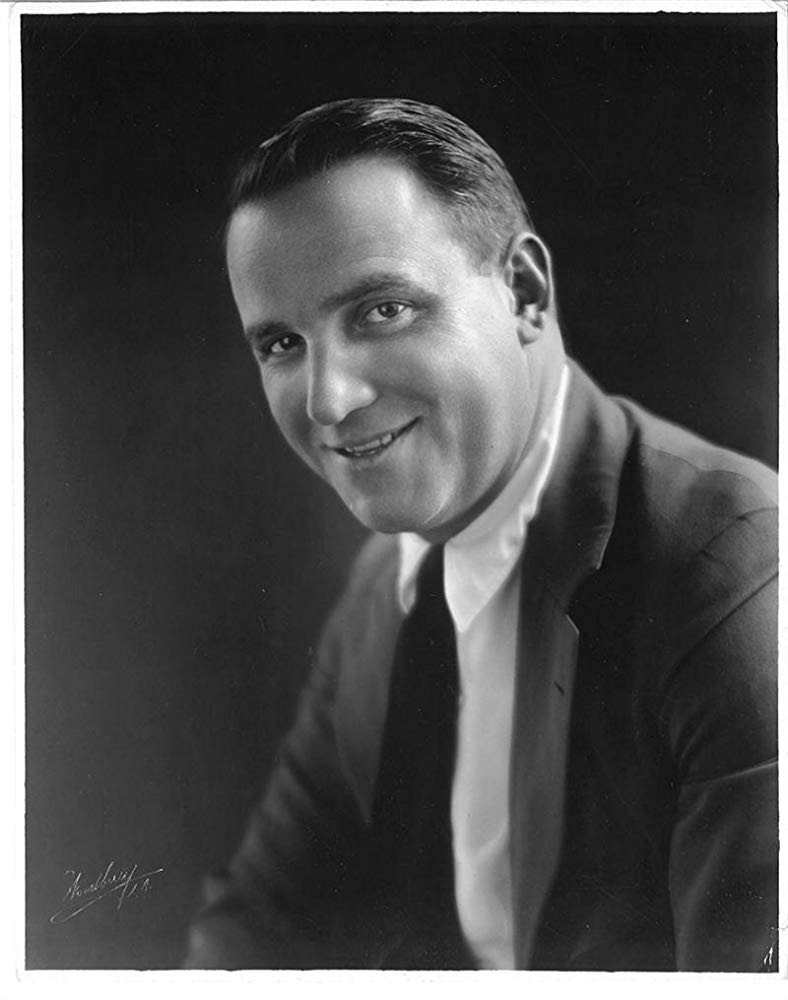
There were undoubtedly Hollywood directors who worked in the industry longer than Allan Dwan, but few of them were as consistently good for the entire half century while at the same time being so little-known. I know about him because he is one of the discoveries of the politique des auteurs to which I subscribed for many years. According to the auteur theory, as it is also known, there were within the Hollywood studio system some directors whose work was almost a guarantee of quality, almost irrespective of genre, studio, or stars.

Consider the following highly shortened list. How many films in it do you recognize?

  • Robin Hood (1922)
  • East Side, West Side (1927)
  • The Iron Mask (1929)
  • Rebecca of Sunnybrook Farm (1938)
  • The Three Musketeers (1939)
  • Up in Mabel’s Room (1944)
  • Getting Gertie’s Garter (1945)
  • Brewster’s Millions (1945)
  • Sands of Iwo Jima (1949)
  • Silver Lode (1954)
  • Cattle Queen of Montana (1954)
  • Slightly Scarlet (1956)

Most of these look and sound like typical studio products which Hollywood turned out by the hundreds each year. But even toward the end of his career (he retired in 1961), Dwan was doing amazing things. In Silver Lode, a B Western starring John Payne, Lizbeth Scott, and Dan Duryea, there is a tracking shot through a Western town of which even Orson Welles would be proud—some two years before Welles’s amazing opening credits shot in Touch of Evil.
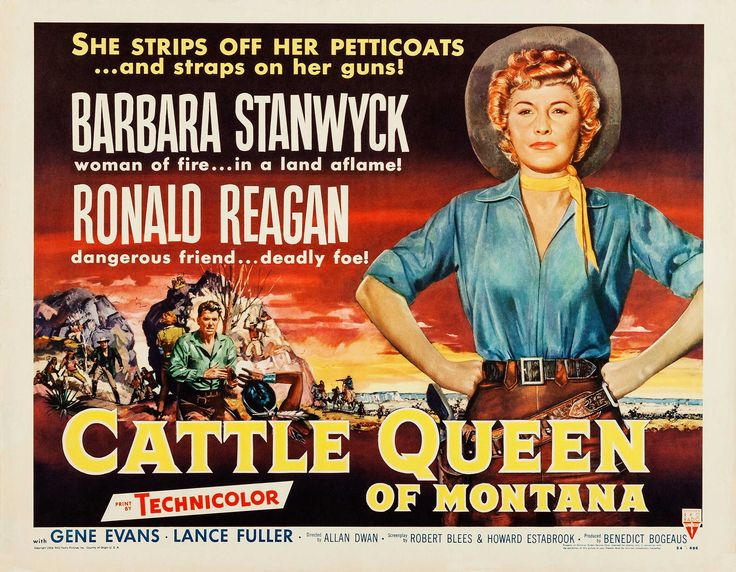
Lobby Card for Cattle Queen of Montana (1954)

Today, I saw Cattle Queen of Montana for the second time. The role of Barbara Stanwyck as Sierra Nevada Jones was a natural for this great star. Even Ronald Reagan managed to shine as a Federal agent investigating suspicious sales of guns to the Blackfeet Indians. There weren’t any directorial fireworks as in Silver Lode, and perhaps there were too many coincidences in the plot, but the aging Dwan showed he still knew how to cut the mustard.

 

The Game of the Goose

The Map of Paris Around Which the Plot of Jacques Rivette’s Le Pont du Nord (1981) Revolves

Sometimes one sees a great film, but it doesn’t seem so at first. Sometimes it has to rattle around in your head for a while before you realize that what you have just seen is a seminal work of art. Such is the case with the films of Jacques Rivette I have seen, particularly Le Pont du Nord (“North Bridge”).

In that film, we have two main characters, played by the mother/daughter team of Bulle and Pascale Ogier. Bulle (Marie Lafée) has just been released from prison and is too wracked with claustrophobia to enter a building or a car without freaking out. Pascale (called by the boy’s name of Baptiste) runs across Bulle three times, making her conclude that they are destined to be together. Pascale is the ultimate paranoiac, mutilating the eyes of models and actors shown on large posters.

Bulle hooks up with her old boyfriend Julien, who seems to be on some strange quest. Pascale pulls a switch on his portfolio, allowing her and Bulle to see its contents, which consists mostly of newspaper clippings and a map of Paris (above) which acts as a kind of game board. Bulle and Pascal decide to follow it, noticing that it seems to be a version of the European Game of the Goose, similar to the English Snakes and Ladders and the American Chutes and Ladders.

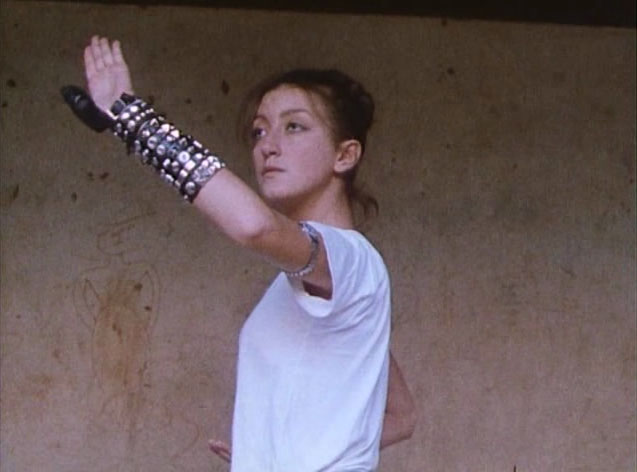
Bulle and Julien meet with death at the square containing the Pont du Nord, but Pascale ends up getting a martial arts lesson from “Max,” one of the mysterious characters who is also playing the game.

Pascale Ogier as Baptiste

I was strongly impressed by Pascale Ogier as the paranoid gamine. Three years later, she was to die at the age of twenty-five of a heart attack aggravated by her use of recreational drugs. She is one of those actresses whose eyes are expressive and who use their glances to attract the viewer’s attention (and, admit it, admiration). I was appalled to find, when checking out her career, that her life was cut so short.

Jacques Rivette is one of the lesser-known directors of the French New Wave. I have seen in all three of his films, set at the beginning—Paris Belongs to Us (1961)—the middle—the film we are discussing—and the end—La Belle Noiseuse (1991)—of his career. All of his films left me hungering for more.


Favorite Films: Some Came Running

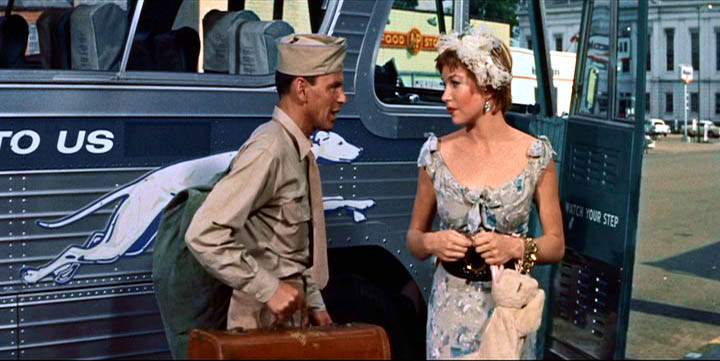
Opening Scene from Some Came Running

We are so conditioned to thinking of the years after the Second World War as some kind of golden age that it is refreshing to see how American films dealt with the era. Some prominent examples include William Wyler’s The Best Years of Our Lives (1946) and Vincente Minnelli’s film adaptation of James Jones’s Some Came Running (1958). In both pictures, the GIs come home to find that the guys with flat feet who stayed behind had all the jobs, money, and women.

From the opening credit sequence with its urban jazz music track as we see Frank Sinatra asleep on a Greyhound bus as the Indiana landscape rolls past, we feel we are in for something different. On the same bus is Shirley MacLaine as a good-time girl Frank had met in Chicago. Both had been drunk and were put on the bus by friends who specified Parkman, Indiana as the destination.

We see Frank at the beginning in his army uniform, though he has also written two books and spent time on a tramp steamer and as an oil rig worker. In Parkman, he is pursued by Shirley while he falls in love with Martha Hyer, a college writing instructor who is impressed with his writing ability but appalled by his lifestyle. Every time he is repulsed by Martha, Frank draws closer to Shirley MacLaine with her ridiculous doggie purse and showy bad-taste clothing, with an intellect to match.

Frank at Smitty’s Bar with Dean Martin

After his first encounter with Martha Hyer, Sinatra runs into Dean Martin as a southern gambler who uses Parkman as a base as he travels around playing poker in the surrounding Indiana cities. The initial scene at Smitty’s with its loud jazz track is my favorite in the film: It shows the bar with its lowlifes right in the middle of the ultra-respectable small town. It even appears that the bar is next door to Sinatra’s brother’s jewelry shop. (The role of the brother, played by Arthur Kennedy, is his smarmiest and most hypocritical role in a long career of playing villains.)

There are a number of significant divergences between the James Jones novel and the Minnelli film. As I have not yet read James Jones, I cannot say which I prefer. But one thing I can say is that Minnelli’s film is even better than The Best Years of Our Lives at portraying the sick soul of America coterminous with its postwar glory, even though the two films are more than ten years apart.


Morose Delectation

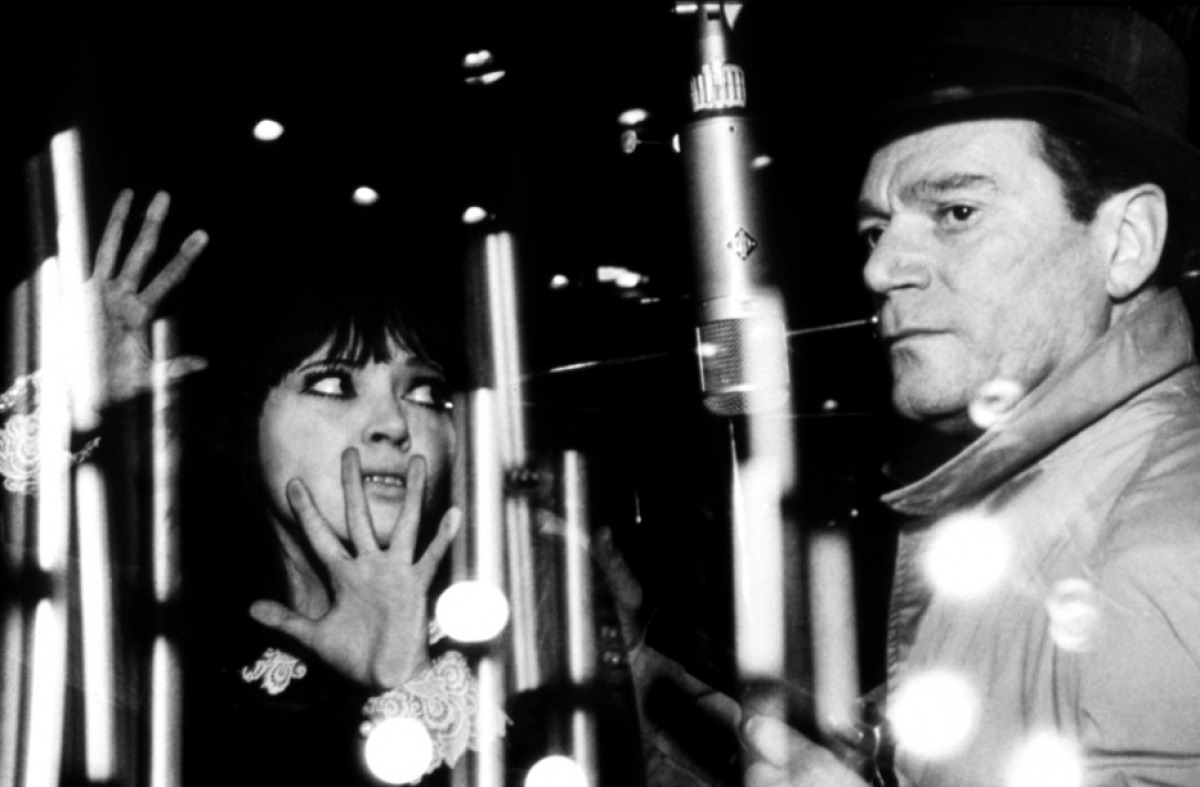
Anna Karina and Eddie Constantine in Godard’s Alphaville

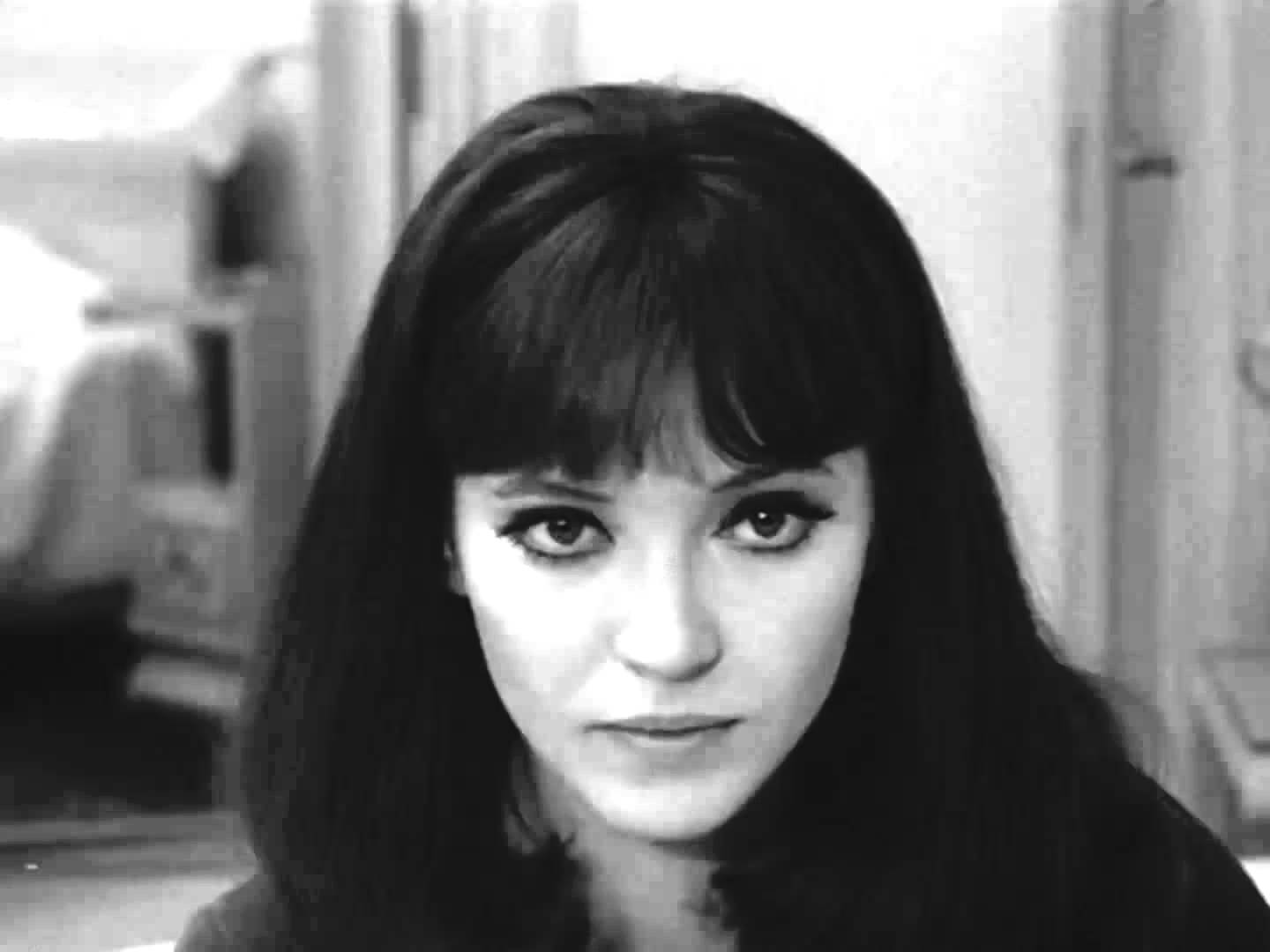
I have begun my re-evaluation of the films of Jean-Luc Godard, beginning with one of my favorites, Alphaville: Une Étrange Aventure de Lemmy Caution (1965). One thing hit me between the eyes right away: I am and have always been in love with Godard’s then wife and star Anna Karina. Those almond-shaped eyes! That beautiful face! For some reason, I had always assumed that she was Russian, probably because the similarity of her name to Anna Karenina, the Tolstoy heroine of the novel of the same name. Instead, she is Danish, born Hanne Karin Bayer.

Long one of my favorite Godard films, Alphaville lurches between two genres: the spy film and science fiction. The original Lemmy Caution was an FBI agent, the creation of a British novelist named Peter Cheyney. Between 1936 and 1945 he wrote ten novels starring Caution, all of which have him speaking a rural dialect in which and was always written as an’ and coming as comin’. I tried reading This Man Is Dangerous (1936), but gave up quickly. Godard took obvious liberties with the character and placed him in another galaxy far far away. Curiously, the French films based on the Lemmy Caution novels usually starred the same Eddie Constantine who played the role in Alphaville.

In the Alphaville of the future (which looks suspiciously like Paris circa 1965), a massive computer called Alpha 60 controls in detail the lives of all its denizens. As a homage to Orwell, Godard has a “Bible” in every room, which is none other than a dictionary of approved words. Words that are dropped out include such terms as “conscience,” ”love,” and “tenderness.”

Could This Be the Most Beautiful Face of the 1960s?

Lemmy Caution falls in love with Anna Karina (playing the role of Natasha Von Braun), whom he refers to as a beautiful sphinx (“Joli Sphinx,” which he repeats twice). Lemmy pulls the old Captain Kirk trick of talking the computer into destroying itself, and while the residents of Alphaville are stricken and dying, drives off with Anna Karina to the Outlands of Nueva York.

Sigh! I think I’ll see some more Godard films with Anna Karina in an act of what one of my old friends called “morose delectation.”


Return to Godard (After Many Years)

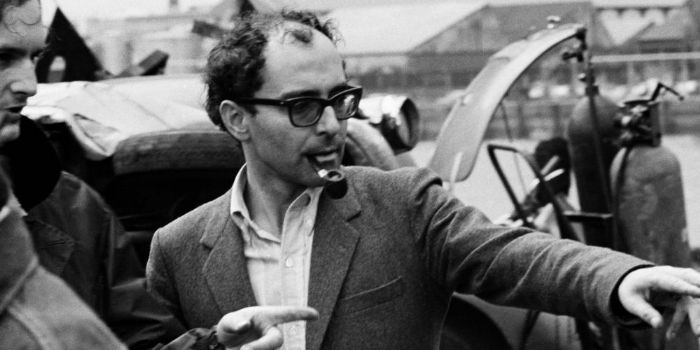
Jean-Luc Godard During His “Golden Age”

From my last two years at Dartmouth to my first two or three years in Los Angeles, I thought that French film director Jean-Luc Godard was the greatest living filmmaker. Since he was still under forty, I thought he had many productive years ahead of him.

When I first came to L.A., I did not drive (that came almost twenty years later). Most of his films received their Southland premieres at the Laemmle Los Feliz Theater on Vermont, a few blocks north of Hollywood Boulevard.  It was a long bus ride involving a transfer in Beverly Hills at Santa Monica and Cañon to a bus that let me off at Santa Monica and Vermont. From there, it was almost a mile to the theater. This was at a time that I was suffering from urethral strictures that made long bus rides an ordeal for me. Several times I wound up wetting myself on the way back. That is a singularly unromantic way of paying for one’s love of art.

The last Godard film I loved was Week-end (1967). Afterwards, he continued to make films, but as a dedicated Maoist and Communist Revolutionary. We all saw signs of this coming in La Chinoise (1967), but couldn’t believe he could throw away his talent for mere propaganda.

After 1970, the only new Godard film I saw was Éloge de l’amour (In Praise of Love), made in 2001, which I saw early this year. In the intervening years, I continued to see my Godard favorites over and over again: Le Mépris, or Contempt (1963), Pierrot le Fou (1965), and Alphaville (1966). This morning, I saw Vivre Sa Vie (1962) and became quite suddenly unblinkered.

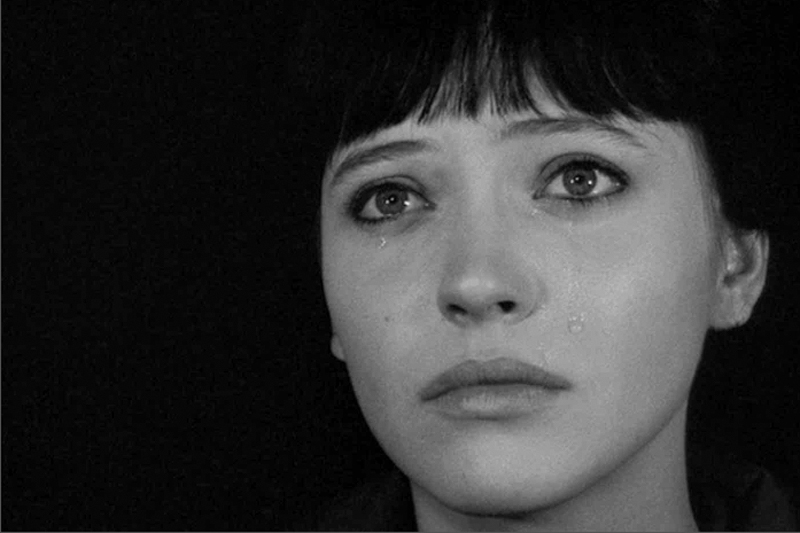
Anna Karina Crying in a Movie Theater in Vivre Sa Vie

I always saw Godard as a free spirit, but now I realized that there was a formal excellence that I had not appreciated. The film stars his wife, the lovely Anna Karina, who in twelve tableaux turns to the world of prostitution, falling in with a pimp who shoots her in the end. Where one would expect such a film to be relatively devoid of emotion, Godard follows Karina during the stages of her fall with a delicacy showing how strongly he felt for her. The above photo is taken in a movie theatre, where she tears up while seing Carl Dreyer’s The Passion of Joan of Arc (1928).

As if my life were not complicated enough, I am now going to stage a multi-year re-evaluation of Godard’s work—if I am lucky to live so long! There really is something there. I’m glad it was not just a youthful infatuation.


A Rare Beauty

Whitney Houston

The 1980s were a strange decade for me. Befoe I met Martine, I was in love with two gorgeous black women—though I was firmly ensconced in the “friend zone” with both of them. There was Melinda, with whom I worked, and Janice, a young physician. And my favorite singer was the lovely Whitney Houston, whose 1985 album, “Whitney Houston” contained some of the most beautiful singing I had ever heard. That plus the fact that she looked like an angel come down to earth made her my favorite listening choice, to the annoyance of some of my friends. The first tape I bought for my new 1985 Mitsubishi Montero was her first album.

Today I saw Kevin Macdonald’s documentary entitled Whitney. The singer’s life was neatly divided into two parts: the spectacular rise and the equally spectacular fall. As beautiful and talented as she was, Whitney was sexually abused as a child—by one of her female relatives—and then she fell in love with and married a debauched ogre, alias singer/dancer Bobby Brown, who help turn her hopes and dreams into mud.

When I look back at the early eighties, I think of the twin scourges of AIDS and cocaine. Cocaine was everywhere. If one was a celebrity, one had no problem getting as much nose powder as one wanted. It is pathetic to see Whitney toward the end of her life, aware that somewhere she had taken a wrong turning, but still faithful to many of the people who were living off her fame and intent on killing the goose that laid their golden eggs.

Hard-Boiled

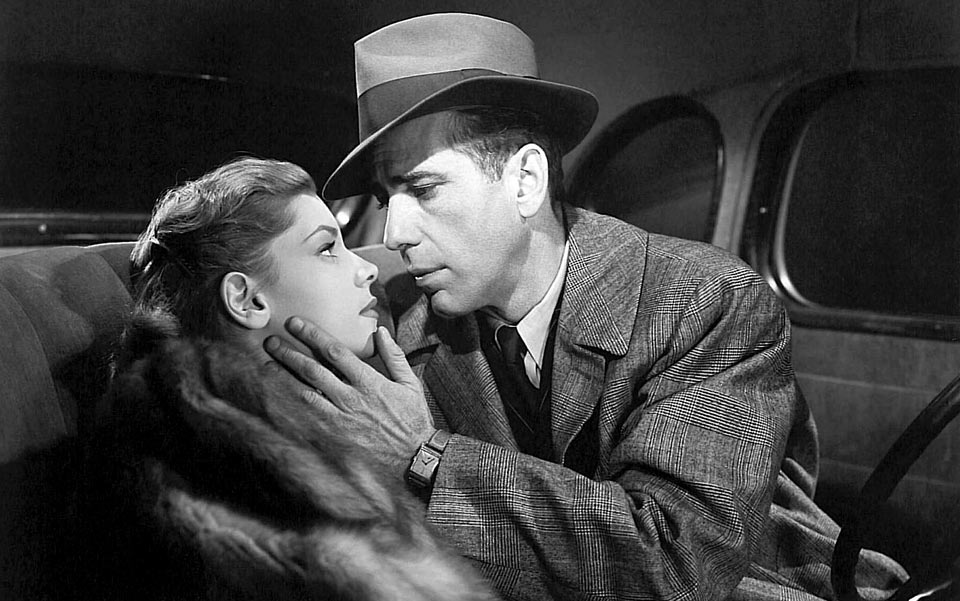
Lauren Bacall and Humphrey Bogart in Howard Hawks’s Masterpiece The Big Sleep (1946)

I’ve written before about American film noir, which includes many of my favorite films, such as The Big Sleep, High Sierra (1941), Double Indemnity (1944), and The Big Heat (1953)—not to mention several hundred other likely prospects.

Today I would like to say a few words about the literary genre that spawned these films. Although it was not until 1945 that the French publishing house Gallimard introduced its Serie Noir editions that gave birth the the genre’s name, noir novels had been written for years. There was even an early noir film by D. W. Griffith entitled The Musketeers of Pig Alley (1913).

What is it about the United States that produced this genre of hard-boiled urban crime fiction? It probably has something to do with our fascination with hard-boiled dicks, cigarettes, hard-luck losers, cheap booze, hot floozies, and guns. Here are just a few mileposts in the genre, alphabetically ordered:

  • W. R. Burnett: High Sierra (1941)
  • James M. Cain: The Postman Always Rings Twice (1934)
  • Raymond Chandler: The Long Goodbye (1953), probably my favorite of all the noir writers.
  • James Ellroy: L.A. Confidential (1990)
  • Kenneth Fearing: The Big Clock (1946)
  • David Goodis: The Moon in the Gutter (1953), which I’m reading now.
  • William Lindsay Gresham: Nightmare Alley (1946)
  • Dashiell Hammett: The Maltese Falcon (1930)
  • Patricia Highsmith: Strangers on a Train (1950)
  • Chester Himes: The Real Cool Killers (1959)
  • Dorothy B. Hughes: In a Lonely Place (1947)
  • Jim Thompson: The Killer Inside Me (1952)
  • Cornell Woolrich: Night Has a Thousand Eyes (1945)

I think I’ll stop at thirteen writers—a most appropriate number for this list. Not coincidentally, all have been made into classic films, both in the U.S. and France. Without straining my mind too much, I could probably double the size of the list. What’s interesting is that this list includes women (Highsmith and Hughes) and one African-American (Himes).

While none of the above names fit in with Beckett, Joyce, Faulkner, and the other literary heavyweights of the last hundred years, I would not be surprised if their works could be found on their night-stands.

Post-Production Blues: Major Dundee

Scene from Major Dundee (1965)

Hollywood is full of stories of battles between the director and the producers. One of the most tragic occurred between Sam Peckinpah and the money men behind Major Dundee. It was only Peckinpah’s third outing as a director of feature films, and he was given a budget of $4.5 million to shoot the film in Mexico. The original director’s cut came in at 4 hours and 38 minutes, and several million dollars over budget. Producer Jerry Bresler promptly denied the director any decision in the post-production process.

He had the film edited down to 123 minutes, which was the version I originally saw at a downtown L.A. theater around 1970. Today, I watched a 136 minute version, which calls itself “The Extended Version,” though is still a bit rough around the edges.

Director Sam Peckinpah

It is a pity that men of no artistic ability like Bresler have such an ability to mar a major work of art. Even with all its jagged edges, Major Dundee is a captivating film. Set in the final years of the Civil War, it tells of a Union officer (Charlton Heston) stationed to New Mexico Territory putting together a unit to revenge a massacre of men, women, and children by Apaches led by one Sierra Chariba. With few regulars on hand at Fort Benlin, he recruits a squad of black Buffalo Soldiers, a few cowboys and outlaws and the usual reprobates, and a group of Confederate prisoners led by Captain Benjamin Tyreen (Richard Harris). When the Apaches cross the Rio Grande into Mexico, Dundee and his men follow them and come into conflict with French troops which then controlled Mexico under the Emperor Maximilian.

Peckinpah always had a special feeling for Mexico. During the shooting of Major Dundee, he fell in love with one of his actresses, Begoña Palacios, and married her. Shown below is a Mexican fan magazine of the period with her picture on the cover.

Begoña Palacios

I will never forget when I saw the rough cut of Peckinpah’s The Wild Bunch (1969) at Warner Brothers Studios. There was a scene of Bill Holden and his men leaving a Mexican village that seemed to go forever. There is a similar scene in Major Dundee, where Charlton Heston captures a small French garrison and finds that the villages does not have enough food to survive. He immediately orders that two of his mules be butchered. There is a long fiesta scene. When Heston and his men leave, the whole village comes out to see him off.

I rather like the special feeling that the director had for Mexico. It gives his films set there a certain glow. It is a pity that Peckinpah died at the age of 59 in 1984. He had indulged in booze and drugs, and they greatly weakened him at a time when he still had a lot to give as one of the greatest artists in the genre of the American Western.


Two Old Friends

French Film Critic André Bazin

On Sunday, I was driving to San Pedro to see a friend; and I stopped at Michael R. Weinstein’s Collectible Books at Alpine Village. Sitting in the film section was a two-volume set of film criticism by André Bazin, the founder of Cahiers du Cinéma in 1951. I had owned hardbound copies of the set when I was a graduate student in the film department at UCLA. In fact, the two volumes of Qu’est-ce que le cinéma? (What Is Cinema?) had been translated into English by my favorite professor in the department, Hugh Gray.

Without any particular knowledge of the United States, Bazin was a marvelously intuitive critic who understood American film genres such as the Western almost as well as he did the French theatrical antecedents of his own country’s cinema. Re-reading his essays “The Western: Or the American Film Par Excellence” and “The Evolution of the Western,” I was taken back to my days as a film freak in the late 1960s and early 1970s. I was a devotee of Cahiers du Cinéma and of the politique des auteurs it espoused. And from there came my knowledge of and love for the American film, by way of France.

My classes with Hugh Gray were among the best I took at UCLA. The film department at UCLA had on its faculty both angels and demons, and Hugh was numbered among the angels.

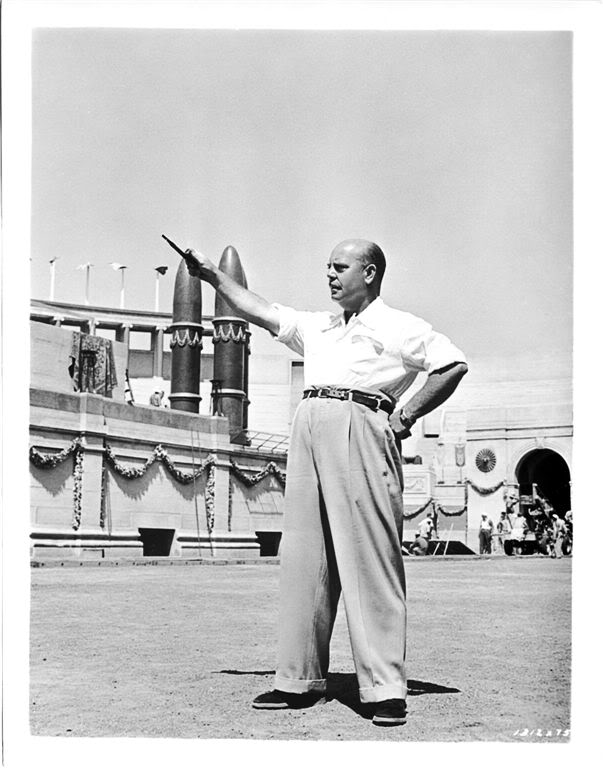
Hugh Gray as a Technical Specialist for Ancient Greek and Roman Film Subjects

Hugh had been an ordained Dominican priest earlier in life, but then left the order and got married. In Hollywood, he was the go-to man for films set in ancient Greece or Rome because of his wide knowledge of the subject. That wide knowledge, combined with his friendliness to his students, made him a superb professor.

I plan to re-read the Bazin essays in the months to come, thinking of the good times I had studying film at UCLA.

Ten Classic British Film Comedies

George Cole as “Flash Harry” and Alastair Sim as Headmistress Millicent Fritton in The Belles of St. Trinian’s

In honour of the Royal Wedding—wait, belay that!—I would like to honour the British for what they made me do in my formative years, namely, to laugh my head off. I just watched one of Martine’s favorite films at her side, The Belles of St. Trinian’s (1954). It starred the great Alastair Sim in two roles, as the Headmistress of St. Trinian’s School for Girls Millicent Fritton and as her scapegrace horse racing tout brother Clarence. You may recall Sim as Ebenezer Scrooge in the best version of Charles Dickens’s A Christmas Carol (1951).

It suddenly hit me that I have never written about the British film comedies that help sustain me through high school and college, while I was suffering from a pituitary tumor that almost killed me in 1966. Consequently, I have put together a list of ten films that I loved and that made me laugh:

  • Passport to Pimlico (1949), directed by Henry Cornelius.
  • Kind Hearts and Coronets (1949), directed by Robert Hamer. With Alec Guinness playing seven parts.
  • Whisky Galore! (1949), directed by Alexander Mackendrick. One of the very best.
  • The Lavender Hill Mob (1951), directed by Charles Crichton. Guinness again.
  • The Importance of Being Earnest (1952), directed by Anthony Asquith. On the importance of Bunburying.
  • The Belles of St. Trinian’s (1954), directed by Frank Launder. Alastair Sim x 2.
  • Father Brown (1954), directed by Alexander Mackendrick. Guinness as Chesterton’s priest/detective.
  • Hobson’s Choice (1954), directed by David Lean. Charles Laughton and John Mills.
  • The Ladykillers (1955), directed by Alexander Mackendrick. Peter Sellers’s first film.
  • School for Scoundrels (1960), directed by Robert Hamer. Based on Stephen Potter’s books.

So you can wake up in the middle of the night at watch the pre-game show for the Royal Wedding, or you can laugh your ass off. Guess what I would recommend!