My Brilliant Acting Career

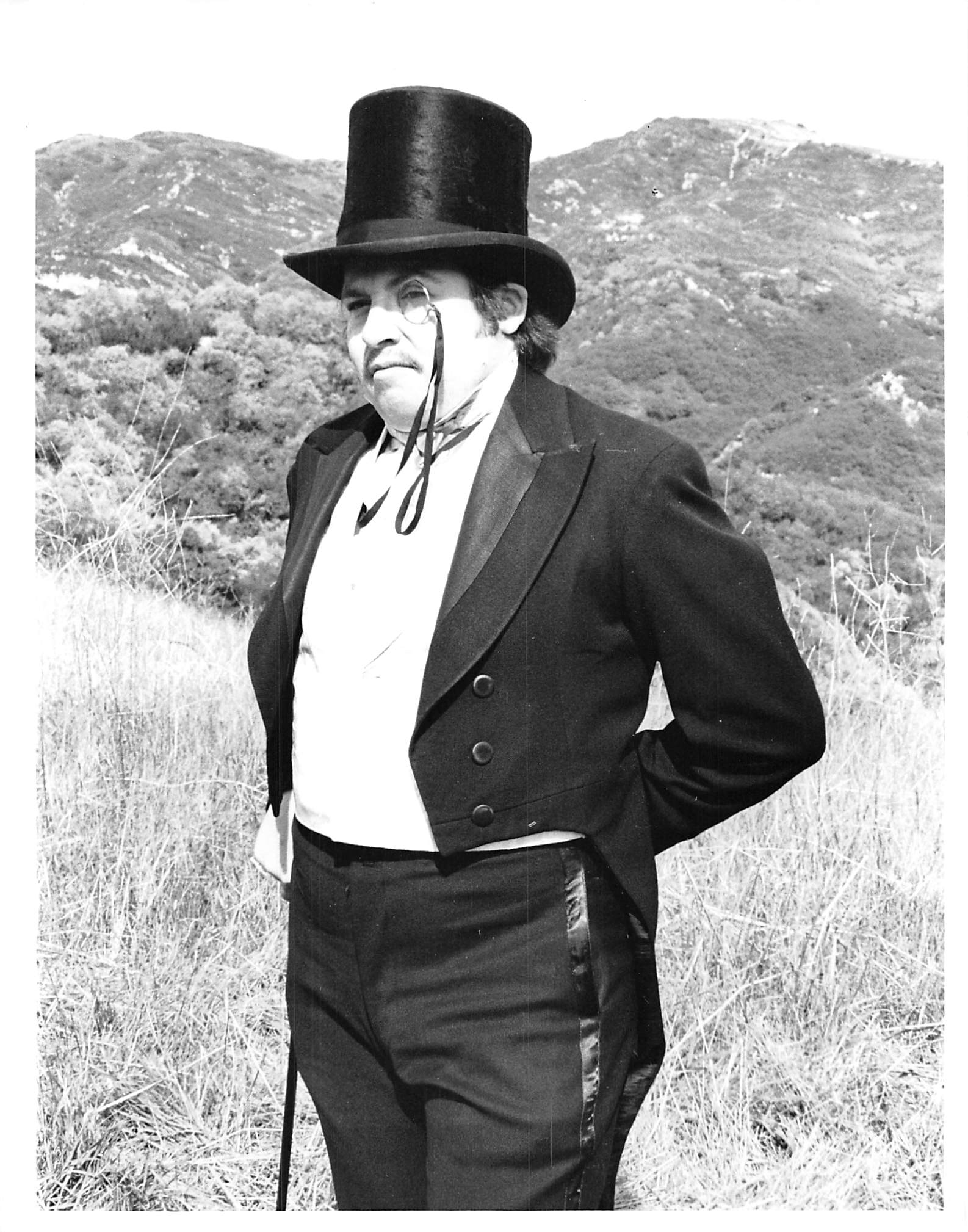
Me As a Dissolute 19th Century Gambler

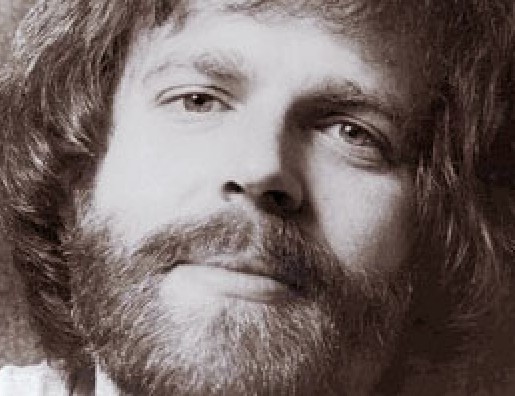
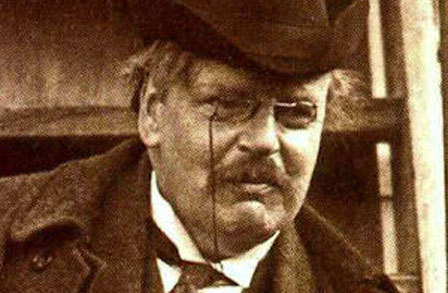
Martine and I have been working at thinning my overflowing collection of books and papers. Today, two 8 x 10 photos emerged of me in a 1970s student film by Trevor Black and Lynette Cahill. If I remember rightly, the film was based on a Chekhov story called “The Duel.” I played a bit part as a cheating gambler. How any self-respecting gambler sport such a rat’s nest of a hairdo is beyond me. The interesting thing is that, unconsciously, in costume I resembled my literary hero, G. K. Chesterton, hair and all. (Today my hair is not much to look at.)

G. K. Chesterton

I enjoyed this brief acting stint, though I was never requested to act again. No casting directors have besieged me to try out for any major studio (or even indie) productions. No matter: I was never really that interested in film production, whether as director, crew, or actor. I just liked to see, talk about, and write about great films. I would have liked to become a professor of film history, but that was not in the cards for me; and I have no regrets about the winding path I wound up taking.

Here is another view of me in costume, acting as the second in a duel:

Me as the Crooked Gambler Acting as the Second in a Duel


If any of you have any lucrative roles for a ratty looking retired guy, please contact me at once.
 

Favorite Films: Two Men in Manhattan (1959)

French Film Director Jean-Pierre Melville (1917-1973)

You have to admit it: He looks like an American. But he comes by it honestly. Not only is he a hero of the French Resistance during the Second World War, but his code name was Melville, based on his love of Herman Melville’s Moby Dick. His real name was Jean-Pierre Grumbach, born an Alsatian Jew in Paris; but he signed all his films as Jean-Pierre Melville.

I have seen four of Melville’s thirteen films. Although the French New Wave of the 1960s resulted in a publicity windfall for Jean-Luc Godard, François Truffaut, and Alain Resnais, there were many French directors who never became quite so well-known across the Atlantic. Jean-Pierre Melville is one of them. Others include Jacques Becker, Jacques Rivette, and Claude Chabrol.

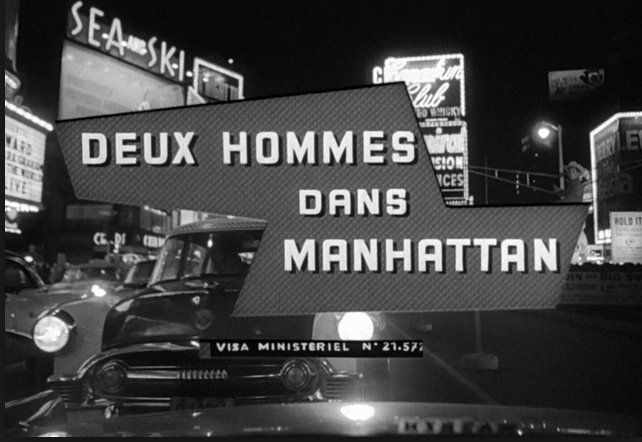
Two Men in Manhattan (Deux Hommes dans Manhattan) is like a Valentine dedicated to New York City at night. A newsman for Agence France Presse in New York is told to investigate the non-appearance of a French diplomat at the United Nations. Moreau (played by Melville himself) looks up his paparazzi friend Delmas. Together, they search for three known past girlfriends of the diplomat, including a Broadway actress, a jazz singer, and a stripper. They even visit a high-priced prostitute known to favor diplomats. When they find that he has died in a girlfriend’s apartment, a conflict erupts when Delmas sees the potential for selling photos that show his death to have been a squalid one. It turns out the deceased was a hero in the Resistance, and Moreau’s boss wants the negatives of the pictures Delmas took.

French Title for Two Men in Manhattan

In no American film of the period have I seen such beautiful scenes of night-time Manhattan. The exteriors in this film are lovely, and the scuttlebutt is that Melville shot them himself. If so, I would regard it as high on the list of the best noir films, irrespective of country of origin.

If you should rent the DVD, I suggest you also watch the extra footage of a conversation between Jonathan Rosenbaum and Ignatiy Vishnevetsky, two knowledgeable film critics who provide excellent background to the movie and Melville’s career.


Favorite Films: King Kong (1933)

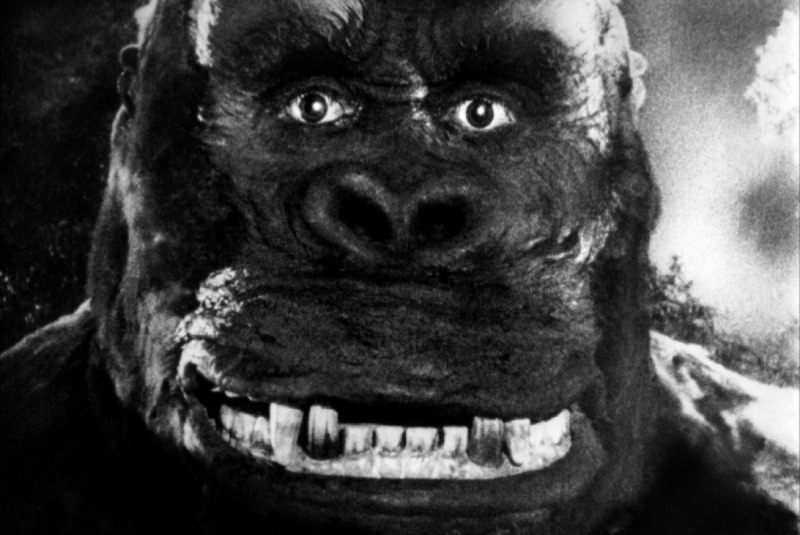
Who Can Resist That Mug?

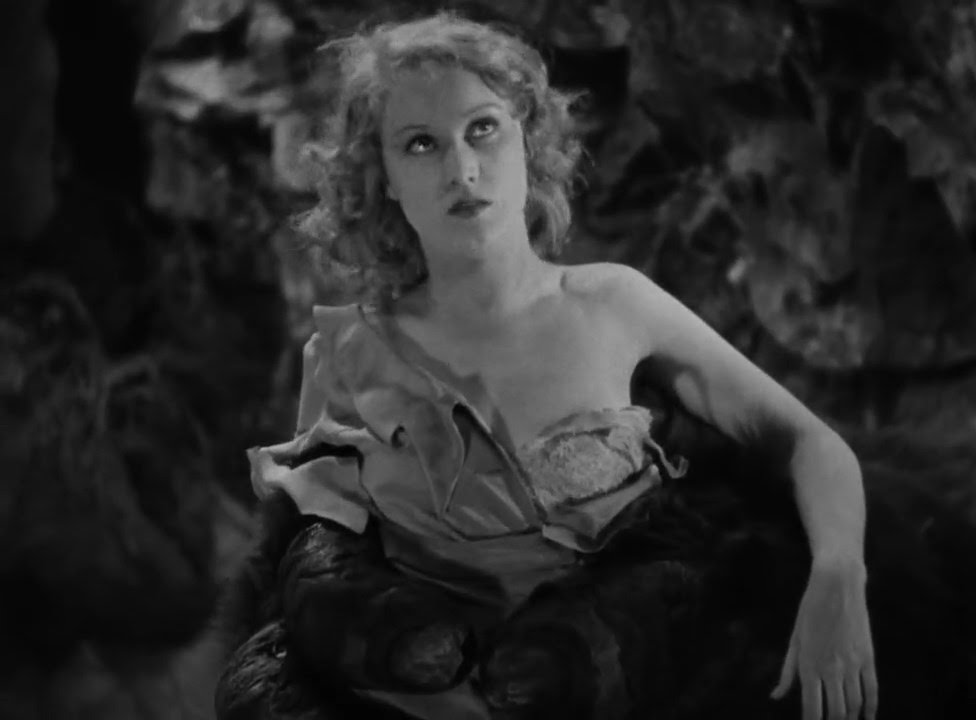
I must have seen the original King Kong (1933) over twenty times by now, and I never seem to grow tired of it. One of the reasons I love it is that it is Pre-Code. As such, it gets away with many scenes that a few scant years later would have received the kibosh from the censors at the Hays Office. In one of my favorites, Kong employs Fay Wray as a scratch-n-sniff toy, stripping away her outer garments as if they were onionskins and holding his fingers up to his nose. You can see the scene on YouTube here.

A few years before he died, I happened to meet the producer and co-director of the film, Merian C. Cooper. He spoke to a film class at UCLA for which I was the graduate teaching assistant. During that class, he gave his own interpretation of what Kong was really about. Now I don’t necessarily take his word for it, but he says that the ape was a symbol of the downtrodden black race which did not know its own power. Maybe, but there are too many vignettes of the giant gorilla munching on black natives or crushing them like insects under his feet for that reasoning to be altogether convincing.

While I liked the big gorilla, I went ape for Fay Wray. After seeing countless movies of the period with goldilocks-looking blondes wearing those stupid cloche hats, like cloth helmets, it was refreshing to see a healthy young woman who would be considered a knockout today—without having to squint your eyes. Oh, and she was also a pretty good screamer.

Fay Wray in the Notorious Scratch-N-Sniff Scene

There have been numrous remakes and near look-alikes, but I still think the only ones worth considering were done by Ernest B. Schoedsack with or without Merian C. Cooper. I am specifically referring to Son of Kong (1933) and Mighty Joe Young (1949). In the age of CGI, Kong just ceases to be interesting. The model work in the Schoedsack/Cooper films was nothing less than superb.


Favorite Movies: Rio Bravo and El Dorado

Ricky Nelson, John Wayne, and Dean Martin in Rio Bravo (1959)

Over a period of eight years, director Howard Hawks filmed virtually the same story twice—both films starring John Wayne—with the only differences being some minor script changes and a different set of supporting actors. The films were Rio Bravo (1959) and El Dorado (1967). Interestingly, both films hold up pretty well today.

Both films were a reaction to Fred Zinnemann’s High Noon (1952), in which Sheriff Gary Cooper tries and fails to enlist the help of his fellow townspeople in fending off an attack of several bad guys seeking vengeance for having jailed several of them. In contrast, John Wayne turns away several offers of help in the Hawks pictures and beats the bad guys anyway. Both times, the sheriff is under attack by wealthy ranchers who bring in hired guns to assist them.

Here are the major cast differences:

  • John Wayne plays himself in both pictures, though in El Dorado, he is a gunfighter assisting his friend, the sheriff, played by Robert Mitchum.
  • Dean Martin plays the drunk lawman in Rio Bravo; Robert Mitchum, in El Dorado.
  • The young gun is played, respectively, by Ricky Nelson and James Caan, in his first major role.
  • The female lead is played, respectively, by Angie Dickinson and Charlene Holt.
  • The deputy comic sidekick is played, respectively, by Walter Brennan and Arthur Hunnicutt.

John Wayne and James Caan in El Dorado (1967)

I just saw Rio Bravo again for the nth time yesterday afternoon. I will summarize it here because it is fresh in my memory. John Wayne and Dean Martin arrest Claude Akins for shooting an unarmed man. Unfortunately, scapegrace though he is, he is the brother of powerful rancher John Russell, who is determined to spring him before the U.S. marshal comes to town in six days. He besieges the jailhouse with his men and orders the musicians in his saloon to play El Deguëllo nonstop. This was a bugle call played by Santa Anna’s Mexican troops during the 1836 siege of the Alamo. Eventually, Russell’s men manage to kidnap Dean Martin. Wayne arranges for an exchange of Martin for Akins at a warehouse at the edge of town. The good guys prevail.

There is a third Howard Hawks film with a similar story, Rio Lobo (1970), which was the director’s last film. Although I love Hawks’s works, this is one you can skip.


Favorite Films: The Thing from Another World (1951)

The Scene That Scared Me Most as a Kid

My favorite science fiction film of the 1950s was The Thing from Another World, an RKO cheapie that was superbly written and, for me as a boy who grew up in that strange era, utterly frightening. The whole film takes place in a research camp in the remote arctic north of Alaska. An army officer (Captain Hendry) receives orders to investigate the landing of an unknown object weighing some 20,000 tons (18 million kilograms)—far above the weight of known aircraft of the period. Also, it could not be a giant meteor because it went up before ultimately landing.

He flies up to the research station and, the next day, scouts out the landing site, in which the entire craft with the exception of a protruding fin is under ice. Hendry’s men line up above the visible edges of the vessel to determine its shape (it is circular, of course) and test the fin for its composition (an unknown alloy of some sort). To study the vessel more carefully, Tobey employs thermite bombs to melt the ice around it. Unfortunately, it also blows up the space ship. In doing so, a large (8 feet or 2.5 meters) figure is thrown from the ship. Still encased in ice, the figure is flown back to the research station.

Tobey orders the windows of the supply room in which it is stored to be broken to keep the figure frozen in ice. One of the guards on a later shift puts an electric blanket over the space alien—for such it turns out to be. The ice melt, the creature awakens, and it immediately goes on the attack.

Flying Saucer Fin Sticking Up Through the Ice

The scientists at the station, led by the venerable Nobelist Dr. Carrington, immediately deduce that the priority must be to communicate with the “obviously” superior creature, even if it turns out to be suicidal in the end. Captain Hendry, on the other hand, is more concerned for the safety of the military and scientific staff. During the beast’s rampages, there is an almost total radio silence with the civilized world because of severe storms.

This 87-minute black and white film was produced in the same year that saw The Day the Earth Stood Still and When Worlds Collide, and it was more successful than either film. My only reaction to that is, to use an expression from the film, “Holy Cat!” By the way, the beast was played by James Arness in his first role.

The film was signed by Christian Nyby as director, though it clearly shows signs of having been heavily influenced by producer Howard Hawks.


Everyday Realism

César Aira, Argentinian Writer Par Excellence

What’s the first thing you do when you wake up? Put on your tuxedo and cummerbund? Sit in bed lolling over a tray of sumptuous breakfast delicacies? Write the Great American Novel? No, no, no. What you do is stagger to the bathroom and empty your bladder. That before anything else—unless you want an untoward accident to put a damper on your day. I realize it would be boring to show these simple rituals in a movie, in which every minute costs a small fortune. But even in fiction, where words are cheap, there is no acknowledgment of a simple biological need.

None to speak of, anyway, until I saw the following line in César Aira’s Ema the Captive:

A sleepy soldier had come out onto the veranda of his house and stopped there, right on the edge, to pee, swaying dangerously.

Hallelujah! This line was in all probability written by a human, and not an android.

Another example of a simple reality not observed, especially in films, is that the hero always finds a parking place directly in front of his destination. In The Big Sleep, Bogart always finds the ideal parking space without even trying. I guess there weren’t that many people around in the 1940s.

Finally, with some rare exceptions, guns almost never misfire. If you look at Wikipedia’s entry on Firearm Malfunction, you will find twelve things that can happen to prevent your gun from shooting. In the real world, not everyone that has firearms is careful with them, or does everything needed to guarantee 100% functionality. Yet one rarely sees a misfire of any sort.

I guess most movies are fantasies, as our parents told us.


Favorite Films: Doctor Mabuse Der Spieler

Doctor Mabuse Putting On a New Disguise

I’m going out on a limb to recommend a 4+ hour 1922 German film about a master criminal. Dr Mabuse der Spieler (Dr Mabuse the Gambler) is the first—and best—of three films that Fritz Lang directed about a master criminal named Mabuse, who was not only a gambler, but a counterfeiter, psychoanalyst, illusionist, stock manipulator, hypnotist, murderer, and a master of disguise. The other two Mabuse films Lang directed were The Testament of Dr Mabuse (1933) and The 1000 Eyes of Dr Mabuse (1960).

The original film starred Rudolf Klein-Rogge as the master criminal, Bernhard Goetzke as State Prosecutor Norbert van Wenk, and Alfred Abel as Count Told.

The period from 1918 through 1924 was a brutal time for the newly founded Weimar Republic after the German loss of World War I. The Treaty of Versailles and the heavy reparations it forced on Germany ultimately led to Hitler and the Third Reich. But before that, it led to political turmoil and hyperinflation. Lang’s film  brought together many of these threads in a film which, however long, maintains a high level of excitement throughout. Much higher, I would add, than most American superhero epics of recent years.

Although he is fantastically wealthy from his crimes, Mabuse is more interested in accumulating power over people than cash. There is a strong element of egoism in his attempts to break people who oppose him or otherwise stand in his way. His main opponent is the State Prosecutor von Wenk, whom Mabuse first hypnotizes into losing at cards and then attempts to assassinate him by bombing his office and getting him by hynotic suggestion to drive an automobile over a cliff. It takes a while, but eventually von Wenk concludes that Mabuse is the man of a thousand faces who has been causing all these crimes.

One of Mabuse’s Hypnotic Suggestions Against von Wenk

I don’t know if I can convince any of you to get this film (which is released in two parts) and actually watch it, I will have to employ hypnotic suggestion to urge you in the process. So here goes: TSI NAN FU and MELIOR. You won’t know what I mean unless you see both parts of the film. So, Ha!


French Noir? Obscurité Française?

Still from Jean-Pierre Melville’s Le Samouraï (1967)

It sounds a bit odd to talk about French noir literature and films, mainly because noir is a French word. Perhaps I should be talking about Obscurité Française. This afternoon, I watched a work of that master of French noir, Jean-Pierre Melville. His film Le Samouraï is a masterpiece, both in its spare visual style and its typical noir attributes. Alain Delon as Jef Costello, the hit man, is a pleasure to watch, as is François Périer, the police superintendent, who goes all out to arrest Jef based on his belief that his alibi would not hold up.

Melville has made other excellent noir films as well, including Bob le Flambeur (1956) and Le Doulos (1963). But Le Samouraï is his best by far.

In addition to noir films, the French are no strangers to noir fiction. Yesterday, I read Three to Kill (1976) by the late Jean-Patrick Manchette (1942-1995), who also wrote Fatale (1977) and Ivory Pearl (1996), the latter of which was unfinished. I am also interested in reading works by Boris Vian (1920-1959), author of I Spit On Your Graves (1946).

The United States has an embarrassment of riches in the genre, starting with Raymond Chandler and Dashiell Hammett, and continuing with David Goodis, Cornell Woolrich, James M. Cain, Mickey Spillane, Charles Willeford, Jim Thompson, Dorothy B. Hughes, Kenneth Fearing, W. R. Burnett, and a host of others. They are one of the joys of recent American literature which I have been taking advantage of during this long, hot summer.


La Politique des Auteurs

Cahiers du Cinema: The French Film Journal That Started It All

I find now that yesterday’s post took a lot for granted. One can’t just float a concept like the auteur theory and expect to be understood. When I first got into films at Dartmouth College, I was influenced by a French monthly called Cahiers du Cinema, and by the work of an American film critic writing for the Village Voice named Andrew Sarris, who tried to translate the French critics’ ideas into the American idiom. For Film Culture magazine (Winter 1962/1963), he wrote a long article entitled “Notes on the Auteur Theory in 1962.” I photocopied his article and kept it with me for years, until he turned it into a book in 1968 entitled The American Cinema: Directors and Directions 1929-1968.

The whole issue of the auteur theory is simple: If the cinema is an art form, then who is the artist in the cinema? Is it the producer? No, he’s mostly just a money man. Is it the film studio? Again, their major concern is money. Is it the writer, the actors, the director of photography, the editor? No times four. They just do what they’re told to do. The auteur theory elevated the director to the role of the artist. When the director is a studio hack, the result can be entertaining, but is rarely great. Yesterday, I wrote:

Why did I not go to the movies this year? Simply put, I remain an auteurist; and there were few films this year made by the directors whose work I follow. I am not interested in the films of William Seiter, Norman Panama, Archie Mayo, George Archainbaud, Alan Crosland, Alfred L. Werker, and any number of studio hacks who never signed their names to a great film. They were for the most part competent film makers whose work was light and entertaining; but I was after bigger game.

Now thye French considered Jerry Lewis to be an auteur, a true film artist. His films after he parted with Dean Martin are usually directed by him in a consistent and very competent way. You may not think that Jerry Lewis is a film artist, but he fits the idea the French have of the immature American male—like it or not.

Director Howard Hawks with Angie Dickinson on the Set of Rio Bravo (1958)

So who are the great film auteurs? There are almost as many lists as there are film critics. I remembered long discussions with my fellow film freaks in the late 1960s as to who was great and who wasn’t: I called the activity “trading bubble gum cards.”

Here is Andrew Sarris’s auteur pantheon:

  • Charles Chaplin
  • Robert Flaherty (he wouldn’t make my list)
  • John Ford
  • D. W. Griffith
  • Howard Hawks
  • Alfred Hitchcock
  • Buster Keaton (though he didn’t sign his name as director)
  • Fritz Lang
  • Ernst Lubitsch
  • F. W. Murnau
  • Max Ophüls
  • Jean Renoir
  • Josef von Sternberg
  • Orson Welles

A few of the names are predominantly European directors who also made several films in America (like Murnau, Ophüls, and Renoir).

Everything Changes

Try to Get Your Kids Interested in This!

This year for the first time in many years I have not attended the films at Cinecon. I did, however, go with Martine to the memorabilia dealers’ rooms. In the past, when my friend Norman Witty was alive, Martine enjoyed acting as his assistant; and she made a number of friendships with the other dealers. So while she chatted with her old friends and acquaintances, I found a comfortable chair and read a book. Also I devoted some time to thinking about what was happening to the dealers and members of Cinecon.

In short, they were getting older and passing on. I saw few people under the age of sixty at the dealers’ tables.

Why did I not go to the movies this year? Simply put, I remain an auteurist; and there were few films this year made by the directors whose work I follow. I am not interested in the films of William Seiter, Norman Panama, Archie Mayo, George Archainbaud, Alan Crosland, Alfred L. Werker, and any number of studio hacks who never signed their names to a great film. They were for the most part competent film makers whose work was light and entertaining; but I was after bigger game.

Then I thought,“Wait a sec! How many auteurists are around these days?” The answer is: damned few, and fewer every year. Instead people go to see superhero films intended for very young males, starring powerful guys and gals who like to wear their Underoos over their street clothes. Then there are the numerous independent productions, about the problems of young people who are altogether too full of themselves. What do I care about Hipster man with his man-bun and immaculately trimmed beard and all his digital toys?

Many of my posts have not been kind to the younger generation—mostly because the things they value are nothing to me, and the things I value, nothing to them. For how long will Cinecon be around to commemorate films of the 1920s and 1930s? I mean, people, we are talking about films that are not even in color!

After my generation leaves the scene, many whole worlds will disappear as if in a puff of cosmic dust.