King of the Bs

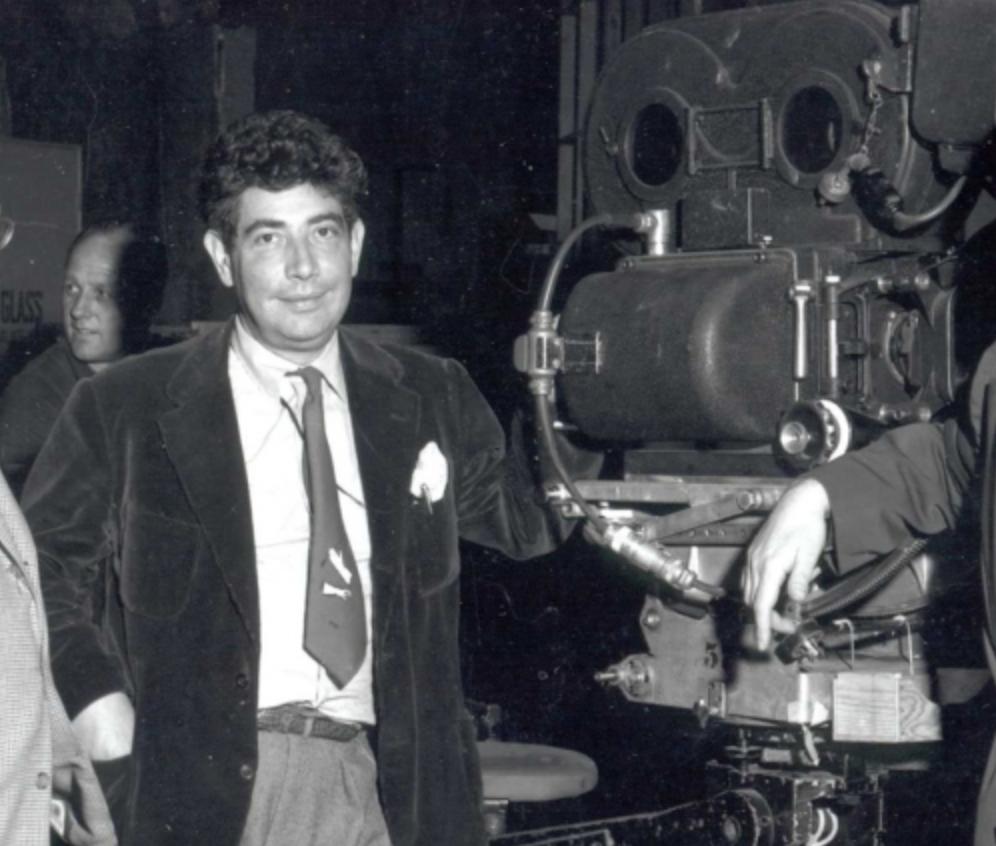
Filmmaker Edgar G. Ulmer (1904-1972)

Back in the day that the big Hollywood studios ran the film market, there were two categories that were offered to movie exhibitors. There were the A films and the B films. The idea was to offer two films to exhibitors for the price of one. The A film was the big draw and almost always the more expensive to produce. Then there were the B films, which were run second on the double features. Sometimes, the big studios produced them, but they also offered products from various small studios that were collectively known as “poverty row.” These studios included:

  • Republic Pictures
  • Monogram Pictures
  • Eagle-Lion Pictures
  • Producers Releasing Corporation (PRC)

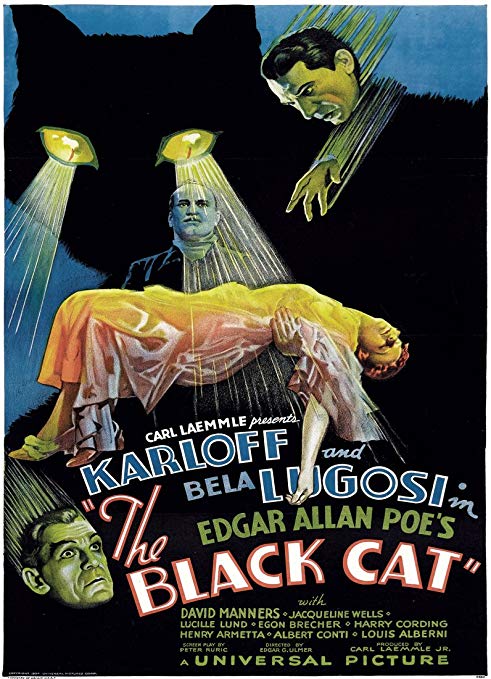
The leading director for PRC was Austrian-born Edgar G. Ulmer who, despite the fact that he rarely worked for the majors, made several dozen films, some of which are masterpieces. My favorite of the lot is a horror film that starred both Bela Lugosi and Boris Karloff, The Black Cat (1934), which he made for Universal. Although the film made money, studio chief Carl Laemmle fired Ulmer for having an affair with one of his married execs. Ever after, Ulmer skirted the edges of the industry.

Incidentally, although the film poster claims that the story for the film was from Edgar Allan Poe, I challenge anyone to explain to me which scenes were from the story. There is a black cat that occasionally appears, but the tale is not Poe’s.

Poster for The Black Cat (1934)

Another great is Detour (1945), a film noir starring Tom Neal and Ann Savage. It’s an amazing film that stands up to repeated viewings. I also liked Bluebeard (1944) with John Carradine. Both films were made for PRC.

I recently saw a film about Ulmer which included an interview with the director. Again and again, when asked how long it took to shoot a named film, he uniformly answered “six days.” This is a man who knew how to produce a creditable work quickly and with a down-to-bone budget.


A Bookworm’s Day

The Westfield Culver City Mall

Today was a day devoted to books. This morning, I took a box of 20 trade paperbacks to the Los Angeles Public Library in Mar Vista as a donation. They are about to have a large book sale in a couple of weeks, and I thought these books would probably sell. After I dropped them off, I sat in one of their comfy chairs and finished reading The Best American Travel Writing 2013, edited by Elizabeth Gilbert. Travel literature is one of my favorite book categories, accounting for much of my reading during the summer months. (As well as being an actual traveler, I am also an armchair traveler.) On my way out, a picked up a free library discard copy of Fodor’s Brazil (2016).

The reason? I am toying with the idea of flying to the State of Bahia, to Salvador and Ilheus, and reading Jorge Amado’s novels which are set there.

Next, I drove to the Westfield Culver City mall, where I ate a light vegetarian lunch at the Vietnamese restaurant in their top floor food court. Afterwards, I bought some milk chocolate clusters with walnuts, peanuts, pecans, and almonds. I spent a couple of hours looking at the Fodor Brazil guide before heading home.

Max von Sydow and Liv Ullmann Arrive on the Island in Hour of the Wolf

By the time I got back, Martine was gone for a doctor’s appointment, so I watched Ingmar Bergman’s Hour of the Wolf (1968), the closest the Swedish director ever came to a gothic horror film, starring Max von Sydow and Liv Ullmann staying on an island of vampires.

After preparing dinner, consisting of Hungarian fasirt with buttered corn on the cob. Afterwords, I started reading Valentin Kataev’s 1927 novel Embezzlers. All in all, not a bad day.


Bosko the Doughboy

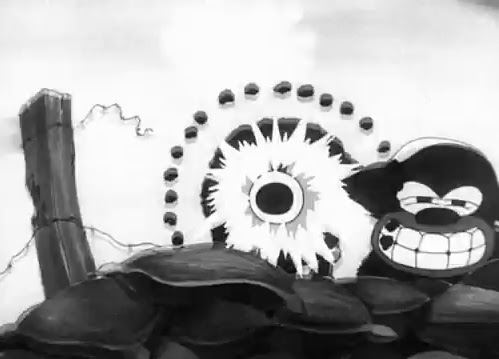
Bosko the Doughboy (1931): Violence and Absurdity

Before the Hays Code was widely adopted around 1934, Hollywood produced a number of wild films that would be frowned upon even in today’s Quentin Tarantino environment. One of the wildest is a Bosko cartoon released by Warner Brothers in 1931 which shows the horrors of World War I in a graphic and yet insanely cheerful manner. Oddly, it was directed by Hugh Harman, whose Harman-Ising cartoon productions usually showed cute animals innocently singing and cavorting on farms and in the wilds.

In “Bosko the Doughboy,” one of the first shots is a brutal machine-gunner who turns his weapon to the camera and shoots the audience.

Machine-Gunning the Audience

I have seen numerous World War I films such as Stanley Kubrick’s Paths of Glory (1957) and the recent They Shall Not Grow Old (2018). Yet neither of these films can hold a candle to “Bosko the Doughboy,” whose experiences would shame the Good Soldier Schweik or Bertolt Brecht or Eugene Ionesco. This is a cartoon which remains on a manic and chirrupy plane even when many of its cute animal characters are shot to pieces by machine guns, cannon, or aerial bombardment. Nobody is sad, even when in articulo mortis.

You have to see this film to believe it. It’s only seven minutes long.

In the very last scene, a bomb explodes right by Bosko, turning him black. His response? He spreads his arms wide and shouts “Mammy!” a la Al Jolson.

Once Upon a Time in Alternate History

10050 Cielo Drive, Site of the Sharon Tate Killings

One of my favorite novels by Philip K. Dick is The Man in the High Castle (1962), in which the United States has lost the Second World War. Germany occupies the Eastern U.S.; and Japan, the Western U.S. In his film Once Upon a Time in Hollywood (2019), Quentin Tarantino dishes up an alternative view of the Sharon Tate killings at 10050 Cielo Drive in Beverly Hills.

I don’t want to spoil the film for any of my readers, so I will hint that in the movie, all the killing takes place next door. Involved are not Sharon Tate and her guests, but Western star Rick Dalton and his stuntman buddy Cliff Booth.

The odd thing is that I actually know the person who occupied the house that is either next door or almost next door. That person was film actor Richard Anderson.

Richard Anderson (1926-2017)

The resident of 10120 Cielo Drive was an actor best known for his role as Oscar Goldman in the TV series The Six-Million Dollar Man. He also had a supporting role in such films as Forbidden Planet (1956), Paths of Glory (1957), The Long Hot Summer (1958), Seven Days in May (1964), and Ted Turner’s Gettysburg (1993). He was our client in the accounting firm in which I worked, and was probably our staff’s favorite client for his lack of pretense, honesty, and overall aura of kindness. When he died in 2017, shortly before I retired, we were all devastated.

So I was amused when Tarantino turns Sharon Tate’s neighbors into wish-fulfillment he-man heroes. I never had a chance to ask Richard about the Manson killings, since it was not considered kosher to pry about painful moments in the life of our clients. But I thought about it from time to time.


On the Surface of Things

Brad Pitt and Leonardo diCaprio in Tarantino’s Once Upon a Time in Hollywood

Once of Oscar Wilde’s most memorable observations in The Picture of Dorian Gray is: “It is only shallow people who do not judge by appearances. The true mystery of the world is the visible, not the invisible….”

That thought flitted in and out of my consciousness as I watched Quentin Tarantino’s Once Upon a Time in Hollywood. Was it a great film? No, but it caught the feeling of the late 1960s in Los Angeles. I had arrived from Cleveland at the tail end of 1966, and I recalled the strange vibe of the times. There was, first of all, the music. Then there were the hippies. I remember buying The Free Press for a quarter every Friday and reading it religiously. It all seemed to come to a head with Charles Manson’s Helter Skelter murders, also known as the Tate-La Bianca killings.

Margaret Qualley as Pussycat, a Manson Girl

One of the things I remember most vividly is my attraction/repulsion response to hippie chicks. Right around 1969, when the film was set, I remember riding the Santa Monica Bus to my job at System Development Corporation. A very cute young blonde boarded on 14th Street with a very short dress on which was written the word “Bamboo” in red over every inch of its white cloth. Her dress was so short that it was of considerable gynecological interest—such that the bus driver almost involuntarily handed her an obscene compliment. She promptly crimsoned and got off the bus at the next stop. But I still remember her vividly some half century later.

Apparently Tarantino felt the same way about the sudden glimpses of female flesh that appeared in the late Sixties. Even the look of L.A. was lovingly captured, from the smog to the relatively light traffic. I loved that about the film.

There were other things that didn’t work quite so well. More about that later.


Favorite Films: Popeye with Robin Williams

Robin Williams and Shelley Duvall Star in the 1980 Film

On Wednesday, i was delighted to find a cheap DVD of one of my favorite films from the 1980s: Robert Altman’s Popeye (1980) from Paramount. I don’t really think it’s a great film, but I find it to be a lovable one, especially for the first hour. (It kind of goes off the rails at the end.) Filming in Malta, Altman creates a whole world in the rackety port of Sweethaven. From the first scene, when Popeye arrives at the port in a wild thunderstorm in a tiny rowboat, we are precipitated into an invented world that is different from but not incompatible with the Max and Richard Fleischer cartoons of past decades. At the same time, it is a musical with strange tunes and a dance film with strange moves.

The Set of Sweethaven Which Forms the World of Altman’s Popeye

At first, Popeye is viewed by the village as an unwanted stranger. He manages to get a room in a boarding house run by the Oyl family, where he meets the daughter Olive. Shelley Duvall as Olive Oyl is perfect casting, even better (but not by much) than Robin Williams as Popeye the Sailor man. Interestingly, the story is about not only the growing relationship between Popeye and Olive, but also about how Popeye learns the benefits of swallowing large amounts of canned spinach.

Bluto is, as expected, the villain of the piece, along with the shadowy figure known as the Commodore (who turns out to be Ray Walston as Popeye’s pappy). Popeye romances Olive away from Bluto, about whom she could only say that he’s “large.”

I love to lose myself in the rich multitextured goofiness of this film. By now I have easily seen it more than ten times.


Monsters: American vs. Japanese

Mark Nagata’s Kaiju Eyezon

As I promised, I stopped in again at the Japanese American National Museum (JANM) in downtown L.A. to take a second look at the “Kaiju vs Heroes: Mark Nagata’s Journey Through the World of Japanese Toys” exhibit. (To refresh your memory, the term kaiju refers to Japanese monsters, like Godzilla, Mothra, and Rodan.) Looking at the kaiju in the exhibition, I noticed that the Japanese monsters were picturesque, bordering on the cute. Even Eyezon in the above illustration, dangerous as he appears, would probably arouse as much amazement as terror.

Another of Nagata’s Kaiju, an Iridescent Giant Lizard

I keep thinking back to the Ishiro Honda’s Toho horror films of the 1950s and 1960s. There was an element of wonder, which was emphasized by the presence of child actors. Look, for instance, at the cute figurines in the above photo below the giant lizard.

What came to mind as I saw these kaiju was the role of the wrathful deities in The Tibetan Book of the Dead. By being frightened of the wrathful deities in the bardo state following death, the decedent is reborn. Only by not being afraid can the soul attain Nirvana.

Contrast the kaiju with American monsters, whose goal is to frighten the bejeezus out of you, like Boris Karloff in The Mummy below:

Boris Karloff in The Mummy (1932)

The aim of American and Western European horror films is to scare you to the maximum extent possible. If you don’t grasp the arms of your theater seatmate, the film is reckoned a failure.

Now maybe if Boris Karloff were iridescent, and children were brought into the picture, we would have something resembling the kaiju figurines I saw at the JANM.


Fastest or Farthest

Adolphe Menjou and Marlene Dietrich in Von Sternberg’s Morocco (1930)

I wonder if I misremember the scene: Marlene Dietrich writes with her lipstick on her vanity mirror, these lines from Rudyard Kipling’s poem “Winning”:

Down to Gehenna or up to the Throne
He travels the fastest who travels alone.

When I searched for the still of the scene, I only came up with a mirror on which was written, again in lipstick, “I changed my mind.” I would obviously have to see the film again to refresh my memory. I know the words are in the film somewhere, and the quote has stuck with me—though sometimes I remembered it as “He travels the farthest who travels alone.”

I like to travel alone, but I think I would much rather travel with Martine or my brother Dan or one of my friends. Unfortunately, Martine thinks I’m much to adventurous in my trips. She claims that anti-malarial medications like Chloroquine or Aralen do not agree with her. Otherwise, she is an ideal travel partner who is genuinely interested in the places I like to visit. The highlight of our travels together was our trip to Argentina and Uruguay in 2011.

My brother is also an excellent travel partner: We tend to agree in advance on the places he wants to see and the places I want to see. Thus far, we have gone on only two trips together: Mexico in 1979 and Ecuador in 2016.

My friends are more problematical in that none of them would dare to visit a Third World country whose language they don’t speak. I always imagine introducing them to Maya ruins or South American volcanoes or Icelandic fjords. But I imagine them as being versions of myself before I started on my travels—all eager to travel to exotic destinations and devil take the risks! Alas, they are not like me. They are irrepressibly themselves. And that’s why they’re my friends.

So I suspect that most of my future travels will be by myself.

Z

It Was the Best Movie Channel Ever

It lasted for fifteen years in all, from 1974 to 1989. The Z Channel really took off when Jerry Harvey was hired as program director in 1980. For the next nine years, Z was the best place to study the art of the cinema, from the silents to the present day. I watched it religiously and even created several hundred videotapes of programs that looked interesting. Even though I was no longer studying film history and criticism at UCLA, with the avowed intention of becoming a college professor, I was still—and am still—a lover of the great films.

In 1988, Jerry Harvey murdered his wife and shot himself. The new owners, SportsChannel, decided to add sports to the program. Almost overnight, movies started playing second fiddle to the Stanley Cup playoffs. Out of a fit of rage, I called the cable network to cancel what I called “the hockey channel.” Evidently, I was not the only one, because the representative who took my call knew exactly what I was talking about without my mentioning the name of the service I was canceling.

Last week, I saw a wonderful documentary directed by Xan Cassavetes, daughter of actor/director John Cassavetes. It was called Z Channel: A Magnificent Obsession (2004). It brought back to me that golden decade, the Eighties, when great films were regularly screened on cable.

Today, by way of contrast, the cable movie channels tend to concentrate on sequels, many of mediocre originals. When HBO or Showtime or Cinemax show a good film, it is an accident.

Jerry Harvey, the Genius Behind Z Channel’s Success

As I watched the Cassavetes documentary, I felt a keen sense of loss. Jerry Harvey had been a genius. Although Z Channel’s subscribers were concentrated in the West Los Angeles area, that is where the movers and shakers in the film industry are concentrated. And they were all, almost to a man, subscribers to Z. It is as if, when those hockey games started showing up on Z,  there were a massive disturbance in the Force. One that has never been reversed or even ameliorated. Years later, I still miss seeing the cinema classics that I have always loved on television.


Favorite Films: They Shall Not Grow Old (2018)

The Original Footage Compared with the Restored, Colorized Image

Almost all of the motion picture film shot during the first quarter of the 20th Century was cranked by hand through the camera. Some of it was shot at 10 frames per second (fps), some at 12 fps, some at 18 fps. Projected today, the film has that herky-jerky quality that resulted in the “fractured flickers” shown on  early television. And that was only one of the differences. Much of the film was not properly exposed; it was in black and white; it was silent; much of it was multi-generational dupes; the film stock was different; and most of the film stock has not survived a century of storage in even the most optimal conditions.

Therefore it was a miracle when I saw Peter Jackson’s They Shall Not Grow Old, which was commissioned by Britain’s Imperial War Museum. The Museum gave the New Zealand director (who gave us The Lord of the Rings and The Hobbit: An Unexpected Journey) carte blanche to take 100 hours of original World War I footage and 600 hours of interviews with survivors and make an interesting film of it.

Jackson did more than that. He had the old footage restored and brilliantly colorized. He had lip readers write down what they men were saying and commissioned actors with the exact Lancashire or Dorset or Scots dialect (based on the regimental insignia on the men’s uniforms) to create a dialog track that synced exactly with lip movements.

The End Result: Real People with Real Faces and Realistic Movements

What resulted from the efforts of Jackson and his crew was resuscitating a whole period of history almost exactly as if it were filmed today using current film-making methods. His Tommies in the trenches in France and Belgium were real people with real faces and real voices. They were not isolated by the whole iconography of silent film.

This is a film which has to be seen to be believed. The whole horror of war in the trenches is brought to life in color and sound. The film is not for everyone: There are numerous shots of bodies of the dead covered with flies, rats in the trenches, gaping wounds, and so on. This is all real war footage—not in any way Disneyfied.