Sugar Water

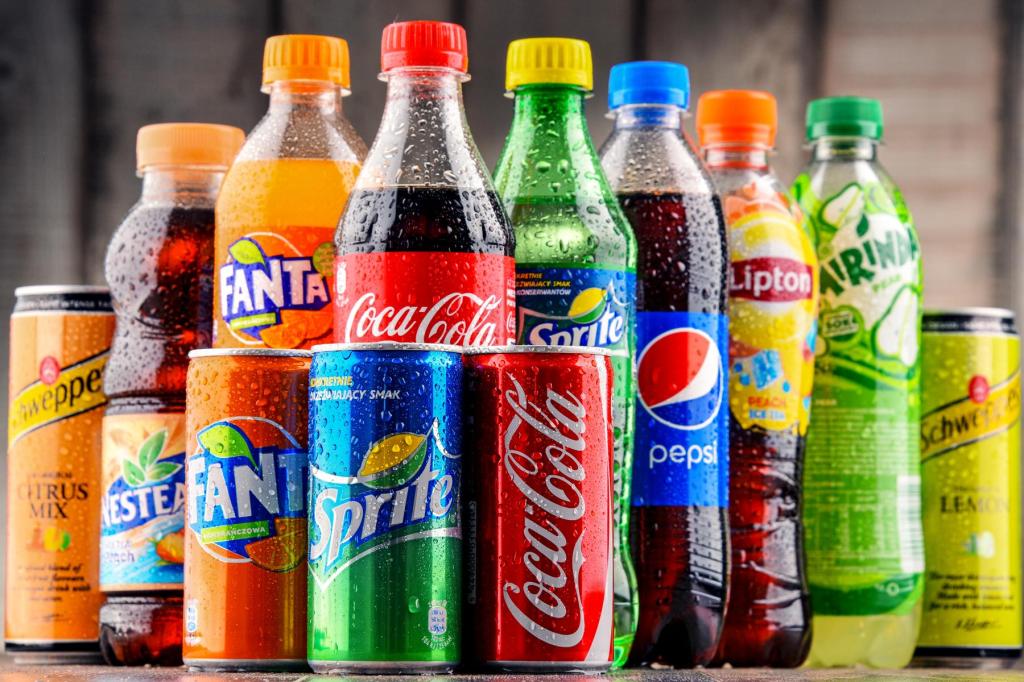
The Many Varieties of Sugar Water

Every time I visit the supermarket, I am amazed by the large variety of sugary drinks, both carbonated and non, and the high price of same. Every so often, I get suckered in to try one, but usually find myself disappointed.

When I travel in Latin America, my usual beverage of choice at restaurants is agua mineral con gas, which is widely available and doesn’t cost much. For some reason, in the United States the beverages are much more expensive, and not always so tasty. I’ve always wondered why this is so.

That’s why at home I usually drink either iced water or my own iced tea, which consists of what remains in my cheap Japanese metal teapot after my breakfast hot tea. Right now, it’s Darjeeling, which makes it much higher quality than the bottled iced teas on the supermarket shelves, and unsweetened to boot. (I am diabetic, so have reason to cut back on sugar at every opportunity.)

As a result, my grocery bill is light on beverages, except for Martine’s low fat milk and distilled water. On the other hand, when I see other supermarket patrons, their carts are loaded down with alcoholic beverages and sweet fizzy water. (For me, the predominant item consists of fruits and vegetables.)

It took many years to switch from the inevitable Coke or Ginger Ale to what I am drinking today. Fortunately, as a result, my blood sugar is manageable, and, I think, my health overall is better.

To Ensenada for Tacos

Doña Sabina of La Guerrerense in Ensenada

An hour south of the Mexican border is the city of Ensenada, which along with Tijuana and several other locations in Baja California has become a foodie hotbed. And we’re not talking sit-down restaurants with white tablecloths and snooty sommeliers, but food stands where crowds of standees munch on world-class Mexican food. Ensenada is famous for having invented the fish taco and the margarita; and Tijuana is home of the Caesar Salad.

In September, my brother and I will drive to Ensenada for a few days and indulge in some serious street grunting. To get an idea of what that might be like, check out this video from Anthony Bourdain’s “Parts Unknown” show:

The little lady in both the photo and the video is Doña Sabina Bandera, whose stand—““La Guerrerense”—is famous for seafood tostadas. In fact, Bourdain called it the best street food purveyor in the world.

I have long felt that something interesting is going on in the Mexican food scene, especially in those parts of Baja so close to Alta California. It will be fun to have some of the best seafood dishes on the continent, and not have to pay a king’s ransom for the privilege.

Currying Flavor

A Vegetarian Curry

The biggest change in my diet since the Covid lockdown has been my growing preference for cooking vegetarian curries. This has dismayed Martine, as she is a confirmed avivore, especially of chicken and turkey. Before, I have been cooking various pasta and rice dishes with ground turkey; but of late, I have tended to avoid ground meat.

Although I have always like curries, my preference has always been for vegetarian curries. That could be the influence of my old friend Mohan Gopalakrishnan, a Brahmin, but I have always thought that Indian cuisine has by far the tastiest vegetarian recipes. It has gotten to the point that I disdain bland American vegetarian dishes. (There are, however, a few Hungarian vegetarian dishes that I’ve always loved.)

Today I cooked up a potato, cauliflower, tomato, and pea curry with a diced-up Serrano chile. To jack up the hotness, I added a little super-hot Indian chile powder. To cool down the dish slightly, I served it with mango chutney and some plain yogurt.

The spices used include black mustard seeds, cumin seeds, turmeric, and garam masala (which is mostly cardamom). The great thing about Indian cuisine is that you can vary the spices and consequently the flavor quite easily. Of course, it helps to have an Indian food store nearby. I usually go to India Sweets and Spices in Culver City. They also have a very decent lunch counter which I patronize regularly.

Going Vegetarian With Style

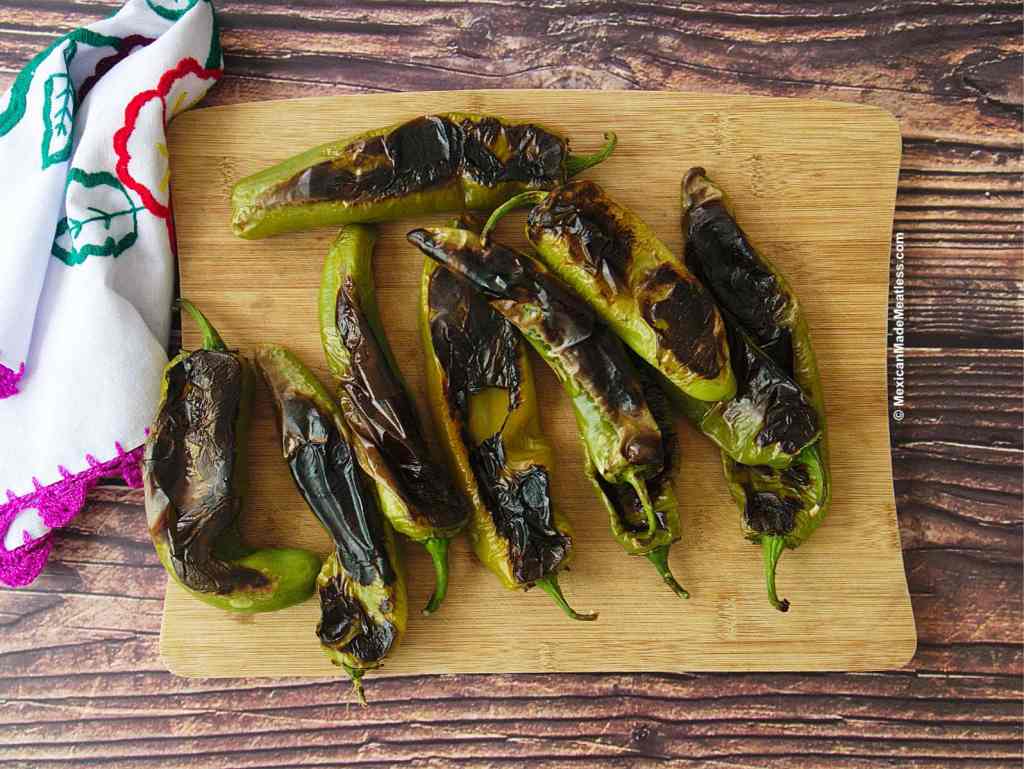
You Start by Fire-Roasting Hatch or Ancho Chiles…

I think that if you are seriously interested in going vegetarian, you should avoid bland vegetarian dishes altogether. That’s why I think that most American vegetarian recipes are yuck.

Of late, I have been working on a Spanish rice recipe that is inspired by three sources:

  • Rice-a-Roni Spanish Rice, combining rice with vermicelli
  • Mexican dishes based on fire-roasted chiles
  • My Mom’s unbearably hot home Hungarian lecso, or tomato and pepper stew (unbearable because I was only a kid at the time)

Here are the steps to making my Spanish Rice recipe:

  1. Get two or more Hatch or Ancho or California or Pueblo chiles. They are about six inches long. Fire roast them until the skin is black and blistered, as in the above photo. Lay them aside to cool.
  2. Toss a half handful of vermicelli or fideo noodles in a pan with olive oil and heat until they turn dark brown. Lay them aside. Pieces should be 1/2 to 3/4 inches in length.
  3. In a large pot with cover, add about a quarter cup of olive oil and begin to heat (medium).
  4. Peel and chop one Spanish onion and add.
  5. Using a small sharp knife, trim the blistered skin from the chiles you have fire roasted. Chop them and add to the onions.
  6. Crush six (yes, six!) cloves of garlic and add to the onions and chile.
  7. Add one cup of long grain rice (I use Trader Joe’s Jasmine Rice) to the mixture and stir for a couple of minutes.
  8. Chop up a pound of ripe, fresh tomatoes and add to the rice. I like Campari Tomatoes for this.
  9. Add the browned vermicelli noodles at this point.
  10. Add salt and pepper to taste.
  11. Add one can of chicken (or vegetable) stock and about 3/4 cup of water.
  12. Lower heat and cover.
  13. When most of the liquid has been absorbed, chop one can of pitted black olives roughly and add to the rice mix. Stir to prevent burning from the bottom.

And that’s pretty much it. The fire-roasted chiles give this dish a nice background burn. If you’re a real chile-head, you can also add a Jalapeño or Serrano chile for an added foreground burn. Yow!

I’m still playing with this recipe, so you may hear more from me about this.

Bad Food

Want to Live a Short Life?

If one looks at what Americans eat, it’s easy to be pessimistic about their health. Scads of fatty fast foods kept on the edge of acceptability by strange petrochemicals, gallons of super-sweet brightly colored beverages, loads of sugar and salt in everything—it’s not a happy prospect.

On Memorial Day weekend, Martine and I went to a Greek festival in the San Fernando Valley. We were shocked to find that, within a short few years, the ability of the church kitchen volunteers to produce good Greek food has declined precipitately. I’ve always loved fried calamari, but what I got was super thin slices of calamari with heavy, slightly burnt breading.

Go to the supermarket, and you will find whole aisles of what purports to be food and is all to frequently of low or no nutritional value. And that is what tends to predominate in the shopping carts of the people in line in front of me. It appears that more and more people are buying prepared food and not bothering to put ingredients together in the kitchen and cook them.

I think that the Covid epidemic is partly responsible. Curiously, it had the opposite effect on me. I started cooking more—and enjoying it more! The only unfortunate thing is that Martine and I are heading in different directions insofar as food is concerned. No matter, I think it’s important to compromise so that, in the long haul, we both get what we want.

The Paprika Connection

Otto’s Hungarian Deli in Burbank

Things were starting to get serious. I was running out of Hungarian paprika, and my supplier of füstölt kolbász (smoked Hungarian sausage) had gone out of business months ago. Normally, I am not a big fan of what I call Eurochow, but in the case of Hungarian cuisine I make an exception.

In Greek mythology, there is a character named Antaeus, who would “challenge all passers-by to wrestling matches and remained invincible as long as he remained in contact with his mother, the earth.” Likewise, I have to remain in contact with my Hungarian roots. Plus, unlike me, Martine is a hardened carnivore; and Hungarian cuisine is definitely a cuisine for carnivores.

On Saturday, Martine and I drove out to Burbank, where, in the middle of a residential block, sits Otto’s Hungarian Import Store and Deli. We used to go there more frequently, but lately Martine has been reluctant to go on long drives due to a pinched nerve in her back.

Fortunately, Otto’s had some good kolbász and big jars of Szegedi and Kalocsai sweet Hungarian paprika. And since Martine had been such a good sport about coming along, I got her some dobos torte and dios baigli.

South and West

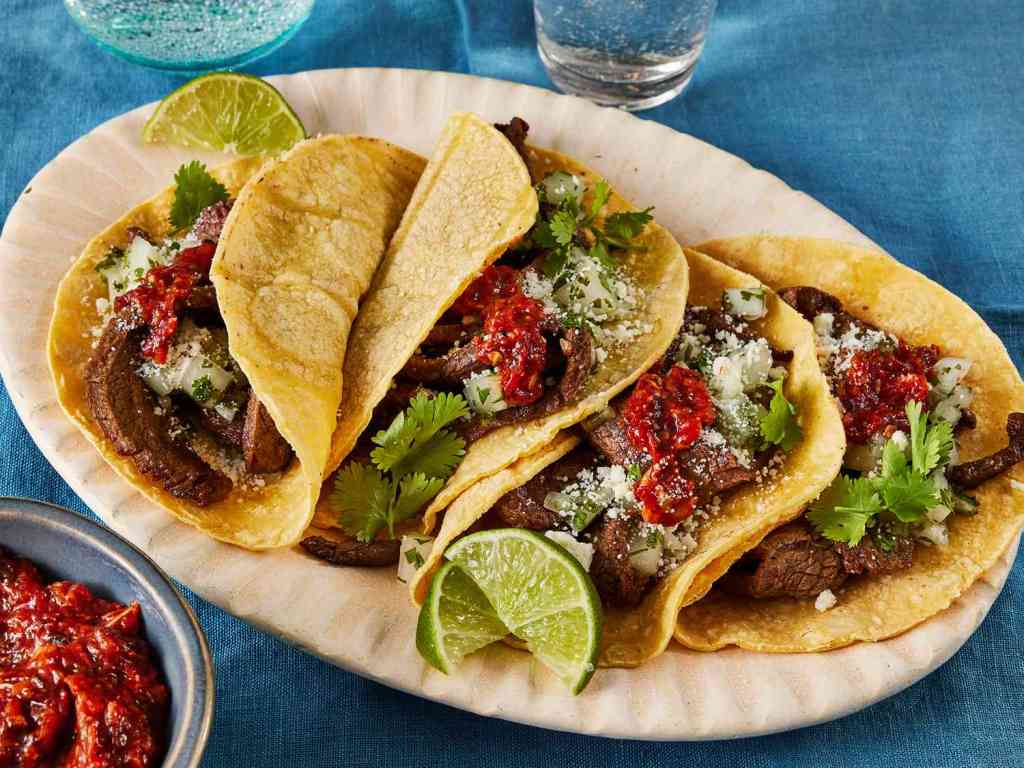
Plate of Tacos

Believe it or not, I first tasted Mexican food at the Mexico Pavilion of the 1964-1965 New York World’s Fair. The whole family had come to the Big Apple from Cleveland to help me decide where to go for graduate school. I was examining two possibilities: New York University (NYU) in Manhattan and UCLA in Los Angeles.

NYU turned out to be a complete washout. I talked to Professor Haig P. Manoogian of the NYU Film Department who did his best to convince me not to apply. Later, when I found that Martin Scorsese dedicated his film Raging Bull to Manoogian, all I could do was shrug my shoulders and blow a raspberry.

The taco that I ate at the World’s Fair was more of an indicator of where I was headed. From a childhood in Cleveland and four years of college in New Hampshire, I was headed south and west to UCLA. During the summer before my start at UCLA, I experimented with Mexican frozen food meals that were incredibly mediocre and inauthentic.

It did not take long for me to eat the real autentico item. When I was living in Santa Monica, I would have many a dinner at Castillo’s, a Mexican steam table deli on Wilshire Boulevard with a very cute server.

My tastes in food continues to go south and west: south to Mexico, and west to China, Japan, and India. Even today, I do not go much for Euro/American chow with its neatly separated meat, potato, and cooked vegetable (the exception being the Hungarian food of my youth, which I still love).

Today, I ate lunch after an early afternoon doctor appointment. I went to Kalaveras in Marina Del Rey and had a couple of carnita tacos and a bottle of draft Modelo beer. It was just what I needed, and it set me to thinking of my history with Mexican food.

American Glop

Does It Need Dipping Sauce Because It’s Dry and Tasteless?

I’m grateful that I was not raised on American food. My mother and great grandmother were superb cooks in the Hungarian tradition. Although as a smaller child I loved hot dogs and hamburgers, I found myself increasingly drawn to food that had real flavor.

Real food is prepared with spices. And not just catsup. I cannot understand why American hamburgers are just meat. My mother mixed ground beef with ground pork, and then added egg, bread, minced onions, garlic, and parsley. We called it fasirt or schnitzli. They were good hot or cold and made great leftovers.

Compare it with the typical American fast food hamburgers. Oh, you’ll probably need a “dipping sauce” consisting of a mixture of warmed-up fat, catsup, and sugar to make it palatable.

If your dish requires a dipping sauce, it’s because the cook did not know how to season the dish. That’s also why hamburgers are often served with some sort of thousand island dressing, because they are not otherwise moist or tasty.

And I’m not just talking about hamburgers, either. Most American food tastes unappetizing and bland to me. I suppose you’d like it only if you were raised on Cheerios until you reached the age of twenty-one. Living in Los Angeles, I would rather go to a good Asian or Latin-American restaurant rather than one of the standard fast food chains. You can get real food there, and it will have flavor.

Spanish Barley

Sort of What My Recipe for Spanish Barley Looked Like

Although I am tending more and more toward a non-Vegan vegetarianism, I have always thought that most American vegetarian cooking is totally blah. I take my cue from Indian cuisine, which is not afraid of strong flavors. The basic recipe I used can be found at GoBarley.Com.

I followed the recipe, but with two additions and two substitutions. At this time of year, one can buy Hatch chiles from New Mexico at a good price. I fire-roasted two chiles and peeled off the blistered skin. Then I chopped up the chiles and added it to the recipe.

Instead of diced low-sodium canned tomatoes, I used eight fresh Roma tomatoes which I chopped. Then, in place of plain paprika, I used smoked paprika to give it additional flavor.

Finally, when I served the barley, I added some Fly by Jing Sichuan Chili Crisp, which I described in an earlier post.

Americans are not used to cooking barley as if it were rice, but there are a number of advantages. First of all, it is far better for someone with Type 2 Diabetes to eat grains with a higher percentage of fiber to carbohydrates. One cup of long-grain white rice has 9% of the daily value of fiber, but 54% of the daily value of carbs. Compare that to raw pearled barley: a cup of barley contains 111% of the daily value of fiber compared to 56% of the daily value of carbohydrates.

Foods that are rich in fiber compared to carbohydrates tend not to overload the pancreas. It’s sort of like a mechanism to time-release carbs to the body rather than bomb the pancreas.

Oh, and it also tastes really great. More chewy than rice, but every bit as good if not better.

A Nice Burn

A Sichuan Seasoning That Will Set You on Fire

My brother and I are well-known fire-eaters. Most of the meals I prepare for myself (but not Martine!) are off the charts when it comes to hotness for most of my friends.

It all started when I went on my first vacation to Mexico in 1975 and discovered El Diablito Chile Habanero. There I was in a hot country with smoke pouring out of my ears—and loving every minute of it! After discovering Marie Sharp’s Chile Habanero from Dangriga, Belize in 2019, I thought I had the perfect picante sauce.

Then my brother introduced me to Fly by Jing Sichuan Chili Crisp (illustrated above), which not only has the perfect burn but actually adds flavor. In the last few weeks, I have experimented with Spanish Rice and Spanish Barley, both seasoned with Fly by Jing. Not only was I sold, but I ordered a couple more bottles from Amazon for when my first bottle goes empty (which should be in about a week).

Interestingly, the chili crisps are made with Chinese ingredients originating in Chengdu by a Chinese-American living in Los Angeles. Her name, BTW, is Jing.