Bad Food

Want to Live a Short Life?

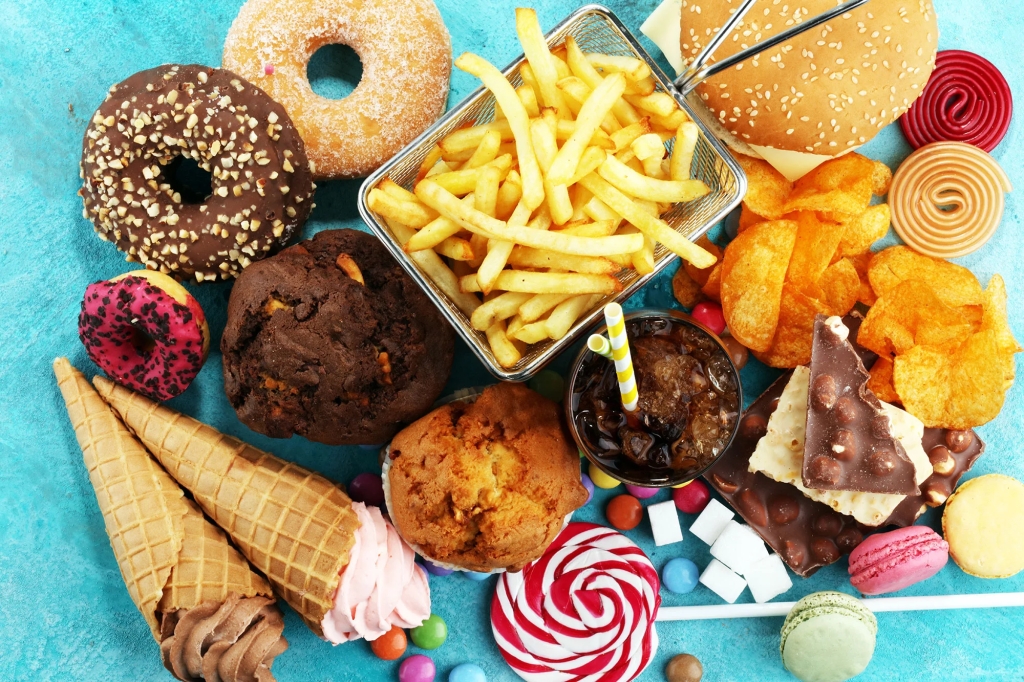
If one looks at what Americans eat, it’s easy to be pessimistic about their health. Scads of fatty fast foods kept on the edge of acceptability by strange petrochemicals, gallons of super-sweet brightly colored beverages, loads of sugar and salt in everything—it’s not a happy prospect.

On Memorial Day weekend, Martine and I went to a Greek festival in the San Fernando Valley. We were shocked to find that, within a short few years, the ability of the church kitchen volunteers to produce good Greek food has declined precipitately. I’ve always loved fried calamari, but what I got was super thin slices of calamari with heavy, slightly burnt breading.

Go to the supermarket, and you will find whole aisles of what purports to be food and is all to frequently of low or no nutritional value. And that is what tends to predominate in the shopping carts of the people in line in front of me. It appears that more and more people are buying prepared food and not bothering to put ingredients together in the kitchen and cook them.

I think that the Covid epidemic is partly responsible. Curiously, it had the opposite effect on me. I started cooking more—and enjoying it more! The only unfortunate thing is that Martine and I are heading in different directions insofar as food is concerned. No matter, I think it’s important to compromise so that, in the long haul, we both get what we want.

The Paprika Connection

Otto’s Hungarian Deli in Burbank

Things were starting to get serious. I was running out of Hungarian paprika, and my supplier of füstölt kolbász (smoked Hungarian sausage) had gone out of business months ago. Normally, I am not a big fan of what I call Eurochow, but in the case of Hungarian cuisine I make an exception.

In Greek mythology, there is a character named Antaeus, who would “challenge all passers-by to wrestling matches and remained invincible as long as he remained in contact with his mother, the earth.” Likewise, I have to remain in contact with my Hungarian roots. Plus, unlike me, Martine is a hardened carnivore; and Hungarian cuisine is definitely a cuisine for carnivores.

On Saturday, Martine and I drove out to Burbank, where, in the middle of a residential block, sits Otto’s Hungarian Import Store and Deli. We used to go there more frequently, but lately Martine has been reluctant to go on long drives due to a pinched nerve in her back.

Fortunately, Otto’s had some good kolbász and big jars of Szegedi and Kalocsai sweet Hungarian paprika. And since Martine had been such a good sport about coming along, I got her some dobos torte and dios baigli.

South and West

Plate of Tacos

Believe it or not, I first tasted Mexican food at the Mexico Pavilion of the 1964-1965 New York World’s Fair. The whole family had come to the Big Apple from Cleveland to help me decide where to go for graduate school. I was examining two possibilities: New York University (NYU) in Manhattan and UCLA in Los Angeles.

NYU turned out to be a complete washout. I talked to Professor Haig P. Manoogian of the NYU Film Department who did his best to convince me not to apply. Later, when I found that Martin Scorsese dedicated his film Raging Bull to Manoogian, all I could do was shrug my shoulders and blow a raspberry.

The taco that I ate at the World’s Fair was more of an indicator of where I was headed. From a childhood in Cleveland and four years of college in New Hampshire, I was headed south and west to UCLA. During the summer before my start at UCLA, I experimented with Mexican frozen food meals that were incredibly mediocre and inauthentic.

It did not take long for me to eat the real autentico item. When I was living in Santa Monica, I would have many a dinner at Castillo’s, a Mexican steam table deli on Wilshire Boulevard with a very cute server.

My tastes in food continues to go south and west: south to Mexico, and west to China, Japan, and India. Even today, I do not go much for Euro/American chow with its neatly separated meat, potato, and cooked vegetable (the exception being the Hungarian food of my youth, which I still love).

Today, I ate lunch after an early afternoon doctor appointment. I went to Kalaveras in Marina Del Rey and had a couple of carnita tacos and a bottle of draft Modelo beer. It was just what I needed, and it set me to thinking of my history with Mexican food.

American Glop

Does It Need Dipping Sauce Because It’s Dry and Tasteless?

I’m grateful that I was not raised on American food. My mother and great grandmother were superb cooks in the Hungarian tradition. Although as a smaller child I loved hot dogs and hamburgers, I found myself increasingly drawn to food that had real flavor.

Real food is prepared with spices. And not just catsup. I cannot understand why American hamburgers are just meat. My mother mixed ground beef with ground pork, and then added egg, bread, minced onions, garlic, and parsley. We called it fasirt or schnitzli. They were good hot or cold and made great leftovers.

Compare it with the typical American fast food hamburgers. Oh, you’ll probably need a “dipping sauce” consisting of a mixture of warmed-up fat, catsup, and sugar to make it palatable.

If your dish requires a dipping sauce, it’s because the cook did not know how to season the dish. That’s also why hamburgers are often served with some sort of thousand island dressing, because they are not otherwise moist or tasty.

And I’m not just talking about hamburgers, either. Most American food tastes unappetizing and bland to me. I suppose you’d like it only if you were raised on Cheerios until you reached the age of twenty-one. Living in Los Angeles, I would rather go to a good Asian or Latin-American restaurant rather than one of the standard fast food chains. You can get real food there, and it will have flavor.

Spanish Barley

Sort of What My Recipe for Spanish Barley Looked Like

Although I am tending more and more toward a non-Vegan vegetarianism, I have always thought that most American vegetarian cooking is totally blah. I take my cue from Indian cuisine, which is not afraid of strong flavors. The basic recipe I used can be found at GoBarley.Com.

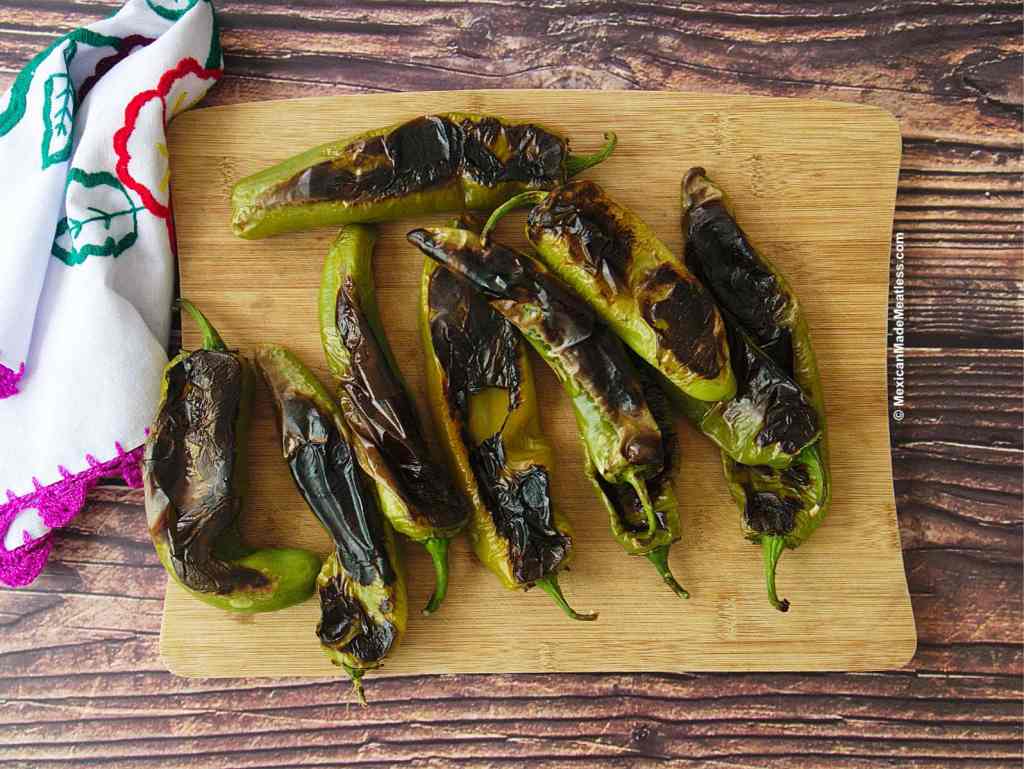
I followed the recipe, but with two additions and two substitutions. At this time of year, one can buy Hatch chiles from New Mexico at a good price. I fire-roasted two chiles and peeled off the blistered skin. Then I chopped up the chiles and added it to the recipe.

Instead of diced low-sodium canned tomatoes, I used eight fresh Roma tomatoes which I chopped. Then, in place of plain paprika, I used smoked paprika to give it additional flavor.

Finally, when I served the barley, I added some Fly by Jing Sichuan Chili Crisp, which I described in an earlier post.

Americans are not used to cooking barley as if it were rice, but there are a number of advantages. First of all, it is far better for someone with Type 2 Diabetes to eat grains with a higher percentage of fiber to carbohydrates. One cup of long-grain white rice has 9% of the daily value of fiber, but 54% of the daily value of carbs. Compare that to raw pearled barley: a cup of barley contains 111% of the daily value of fiber compared to 56% of the daily value of carbohydrates.

Foods that are rich in fiber compared to carbohydrates tend not to overload the pancreas. It’s sort of like a mechanism to time-release carbs to the body rather than bomb the pancreas.

Oh, and it also tastes really great. More chewy than rice, but every bit as good if not better.

A Nice Burn

A Sichuan Seasoning That Will Set You on Fire

My brother and I are well-known fire-eaters. Most of the meals I prepare for myself (but not Martine!) are off the charts when it comes to hotness for most of my friends.

It all started when I went on my first vacation to Mexico in 1975 and discovered El Diablito Chile Habanero. There I was in a hot country with smoke pouring out of my ears—and loving every minute of it! After discovering Marie Sharp’s Chile Habanero from Dangriga, Belize in 2019, I thought I had the perfect picante sauce.

Then my brother introduced me to Fly by Jing Sichuan Chili Crisp (illustrated above), which not only has the perfect burn but actually adds flavor. In the last few weeks, I have experimented with Spanish Rice and Spanish Barley, both seasoned with Fly by Jing. Not only was I sold, but I ordered a couple more bottles from Amazon for when my first bottle goes empty (which should be in about a week).

Interestingly, the chili crisps are made with Chinese ingredients originating in Chengdu by a Chinese-American living in Los Angeles. Her name, BTW, is Jing.

In Praise of Tacos

Tacos al Pastor from King Tacos

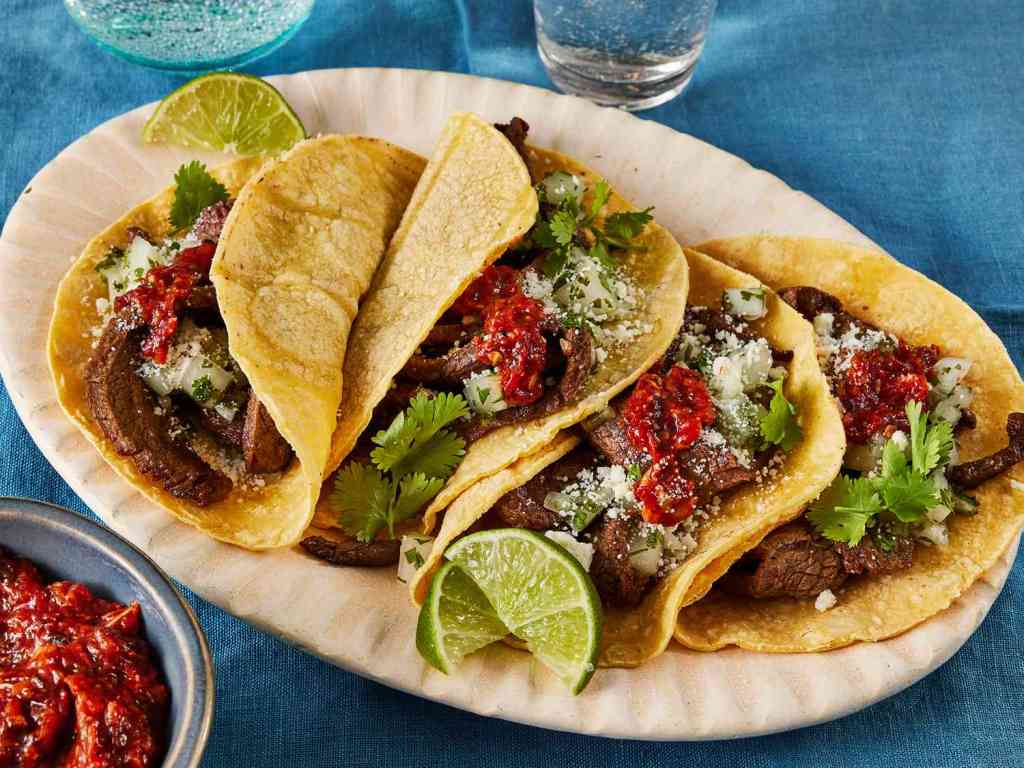
Tacos come in two basic varieties. There are the hard shell tacos which disintegrate the moment you put your hands on them; and there are the soft shell tacos, usually made with corn tortillas, which you can pinch without having a mess in your lap. I suppose there are soft shell flour tortillas in places like Northwest Mexico, but they are infrequently found across el border.

Today I drove Martine to Lakewood for an appointment with her ophthalmologist. On the way, I noticed there was a King Tacos on Lakewood Boulevard just south of Alondra, and a light suddenly went on in my memory. About twenty or thirty years ago, I attended an L.A. Galaxy professional soccer game at the Rose Bowl. While there, I bought several tacos from the concessionaire, who was King Tacos. I remember really liking them, but I had not been to any of the low rent parts of town where branches of King Tacos tend to congregate … until today.

I had three tacos el pastor with a Diet Pepsi, which I enjoyed mightily. There is something about Mexican antojitos (“little whimsies”) which help make Mexican cuisine one of the great world cuisines—and that’s before even figuring in some regional variants as Oaxácan and Yucatec cuisines.

I shall make it a point to return to King Tacos again. Still great after so many years!

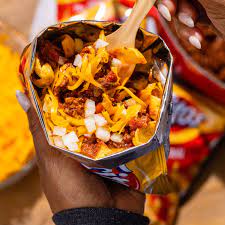
Frito Pies

This Is the Way It Looked When I First Ate One

The first time I ate a Frito Pie, it looked like the above photo, and it was purchased from where it was invented, a lunch counter in Santa Fe, New Mexico.

The second time was today. I cooked it myself from this recipe. As I made it to please Martine, the finickiest of all eaters, there was no way I could add raw onions as a garnish. And I used a mild La Victoria Red Enchilada sauce, even though my preferences is for spicy hot dishes. I second the recommendation of using Ranch House canned beans, as they go very well with this recipe. Oh, and I recommend extra sharp cheddar cheese. By the way, don’t use any other chips other than original recipe Fritos: That’s why it’s called Frito Pie.

Tomorrow, I will serve the leftovers with cut up fresh avocado. It’s not in the recipe, but I think it would go well with it.

One Word: Plastic

Do We Eat a Credit Card Worth of Plastic Every Week?

In 2019, the World Wildlife Fund quoted research from the University of Newcastle, Australia, to the effect that all of us eat a credit card worth of plastic in our food every week. I have heard the expression that you have to eat a peck of dirt before you die, but this is ridiculous. I read an article entitled “No, you don’t eat a credit card worth of plastic every week. But you still swallow a lot of it” on Salon.Com.

Although plastics of various sorts have been around for decades, they have not been studied as intensively as they deserve to be. After all, we as a people tend to be early adopters of convenient new technologies. It is only later that the grim news hits the streets.

It’s the same with cell phones. There have been arguments pro and con about the phones causing brain cancer, but it is very likely that there are other ill effects that will not come out for years. Back in the mid 1980s, I was involved selling demographic data for telephone service providers to be used in deciding where to erect cell phone towers. Now I feel somewhat guilty about my participation in this effort.

Getting back to plastics, an article in the journal Environmental Health Perspectives stated:

Current estimates suggest that over 10,000 unique chemicals are linked to chemical manufacturing, many with unknown health effects and others identified as chemicals of concern. With such a large number of chemicals, it is very challenging to identify the key exposures we should be measuring to study health impacts of microplastics, as well as understanding their levels in humans.

Dr. Shanna Swan, a professor of environmental medicine and public health at Mount Sinai School of Medicine in New York City, has documented plummeting human sperm counts possibly being affected by widespread plastic pollution: “I think it is important to note that micro and nanoplastics (MNPs) can increase the body burden of the previously recognized — and often studied — chemicals in plastic (most notably phthalates, bisphenols, parabens etc.).”

I suppose we’ll find out the whole truth eventually, but not before the human species has been irretrievably changed by the prevalence of plastics in our environment and our food.

The Tea Drinker

Iced Tea with Lemon

For many years now, I have begun each morning making a pot of Indian black tea, which I drink with a bit of honey (usually Mexican mesquite honey) and a squeeze of lime. By afternoon, what remains in the pot becomes iced tea—up to three glasses full. I try not to drink the entire contents of the pot every day, because tea acts as a diuretic. But in hot weather, I violate this rule of thumb.

Usually, I drink my iced tea without anything added. Sometimes, especially when there is company, I will fill a pitcher with iced tea and add artificial sweetener, the juice of a whole lemon, and a jigger of high quality dark rum, preferably Ron Zacapa Edición Negra from Guatemala or Myers’s Original Dark Rum from Jamaica. The rum is for flavor only and is not enough for intoxication.

My mother has told me that, as a baby, I used to sip from her coffee. Now I will not touch coffee, and do not even like coffee-flavored ice creams or candies. And when it comes to carbonated sodas, I rarely drink more than one glass every couple of weeks, usually at a restaurant.

That doesn’t quite make me a man of one beverage, but it comes close. I also like unsweetened mineral water, fruit juices, tomato juice, and lemonade. Put everything else I drink against hot and iced tea, however, and the tea I drink outweighs all my other options, except maybe for plain water, and that only during heat waves. (Too much tea, and I pretty much have to live in the bathroom.)

What is it about Indian black tea that appeals to me so much? It’s difficult o find the exact words, but good tea has a clarity of flavor that satisfies without causing satiety. For years, I have been buying Ahmad of London loose teas by the pound, usually:

  • Darjeeling, the best Indian black tea
  • Ceylon from Sri Lanka
  • Assam, Baruti and Ghalami varieties mostly in cold weather

Occasionally, when traveling, I will drink an English Breakfast or Irish Breakfast tea from tea bags. In Asian restaurants, I drink end enjoy green tea. But thank you, no Earl Grey please!