“A Man of Great Personal Integrity”

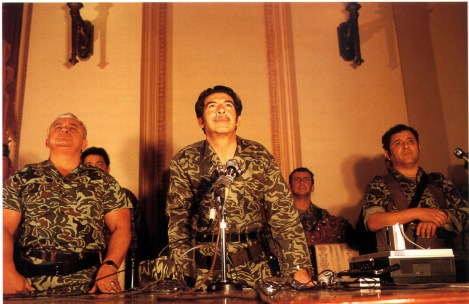
Efrain Rios Montt and Henchmen

Efrain Rios Montt and Henchmen

For many years, between 1975 and 1992, I traveled across Southern Mexico in search of Mayan ruins. Friends have asked me whether I have seen the ruins at Tikal in Guatemala, but all I could do was sadly shake my head. The closest I came to Guatemala was the Mexican State of Quintana Roo on the Yucatán Peninsula. I would dearly love to have crossed the border into Belize, and from there proceeded to Tikal, but it was not to be. The reason was the ugly stories filtering across the border of massacres, torture, rape, and genocide, especially of the native Mayan population. The perpetrator? One Efrain Rios Montt (pictured in the center above), who had staged a rightist coup in 1982.

It was only when President Ronald Reagan called Rios Montt “a man of great personal integrity” who had been given a “bum rap” as a human rights abuser when I knew that we were dealing here with a world-class criminal rat. Out of a population of some seven million in 1980, Rios Montt and his death squads were responsible for some 200,000 extra-judicial murders in Guatemala, “the land of the eternal spring.” Over a million natives fled the country for safety in the United States and elsewhere. Yet the Reagan administration continued to support the man and offer him aid.

In 2012, Rios Montt was charged with genocide and was convicted. But then his daughter Zury warned other of the nation’s leaders that, if Rios Montt served any time, they would be next. The verdict was repudiated by the Constitutional Court, and Rios walked a free man. The people of Guatemala are still trying, however, to have him called to account for his crimes against his people, either at home or at The Hague. Rios might be in his eighties, but he should not be allowed to die as a free man.

Sea Legs

Commandant Louis Joseph Lahure has a singular distinction in military history — he defeated a navy on horseback.  Occupying Holland in January 1795, the French continental army learned that the mighty Dutch navy had been frozen into the ice around Texel Island. So Lahure and 128 men simply rode up to it and demanded surrender. No shots were fired.

Quick Quote from Futility Closet

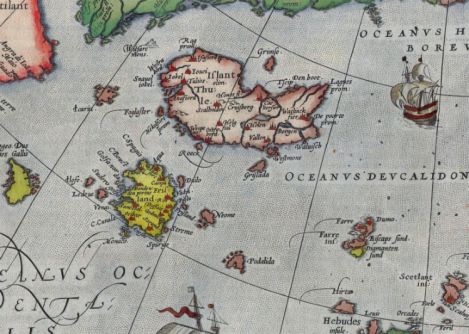
Where on Earth Is Frisland?

It Looks As If It Is South of Iceland

It Looks As If It Is South of Iceland

Until late in the Sixteenth Century, maps of Europe had a largish island called Frisland (also called Frischlant, Friesland, Frislandia, or Fixland) situated south of Iceland. It is thought that an Italian mapmaker named Nicolo Zeno was first responsible for the placement of the imaginary island on his charts in 1558. Then, in 1573, the Fleming Abraham Ortelius picked it up for his maps, followed by Gerard Mercator (he of the projection) of Duisburg. In 1576, Martin Frobischer thought he was in Frisland when, actually, he had overshot it and found himself in Greenland.

I am indebted to Benedikt Jóhannesson of the Iceland Review for turning me on to this existence of this cartographic canard. I remember standing on the farthest southern point of the Westmann Islands in Iceland and looking south. I saw quite a few small, rather volcanic rocks to the south—but nothing as large as Frisland is represented to be. Perhaps it’s the original Fantasy Island.

Curiously, this part of the ocean lies along the Mid-Atlantic Ridge. There have been volcanic islands that arose from the bottom of the sea, only to subside or be eroded away after the eruption that created them spent its fury. Perhaps someone reported some such island—though no way that large—and some mapmakers picked it up and embellished it a bit. A good example of such an island is Ferdinandea, between Sicily and Tunisia, which appeared and disappeared several times. It lasted long enough for several countries in the Nineteenth Century to dispute its ownership.

“Vive Boulanger! Vive la France!”

General Georges Boulanger, “The man on Horseback”

General Georges Boulanger, “The Man on Horseback”

The period between the Revolution and the First World War in France is virtually unknown to the Anglo-American world.I am currently reading Frederick Brown’s For the Soul of France: Culture Wars in the Age of Dreyfus. It is an excellent book that has helped me to “connect the dots” from French literature and films. For instance, I knew about France’s humiliation at the hands of the German army in the Franco-Prussian War of 1870, in which it lost the provinces of Alsace and Lorraine. I knew about the Commune and its destruction at the hands of Adolph Thiers’s government at Versailles. What I did not know was that France was left a deeply divided country. On one hand stood Paris and the larger cities; on the other, La France Profonde, what we in America would refer to as “The Heartland” or “Flyover Country.”

It was a period reminiscent of 21st century America, with its war between religion and liberalism—except in France, religion meant the Catholic Church. Liberalism was associated with those Commie Communards who were shot to death by the French army at the Mur des Fédérés at Paris’s Père Lachaise Cemetery. As the 1870s shaded into the 1880s, Paris was not unlike present-day Washington in its seemingly irreconcilable divisions.

At this time, there arose a would-be Messiah, General Georges Boulanger, “The Man on Horseback,” beyond whom many of the irreconcilables were mysteriously reconciled. As Maurice Barrès said, “The important thing about popular heroes is not so much their own intentions but the picture of them that people create in their own minds.”

It is not that Boulanger had an undistinguished military career. He fought successfully in Algeria, Tunisia, Viet Nam, and Italy. He was wounded (and addicted to the morphine used to relieve him from the pain). And he enjoyed the adulation of crowds. As Frederick Brown writes:

While Boulanger marked time, Boulangism marched forward and continued to raise alarms. Jules Ferry, who understood the revolutionary impetu of revanchism in what was becoming a widespread movement, deplored its brutish character. “For some time we have been witnessing the development of a species of patriotism hitherto unknown in France,“ Ferry declared. “It is a noisy despicable creed that seeks not to unify and appease but to set citizens against one another…. If one believes its spokesmen, love of country belongs to one party alone, or to one sect within that party, and all who do not think as they do, who would not wish to substitute … the impulse of irresponsible crowds for the free and reflective action of public powers, all who do not worship their idols and trot alongside behind the the chariot … are all held indiscriminately to be partisans of the foreigner!”

How like our own time! We may not have a “Man on Horseback” to support, but the prevalent disgust at the divisions between left and right are, I feel, ripe for exploitation.

What ever happened to Boulanger? Although he seemed to be the coming thing, he was outmaneuvered politically by a nobody named Ernest Constans and forced to flee to Belgium. The charge was “plotting to subvert the legally constituted government.” From Belgium, Boulanger exiled himself to Saint-Hélier on the Isle of Jersey. When his wife Marguerite sickened and died, Boulanger blew his brains out in front of the headstone of her grave at Ixelles Cemetery in Brussels.

As one of his former adherents proclaimed, “General Boulanger didn’t deceive us. It was we who deceived ourselves. Boulangism is failed Bonapartism. To succeed, it needs a Bonaparte, and Boulanger as Bonaparte was a figment of our imagination.”

Isn’t that the way it always is?

Looking Out for Number Two

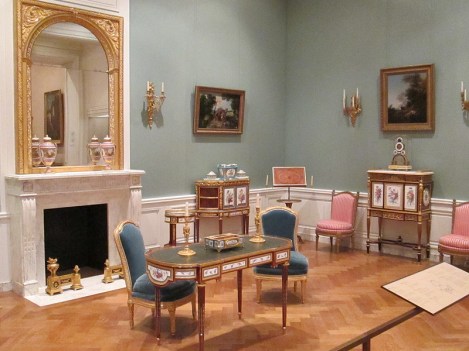
Elegance and—Yes!—Squalor

Elegance and—Yes!—Squalor

The galleries of 17th and 18th Century French furniture at the Getty Center are our favorite parts of their permanent collection. For one thing, they’re not as crowded as the galleries with paintings; for another, they let you take photographs. An elegant table or chair or cabinet can be just as much a work of art as a sculpture or an oil painting. It’s just that we are conditioned by our culture to regard fine art as something in oils on a canvas or wood backing. In fact, some of the furniture in the Getty incorporate small paintings on some of their panels.

Which brings me, by a commodius vicus of recirculation, to the Palace of Versailles in France. Imagine several miles of corridors with furniture such as pictured above, gorgeous drapes, halls with mirrors, paintings, gilded moldings, and in general the finest workmanship in all the fittings.

There was, however, one glaring exception: There were no bathrooms. Oh, the king, queen, and selected nobles had their own chaises percées which they could summon with a hand signal to one of their entourage. Anyone who was properly dressed (that meant a sword for you gentlemen, which could be rented from the palace concierge upon entry) would walk into the palace, wander into the King’s bedroom and watch him snuggle with his consort from behind a gold railing, and stroll through the grounds at his leisure.

But, being a mammal, there was always the chance that he or she would get “caught short.” When asking for the nearest restroom would get you nothing but disrespectful sniggers. According to one Internet source:

It’s difficult to believe today when gazing at the gleaming golden palace, but life at Versailles was actually quite dirty. There were no bathrooms as we would know them. Courtiers and royalty used decorative commodes in each room, while commoners simply relieved themselves in the hallways or stairwells. No one bothered to house-train the royal dogs, and servants did not consider cleaning up after them to be part of their job description. The constantly-altered chimneys did not draw well, so everything inside was covered with soot. The filth and disorder at Versailles during the ancient regime were noted in many records of the time.

So, imagine, if you will, what it was like to tour the palace being careful not to slip on another person’s bodily effluvia. Because it was considered beneath the monarch to concern himself with such trivial matters, it was not until 1715 that he ordered a weekly cleanup of the corridors by his servants. Imagine what it must have been like by then. Even today it’s a problem for tourists, according to one TripAdvisor report.

What a contrast between elegance and squalor!

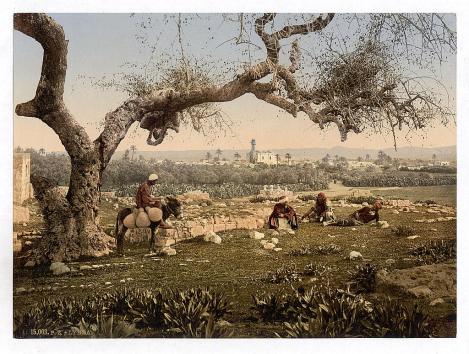
Lydda

The (Former) Palestinian City of Lydda

The (Former) Palestinian City of Lydda (ca. 1900)

It looks idyllic, doesn’t it? And it was, until 1948. At that point, the newly formed Israel Defense Forces expelled the inhabitants of this peaceful city in which Jews and Palestinians had lived side by side for generations. In an article for the New Yorker published in the October 21, 2013 issue entitled “Lydda, 1948,” Ari Shavit writes:

But, looking straight ahead at Lydda, I wonder if peace is possible. Our side is clear: we had to come into the Lydda Valley and we had to take the Lydda Valley. There is no other home for us, and there was no other way. But the Arabs’ side, the Palestinian side, is equally clear: they cannot forget Lydda and they cannot forgive us for Lydda. You can argue that it is not the occupation of 1967 that is at the core of the Israel-Palestinian conflict, but the tragedy of 1948. It’s not only the settlements that are an obstacle to peace but the Palestinians’ yearning to return, one way or another, to Lydda and to dozens of other small towns and villages that vanished during one cataclysmic year. But the Jewish State cannot let them return. Israel has a right to live, and if Israel is to live it cannot resolve the Lydda issue. What is needed to make peace now between the two peoples of this land may prove more than humans can summon.

I sit here in West Los Angeles, within hailing distance of the Gabrielino Indians’ shrine at Kuruvungna Springs on the grounds of the present-day University High School. In June and July of this year, I vacationed in Iceland, where a resurgent Viking population drove out the Irish monks that had originally settled the island. (Now there is no trace of their ever having done so.) If all goes well, my next vacation will be in Peru, where the Spanish looted and destroyed the Inca Empire. Their criollo descendants still control the economy and the political power, leaving the Andean serranos and jungle tribes near the headwaters of the Amazon as second-class citizens.

Unfortunately, with its burgeoning West Bank settlements, Israel is continuing the process it began in 1948 of squeezing out, to the maximum extent possible, the indigenous Palestinian population. I cannot condone Israel’s settlement policy, especially with its Likud Party racist underpinnings; but I cannot afford to be too absolute because I realize there is a faint trace of blood on my own hands and on those of my forebears.


A Most Unprepossessing Man

The Mouse That Conquered the Lions

The Mouse That Conquered the Lions

This is my last posting inspired by my reading of William H. Prescott’s The History of the Conquest of Peru, which I have just completed. After the Incas were conquered and Atahuallpa executed, there arose in Peru a civil war between the two partners of the enterprise, Francisco Pizarro and Diego de Almagro, and after these two were killed, between their families. Finally, Gonzalo Pizarro, Francisco’s brother, was firmly in power—or so he thought. There was still the Spanish crown with which to contend. Carlos V and later Philip II sent various representatives, some well chosen, some notoriously bad.

Finally, the Spanish cleric Pedro de la Gasca was sent with broad authority to put an end to the conflicts and to secure Peru to the crown. Where others failed, Gasca finally succeeded. While a most unprepossessing man, he had vast reserves of shrewdness and good judgment which enabled him to take down the last of the Pizarros and unite the people behind him:

After the dark and turbulent spirits with which we have been hitherto occupied, it is refreshing to dwell on a character like that of Gasca. In the long procession which has passed in review before us, we have seen only the mail-clad cavalier, brandishing his bloody lance, and mounted on his war-horse, riding over the helpless natives, or battling with his own friends and brothers; fierce, arrogant, and cruel, urged on by the lust of gold, or the scarce more honorable love of a bastard glory. Mingled with these qualities, indeed, we have seen sparkles of the chivalrous and romantic temper which belongs to the heroic age of Spain. But, with some honorable exceptions, it was the scum of her chivalry that resorted to Peru, and took service under the banner of the Pizarros. At the close of this long array of iron warriors, we behold the poor and humble missionary coming into the land on an errand of mercy, and everywhere proclaiming the glad tidings of peace. No warlike trumpet heralds his approach, nor is his course to be tracked by the groans of the wounded and the dying. The means he employs are in perfect harmony with his end. His weapons are argument and mild persuasion. It is the reason he would conquer, not the body. He wins his way by conviction, not by violence. It is a moral victory to which he aspires, more potent, and happily more permanent, than that of the blood-stained conqueror. As he thus calmly, and imperceptibly, as it were, comes to his great results, he may remind us of the slow, insensible manner in which Nature works out her great changes in the material world, that are to endure when the ravages of the hurricane are passed away and forgotten.

With the mission of Gasca terminates the history of the Conquest of Peru. The Conquest, indeed, strictly terminates with the suppression of the Peruvian revolt, when the strength, if not the spirit, of the Inca race was crushed for ever. The reader, however, might feel a natural curiosity to follow to its close the fate of the remarkable family who achieved the Conquest. Nor would the story of the invasion itself be complete without some account of the civil wars which grew out of it; which serve, moreover, as a moral commentary on preceding events, by showing that the indulgence of fierce, unbridled passions is sure to recoil, sooner or later, even in this life, on the heads of the guilty.

I find it interesting that the Bolivian stamp illustrated above honors Gasca and pokes fun at neighboring Peru, which had to be pacified by this mouse of a Spanish cleric.

The Conquistador

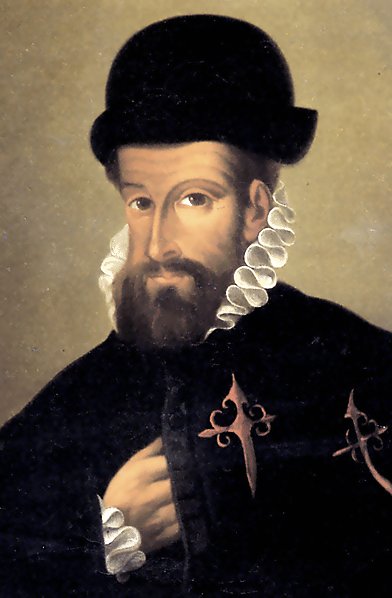
Francisco Pizarro (d. 1541)

Francisco Pizarro (d. 1541)

No one is quite sure when the great conquistador Francisco Pizarro was born. As he was a bastard, no one noted such niceties. He was raised to be a soldier—and he was a good one. But he was also illiterate, because no one took care that he learn to read and write, or to act the part of a gentleman. So he grew up a litle on the wild side, a man of great talents and a great destiny. With a handful of men, he destroyed an empire.

On this Columbus Day—a holiday which we are growing ever more abashed about celebrating without twinges of guilt—it is interesting to note the career of this man, who took on the mighty Inca empire, killed Atahuallpa, its leader, and sent vast treasures of gold and silver to his monarch across the Atlantic.

Pizarro founded cities, most especially Lima, enslaved the native Incas, acted at times with condign cruelty, and at other times with lightness and gentility. But, in the end, all was thrown into chaos by a partnership that failed. At the outset, he formed a compact with his fellow conquistador (and fellow bastard) Diego de Almagro. It was Pizarro, however, who seemed to get all the credit for the conquest from Charles V in Spain, who only belatedly recognized the one-eyed Almagro for his role in the conquest. In the meantime, envy had taken control; and Almagro wrested Cuzco from his partner. Francisco Pizarro’s brother Hernando defeated the rebel at Las Salinas, after which he had him tried, convicted, and executed by garroting.

The brief civil war did not have a clear victor, as, within three years, Francisco Pizarro, was assassinated by remnants of the Almagro faction in Lima. Finally, the Spanish had to step in to restore order.

In his magisterial History of the Conquest of Peru, William H. Prescott waxes lyrical about all the might-have-beens in the late conquistador’s life:

Nor can we fairly omit to notice, in extenuation of his errors, the circumstances of his early life; for, like Almagro, he was the son of sin and sorrow, early cast upon the world to seek his fortunes as he might. In his young and tender age he was to take the impression of those into whose society he was thrown. And when was it the lot of the needy outcast to fall into that of the wise and virtuous? His lot was cast among the licentious inmates of a camp, the school of rapine, whose only law was the sword, and who looked upon the wretched Indian as their rightful spoil.

Who does not shudder at the thought of what his own fate might have been, trained in such a school? The amount of crime does not necessarily show the criminality of the agent. History, indeed, is concerned with the former, that it may be recorded as a warning to mankind; but it is He alone who knoweth the heart, the strength of the temptation, and the means of resisting it, that can determine the measure of the guilt.

Contrast Pizarro with Cortés, who knew how to read and write and who was able to protect his own place in history with his writings after the conquest of the Aztecs. Nonetheless, it is interesting to note that in neither Mexico or Peru are there any monuments to the conquistadores who secured those lands for Spain.

To Each According to His Needs

Llama

Llama

A similar arrangement prevailed with respect to the different manufactures as to the agricultural products of the country. The flocks of llamas, or Peruvian sheep, were appropriated exclusively to the Sun and to the Inca. Their number was immense. They were scattered over the different provinces, chiefly in the colder regions of the country, where they were intrusted to the care of experienced shepherds, who conducted them to different pastures according to the change of season. A large number was every year sent to the capital for the consumption of the Court, and for the religious festivals and sacrifices. But these were only the males, as no female was allowed to be killed. The regulations for the care and breeding of these flocks were prescribed with the greatest minuteness, and with a sagacity which excited the admiration of the Spaniards, who were familiar with the management of the great migratory flocks of merinos in their own country.

At the appointed season, they were all sheared, and the wool was deposited in the public magazines. It was then dealt out to each family in such quantities as sufficed for its wants, and was consigned to the female part of the household, who were well instructed in the business of spinning and weaving. When this labor was accomplished, and the family was provided with a coarse but warm covering, suited to the cold climate of the mountains,—for, in the lower country, cotton, furnished in like manner by the Crown, took the place, to a certain extent, of wool,— the people were required to labor for the Inca. The quantity of the cloth needed, as well as the peculiar kind and quality of the fabric, was first determined at Cuzco. The work was then apportioned among the different provinces. Officers, appointed for the purpose, superintended the distribution of the wool, so that the manufacture of the different articles should be intrusted to the most competent hands. They did not leave the matter here, but entered the dwellings, from time to time, and saw that the work was faithfully executed. This domestic inquisition was not confined to the labors for the Inca. It included, also, those for the several families; and care was taken that each household should employ the materials furnished for its own use in the manner that was intended, so that no one should be unprovided with necessary apparel. In this domestic labor all the female part of the establishment was expected to join. Occupation was found for all, from the child five years old to the aged matron not too infirm to hold a distaff. No one, at least none but the decrepit and the sick, was allowed to eat the bread of idleness in Peru. Idleness was a crime in the eye of the law, and, as such, severely punished; while industry was publicly commended and stimulated by rewards.—William H. Prescott, History of the Conquest of Peru


Food Fight

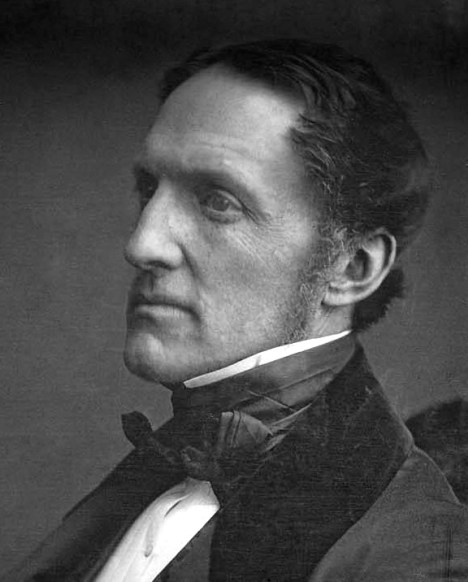
William H. Prescott (1796-1859)

William H. Prescott (1796-1859)

It all started with a food fight in the Harvard University dining hall, or commons. A not particularly distinguished student from a famous family, William Hickling Prescott was hit in the left eye with a crust of bread. The impact destroyed the vision of his left eye for life and, in fact, knocked him out. The trouble began when he started suffering degeneration in his right eye. During his youth, there were whole months at a time when Prescott was blind and had to stay in a darkened room.

But things got better. By then, Prescott went to Europe and fell in love with the history of Spain. He wrote The History of the Reign of Ferdinand and Isabella (1837), followed by The History of the Conquest of Mexico (1843) and The History of the Conquest of Peru (1847). During his most productive years, there were still times when he was unable to read or even see. Using the help of secretaries and a device called a noctograph, which enabled him to write clearly in total darkness, Prescott managed to write some of the greatest works of history published in the nineteenth century. In his Preface to The Conquest of Peru, he wrote:

While at the University, I received an injury in one of my eyes, which deprived me of the sight of it. The other, soon after, was attacked by inflammation so severely, that, for some time, I lost the sight of that also; and though it was subsequently restored, the organ was so much disordered as to remain permanently debilitated, while twice in my life, since, I have been deprived of the use of it for all purposes of reading and writing, for several years together. It was during one of these periods that I received from Madrid the materials for the “History of Ferdinand and Isabella,” and in my disabled condition, with my Transatlantic treasures lying around me, I was like one pining from hunger in the midst of abundance. In this state, I resolved to make the ear, if possible, do the work of the eye. I procured the services of a secretary, who read to me the various authorities; and in time I became so far familiar with the sounds of the different foreign languages (to some of which, indeed, I had been previously accustomed by a residence abroad), that I could comprehend his reading without much difficulty. As the reader proceeded, I dictated copious notes; and, when these had swelled to a considerable amount, they were read to me repeatedly, till I had mastered their contents sufficiently for the purposes of composition. The same notes furnished an easy means of reference to sustain the text.

Still another difficulty occurred, in the mechanical labor of writing, which I found a severe trial to the eye. This was remedied by means of a writing-case, such as is used by the blind, which enabled me to commit my thoughts to paper without the aid of sight, serving me equally well in the dark as in the light. The characters thus formed made a near approach to hieroglyphics; but my secretary became expert in the art of deciphering, and a fair copy—with a liberal allowance for unavoidable blunders—was transcribed for the ‘use of the printer. I have described the process with more minuteness, as some curiosity has been repeatedly expressed in reference to my modus operandi under my privations, and the knowledge of it may be of some assistance to others in similar circumstances.

Though I was encouraged by the sensible progress of my work, it was necessarily slow. But in time the tendency to inflammation diminished, and the strength of the eye was confirmed more and more. It was at length so far restored, that I could read for several hours of the day though my labors in this way necessarily terminated with the daylight. Nor could I ever dispense with the services of a secretary, or with the writing-case; for, contrary to the usual experience, I have found writing a severer trial to the eye than reading,—a remark, however, which does not apply to the reading of manuscript; and to enable myself therefore, to revise my composition more carefully, I caused a copy of the “History of Ferdinand and Isabella” to be printed for my own inspection, before it was sent to the press for publication. Such as I have described was the improved state of my health during the preparation of the “Conquest of Mexico”; and, satisfied with being raised so nearly to a level with the rest of my species, I scarcely envied the superior good fortune of those who could prolong their studies into the evening, and the later hours of the night.

But a change has again taken place during the last two years. The sight of my eye has become gradually dimmed, while the sensibility of the nerve has been so far increased, that for several weeks of the last year I have not opened a volume, and through the whole time I have not had the use of it, on an average, for more than an hour a day. Nor can I cheer myself with the delusive expectation, that, impaired as the organ has become, from having been tasked, probably, beyond its strength, it can ever renew its youth, or be of much service to me hereafter in my literary researches. Whether I shall have the heart to enter, as I had proposed, on a new and more extensive field of historical labor, with these impediments, I cannot say. Perhaps long habit, and a natural desire to follow up the career which I have so long pursued, may make this, in a manner, necessary, as my past experience has already proved that it is practicable.

It is with some frustration that I note that Prescott and his great contemporaries, Francis Parkman (The Oregon Trail, The French in North America) and John Lothrop Motley (The Rise of the Dutch Republic) are virtually ignored today—despite the fact that their literary histories are on a par with the best. That he was able to accomplish so much with his vision problems is a miracle. In fact, his histories in general are a miracle.

In preparation for an eventual visit to Peru, I am now reading The History of the Conquest of Peru and marvelling at its author’s insightfulness and sparkling literary style.