The Conquistador

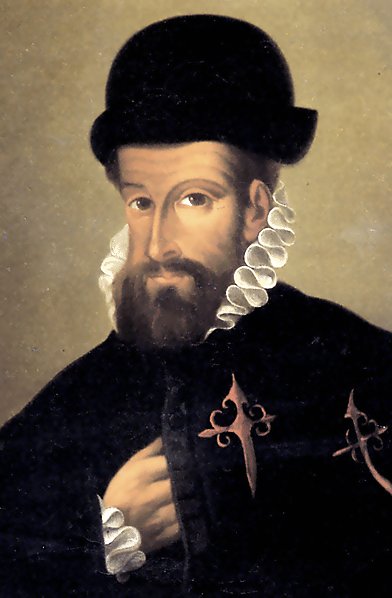
Francisco Pizarro (d. 1541)

Francisco Pizarro (d. 1541)

No one is quite sure when the great conquistador Francisco Pizarro was born. As he was a bastard, no one noted such niceties. He was raised to be a soldier—and he was a good one. But he was also illiterate, because no one took care that he learn to read and write, or to act the part of a gentleman. So he grew up a litle on the wild side, a man of great talents and a great destiny. With a handful of men, he destroyed an empire.

On this Columbus Day—a holiday which we are growing ever more abashed about celebrating without twinges of guilt—it is interesting to note the career of this man, who took on the mighty Inca empire, killed Atahuallpa, its leader, and sent vast treasures of gold and silver to his monarch across the Atlantic.

Pizarro founded cities, most especially Lima, enslaved the native Incas, acted at times with condign cruelty, and at other times with lightness and gentility. But, in the end, all was thrown into chaos by a partnership that failed. At the outset, he formed a compact with his fellow conquistador (and fellow bastard) Diego de Almagro. It was Pizarro, however, who seemed to get all the credit for the conquest from Charles V in Spain, who only belatedly recognized the one-eyed Almagro for his role in the conquest. In the meantime, envy had taken control; and Almagro wrested Cuzco from his partner. Francisco Pizarro’s brother Hernando defeated the rebel at Las Salinas, after which he had him tried, convicted, and executed by garroting.

The brief civil war did not have a clear victor, as, within three years, Francisco Pizarro, was assassinated by remnants of the Almagro faction in Lima. Finally, the Spanish had to step in to restore order.

In his magisterial History of the Conquest of Peru, William H. Prescott waxes lyrical about all the might-have-beens in the late conquistador’s life:

Nor can we fairly omit to notice, in extenuation of his errors, the circumstances of his early life; for, like Almagro, he was the son of sin and sorrow, early cast upon the world to seek his fortunes as he might. In his young and tender age he was to take the impression of those into whose society he was thrown. And when was it the lot of the needy outcast to fall into that of the wise and virtuous? His lot was cast among the licentious inmates of a camp, the school of rapine, whose only law was the sword, and who looked upon the wretched Indian as their rightful spoil.

Who does not shudder at the thought of what his own fate might have been, trained in such a school? The amount of crime does not necessarily show the criminality of the agent. History, indeed, is concerned with the former, that it may be recorded as a warning to mankind; but it is He alone who knoweth the heart, the strength of the temptation, and the means of resisting it, that can determine the measure of the guilt.

Contrast Pizarro with Cortés, who knew how to read and write and who was able to protect his own place in history with his writings after the conquest of the Aztecs. Nonetheless, it is interesting to note that in neither Mexico or Peru are there any monuments to the conquistadores who secured those lands for Spain.

To Each According to His Needs

Llama

Llama

A similar arrangement prevailed with respect to the different manufactures as to the agricultural products of the country. The flocks of llamas, or Peruvian sheep, were appropriated exclusively to the Sun and to the Inca. Their number was immense. They were scattered over the different provinces, chiefly in the colder regions of the country, where they were intrusted to the care of experienced shepherds, who conducted them to different pastures according to the change of season. A large number was every year sent to the capital for the consumption of the Court, and for the religious festivals and sacrifices. But these were only the males, as no female was allowed to be killed. The regulations for the care and breeding of these flocks were prescribed with the greatest minuteness, and with a sagacity which excited the admiration of the Spaniards, who were familiar with the management of the great migratory flocks of merinos in their own country.

At the appointed season, they were all sheared, and the wool was deposited in the public magazines. It was then dealt out to each family in such quantities as sufficed for its wants, and was consigned to the female part of the household, who were well instructed in the business of spinning and weaving. When this labor was accomplished, and the family was provided with a coarse but warm covering, suited to the cold climate of the mountains,—for, in the lower country, cotton, furnished in like manner by the Crown, took the place, to a certain extent, of wool,— the people were required to labor for the Inca. The quantity of the cloth needed, as well as the peculiar kind and quality of the fabric, was first determined at Cuzco. The work was then apportioned among the different provinces. Officers, appointed for the purpose, superintended the distribution of the wool, so that the manufacture of the different articles should be intrusted to the most competent hands. They did not leave the matter here, but entered the dwellings, from time to time, and saw that the work was faithfully executed. This domestic inquisition was not confined to the labors for the Inca. It included, also, those for the several families; and care was taken that each household should employ the materials furnished for its own use in the manner that was intended, so that no one should be unprovided with necessary apparel. In this domestic labor all the female part of the establishment was expected to join. Occupation was found for all, from the child five years old to the aged matron not too infirm to hold a distaff. No one, at least none but the decrepit and the sick, was allowed to eat the bread of idleness in Peru. Idleness was a crime in the eye of the law, and, as such, severely punished; while industry was publicly commended and stimulated by rewards.—William H. Prescott, History of the Conquest of Peru


Food Fight

William H. Prescott (1796-1859)

William H. Prescott (1796-1859)

It all started with a food fight in the Harvard University dining hall, or commons. A not particularly distinguished student from a famous family, William Hickling Prescott was hit in the left eye with a crust of bread. The impact destroyed the vision of his left eye for life and, in fact, knocked him out. The trouble began when he started suffering degeneration in his right eye. During his youth, there were whole months at a time when Prescott was blind and had to stay in a darkened room.

But things got better. By then, Prescott went to Europe and fell in love with the history of Spain. He wrote The History of the Reign of Ferdinand and Isabella (1837), followed by The History of the Conquest of Mexico (1843) and The History of the Conquest of Peru (1847). During his most productive years, there were still times when he was unable to read or even see. Using the help of secretaries and a device called a noctograph, which enabled him to write clearly in total darkness, Prescott managed to write some of the greatest works of history published in the nineteenth century. In his Preface to The Conquest of Peru, he wrote:

While at the University, I received an injury in one of my eyes, which deprived me of the sight of it. The other, soon after, was attacked by inflammation so severely, that, for some time, I lost the sight of that also; and though it was subsequently restored, the organ was so much disordered as to remain permanently debilitated, while twice in my life, since, I have been deprived of the use of it for all purposes of reading and writing, for several years together. It was during one of these periods that I received from Madrid the materials for the “History of Ferdinand and Isabella,” and in my disabled condition, with my Transatlantic treasures lying around me, I was like one pining from hunger in the midst of abundance. In this state, I resolved to make the ear, if possible, do the work of the eye. I procured the services of a secretary, who read to me the various authorities; and in time I became so far familiar with the sounds of the different foreign languages (to some of which, indeed, I had been previously accustomed by a residence abroad), that I could comprehend his reading without much difficulty. As the reader proceeded, I dictated copious notes; and, when these had swelled to a considerable amount, they were read to me repeatedly, till I had mastered their contents sufficiently for the purposes of composition. The same notes furnished an easy means of reference to sustain the text.

Still another difficulty occurred, in the mechanical labor of writing, which I found a severe trial to the eye. This was remedied by means of a writing-case, such as is used by the blind, which enabled me to commit my thoughts to paper without the aid of sight, serving me equally well in the dark as in the light. The characters thus formed made a near approach to hieroglyphics; but my secretary became expert in the art of deciphering, and a fair copy—with a liberal allowance for unavoidable blunders—was transcribed for the ‘use of the printer. I have described the process with more minuteness, as some curiosity has been repeatedly expressed in reference to my modus operandi under my privations, and the knowledge of it may be of some assistance to others in similar circumstances.

Though I was encouraged by the sensible progress of my work, it was necessarily slow. But in time the tendency to inflammation diminished, and the strength of the eye was confirmed more and more. It was at length so far restored, that I could read for several hours of the day though my labors in this way necessarily terminated with the daylight. Nor could I ever dispense with the services of a secretary, or with the writing-case; for, contrary to the usual experience, I have found writing a severer trial to the eye than reading,—a remark, however, which does not apply to the reading of manuscript; and to enable myself therefore, to revise my composition more carefully, I caused a copy of the “History of Ferdinand and Isabella” to be printed for my own inspection, before it was sent to the press for publication. Such as I have described was the improved state of my health during the preparation of the “Conquest of Mexico”; and, satisfied with being raised so nearly to a level with the rest of my species, I scarcely envied the superior good fortune of those who could prolong their studies into the evening, and the later hours of the night.

But a change has again taken place during the last two years. The sight of my eye has become gradually dimmed, while the sensibility of the nerve has been so far increased, that for several weeks of the last year I have not opened a volume, and through the whole time I have not had the use of it, on an average, for more than an hour a day. Nor can I cheer myself with the delusive expectation, that, impaired as the organ has become, from having been tasked, probably, beyond its strength, it can ever renew its youth, or be of much service to me hereafter in my literary researches. Whether I shall have the heart to enter, as I had proposed, on a new and more extensive field of historical labor, with these impediments, I cannot say. Perhaps long habit, and a natural desire to follow up the career which I have so long pursued, may make this, in a manner, necessary, as my past experience has already proved that it is practicable.

It is with some frustration that I note that Prescott and his great contemporaries, Francis Parkman (The Oregon Trail, The French in North America) and John Lothrop Motley (The Rise of the Dutch Republic) are virtually ignored today—despite the fact that their literary histories are on a par with the best. That he was able to accomplish so much with his vision problems is a miracle. In fact, his histories in general are a miracle.

In preparation for an eventual visit to Peru, I am now reading The History of the Conquest of Peru and marvelling at its author’s insightfulness and sparkling literary style.

Stormy Petrel

Lieutenant General Nathan Bedford Forrest

Lieutenant General Nathan Bedford Forrest

Probably the ultimate bad ass of the Civil War was Lieutenant General Nathan Bedford Forrest, commander of Confederate cavalry forces operating primarily in Mississippi and his native state of Tennessee. Just to give you an idea of how divisive a figure he has come to be, the above image was hijacked from the website of the Ku Klux Klan, of which Forrest was first Grand Wizard.

I have just finished reading Jack Hurst’s Nathan Bedford Forrest: A Biography. What is it that interests me about this man? First of all, the late Civil War historian and novelist Shelby Foote referred to him as being one of the two authentic geniuses produced by the conflict. The other was Abraham Lincoln. As William Tecumseh Sherman wrote, he was “the most remarkable man [the war produced, with] a genius for strategy which was original and … to me incomprehensible… He seemed always to know what I was doing or intended to do, while I … could never … form any satisfactory idea of what he was trying to accomplish.”

Forrest used cavalry in a manner that dumfounded his enemy. Instead of attacking on horseback, he used the horses to move his men to battle, whereupon he had them fight on foot as if they were infantry. Once, when attacked on two sides by Union forces, he divided his forces in two and had them attack in both directions. At the Battle of Brice’s Crossroads, which he won against insuperable odds, he made one maneuver which I simply cannot wrap my head around: He attacked with artillery.

One result of his unconventional methods was that he didn’t get along with higher ranking generals with whom he was supposed to cooperate. At one point, he threatened Braxton Bragg to his face. There were numerous other Confederate generals with whom he refused to fight, with the result that, most of the time, he was on his own in territory that he knew well from his childhood.

In the north, he is most famous for the massacre of Fort Pillow in Tennessee, which was mostly manned by black Union forces. When he felt that the negotiations for a truce were being conducted with bad faith (as, indeed, he had some reason to believe), he ordered his men to “kill every God damned one of them.” When he saw the results of his orders, he relented; but not before hundreds of black and white Union soldiers were killed rather than captured. The taint of this action was to haunt him for the rest of his life.

Although he did not found the Ku Klux Klan, Forrest was its first Grand Wizard. After a couple of years, however, he saw where the organization was headed and decided to repudiate it. Instead, he went in for building a railroad between Memphis and Selma, Alabama. The reputation as the perpetrator of the Fort Pillow massacre and his association with the KKK continued to follow him. As he began to suffer bad health, Forrest tried to become a force for good in the South and even became supportive of the African-Americans with whom he dealt, to the extent that hundreds honored him at his funeral when he died of advanced diabetes in 1877.

When it became clear to him that the Southern cause in the Civil War was lost, he addressed his troops:

Civil war, such as you have just passed through, naturally engenders feelings of animosity, hatred, and revenge. It is our duty to divest ourselves of all such feelings, and, as far as in our power to do so, to cultivate friendly feelings toward those with whom we have so long contended…. Neighborhood feuds, personal animosities, and private differences should be blotted out; and, when you return home, a manly, straightforward course of conduct will secure the respect even of your enemies. Whatever your responsibilities may be to the government, to society, or to individuals, meet them like men.

… I have never, on the field of battle, sent you where I was unwilling to go myself; nor would I now advise you to a course which I felt myself unwilling to pursue. You have been good soldiers, you can be good citizens. Obey the laws, preserve your honor, and the government to which you have surrendered can afford to be, and will be, magnanimous.

Today, when the stormy petrel figure of Nathan Bedford Forrest is still being used to divide Americans, it is interesting to see in him a person who changed during his lifetime from a slave dealer in Memphis to a powerful guerrilla fighter to a Klansman and finally to the much-loved warden of a prison farm on an island in the Mississippi where most of his charges were black.

Living in the Past?

Not Altogether a Bad Thing

Not Altogether a Bad Thing

My brother and I usually talk on the phone on Sunday mornings, usually while I’m on my weekend hike. (That wasn’t the case today, however, because of the heat.) I hadn’t called him first because I was watching the DVD version of Ken Burns’s multi-part documentary The Civil War (1990), specifically the episode relating to Gettysburg, Vicksburg, and Chickamauga. Dan was curious to know why I was watching it. I replied that, frequently, during the hottest part of the summer, I would read a lot about the Civil War and watch DVDs on the subject. For instance, last month I watched Ted Turner’s production of Gettysburg (1993) with Tom Berenger, Martin Sheen, and Jeff Daniels.

“Boy, you really like living in the past, don’t you?” was Dan’s response.

“Absolutely,” I replied. “There’s little to like about what’s happening right now. After all, we’re getting ready to go to war again in the Middle East.”

Strictly speaking, I don’t live in the past. Although my tastes in music might be mostly 18th and 19th century, I am very partial to Jazz, the Blues, and folk music. I am more aware of what’s happening than people who rely on television news. Perhaps I do read the papers, getting the Los Angeles Times home-delivered seven days a week; but I get most of my news updates from the Internet, from the websites of CNN, MSNBC, and the BBC. Occasionally, I also check out Al Jazeera.

I am quite aware that many people who live in the past do so out of fear of the present. I have no particular fear of the present. If I like the history and literature of the past, it is partly to understand the present. Take a look at the illustration above, for instance: We are still fighting the American Civil War a hundred and fifty years later. The  Confederate States of America have found a way to bollix up the Senate by requiring that all measures pass with at least a 60-40 vote in order to avoid a filibuster. Do we have majority rule in the Senate? Not really. We’re sill hung up on States’ Rights, and talk of Secession is still in the air. We may no longer have literal slavery; but racism is rife and the villains have shifted from the rich plantation owners to the rich CEOs, the so-called One Percent.

No, if I spend time in the past, it is with an eye to the present. I urge all of you to read Herodotus, Thucydides, Livy, Tacitus, Philippe de Commynes, Gibbon, Parkman, Prescott—and, yes, the Civil War historians—for a unique perspective on the present.

Mining the Comstock Lode

Timothy O’Sullivan Rare Photo of a Miner Near Virginia City

Timothy O’Sullivan Rare Photo of a Miner Near Virginia City

The above photograph is one of several taken by Timothy O’Sullivan over a hundred years ago giving rare views of the Old West. You can find a number of them at the Daily Mail website.

What I found interesting about the above photograph were the conditions under which it was taken. According to the caption:

Silver mining: Here photographer Timothy O’Sullivan documents the actvities of the Savage and the Gould and Curry mines in Virginia City, Nevada, in 1867 900ft underground, lit by an improvised flash—a burning magnesium wire, O’Sullivan photographed the miners in tunnels, shafts, and lifts. During the winter of 1867-68, in Virginia City, Nevada, he took the first underground mining pictures in America. Deep in mines where temperatures reached 130 degrees, O’Sullivan took pictures by the light of magnesium wire in difficult circumstances.

Another of my favorites is this view of Paiute Indians taken near Cottonwood Springs, Nevada (in Washoe County).

Paiute Indians in Nevada

Paiute Indians in Nevada

I recommend you view the website when you get a chance.

Act Like It’s a Victory

Schematic of the Battle of Cold Harbor

Schematic of the Battle of Cold Harbor

I think I am coming to the end of my Civil War enthusiasm. But then, it can suddenly be revived at a moment’s notice—so don’t count too much on it.

My chief interest has been Ulysses S. Grant, who finally figured out how to win the Civil War for Lincoln. There had been so many failures in the leadership of the Army of the Potomac. A noxious pattern was established, which consisted of rampant braggadocio followed by condign defeat followed by a retreat to lick their wounds.

Look at that schematic of the Battle of Cold Harbor. Like all the victories of Grant’s 1864 Overland Campaign, it was by no means a rout. It could even be viewed as a defeat. The Army of the Potomac suffered more casualties than the Army of Northern Virginia—except for one key difference. Grant stayed put and prepared for the next battle, and Lee inexorably backed toward the Confederate capital at Richmond. (This is exactly the opposite of Lee vs. previous commanders of the Army of the Potomac, who always backed toward Washington in case they had to defend it.)

Between the Battle of the Wilderness and the Siege of Petersburg, Grant kept applying the pressure, and Lee kept responding. Casualties almost didn’t matter. If Lee lost a man, he had great difficulty replacing him. For Grant, there was a pool of two and a half million men of military age who had not yet served (though it was difficult at times getting them to enlist).

By acting as if the battle were a victory and getting ready for the next one, Grant guaranteed a Northern victory.


Two Role Models

General Winfield Scott (1786-1866)

General Winfield Scott (1786-1866)

While he was a cadet a West Point, Ulysses S. Grant admired the spit and polish of General Winfield Scott, under whom he was to fight in the Mexican War that followed. For a while, Grant emulated him, but changed his mind when the local rubes would make fun of him for looking like a toy soldier.

Then, when the Mexican War began with Grant as a brevet lieutenant, he saw an entirely different kind of general. According to Bruce Catton in his book U.S. Grant and the American Military Tradition:

[Zachary] Taylor was a natural. A professional soldier but not a West Pointer, he had fought in the War of 1812 and subsequently in many a campaign against the Indians. He had an ostentatious and wholly sincere dislike for military formality. By custom, he wore blue jeans, a long linen duster and a floppy straw hat, and he would lounge around headquarters like a seedy backwoods farmer. On the parade ground, when he sat on his horse to review troops or to watch drill or maneuvers, he was as likely as not to sit sidesaddle, chewing tobacco and behaving like a man who casually watches the field hands harvest a crop.

General Zachary Taylor (1784-1850)

General Zachary Taylor (1784-1850)

Both Scott and Taylor wir first-rate generals. When Fort Sumter was fired on in 1861, Winfield Scott was in charge of the Federal Army, but he was too ridden with dropsy and gout—not to mention obesity—to be able to mount a horse, so he offered his command to Robert E. Lee. Of course, when Virginia seceded from the Union, Lee went over to the Rebs, and Irvin McDowell got the nod to head the Army of the Potomac.

Interestingly, Winfield Scott’s master plan for starving the Confederacy into submission was the so-called “Anaconda Plan,” which called for a naval blockade and the capture of the Mississippi. He may have been called “Old Fuss and Feathers” toward the end of his life, but Scott knew what he was doing; and Grant copied his Western strategy from him.

Grant had two excellent role models, which he needed, because the array of timid military ignoramuses who headed the Army of the Potomac before him did not have much to offer their successors other than a long string of defeats.

Favorite Films: Gettysburg (1993)

Probably the Greatest Ever Movie Made for Television

Probably the Greatest Ever Movie Made for Television

Since reading the second volume of Shelby Foote’s magnificent The Civil War: A Narrative, I have decided to read some more histories during the heat of the summer. But first, I thought it was a good time to see the Turner movie of Gettysburg directed by Ronald F. Maxwell.

The film is a real labor of love, with excellent performances by Martin Sheen as Robert E. Lee (he was too short for the role, but was most convincing), Tom Berenger as General James Longstreet, Sam Elliott as General John Buford, and Jeff Daniels as Colonel Joshua Chamberlain. What is so remarkable is that so many of the minor roles were acted with so much passion that they stick in the mind even after twenty years. I am thinking particularly of Richard Jordan as General “Lo” Armistead; Patrick Gorman as General John Bell Hood; and Brian Mallon as General Winfield Scott Hancock.

The use of Civil War re-enactors on both sides made a big difference. This was literally a cast of thousands—thousands of enthusiastic volunteers who had their own uniforms and were accoutered with all the authentic accessories. The only disadvantage to using re-enactors is that so many of them are stout and in late middle age, but one can overlook that.

Also significant was that the script was based on Michael Shaara’s novel The Killer Angels, which focussed on several key parts of the battle, namely the charge on Little Round Top and Pickett’s suicidal charge on the center of the Union line on Cemetery Ridge. There were other actions that never quite make it to the forefront in histories, not to speak of this movie: I am thinking of Ewell’s assaults on Cemetery Hill (not to be confused with the Ridge) and Culp’s Hill. Without that focus, the battle, like many Civil War battles, tends to be too diffuse. (The classic example of a diffuse battle was Chickamauga fought near Chattanooga later that year.)

As good as Gettysburg the movie is, the same director tried to make a prequel ten years later: Gods and Generals (2003) was a rather flaccid failure. Jeff Daniels plays the same role, but he had gained quite a few pounds while he was at Chancellorsville a scant few months earlier.


From the Confederate Point of View

Historian Shelby Foote (1916-2005)

Historian Shelby Foote (1916-2005)

If you have ever seen the multipart Ken Burns documentary on the Civil War first broadcast by PBS in September 1990, you will undoubtedly remember Shelby Foote (above), who is famous for his trilogy The Civil War: A Narrative. For today, I decided to post my review of the second volume of his trilogy, covering the pivotal year of 1863.

Ever since I first came across the works of Bruce Catton in my teens, I have been an aficionado of the American Civil War. So much concentrated slaughter among peoples who resembled one another so much! Also, so many lessons to be learned about the arts of leadership, and what happens when they are lacking—as in all but the last generals in charge of the Army of the Potomac!

This is the second volume of three of historian Shelby Foote’s The Civil War: A Narrative. Nestled away in the “Bibliographical Note” section at the end is this revealing quote:

As for method, it may explain much for me to state that my favorite historian is Tacitus, who dealt mainly with high-placed scoundrels, but that the finest compliment I ever heard paid a historian was rendered by Thomas Hobbes in the forward to his translation of The Peloponnesian War, in which he referred to Thucydides as “one who, though he never digress to read a Lecture, Moral or Political, upon his own Text, nor enter into men’s hearts, further than the Actions themselves evidently guide him … filleth his Narrations with that choice of matter, and ordereth them with that Judgement, and with such perspicuity and efficacy expresseth himself that (as Plutarch saith) he maketh his Auditor a Spectator. For he setteth his Reader in the Assemblies of the People, and in their Senates, at their debating; in the Streets, at their Seditions; and in the Field, at their Battels.” There indeed is something worth aiming at, however far short of attainment we fall.

I don’t think Foote falls far short at all. In Periclean Athens, there was not much first-hand information upon which the historian could rely, whereas the Civil War is one of the most written-about episodes in all of world history. In addition to making his information vivid, Foote has to wade through terabytes of minutiae to find interesting episodes. One example: Southern General Nathan Bedford Forrest, encountering one of his men in headlong retreat, stopping him in his tracks, pulling down his trousers, and administering a savage spanking with a brush in front of his peers to motivate him to reconsider, which he did.

The period covered by the volume is calendar year 1863, in which two of the most decisive Union victories took place: Gettysburg and Vicksburg — right around the 4th of July. The other major battle discussed was Chickamauga, a Southern victory which ruined the careers of both generals, Rosecrans and Bragg, and which could have gone either way if a third of the Union line had not panicked and run. There is also a brief look-ahead to the spring of 1864, when U.S. Grant was named a Lieutenant General and appointed to the Army of the Potomac.

This 966-page book seems shorter than its weight would imply. That is due to Foote. In fact, this volume is so good that two extracts have been separately published as books: The Stars in Their Courses about Gettysburg and The Beleaguered City about Vicksburg, both of which are excellent reads in their own right.