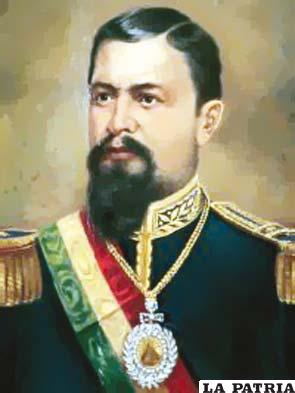
Were the consequences not so tragic, [Bolivian President Hilarion] Daza’s trek through Tarapacá’s hinterland might provoke coarse laughter. From the onset of his campaign, the general demonstrated an almost monumental incompetence: he refused to hire guides to lead his forces through the unforgiving and unknown wasteland. Rather than travel at night, and thus spare his men from the searing desert sun, Daza instead advanced during the day. (Apparently he feared, with good reason, that his troops might desert under the cover of darkness.) The Bolivian general rejected a Peruvian offer of ambulances, and he ordered his artillery to remain in Arica [to the rear]. Perhaps one of Daza’s most criminally negligent acts was that [of] his refusal to bring sufficient water with him. Worse, he permitted his men to fill their canteens with wine or raw spirits, a disastrous mistake given the fact that the nearest supply of water was a substantial distance away from Arica. Col. Narciso Tablares, alerted by a commissary official that Daza’s expedition would carry only eleven water skins, warned the general that his men might run out of water. When Daza haughtily dismissed these fears with the words “You do what you are told,” Tablares had little choice but to obey.—William F. Sater, Andean Tragedy: Fighting the War of the Pacific, 1879-1884
Home » history (Page 16)
Category Archives: history
Bloody Wars of the Americas
This post is about three wars fought in South America between1864 and 1935—wars that most people in the United States have never heard of. Yet withal they were extremely bloody, involved transfers of large amounts of territory between the combatants, and set some of the participants back for decades.
The War of the Triple Alliance
Here’s one that’s difficult to even imagine, considering the unevenness of the sides. Arrayed on one side was Paraguay under dictator Francisco Solano López, one of the more imbecilic caudillos in South America’s bloody history. Arrayed against it was Brazil. But wait, there’s more. Argentina and Uruguay jumped in on the side of Brazil. This is also referred to as the Paraguayan War. Before López and 1.2 million Paraguayans, or 90% of the pre-war population, was killed. You can read about it in John Gimlette’s wonderful book about Paraguay called At the Tomb of the Inflatable Pig. After this war, Paraguay pretty much disappeared from the world scene—until it was time for the next war it fought.
The War of the Pacific
We move ahead to period 1879-1884. Bolivia actually had a seacoast with seaports back then, and its lands in the Atacama Desert were a rich source of nitrates. These were mined by a Chilean company called the Antofagasta Nitrate & Railway Company. The adjacent parts of Peru around Tacna and Arica were also being mined for nitre, which was at the time the number one export of Pacific South America. But then Hilarion Daza, the idiot caudillo of Bolivia, decided to levy a tax against the Chileans, and the nitre hit the fan. Chile invaded the Bolivian. Unfortunately for Peru, it had a mutual defense alliance with Bolivia, so it joined the fray.
Although the armies of Peru and Bolivia greatly outnumbered the Chileans, the Chileans were better officered. As William F. Sater wrote in his excellent Fighting the War of the Pacific, 1879-1884:
Peruvian intellectual Ricardo Palma said of the officer corps that “for every ten punctilious and worthy officers, you have ninety rogues, for whom duty and motherland are empty words. To form an army, you have to shoot at least half the military.”
In addition, there was one commissioned officer and one non-commissioned officer for every three privates. That’s not a terribly good ratio.
Anyhow, Bolivia and Peru lost the war and huge amounts of territory, and Bolivia became a landlocked country.
The Chaco War
This one is between the only two landlocked countries in South America, Bolivia and Paraguay—two losers if there ever were any. It was fought over the Gran Chaco, an area that was thought to harbor vast oil reserves. Typically, Royal Dutch Shell supported Paraguay; and Standard Oil backed Bolivia. This war is also called La Guerra de la Sed, or “The War of Thirst,” because so many of the combatants died of thirst fighting among the cacti of the arid region.
Between 1932 and 1935, the Chaco War led to lots of casualties, and a gain for Paraguay, which surprisingly won the war:
By the time a ceasefire was negotiated for noon June 10, 1935, Paraguay controlled most of the region. In the last half-hour there was a senseless shootout between the armies. This was recognized in a 1938 truce, signed in Buenos Aires in Argentina and approved in a referendum in Paraguay, by which Paraguay was awarded three-quarters of the Chaco Boreal, 20,000 square miles (52,000 sq km). Two Paraguayans and three Bolivians died for every square mile. Bolivia did get the remaining territory that bordered Paraguay’s River, Puerto Busch.
Over the succeeding 77 years, no commercial amounts of oil or gas were discovered in the portion of the Chaco awarded to Paraguay, until 26 November 2012, when Paraguayan President Federico Franco announced the discovery of oil reserves in the area of the Pirity river…. The President claimed that “in the name of the 30,000 Paraguayans who died in the war” the Chaco will become the richest oil-bearing region in South America. Oil and gas resources extend also from the Villa Montes area and the portion of the Chaco awarded to Bolivia northward along the foothills of the Andes. Today these fields give Bolivia the second largest resources of natural gas in South America after Venezuela. (Wikipedia)
Again, Gimlette’s At the Tomb of the Inflatable Pig is a good source of the only war that Paraguay could be said to have won, though it was only a booby prize for decades.
The cartoon above is taken from Poliical Cartoon Gallery by Derso and Kelen, which is well worth a look.
Revisiting: Anna Politkovskaya
This is an article I wrote for the old Yahoo! 360 back in 2008. Currently, I am reading Is Journalism Worth Dying For? Final Dispatches.
I have just had a harrowing experience, having finished reading Anna Politkovskaya’s A Dirty War: A Russian Reporter in Chechnya. We don’t hear much about Chechnya these days: Vladimir Putin has succeeded in muddying the waters by getting us all to regard the entire civilian population of the province as Muslim terrorists. Based on Politkovskaya’s reportage, there are actually four groups of terrorists in Chechnya:
- The actual terrorist bands themselves, highly mobile groups widely dispersed in the mountains of Chechnya, Ingushetia, and Daghestan.
- The Chechen civilian government under the Russians, which cynically exploits the suffering of the local population for financial gain.
- Contract soldiers, the Russian equivalent of Blackwater, which is a force on its own. They maintain pseudo-checkpoints which are simply an excuse for mayhem.
- The Russian Army itself, which authorizes local “cleansing” operations, consisting of robbery, torture, rape, and murder without being held responsible to anyone. Also, Russian soldiers themselves are frequently the victims of other units which have a bone to pick with them.
Running through the book are a series of stories about the Grozny Old Peoples’ Home. Most of the sick, elderly tenants are Russians, not Chechens; Russian Orthodox, not Islamic. Yet the residents are treated by all parties as the enemy. Politkovskaya (photograph above) wrote several articles explaining their plight, checking back with them every few months. They had no food or medical care, and were afraid to venture outside for fear of running afoul of armed parties of any description.
The only hospital in bombed-out Grozny had a few volunteer doctors, but no medicines. Such medications as were sent from Moscow were intercepted by the Chechen [pro-Russian] civilian government and sold on the black market.
When there were too many casualties in a Russian army operation, it was not unusual for the wounded to be taken not to a nearby military hospital, but to a more distant civilian hospital where there was no electricity, no medications, and only a skeleton staff. Whether they live or die, they are considered as deserters and therefore do not adversely affect any Russian officer’s military reputation. Many of the wounded soldiers die without identification, leading their families to spend years and a small fortune trying to find out what happened to their sons. (I wonder if this sort of thing was also going on [during the Soviet occupation of] Afghanistan.)
If you leave your apartment in Grozny, be very careful. You might find well-hidden anti-personnel mines at your doorstep or even within the apartment. This is a common cause of death throughout Chechnya.
When Politkovskaya encountered particularly obnoxious politicians or generals, she would publish their cell phone numbers in the Novaya Gazeta, for whom she worked at that time, and urge people to say to their face what they thought of them.
As one could expect, a woman like this makes lots of powerful enemies. On October 7, 2006, the crusading journalist was shot to death in the elevator on the way to her apartment in Moscow. After an “investigation” of sorts, no guilty party was found. Vladimir Putin, who most likely ordered the assassination, points the finger at some unnamed gunman from the West. After all, he says, she had no influence in Russia: Her audience were mostly liberals in Europe and America.
Politkovskaya was a singularly brave journalist and paid the ultimate price for it. Compare them to American journalists who were supinely complicit in the atrocities of the Bush-Cheney administration. No awards for courage there.
“A Man of Great Personal Integrity”
For many years, between 1975 and 1992, I traveled across Southern Mexico in search of Mayan ruins. Friends have asked me whether I have seen the ruins at Tikal in Guatemala, but all I could do was sadly shake my head. The closest I came to Guatemala was the Mexican State of Quintana Roo on the Yucatán Peninsula. I would dearly love to have crossed the border into Belize, and from there proceeded to Tikal, but it was not to be. The reason was the ugly stories filtering across the border of massacres, torture, rape, and genocide, especially of the native Mayan population. The perpetrator? One Efrain Rios Montt (pictured in the center above), who had staged a rightist coup in 1982.
It was only when President Ronald Reagan called Rios Montt “a man of great personal integrity” who had been given a “bum rap” as a human rights abuser when I knew that we were dealing here with a world-class criminal rat. Out of a population of some seven million in 1980, Rios Montt and his death squads were responsible for some 200,000 extra-judicial murders in Guatemala, “the land of the eternal spring.” Over a million natives fled the country for safety in the United States and elsewhere. Yet the Reagan administration continued to support the man and offer him aid.
In 2012, Rios Montt was charged with genocide and was convicted. But then his daughter Zury warned other of the nation’s leaders that, if Rios Montt served any time, they would be next. The verdict was repudiated by the Constitutional Court, and Rios walked a free man. The people of Guatemala are still trying, however, to have him called to account for his crimes against his people, either at home or at The Hague. Rios might be in his eighties, but he should not be allowed to die as a free man.
Sea Legs
Commandant Louis Joseph Lahure has a singular distinction in military history — he defeated a navy on horseback. Occupying Holland in January 1795, the French continental army learned that the mighty Dutch navy had been frozen into the ice around Texel Island. So Lahure and 128 men simply rode up to it and demanded surrender. No shots were fired.
Quick Quote from Futility Closet
Where on Earth Is Frisland?
Until late in the Sixteenth Century, maps of Europe had a largish island called Frisland (also called Frischlant, Friesland, Frislandia, or Fixland) situated south of Iceland. It is thought that an Italian mapmaker named Nicolo Zeno was first responsible for the placement of the imaginary island on his charts in 1558. Then, in 1573, the Fleming Abraham Ortelius picked it up for his maps, followed by Gerard Mercator (he of the projection) of Duisburg. In 1576, Martin Frobischer thought he was in Frisland when, actually, he had overshot it and found himself in Greenland.
I am indebted to Benedikt Jóhannesson of the Iceland Review for turning me on to this existence of this cartographic canard. I remember standing on the farthest southern point of the Westmann Islands in Iceland and looking south. I saw quite a few small, rather volcanic rocks to the south—but nothing as large as Frisland is represented to be. Perhaps it’s the original Fantasy Island.
Curiously, this part of the ocean lies along the Mid-Atlantic Ridge. There have been volcanic islands that arose from the bottom of the sea, only to subside or be eroded away after the eruption that created them spent its fury. Perhaps someone reported some such island—though no way that large—and some mapmakers picked it up and embellished it a bit. A good example of such an island is Ferdinandea, between Sicily and Tunisia, which appeared and disappeared several times. It lasted long enough for several countries in the Nineteenth Century to dispute its ownership.
“Vive Boulanger! Vive la France!”
The period between the Revolution and the First World War in France is virtually unknown to the Anglo-American world.I am currently reading Frederick Brown’s For the Soul of France: Culture Wars in the Age of Dreyfus. It is an excellent book that has helped me to “connect the dots” from French literature and films. For instance, I knew about France’s humiliation at the hands of the German army in the Franco-Prussian War of 1870, in which it lost the provinces of Alsace and Lorraine. I knew about the Commune and its destruction at the hands of Adolph Thiers’s government at Versailles. What I did not know was that France was left a deeply divided country. On one hand stood Paris and the larger cities; on the other, La France Profonde, what we in America would refer to as “The Heartland” or “Flyover Country.”
It was a period reminiscent of 21st century America, with its war between religion and liberalism—except in France, religion meant the Catholic Church. Liberalism was associated with those Commie Communards who were shot to death by the French army at the Mur des Fédérés at Paris’s Père Lachaise Cemetery. As the 1870s shaded into the 1880s, Paris was not unlike present-day Washington in its seemingly irreconcilable divisions.
At this time, there arose a would-be Messiah, General Georges Boulanger, “The Man on Horseback,” beyond whom many of the irreconcilables were mysteriously reconciled. As Maurice Barrès said, “The important thing about popular heroes is not so much their own intentions but the picture of them that people create in their own minds.”
It is not that Boulanger had an undistinguished military career. He fought successfully in Algeria, Tunisia, Viet Nam, and Italy. He was wounded (and addicted to the morphine used to relieve him from the pain). And he enjoyed the adulation of crowds. As Frederick Brown writes:
While Boulanger marked time, Boulangism marched forward and continued to raise alarms. Jules Ferry, who understood the revolutionary impetu of revanchism in what was becoming a widespread movement, deplored its brutish character. “For some time we have been witnessing the development of a species of patriotism hitherto unknown in France,“ Ferry declared. “It is a noisy despicable creed that seeks not to unify and appease but to set citizens against one another…. If one believes its spokesmen, love of country belongs to one party alone, or to one sect within that party, and all who do not think as they do, who would not wish to substitute … the impulse of irresponsible crowds for the free and reflective action of public powers, all who do not worship their idols and trot alongside behind the the chariot … are all held indiscriminately to be partisans of the foreigner!”
How like our own time! We may not have a “Man on Horseback” to support, but the prevalent disgust at the divisions between left and right are, I feel, ripe for exploitation.
What ever happened to Boulanger? Although he seemed to be the coming thing, he was outmaneuvered politically by a nobody named Ernest Constans and forced to flee to Belgium. The charge was “plotting to subvert the legally constituted government.” From Belgium, Boulanger exiled himself to Saint-Hélier on the Isle of Jersey. When his wife Marguerite sickened and died, Boulanger blew his brains out in front of the headstone of her grave at Ixelles Cemetery in Brussels.
As one of his former adherents proclaimed, “General Boulanger didn’t deceive us. It was we who deceived ourselves. Boulangism is failed Bonapartism. To succeed, it needs a Bonaparte, and Boulanger as Bonaparte was a figment of our imagination.”
Isn’t that the way it always is?
Looking Out for Number Two
The galleries of 17th and 18th Century French furniture at the Getty Center are our favorite parts of their permanent collection. For one thing, they’re not as crowded as the galleries with paintings; for another, they let you take photographs. An elegant table or chair or cabinet can be just as much a work of art as a sculpture or an oil painting. It’s just that we are conditioned by our culture to regard fine art as something in oils on a canvas or wood backing. In fact, some of the furniture in the Getty incorporate small paintings on some of their panels.
Which brings me, by a commodius vicus of recirculation, to the Palace of Versailles in France. Imagine several miles of corridors with furniture such as pictured above, gorgeous drapes, halls with mirrors, paintings, gilded moldings, and in general the finest workmanship in all the fittings.
There was, however, one glaring exception: There were no bathrooms. Oh, the king, queen, and selected nobles had their own chaises percées which they could summon with a hand signal to one of their entourage. Anyone who was properly dressed (that meant a sword for you gentlemen, which could be rented from the palace concierge upon entry) would walk into the palace, wander into the King’s bedroom and watch him snuggle with his consort from behind a gold railing, and stroll through the grounds at his leisure.
But, being a mammal, there was always the chance that he or she would get “caught short.” When asking for the nearest restroom would get you nothing but disrespectful sniggers. According to one Internet source:
It’s difficult to believe today when gazing at the gleaming golden palace, but life at Versailles was actually quite dirty. There were no bathrooms as we would know them. Courtiers and royalty used decorative commodes in each room, while commoners simply relieved themselves in the hallways or stairwells. No one bothered to house-train the royal dogs, and servants did not consider cleaning up after them to be part of their job description. The constantly-altered chimneys did not draw well, so everything inside was covered with soot. The filth and disorder at Versailles during the ancient regime were noted in many records of the time.
So, imagine, if you will, what it was like to tour the palace being careful not to slip on another person’s bodily effluvia. Because it was considered beneath the monarch to concern himself with such trivial matters, it was not until 1715 that he ordered a weekly cleanup of the corridors by his servants. Imagine what it must have been like by then. Even today it’s a problem for tourists, according to one TripAdvisor report.
What a contrast between elegance and squalor!
Lydda
It looks idyllic, doesn’t it? And it was, until 1948. At that point, the newly formed Israel Defense Forces expelled the inhabitants of this peaceful city in which Jews and Palestinians had lived side by side for generations. In an article for the New Yorker published in the October 21, 2013 issue entitled “Lydda, 1948,” Ari Shavit writes:
But, looking straight ahead at Lydda, I wonder if peace is possible. Our side is clear: we had to come into the Lydda Valley and we had to take the Lydda Valley. There is no other home for us, and there was no other way. But the Arabs’ side, the Palestinian side, is equally clear: they cannot forget Lydda and they cannot forgive us for Lydda. You can argue that it is not the occupation of 1967 that is at the core of the Israel-Palestinian conflict, but the tragedy of 1948. It’s not only the settlements that are an obstacle to peace but the Palestinians’ yearning to return, one way or another, to Lydda and to dozens of other small towns and villages that vanished during one cataclysmic year. But the Jewish State cannot let them return. Israel has a right to live, and if Israel is to live it cannot resolve the Lydda issue. What is needed to make peace now between the two peoples of this land may prove more than humans can summon.
I sit here in West Los Angeles, within hailing distance of the Gabrielino Indians’ shrine at Kuruvungna Springs on the grounds of the present-day University High School. In June and July of this year, I vacationed in Iceland, where a resurgent Viking population drove out the Irish monks that had originally settled the island. (Now there is no trace of their ever having done so.) If all goes well, my next vacation will be in Peru, where the Spanish looted and destroyed the Inca Empire. Their criollo descendants still control the economy and the political power, leaving the Andean serranos and jungle tribes near the headwaters of the Amazon as second-class citizens.
Unfortunately, with its burgeoning West Bank settlements, Israel is continuing the process it began in 1948 of squeezing out, to the maximum extent possible, the indigenous Palestinian population. I cannot condone Israel’s settlement policy, especially with its Likud Party racist underpinnings; but I cannot afford to be too absolute because I realize there is a faint trace of blood on my own hands and on those of my forebears.
A Most Unprepossessing Man
This is my last posting inspired by my reading of William H. Prescott’s The History of the Conquest of Peru, which I have just completed. After the Incas were conquered and Atahuallpa executed, there arose in Peru a civil war between the two partners of the enterprise, Francisco Pizarro and Diego de Almagro, and after these two were killed, between their families. Finally, Gonzalo Pizarro, Francisco’s brother, was firmly in power—or so he thought. There was still the Spanish crown with which to contend. Carlos V and later Philip II sent various representatives, some well chosen, some notoriously bad.
Finally, the Spanish cleric Pedro de la Gasca was sent with broad authority to put an end to the conflicts and to secure Peru to the crown. Where others failed, Gasca finally succeeded. While a most unprepossessing man, he had vast reserves of shrewdness and good judgment which enabled him to take down the last of the Pizarros and unite the people behind him:
After the dark and turbulent spirits with which we have been hitherto occupied, it is refreshing to dwell on a character like that of Gasca. In the long procession which has passed in review before us, we have seen only the mail-clad cavalier, brandishing his bloody lance, and mounted on his war-horse, riding over the helpless natives, or battling with his own friends and brothers; fierce, arrogant, and cruel, urged on by the lust of gold, or the scarce more honorable love of a bastard glory. Mingled with these qualities, indeed, we have seen sparkles of the chivalrous and romantic temper which belongs to the heroic age of Spain. But, with some honorable exceptions, it was the scum of her chivalry that resorted to Peru, and took service under the banner of the Pizarros. At the close of this long array of iron warriors, we behold the poor and humble missionary coming into the land on an errand of mercy, and everywhere proclaiming the glad tidings of peace. No warlike trumpet heralds his approach, nor is his course to be tracked by the groans of the wounded and the dying. The means he employs are in perfect harmony with his end. His weapons are argument and mild persuasion. It is the reason he would conquer, not the body. He wins his way by conviction, not by violence. It is a moral victory to which he aspires, more potent, and happily more permanent, than that of the blood-stained conqueror. As he thus calmly, and imperceptibly, as it were, comes to his great results, he may remind us of the slow, insensible manner in which Nature works out her great changes in the material world, that are to endure when the ravages of the hurricane are passed away and forgotten.
With the mission of Gasca terminates the history of the Conquest of Peru. The Conquest, indeed, strictly terminates with the suppression of the Peruvian revolt, when the strength, if not the spirit, of the Inca race was crushed for ever. The reader, however, might feel a natural curiosity to follow to its close the fate of the remarkable family who achieved the Conquest. Nor would the story of the invasion itself be complete without some account of the civil wars which grew out of it; which serve, moreover, as a moral commentary on preceding events, by showing that the indulgence of fierce, unbridled passions is sure to recoil, sooner or later, even in this life, on the heads of the guilty.
I find it interesting that the Bolivian stamp illustrated above honors Gasca and pokes fun at neighboring Peru, which had to be pacified by this mouse of a Spanish cleric.


You must be logged in to post a comment.