Two Conquistadores

Francisco Pizarro (1478-1541), Conqueror of the Incas

The two great Spanish conquerors of pre-Columbian civilizations could not have been more different from each other. Hernán Cortés was born of lesser Spanish nobility in Medellín, Castile. According to Bernal Díaz del Castillo, who served with him at the conquest of the Aztecs:

He was of good stature and body, well proportioned and stocky, the color of his face was somewhat grey, not very cheerful, and a longer face would have suited him more. His eyes seemed at times loving and at times grave and serious. His beard was black and sparse, as was his hair, which at the time he sported in the same way as his beard. He had a high chest, a well shaped back and was lean with little belly.

He was also fairly well educated, though his parents had despaired of making a lawyer out of him, though he did serve for two years as a notary, which did equip him with a legal background of sorts.

Francisco Pizarro, the conqueror of the Incas of Peru, was actually the second cousin once removed of Cortés, though nowhere near as well educated. In fact, he was illiterate as well as being illegitimate. Moreover, he was such a poor horseman that he confused Atahualpa, the Inca, because he was always on foot.

Where Pizarro’s background shows is that while Cortés wrote at great length to the King of Spain to justify his behavior in New Spain (Mexico and Central;America)., Pizarro never wrote anything. In addition, many of his soldiers were equally illiterate. In fact, when Agustín de Zarate was sent by the King to investigate the Inca conquest, he was forbidden by Francisco de Carvajel, a lieutenant of Gonzalo Pizarro’s, to “record his master’s deeds.” Zarate did it anyhow, but from the safety of His Majesty’s Dutch domains.

Did the difference between the two conquerors have any positive results for the conquered? Not at all. The record of misery for the native peoples of the New World was in both cases marked by death, disease, cruelty, and slavery.

Ancient Peruvian Warfare

Wait a Sec! Pre-Columbian Warriors Had No Iron or Steel

I have been reading (and enjoying) Hugh Thomson’s A Sacred Landscape: The Search for Ancient Peru. In it, he discusses the nature of warfare during the Sechin culture (1800-1300 BC).

Before coming to Sechin I had talked to Henning Bischof, the distinguished German archaeologist now in his late sixties who had done pioneering work at Cerro Sechin between 1979 and 1984. Together with Peruvian colleagues, he had been the first to establish an accurate radiocarbon figure for the site, when they had found a wooden post supporting one wall and dated it around 1500 BC. I asked him about the intense debate on the meaning of the frieze [depicting human sacrifice].

What you have to remember,” said Henning in slightly accented but perfectly grammatical English, “is what was happening to Peru when all these different interpretations were being made.” He argued that Peruvian archaeology reflected political events far more than has ever been acknowledged. While the military governments of the sixties and seventies held sway, they welcomed a purely military interpretation of the frieze—Peru’s great military past, so to speak, which they were inheriting—“and that interpretation is precisely what the archaeologists gave them.”

But as Henning pointed out, there was a real problem with any interpretation of the frieze as military: without iron, the weapons available for actual warfare to the people of Sechin would never have been able to achieve such clean-cut savagery, Speaking in his precise German accent, Henning said: “It would have been impossible to cut off limbs in combat. You must remember that it is time-consuming work to disassemble a human body.” Any warfare would have been a far cruder process of slings and battering stones.

Trianon

The Crown of St. Stephen of Hungary

Looking back at the treaties that ended the First World War, it appears that the Hungarian half of the Kingdom of Austria-Hungary was made to pay the heavier price for what was essentially the Emperor Franz Joseph’s decision to go to war against the Serbs for assassinating the heir to the throne in Sarajevo. According to Wikipedia:

The treaty regulated the status of the Kingdom of Hungary and defined its borders generally within the ceasefire lines established in November-December 1918 and left Hungary as a landlocked state that included 93,073 square kilometres (35,936 sq mi), 28% of the 325,411 square kilometres (125,642 sq mi) that had constituted the pre-war Kingdom of Hungary (the Hungarian half of the Austro-Hungarian monarchy). The truncated kingdom had a population of 7.6 million, 36% compared to the pre-war kingdom’s population of 20.9 million.Though the areas that were allocated to neighbouring countries had a majority of non-Hungarians, in them lived 3.3 million Hungarians – 31% of the Hungarians – who then became minorities.

How Trianon Chopped Hungary to Bits

Pieces of Hungary went to Yugoslavia, Romania (the largest chunk, all of Transylvania), Russia, Czechoslovakia, and even Austria. What did Austria lose for its participation in the war? Essentially, Bohemia (to Czechoslovakia) and the much of the Tirol (to Italy). The new borders of Hungary became to larger of the two green areas in the above map.

I can understand separating out the Slovenians, Croatians, Russians, and Slovaks; but a great injustice was done to the Hungarians of Transylvania, who are treated as second-class citizens of Romania.

Taking a Bite Out of Heimaey

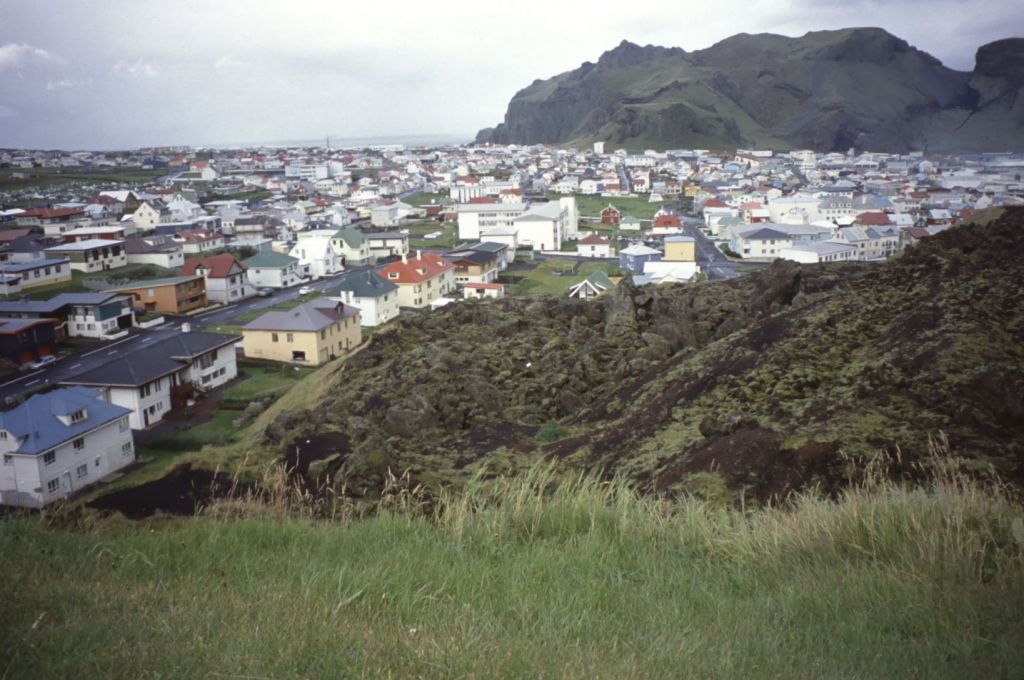
What the Volcano Eldfell Left of Heimaey (2001)

On January 21, 1973 the volcano Eldfell in Iceland’s Westman Islands began a sustained eruption that destroyed a large part of the town of Heimaey. I visited the island twice, in 2001 and 2013. During the second visit, I hiked around the massive lava flow that ate up some 400 buildings and several entire streets.

If you are interested in reading about the heroic fight to save Heimaey, I urge you to read John McPhee’s book, The Control of Nature (1989), which contains an essay entitled “Cooling the Lava.” The Icelanders saved most of the town by spraying sea water at the lava to cool it. Never before had this method been used against this type of disaster. Of course, there are not many towns of any size so close to an active volcano.

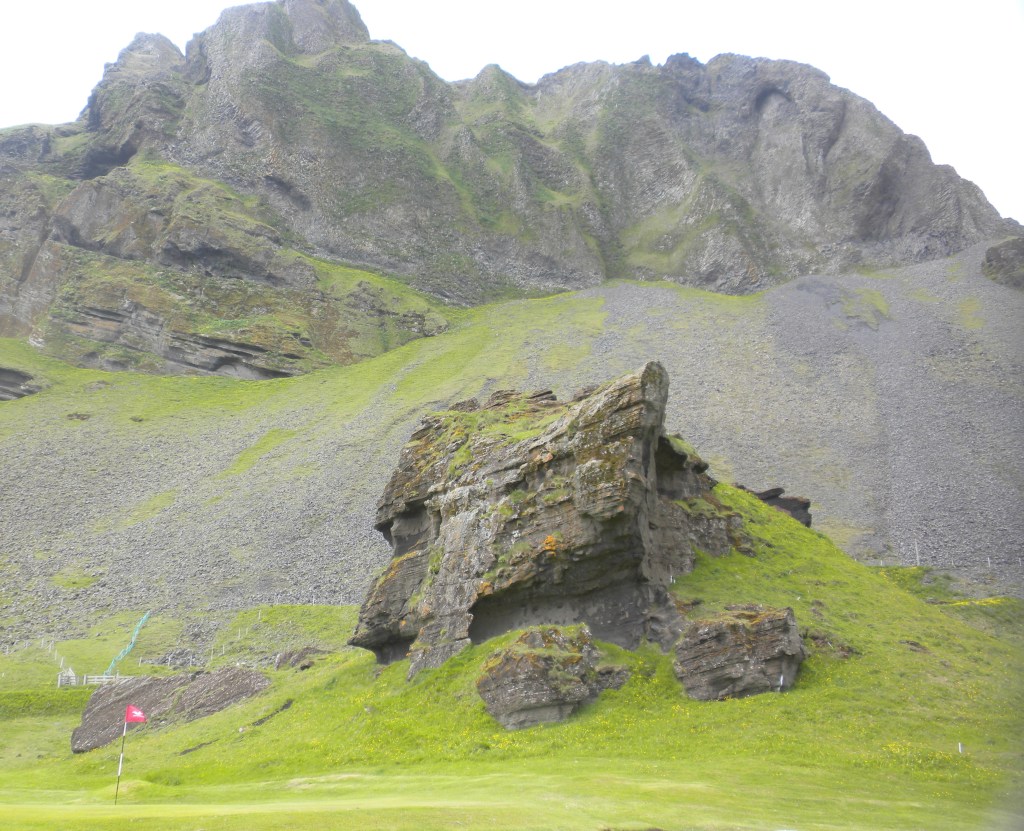
The Summit of Eldfell in 2013

As one hikes atop the lava that buried so many homes, one can still see signs indicating the streets that were lost. One such can be seen in the lower left-hand corner of the above photograph. In 2013, work was under way on a museum called Eldheimar for which several houses covered by the lava were excavated.

Just to give you an idea of the horror faced by the Icelanders, here is a picture taken during the eruption:

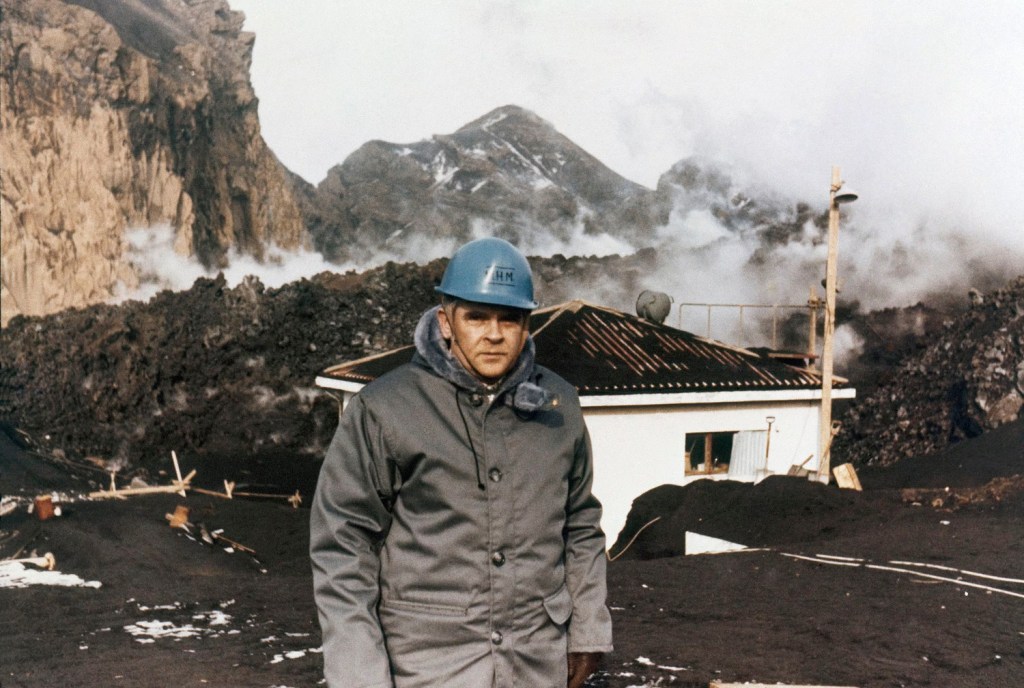
Pictured here is Mayor Magnus Magnusson of the finishing port of Heimaey, Iceland, who has been fighting to save the harbor from a relentlessly advancing wave of lava from the volcano Eldfell, March 3, 1973. (AP Photo)

Off the Grid: The USMC Goofs

Camp Dunlap Marker

It’s amusing to think that Slab City exists primarily because the military lawyers who drew up the papers for deeding the land Camp Dunlap was situated on to the State of California made a slight error. According to Wikipedia:

As of October 6, 1961, a quitclaim deed conveying the land to the State of California was issued by the Department of Defense as it was determined the land was no longer required. The deed did not contain any restrictions, recapture clauses, or restoration provisions. All of the former Camp Dunlap buildings had been removed. The remaining slabs were not proposed for removal. Later, legislation required that revenue generated from this property would go to the California State Teachers’ Retirement System.

But was there ever any revenue generated from the Camp Dunlap property? Who would be so imprudent as to spend good money buying land occupied by squatters, tweakers, snowbirds, religious freaks, people hiding out from the law, and other non-solid citizens?

If the bronze plaque above looks weirdly shaped, it’s because it is shaped like Imperial County.

The Good Emperor

Marcus Aurelius Antoninus (AD 121-180)

When Edward Gibbon came to write The Decline and Fall of the Roman Empire, he began with what he regarded as a golden age in the affairs of men, namely, the reign of the five “good” Antonine emperors. These were Nerva (AD 96-98), Trajan (AD 98-117), Hadrian (AD 117-138), Antoninus Pius (AD 138-161), and Marcus Aurelius (AD 161-180).

Among all the Roman emperors, it was only Marcus Aurelius who, in his Meditations, published a work of Stoic philosophy that is read to this day. It was he who wrote:

When you first rise in the morning tell yourself: I will encounter busybodies, ingrates, egomaniacs, liars, the jealous and cranks. They are all stricken with these afflictions because they don’t know the difference between good and evil. Because I have understood the beauty of good and the ugliness of evil, I know that these wrong-doers are still akin to me . . . and that none can do me harm, or implicate me in ugliness—nor can I be angry at my relatives or hate them. For we are made for cooperation.

Today was the last day at the Getty Villa in Pacific Palisades for a 3½-pound gold head of the emperor to be on display, so I felt I just had to see it. So I drove out to the Villa with my 90-year-old neighbor Luis to see it and check out the permanent collections as well.

It was well worth seeing, even though I developed a bad case of museum legs which tired me out after five hours. I visit the museum two or three times a year, and i love it more each time. And now I feel I should re-read the Meditations. I mean, how many world leaders ever wrote a major work of philosophy that still has worth in today’s world?

The Barbarians Are Coming! The Barbarians Are Coming!

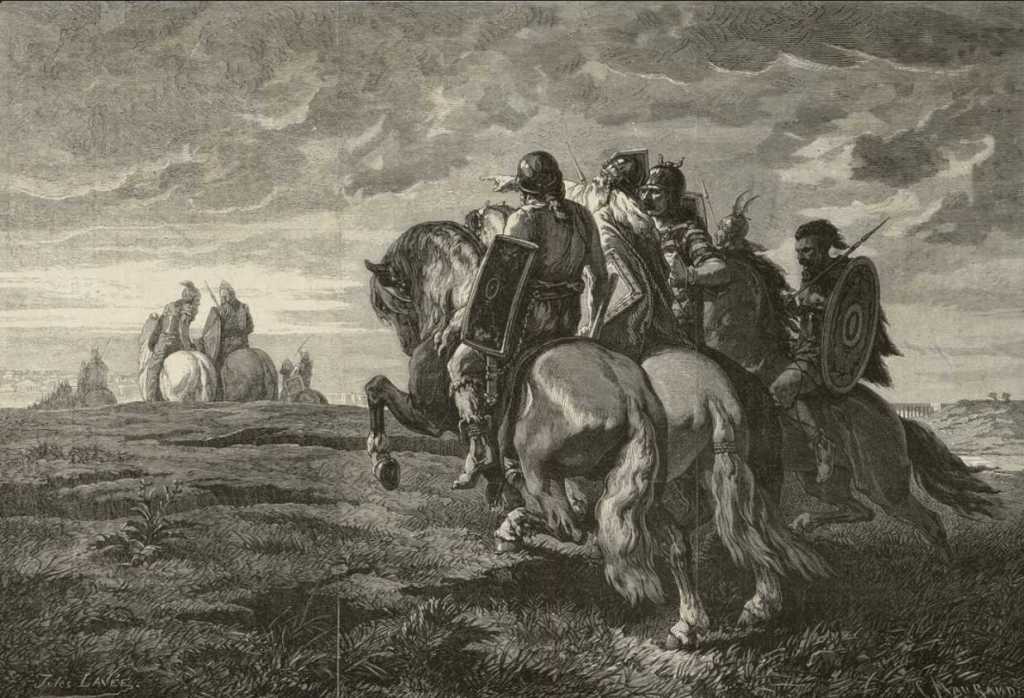
There are two ways of looking at the Barbarian Invasions of the Roman Empire. For the first, we have Orientius, said to be a cleric from Gascony, in his Commonitorium:

Look at how death has swept through the entire world,
at how many peoples have been affected by the madness of war.
What use are thick forests or high and inaccessible mountains,
what use the raging torrents with violent whirlpools,
carefully located fortresses, cities protected by their walls,
positions defended by the sea, the squalor of hiding places,
the darkness of caves and the hovels among the rocks;
nothing has been of use in avoiding the barbarians hunting in a pack….
In the villages and the villas, in the fields and at the crossroads,
in all the hamlets, on the roads and in every other place,
death, suffering, massacres, fire-raising, and mourning:
the whole of Gaul was burning in a single blaze.

Then there is the view of Greek poet Constantine Cavafy in his wonderful poem:

Waiting for the Barbarians

What are we waiting for, assembled in the forum?

The barbarians are due here today.

Why isn’t anything going on in the senate?
Why are the senators sitting there without legislating?

Because the barbarians are coming today.
What’s the point of senators making laws now?
Once the barbarians are here, they’ll do the legislating.

Why did our emperor get up so early,
and why is he sitting enthroned at the city’s main gate,
in state, wearing the crown?

Because the barbarians are coming today
and the emperor’s waiting to receive their leader.
He’s even got a scroll to give him,
loaded with titles, with imposing names.

Why have our two consuls and praetors come out today
wearing their embroidered, their scarlet togas?
Why have they put on bracelets with so many amethysts,
rings sparkling with magnificent emeralds?
Why are they carrying elegant canes
beautifully worked in silver and gold?

Because the barbarians are coming today
and things like that dazzle the barbarians.

Why don’t our distinguished orators turn up as usual
to make their speeches, say what they have to say?

Because the barbarians are coming today
and they’re bored by rhetoric and public speaking.

Why this sudden bewilderment, this confusion?
(How serious people’s faces have become.)
Why are the streets and squares emptying so rapidly,
everyone going home lost in thought?

Because night has fallen and the barbarians haven’t come.
And some of our men just in from the border say
there are no barbarians any longer.

Now what’s going to happen to us without barbarians?
Those people were a kind of solution.

Now which attitude do we take if Donald Trump and his incel hoards should regain the Presidency of the United States?


When Alexander Got Tyred Out

Ancient Tyre

I have been reading Niccolò Machiavelli’s The Discourses, in which he writes about governance and warfare in his day (around AD 1517). In Book II, he gives an anecdote about how not to negotiate with Alexander the Great:

When the whole East had been overrun by Alexander of Macedon, the citizens of Tyre (then at the height of its renown, and very strong from being built, like Venice, in the sea), recognizing his greatness, sent ambassadors to him to say that they desired to be his good servants, and to yield him all obedience, yet could not consent to receive either him or his soldiers within their walls. Whereupon, Alexander, displeased that a single city should venture to close its gates against him to whom all the rest of the world had thrown theirs open, repulsed the Tyrians, and rejecting their overtures set to work to besiege their town. But as it stood on the water, and was well stored with victual and all other munitions needed for its defence, after four months had gone, Alexander, perceiving that he was wasting more time in an inglorious attempt to reduce this one city than had sufficed for most of his other conquests, resolved to offer terms to the Tyrians, and to make them those concessions which they themselves had asked. But they, puffed up by their success, not merely refused the terms offered, but put to death the envoy sent to propose them. Enraged by this, Alexander renewed the siege, and with such vigour, that he took and destroyed the city, and either slew or made slaves of its inhabitants.

Leonardo’s End

The Clos Lucé, Leonardo da Vinci’s Château in Amboise, France

It is not generally known that Leonardo da Vinci spent his final years in Amboise, France, where he was honored by François I with his own little château within walking distance of the Royal Palace. Some twenty years ago, Martine and I visited the Loire where we saw the châteaux at Chambord, Chenanceau, Chaumont, Villandry, Azay-le-Rideau, Cheverny, and Amboise.

We based ourselves in Amboise and spent time at François I’s château of Amboise. We were startled to see in the château’s chapel of St. Florentin the tomb of the great Italian artist and thinker:

Tomb of Leonardo da Vinci at Amboise

We then found out about Leonardo’s nearby home and visited it. Leonardo had spent many thankless years with Lodovico Sforza, the ruler of Milan, without really being appreciated for his talents. It is good to know that, in his last years, Leonardo found a ruler who did not mistreat him. In fact, Giorgio Vasari says that François I cradled Leonardo’s head on his deathbed. Whether or not he did, Leonardo died will full honors on May 2, 1519..

Et Tu, Brute?!

The Assassination of Julius Caesar by Mariano Rossi (1731-1807)

I have just finished reading an interesting book that sheds light on how rhetoric influenced the way people acted in ancient Rome. J. E. Lendon’s That Tyrant Persuasion: How Rhetoric Shaped the Roman World shows that public speechifying was the dominant mass medium of the time and affected the laws and, in many respects, the way people acted.

Lendon used as his prime example the conspiracy to assassinate Julius Caesar by Brutus, Cassius, and their associates. In Chapter Four, he discusses eight reasons why the whole conspiracy had been a shambles:

  • Decimus Brutus had armed gladiators near the Senate House of Pompey. Why did they not kill Caesar?
  • Why did all the conspirators in the Senate House want to stab Caesar themselves, producing a confused melee?
  • Why did the conspirators do nothing about Mark Antony and Marcus Lepidus, or any other followers of Caesar, not even arrest them for kid-glove treatment if the fastidious Brutus insisted? It was especially leaving Antony alive that Cicero later regarded as “childish.”
  • Why did Brutus think that after the assassination he would be able to address the Senate? Why did he not expect the senators, most of them loyalists of Caesar, to be terrified of the deed?
  • Why were the conspirators apparently surprised by the panic their deed caused in the city?
  • Why did the conspirators go up the Capitoline Hill?
  • Why did the conspirators spend March 16 giving speeches in the Forum?
  • Why, other than descending to give speeches, did the conspirators apparently have no plans for what to do after they ascended the Capitoline Hill, given that the reactions of Lepidus, Antony, their troops, and Caesar’s veterans could have been predicted?

In his book, Lendon deals with each of these questions in great detail. As I read his book, I suddenly saw that public speaking in ancient Rome was the equivalent of our social media, and that the conspirators who, at Donald Trump’s urging, marched on the Capitol on January 6, 2021 were being misled in much the same way that Brutus and his co-conspirators were by the conventions of ancient rhetoric.