A Civilized Man

MƒEXICO D.F. 19 NOVIEMBRE2007.-El escritor Sergio Pitol, presento su nueva obra literaria que lleva como titulo “Trilog’a de la Memor’a” esto en la Casa del Refugio. FOTO: GUILLERMO PEREA/CUARTOSCURO.COM

Mexican author Sergio Pitol Deméneghi (1933-2018) was a man of the world. As a writer and diplomat, he traveled the world and wrote some fascinating books that were a curious mélange of literature, autobiography, and travel. The following is taken from his The Art of Flight.

[Italian philosopher] Norberto Bobbio offers a definition of the “civilized” man that embodies the concept of tolerance as daily action, a working moral exercise: The civilized man “lets others be themselves irrespective of whether these individuals may be arrogant, haughty, or domineering. They do not engage with others intending to compete, harass, and ultimately prevail. They refrain from exercising the spirit of contest, competition, or rivalry, and therefore also of winning. In life’s struggle [civilized men] are perpetual losers. […] This is because in this kind of world there are no contests for primacy, no struggles for power, and no competitions for wealth. In short, here the very conditions that enable the division of individuals into winners and losers do not exist.“ There is something enormous in those words. When I observe the deterioration of Mexican life, I think that only an act of reflection, of critique, and of tolerance could provide an exit from the situation. But conceiving of tolerance as it is imagined in Bobbio’s text implies a titanic effort. I begin to think about the hubris, arrogance, and corruption of some acquaintances, and I become angry, I begin to list their attitudes that most irritate me, I discover the magnitude of contempt they inspire in me, and eventually I must recognize how far I am from being a civilized man.

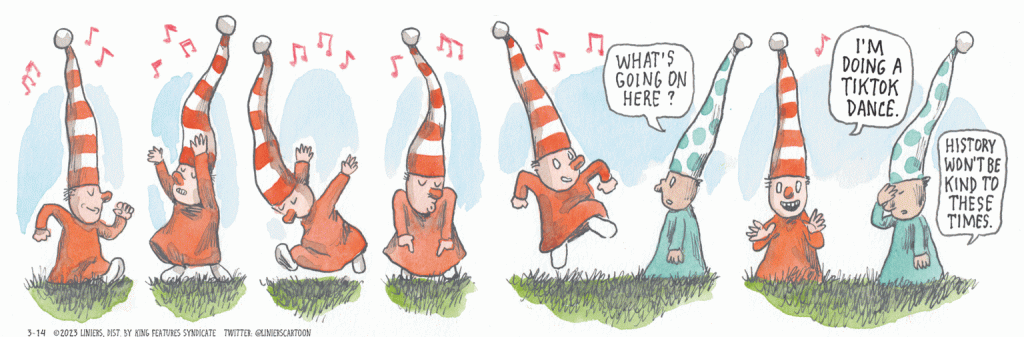
Happy Dance

Macanudo Comic Strip for Today

Turn that frown upside-down.

Well, that works, doesn’t it? All you have to do is crack a smile, do a happy dance, and you’re guaranteed to be happy, no?

Okay, I’ll believe that works in the case of Charles Schulz’s Snoopy, but it’s a little different for humans. Happiness is transitory, but unhappiness tends to persist. Of the Four Noble Truths of Buddhism, the first is about suffering:

The First Noble Truth is the idea that everyone suffers and that suffering is part of the world. Buddhists believe in the cycle of samsara, which is the cycle of birth, life, death and rebirth. This means that people will experience suffering many times over. All of the things a person goes through in life cause suffering and they cannot do anything about it. Instead, they have to accept that it is there. People may use temporary solutions to end suffering, such as doing something they enjoy. However, this does not last forever and the suffering can come back when the enjoyment ends. Buddhists want to work to try to stop suffering. However, the first step is to acknowledge that there is suffering – it happens and it exists.

That’s one of the main reasons I get this smirk on my face when someone does a Happy Dance on TV because his trash is being picked up, his or her skin is free from eczema, or it’s Friday and TGIF.

Is that because I am an unhappy person? Not at all. It’s just that putting on a happy face does not mean you are happy. It just means that you are employing magical thinking to avoid acknowledging the reality of suffering in our lives.

If you absolutely must do a Happy Dance, do it like Snoopy: Realize that life is what it is, and your little dance interlude won’t change that.

Future

George Jetson’s Neighborhood

If any writer alive today has a handle on the future—what it is likely to be—that writer is William Gibson, the author of Neuromancer and the inventor of the term cyberspace. I have just finished reading his book of essays, entitled Distrust That Particular Flavor. In a talk delivered o the Book Expo America in 2010, he wrote:

But I really think [that pundits are] talking about the capital-F Future, which in my lifetime has been a cult, if not a religion. People my age are products of the capital-F Future. The younger you are, the less you are a product of that, If you’re fifteen or so, today, I suspect you inhabit a sort of endless digital Now, a state of atemporality enabled by our increasingly efficient prosthetic memory. I also suspect that you don’t know it, because, as anthropologists tell us, one cannot know one’s own culture.

The Future, capital-F, be it crystalline city on a hill or radioactive postnuclear wasteland, is gone. Ahead of us, there is merely … more stuff. Events. Some tending to the crystalline, some to the wasteland-y. Stuff: the mixed bag of the quotidia.

I think of Gibson’s capital-F Future as being more along the line of the old The Jetsons animated television program or the novels of H. G. Wells or Isaac Asimov. The future presented in those works is more a reflection of their creators’ times, and not our own.

William Gibson

I think that, because of his belief regarding the future, Gibson’s more recent novels have been less science fiction-y. Books such as Zero History are set in what appears, on one hand, to be the present—but instead are set in some not-too-distant future with multiple hooks to our present.

In a number of essays, Gibson examines our strange atemporal present, with fascinating essays on Tokyo (“My Own Private Tokyo”) and Singapore (“Disneyland with the Death Penalty”).

Pants On Fire

According to the Baltimore Catechism in which we Catholic schoolkids were drilled in religion class, there are seven types of capital sin. They are:

  • Pride
  • Covetousness
  • Lust
  • Anger
  • Gluttony
  • Envy
  • Sloth

Conspicuously missing from the list is lying, which seems to me to be the prime sin of the 21st Century. According to the Washington Post, our former president told 30,573 lies during his four years in office. Now we have George Santos (R-NY), who seems unable or unwilling to tell the truth about anything. And it’s not just a Republican vice, though it seems most prevalent in the political world.

I can deal with violations of any of the above mentioned capital sins, but I find myself revulsed by someone who lies to me. None of the seven capital sins affects me as much as lying, which is an offense I feel is directed at me, to deliberately mislead me.

A Grier-Musser Valentine

Valentine’s Day Memorabilia at the Grier-Musser Museum

On Sunday, Martine and I stopped in at the Grier-Musser Museum in the shadow of Downtown L.A. to see their Valentine’s Day memorabilia. Of late, Susan and Rey Tejada have been concentrating on paper in the form of old-fashioned images on postcards, greeting cards, and books—especially with pop-up illustrations.

There’s something about seeing this type of material in the Victorian mansion on Bonnie Brae Street that sends you back in time. Afterwards, we sat down with Rey and Susan over cookies and punch and talked for a couple of hours.

Although I got Martine a card for Valentine’s Day, we both decided to go out for lunch on the day after, when we were less likely to run into crowds. So tomorrow we will have a nice English lunch at Ye Olde King’s Head in Santa Monica. It is a great place to have fish and chips or bangers and mash or Cornish pasties. Fortunately, one is not likely to encounter such downmarket English cuisine items as spaghetti sandwiches or baked beans on toast.

Martine and I hope you enjoyed this little gem of a holiday. Why do I call it that? I would rather honor the love I feel than some bogus political or historical event, such as Columbus “discovering” America. After all, wasn’t he met at the beach by the local residents?

The Origin of Valentines Day

When I was a child at St. Henry’s Elementary School in Cleveland, Ohio, I studied in religion class how the holiday began. Apparently there was a Saint Valentine. Actually, there were three of them; the one after whom the holiday was named was called Saint Valentine of Rome. According to the Catholic Online web site: “St. Valentine is the Patron Saint of affianced couples, bee keepers, engaged couples, epilepsy, fainting, greetings, happy marriages, love, lovers, plague, travellers, and young people. He is represented in pictures with birds and roses and his feast day is celebrated on February 14.”

I find it interesting that Valentine is also the patron saint of epilepsy, fainting, and plague. This seems to go against all the lovey dovey stuff, but then that happens fairly frequently with the saints.

When I wish Martine a Happy Valentines Day tomorrow morning, I will of course refrain from bringing up all the negative stuff.

Shimmering into Non-Existence

It was early in the morning of February 9, 1971 at precisely 6:00 AM Pacific Standard Time. I was half-asleep when I suddenly heard the howling of several dogs in the Santa Monica neighborhood where I lived. Within seconds, I felt the bed and the whole building shaking, accompanied by a deep noise as if the earth was being fractured (which it was). I held on to the mattress for dear life, but found myself on the floor nonetheless.

That was my experience of the Sylmar Earthquake, also known as the San Fernando Earthquake. Ever since then, I have been scared of quakes. Was it a small quake? Perhaps it was the precursor of a much larger quake. The Northridge Earthquake of January 17, 1994 was like that, following in the wake of several much smaller quakes centered in Santa Monica Bay.

Now when I see pictures of the Gaziantep temblor that shook parts of Turkey and Syria, I feel as if the solidity I feel of my footsteps on the ground is a possible illusion. Without warning, the buildings around me could come crashing down, possibly with me in one of them.

This afternoon, I took a walk along the Venice Boardwalk, stopping in at Small World Books to buy the work of a recommended Swiss author. As I looked at the buildings along the Boardwalk, I almost felt the ground under my feet begin to move. I remember the Tsunami Evacuation Route signs scattered around the streets in the area and felt that terra firma within a matter of seconds could sport waves like the sea; and, if the quake was out at sea, a giant wave could inundate the low-lying blocks along the ocean before I could get to safety.

If you’ve never been in a major quake, you could laugh away the small quakes. But after 1971 and 1994, there is no laughing. I am on high alert. Will it rapidly get worse? Or is this just another little memento mori?

Space Aliens and Christianity

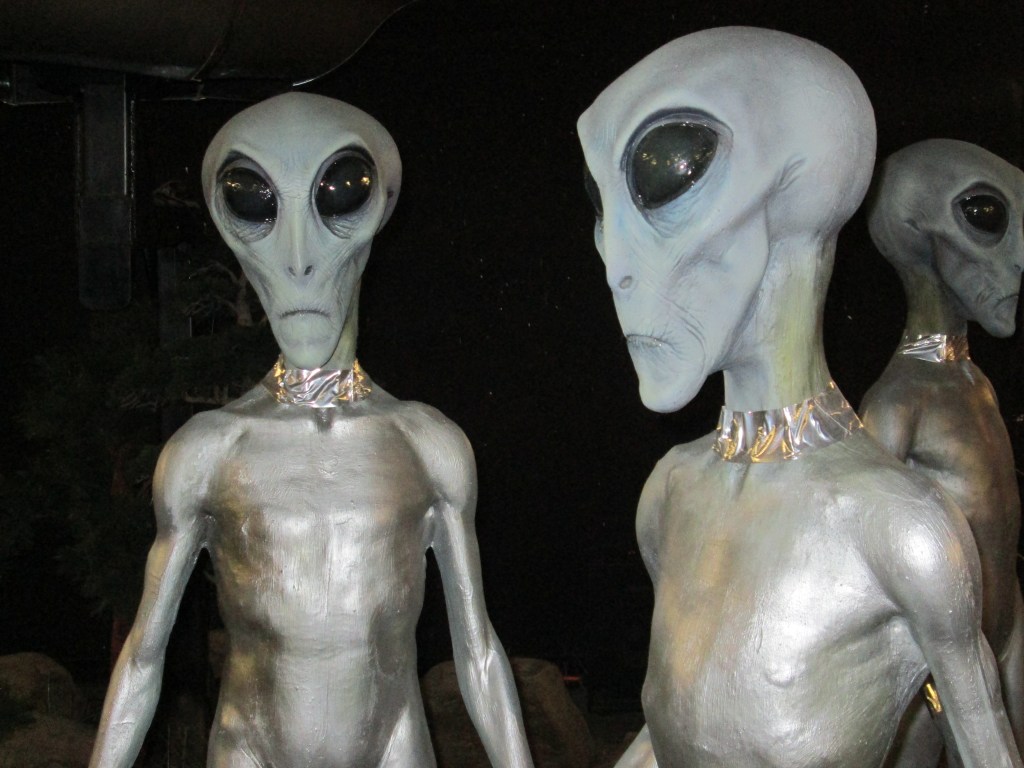
Space Aliens from Roswell, NM UFO Museum

What happens to Christianity if space aliens from another world were to make contact with us? What would they made of the Garden of Eden, the Incarnation, the Crucifixion and a thousand other details that are part and parcel of Christianity? What are the chances that any of the space aliens would ever convert to Christianity?

In fact, all the major monotheistic religions would come across as quaint and primitive. That includes Judaism and Islam. The life experience of creatures from another world would be so radically different that they in turn would affect how (and whom) earthlings worshiped.

I do not necessarily believe that we will ever contact space aliens, but I do wonder what would be the result of such a contact. At worst, it would be like that famous Twilight Zone episode from Season Three of that show entitled “To Serve Man.” (At the end of the episode, it is revealed that the “To Serve Man” book the aliens carried was not an altruistic guide, but a cookbook!) At best, there is the movie The Day the Earth Stood Still (1951) with Michael Rennie’s Klaatu come to warn Earth that it is in danger of destroying itself.

Myself, I am more inclined to think of any space invaders as Conquistadores come to enslave the planet and mine it for its riches.

Birthday! Birthday!! Birthday!!!

Now Imagine This Cake with 78 Candles on It

Over the last few decades, I have become quite blasé about my date of birth. I usually saw I was born on the thirteenth day of the thirteenth month (which is true, as the months wrap around). When asked for my astrological sign, I say, “No Trespassing.”

When you’re young, you get all kinds of cake and presents. When you’re my age, you just get measurably older.

Am I any wiser? Not really, I am probably a little more tolerant maybe up two percentage points. I have definitely noticed I am getting more crabby. (Those kids had better get off my lawn, STAT, or I’ll have to reach for my flamethrower.)

After what I went through with my brain tumor more than half a century ago, I never thought I would live this long. Even as a grade school kid, I looked forward to the year 2000 and thought, “Wow, if I live to that year, I’ll be fifty-five years old!” And to an eight-year-old, that seemed really O-L-D.

My father died at the age of seventy-four; and my mother, at the age of seventy-nine. Though I am minus a few body parts (pituitary gland, left hip), I am still surprisingly healthy. The joints are getting a bit creaky, but I can still walk. As for my mind, well let us speak respectfully of the dead.

I wonder, what kind of crap will I write when I reach seventy-nine?

Entanglement

It Baffled Einstein, But Suggests a Whole Different Outlook on the Universe

Einstein called it “spooky action at a distance” and quipped, “God does not play dice with the universe!” But apparently, He does. Mind-bending experiments have seemingly invalidated the speed of light (186,000 miles per second) when two protons shot in opposite directions sped away from each other at that speed. A measurement of one of the two protons affected the other one instantaneously, although theoretically communication between them was impossible. Here is one recent explanation by a physicist.

In the Wikipedia article on Quantum Entanglement, it says:

Measurements of physical properties such as position, momentum, spin, and polarization performed on entangled particles can, in some cases, be found to be perfectly correlated. For example, if a pair of entangled particles is generated such that their total spin is known to be zero, and one particle is found to have clockwise spin on a first axis, then the spin of the other particle, measured on the same axis, is found to be anticlockwise. However, this behavior gives rise to seemingly paradoxical effects: any measurement of a particle’s properties results in an irreversible wave function collapse of that particle and changes the original quantum state. With entangled particles, such measurements affect the entangled system as a whole.

Apparently some things in the universe are linked together in ways we do not yet understand.

At the same time, I think people are also similarly “entangled.” For example, I firmly believe one cannot avoid auto accidents without being able to make a good guess whether the other driver (whose face you have not seen) is going to cut in front of you. Unless I am distracted by conversing with a passenger, I am pretty good at “reading” traffic. How is that possible?

Then there is the whole question of presentiments of disaster which are proven to be true, There have been studies that people who have survived disasters had some foreshadowing of what was to occur. Does that mean that people are in some strange way entangled with events?

We are used to seeing people, things, and events as existing in separate “boxes.” What if some elements are in fact separate, and others are interlinked in ways we cannot foresee? Perhaps in future scientists will be able to describe how some of these entanglements work. Until then, we will just have to open our minds to a certain degree of strangeness. Which is probably a good idea in any case.