Why I’m Such a Lousy Chess Player

White to Move and Mate in 2

Actually, I do not know the solution to the above chess problem, although it is a famous one by fellow Hungarian György Bakcsi. I suppose, given a large expanse of time, I could figure it out. (My source is here, but no solution is given.)

I probably would never have gotten into this position. You see, I am an odd sort of chess player. Instead of seeking unbalanced positions that lead to a win, I seek balanced positions that have a high aesthetic value. And that’s when I lose. I have frequently lost to people who learned the moves from me. I’m very good at teaching people how to play chess; but I’m not very good at teaching people how to win at chess. Oh, I can go over the corridor mate, the fool’s mate, and various other typical positions as samples; but I am useless at showing how to set up the position.

And yet I love chess. If I could, I wouldn’t mind traveling with a chess set and chessboard, setting it up in a public place, and going over the moves of such great players as Capablanca, Alekhine, and Keres. You know what would happen, though? Someone would come up and offer to play chess with me. I would invariably turn my would-be opponent down, because I am more interested in studying chess than playing, especially with strangers.

No matter, I still love the game. When the children of my friends try to interest me in their computer games, I always tell them there is only one game for me, and that is chess. It is infinite. The different combinations of the first 10 moves by white and black alone is a number larger than the number of atoms in the universe.

Could You Spare a Crust of Bread for a Hungry Peacock?

Where’s His Cardboard Sign?

Today I took Martine to the Los Angeles Arboretum. There we ate at the Peacock Café, where various peacock moochers attempted to cadge some treats from us. Martine was good (the Arboretum doesn’t want visitors to feed their wildlife), but I couldn’t help leaving a few crumbs of bread on the side of the table, which were voraciously accepted.

Martine and I are going through a difficult period. She still wants to leave Los Angeles. Not being married, I could not stop her. All I could do is keep the welcome mat out for her at all times. If she left, she would probably go back to Sacramento, where pretty much the only people she knows are in the cemetery. I feel sometimes as if I were treading barefoot on broken glass. Still, the way things are, I prefer being with her than without her. We have been together for almost thirty years, and I like being with her, even during difficult times.

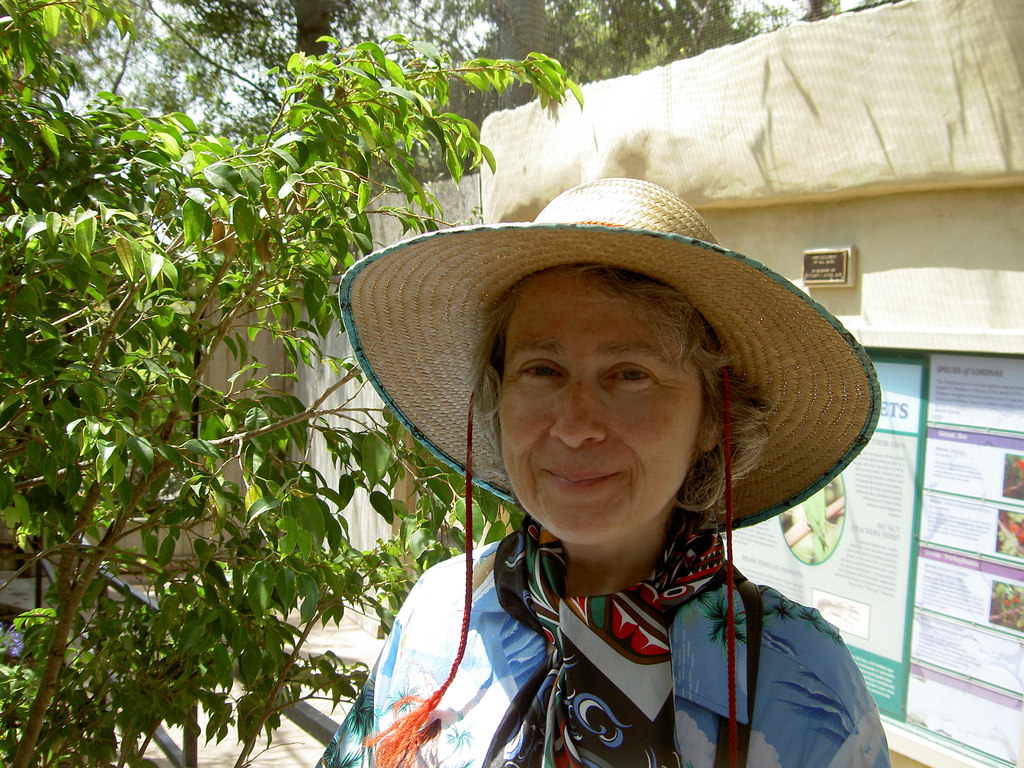
Martine at the L.A. Arboretum

No, I am not interested in looking for someone else at this point so that I can celebrate Martine’s attempts to live alone without friends or funds. Some people are difficult, but if they are at the same time gentle and kind, they are worth their weight in gold.

Afterwards, we went to the China Islamic Restaurant in Rosemead, where I ordered lamb chow mein with fresh dough-cut noodles and sesame green onion bread.

Fun with Calvin and Hobbes

I Miss Calvin and Hobbes

Let’s face it: I never really grew up. I sill love the comics. My day is not complete until I have read the comics in the Los Angeles Times, which I have delivered at home daily and Sundays. I still miss many of the cartoon strips that no longer appear, going all the way back to Walt Kelly’s Pogo. I also loved Gary Larson’s The Far Side, Johnny Hart’s B.C. and The Wizard of Id, and Patrick McDonnell’s Mutts. Fortunately, some great comic strips come back: I am thinking of Berkeley Breathed’s Bloom County, which now appears with new cartoons on Facebook.

Bill Watterson’s Calvin and Hobbes lasted from 1985 to 1995, but you can see all of them at Gocomics.Com. I am slowly re-reading the entire work of this great cartoonist and philosopher.


When the Sunday paper arrives, I still read the comics starting from the bottom of the last page and ending up with the top of the first page. Some habits never die.

Gemina

Gemina, the Giraffe With the Crooked Neck

Tomorrow, I will take Martine to one of our favorite places, the Santa Barbara Zoo. Martine will probably leave me at some point in the next two or three weeks, so I want to spend some of that time revisiting places we love.

Although Los Angeles has a bigger zoo, it is so crowded and so constricted by constant construction that visitors have a hard time negotiating the paths without getting run over by harassed parents pushing strollers. As their website says, the SB Zoo has 500 animals and only 30 acres. That’s just about our speed, and tomorrow promises to be a nice day.

The most remarkable animal we have seen at the Zoo is the late Gemina, the giraffe with the crooked neck. The following long quote is a release from the zoo that I thought I’d like to pass on to you:

If you visited the Zoo between 1990 and 2008, you probably saw an unusual giraffe. Her name was Gemina and she had a crook in her neck.

Born at the San Diego Wild Animal Park (now San Diego Safari Park) in 1986, Gemina was a Baringo (or Rothschild’s) giraffe, and joined the Santa Barbara Zoo’s giraffe herd when she was just about a year old.

Her neck seemed normal until a bump appeared when she was around three years old. Slowly, over time, it sharpened into a distinctive “V”, which interrupted the graceful curve of her neck.

Though she was examined by veterinarians, a cause for the crook could not be determined. The good news? In spite of her appearance, she didn’t exhibit any signs of being in pain.

In fact, the crook didn’t hamper Gemina’s life at the Zoo. She received normal treatment by zookeepers, ate normally, gave birth to a calf, and was an accepted member of the Zoo’s giraffe herd. She was beloved by our guests, locals and visitors alike.

Long before I came to work here as the Zoo’s publicist, management had decided not to sensationalize Gemina. We could have emblazoned her image on t-shirts and made banners with her silhouette, but that’s not our style. She was a member of the giraffe herd, and not to be exploited. We responded to media requests, but didn’t push out the story.

But Gemina became an icon in spite of our low-key approach. In its second season (2004), “The Bachelor” filmed a sunset dinner at the giraffe exhibit, and the couple met Gemina. In the 2005 television show “Miracle Workers,” she was the source of inspiration for a young boy with severe scoliosis. In 2007, she was voted Number One of the “Seven Wonders of Santa Barbara” in a local radio station poll.
Martine at the Santa Barbara Zoo in 2007 … in Happier Times

By then, she was 20 years old, which is elderly for a giraffe in captivity. We threw a party for her 21st birthday, knowing that her time was nearing an end. Many of us had tears in our eyes when Zoo Campers, wearing self-made giraffe hats, sang “Happy Birthday.”

She lived another five months, before she stopped eating and her health declined. Gemina was humanely euthanized on January 9, 2008. It was a sad day at the Zoo.

But her memory lives on. Gemina is still the most asked-about animal at the Zoo, even eight years later. A children’s book, “Gemina the Crooked-Neck Giraffe,” written and illustrated by Karen B. Winnick, was released in 2013, and is still for sale in the Zoo Gift Store (all proceeds benefit the Zoo).

Now, her fans can again visit Gemina. Her distinctive top six vertebrae, skull, and jawbone have been preserved and rearticulated, and are now on view in a display case as part of the Zoo’s “Animals…Inside Out” art exhibit in the Discovery Pavilion’s Volentine Gallery.

It’s free, with admission, to view Gemina and the exhibit of cool animal x-rays. Gemina’s skeleton is on view 10 a.m. to 3 p.m. weekdays, and 9:30 a.m. to 4:30 p.m. on weekends.

Thanks goes to Skulls Unlimited for her skeletal work, and to TruPart, a Ventura company, for building the display case free of charge.

Gemina reminds us all that being different is just fine. She’s a reminder to me not to blithely feed the media’s appetite for the odd and outrageous. That we can tell a quieter story, about being accepted in a herd of your peers and loved by a generation of visitors. That one giraffe can still stand tall, even with a crooked neck.


 

Wandering Mindfully in DTLA

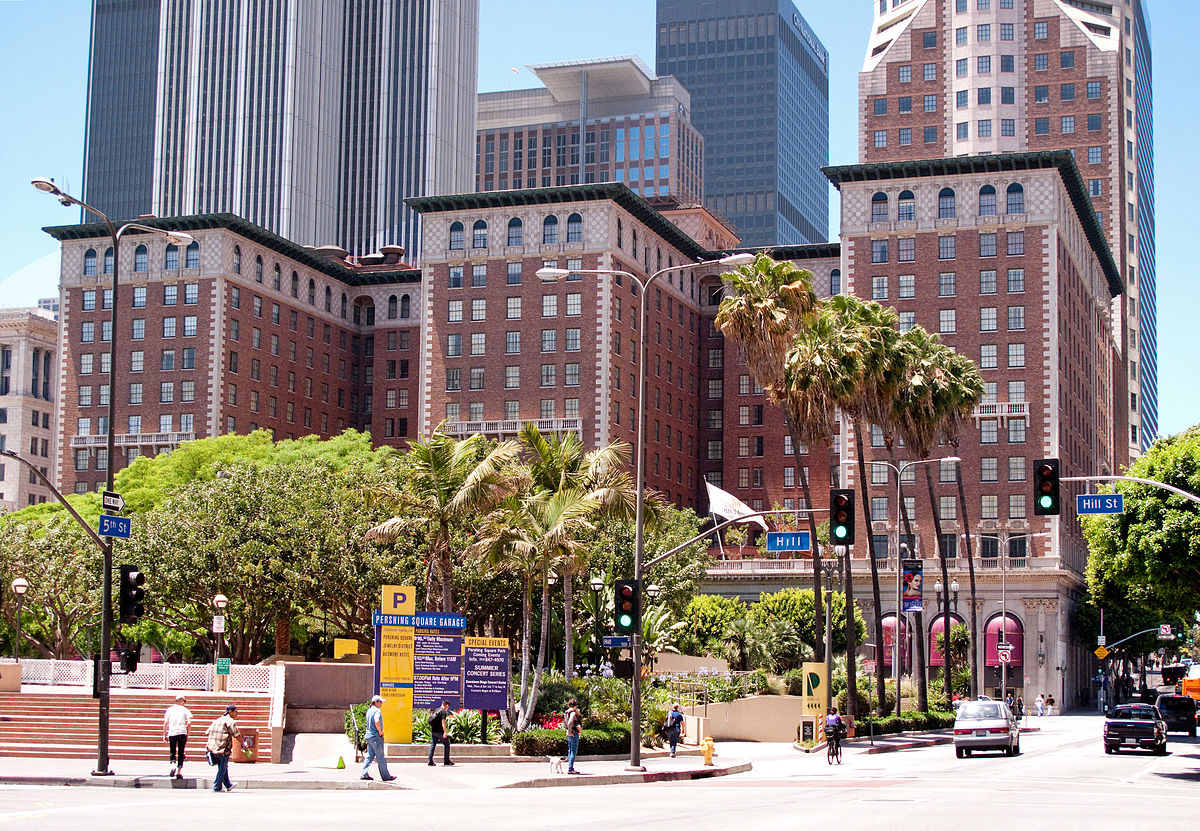
The Millenium Biltmore Hotel on Pershing Square in Los Angeles

I am facing a change in my life relating to my relationship with Martine. It appears that, before long, we will not be together. The odd thing is that we still love each other: The reason for Martine’s desire to leave has more to do with how she feels about herself. There is a French expression bien dans sa peau: Feeling comfortable within one’s own skin. Ever since she got a pinched nerve in her back early in 2013, she has not felt well. Plus, she seems to just want to leave Los Angeles, which I cannot do at this time without quitting my job and running through my savings..

My first reaction was anger and sadness. The sadness is still there, but to make her feel even more depressed would be doing her an injustice. All I can do is hope she will discover that life with me is indeed preferable—even if it is in Los Angeles. My door will remain open for her.

How am I coping with this event? I will concentrate on my mindful meditation practice. I wandered around downtown LA (a.k.a. DTLA) after my meditation session at the Central Library. I ate lunch at the Bugis Street Brasserie at the Millenium Biltmore Hotel on Pershing Square. The red awnings at the lower right of the above photo is where the restaurant is located.

Then I stopped in at the Last Bookstore at 5th and Spring, looking for more Teju Cole books. Apparently they sold out. Then I took the Dash D bus to Union Station and waited for the Santa Monica Big Blue Bus #R10 to take me back home.

Home will be a different experience, but I am resolute about not poisoning the well.


What, Me, Getting Lost?

This Image Is Practically Engraved in My Memory

Apparently, I have this phobia of getting lost. When my brother and I were in Ecuador last October, we could not find any street atlases; though, it wouldn’t have done us any good if we had them, because outside the central tourist area of the cities, there were no street signs. Dan made fun of me for my meltdowns when we wandered off what maps we had. There mus have been an incident in my childhood when getting lost from my Mommy and Daddy terrified me. I wrote a blog about this entitled Where the Streets Have No Name.  (Sorry, Edge and Bono!)

Where this is all leading to is a dream I had last night. I was traveling alone in the City of London. Having been there five or six times and having expended fierce amounts of shoe leather each time, I have a good picture of the city permanently resident in my head. I was trying to find a bookstore near Charing Cross Road, but had no idea where I was. And, even more peculiar, there did not appear to be any Underground or Tube stations on the inadequate map I had.

I had had some sort of meeting and was wandering around the city with some of the participants. At one point, they decided to stop and have an impromptu cricket match, which fortunately did not last long. When they stopped, we kept wandering in an easterly direction, coming on a square with a large Catholic church and a troupe of nuns ministering to the need of a large bump encampment. I thought to myself, “Gee, I had no idea there were so many bums in London.”

In the end, the dream just came to a stop. (Did I wake up at that point?) Although I jnever got to my bookstore nor to any other recognizable monument or building, I was more perplexed than terrified.

Thi9s is not the first time I got lost in my dreams. In none of them did my reaction rise to nightmare levels, but it is an interesting recurring theme—sort of like having to give a public speech while buck naked.


Musashi and the Flies

You Don’t Have to Draw a Sword to Prove Your Swordsmanship

I had forgotten the movie in which this scene took place until I viewed the DVD this morning. The great masterless samurai, Musashi Miyamoto (played by the redoubtable Toshiro Mifune), is holed up in a cheap inn in which a loud group of gamblers was partying. When Musashi’s disciple, Jotaro, goes out and tells them to shut up, they decide to teach Musashi a lesson. They charge up he stairs to his room, where Musashi is calmly eating a dish of noodles with his chopsticks. He is not much bothered by the gamblers, but he is irritated by the flies buzzing around him and his meal. Without sparing a glance elsewhere, he reaches out with his chopsticks and kills several flies, one after the other. The gamblers are awestruck at Musashi’s demonstration of icy control and quietly back out of his room. In fact, their ringleader, Kumogoro, insists on becoming Musashi’s disciple.

The film is Duel at Ganryu Island (1956), the third film in Hiroshi Inagaki’s Samurai trilogy.

Although the Inagaki trilogy is by no means the greatest of samurai films, I have so many happy memories of seeing the films that I have invested them with perhaps more merit than they deserve. They are, in fact, quite good—particularly at influencing a 21-year-old who had just arrived in Los Angeles and found the whole genre congenial to him.

Samurai Swords

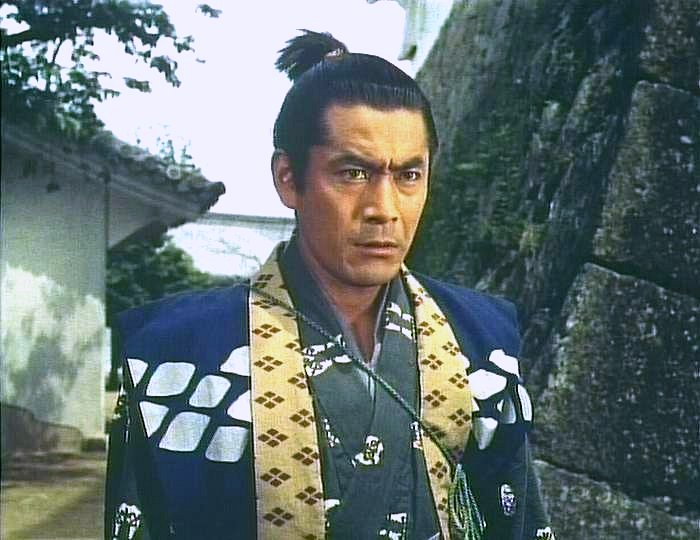
Toshiro Mifune as Musashi Miyamoto

The above scene is an evocative moment in Musashi Miyamoto (1954), the first film in Hiroshi Inagaki’s Samurai trilogy. Musashi, heretofore called Takezo, has been imprisoned in Himeji Castle by the wily (and wise) Buddhist priest Takuan for three years. He has just stepped out of the castle for the first time and takes a look back at the walls that held him while he learned to tame his wild impulses.

I first saw Inagaki’s trilogy at a seminal point in my life. I had just moved to Los Angeles to start studying film history and criticism at UCLA. Before my classes  began in January 1967, the Toho La Brea theater began screening Musashi Miyamoto. In the following months, Duel at Ichijoji Temple (1955) and Duel on Ganryu Island (1956)—the remaining films of the trilogy—were to be shown. Although I had seen many films at Dartmouth College, I was just starting to get into the whole jidai-geki genre.

Also, I fell in love with Kaoru Yachigusa, the perennially frustrated love interest in the trilogy.

In fact, I got so much into it that, in June, I moved to an apartment on Mississippi Avenue, right in the heart of the Sawtelle Japanese-American neighborhood. At that time, there were two Japanese restaurants around the corner, the O-Sho and the Futaba Grill, where I frequently dined, learning how to tame those unruly chopsticks. My ignorance was still pretty much in evidence: I took the squares of tofu in my miso shiru soup to be shark’s fin.

Kaoru Yachigusa as Otsu, the Love Interest in the Trilogy

Before long, I was going with my film friends to all five Japanese movie theaters in Los Angeles: Not only he Toho LaBrea, but the Kabuki (Shochiku Studio) and Kokusai (Daiei Studio) near Adams and Crenshaw, and the Sho Tokyo (Daiei Studio) and Linda Lea (Tohei Studio). Now all five theaters are gone, but back then, I collaborated with two of my friends (Alain Silver and Jim Ursini) in a column for The UCLA Daily Bruin entitled “The Exotic Filmgoer,” which commemorated not only the Japanese theaters, but some of he others. We wrote under the collective pseudonym of Tarnmoor.

The Criterion Collection has released DVD and Blue-Ray editions of the Samurai trilogy, which are well worth your while.

“This Must Be Thursday”

The Richard Riordan Central Library in Downtown Los Angeles

The entire quote is from Douglas Adams, author of The Hitchhiker’s Guide to the Galaxy: “This must be Thursday. I never could get the hang of Thursdays.” And that’s the way I felt when I was working full time in an accounting office. I never did get along very well with my boss (nobody could), so when he cut me back to two days a week, I saw that as an opportunity. I said, “Okay, I’ll work on Tuesdays and Fridays.” Those were days when our late tax manager worked, so my boss couldn’t use me as a highly unqualified tax manager, which he was not above doing.

One Thursday in June 2016, I took the Expo Line downtown and hung out at the Central Library on Fifth Street. Just by chance, I noticed that there was a regular Mindful Meditation session conducted by the UCLA Mindful Awareness Research Center (MARC), and I attended.  And I’ve been attending ever since. I read for a couple of hours in the Literature and Fiction Department on the top floor, and usually check out a couple of books. Then I go to Meeting Room A on the ground floor where the sessions are held.

In more ways than one, the Central Library has become a part of my life. I feel energized by these meditation sessions. Afterwards, I go for lunch either to the Grand Central Market on Hill Street, Little Tokyo, Chinatown, or Olvera Street. Then I take the Big Blue Bus R10 freeway flier back home.

So now I can say I get the hang of Thursdays. It’s one of my favorite days of the week. That leaves Mondays and Wednesdays for doctors’ appointments and miscellaneous explorations of this gigantic city of which I am becoming more of a part as time passes.


Alienation Effect

Rod Serling with Playhouse 90 Logo

Today was a strange day. It was beastly hot and humid, with a Mexican Monsoon effect. Having no air conditioning in our apartment—and living in an area that regularly gets hit by power blackouts—Martine and I decided to go to the Paley Center for Media in Beverly Hills.  The lobby was crowded with young tourist couples seeing the displays about American Horror Story, a series on FX with which I was previously unacquainted. These guys (and their women) were heavily tattooed, wore their baseball hats backwards, did not know to flush toilets, and led with their smart phones taking pictures of everything in sight.

I suddenly felt old. Here I was with a large group of young people that made me feel alienated. And here I was going to see a couple of Playhouse 90 episodes from 1959. I might has well have been talking in Armenian to a group of prairie dogs. Did I feel bad about that? In a way I did, though I would not have considered going far to seek common ground with them: The gulf between me and them yawned as big as the Grand Canyon.

But I felt delighted with the Playhouse 90 episodes I saw, shot in consecutive weeks. The first was “The Town That Turned to Dust,” written and introduced by Rod Serling and directed by John Frankenheimer. The story was about a lynching in a small Texas border town called Dempseyville of a Mexican youth who was accused by William Shatner, as the local dry goods merchant, of beating up his wife Fay Spain and robbing the store. The sheriff who is powerless to prevent the lynching is Rod Steiger, in a powerful role, with James Gregory as a visiting newspaperman.

The other was a dramatization of “The Great Gatsby” starring Robert Ryan as Gatsby and Jeanne Crain as Daisy May Buchanan. Rod Taylor was excellent as Nick Carraway. Rod Serling introduced the episode, which was directed by Franklin Schaffner.

Although I do not watch much (if any) current television, I have a great deal of love and respect for the early days of the medium. Back at the beginning, they not only knew how to produce superlative entertainment, but used people who knew how to act, not just nod their heads meaningfully.