M-I-C-K-E-Y M-O-U-S-E!

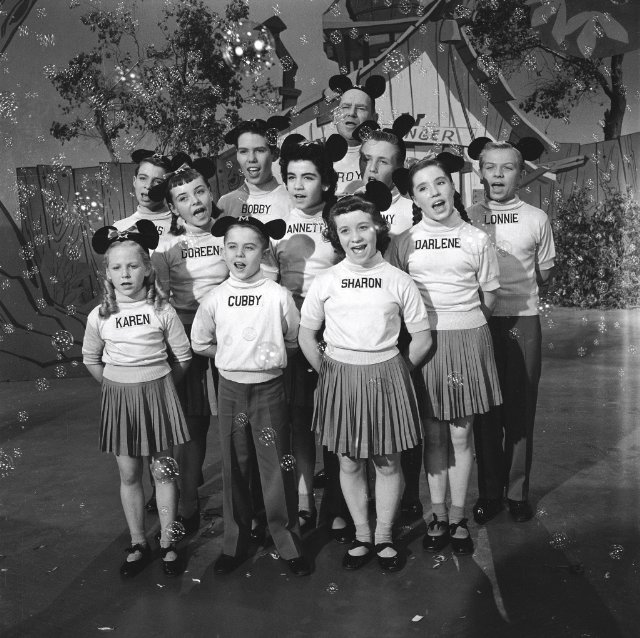
Mousketeers with Jimmie Dodd

Mousketeers Around the 1950s

It all started in 1955. Not that it was the first TV show for kids—the Howdy Doodie Show beat it by eight years—but it was the first kids show featuring kids. I am referring, of course, to the Mousketeers of the Mickey Mouse Club.

After a morning doing tax returns at work, I acceded to Martine’s request to drop in at the Paley Center for Media in Beverly Hills. While Martine was watching some of her faves, I decided to see two episodes of the Mickey Mouse Club show, one from 1956 and one from 1957.

I saw at once why the show was a success. Not because I was entertained the way when I was a kid, but because Walt Disney had so much material lying around in film cans that there wasn’t as much of a burden to come up with new material for every show. Every show ended with a quarter hour cartoon segment from the vaults, and there were regularly repeating cartoon intros for the opening and many of the segment categories.

The live portions included the talents of the Mousketeers, including singing and dancing, and visiting a training center for firemen. They also featured local talent such as an archery champion and two yo-yo experts, all of whom were in their teens.

Of course, I watched the show religiously until I deemed myself too old and sophisticated and no longer in love with Annette Funicello with her dark hair and flashing eyes.

Tannu Tuva or Bust!

Very Nice, But There Were No Railroads in Tuva

Very Nice, But There Were No Railroads in Tuva

One of the things I remember most vividly from my stamp collecting days was the availability of postage stamps for non-countries. These were for real places on the map, but not for entities that had their own postal services. The one I remember most vividly is Tannu Tuva (formerly in the Soviet Union).

According to Wikipedia:

Tuva was a region in central Asia between Russia and Mongolia, which in 1921, under Russian instigation, became the Tuvan People’s Republic. A treaty between the Soviet Union and the Mongolian People’s Republic in 1926 affirmed the country’s independence, although no other countries formally recognized it. In 1944, it was annexed to the Soviet Union as part of the Tuvan Autonomous Oblast and in 1961 became the Tuva Autonomous Soviet Socialist Republic. Its successor since 1992, the Tuvan Republic, is a member of the Russian Federation.

I remember reading a book in the 1990s about American physicist Richard Feynman’s failed attempts to visit Tuva, which were detailed in a book by Ralph Leighton entitled Tuva or Bust!: Richard Feynman’s Last Journey. Apparently he never got a visa approval before his final illness.

Some early Tuvan stamps may actually have been used postally, at least in the early days. Most, however, were issued in Moscow with picturesque settings to hard currency from capitalist collectors for Mother Russia. The stamp pictured above of a camel racing a railroad train was a bit fanciful, as there are no railroads in Tuva. Also, why wasn’t the text on the stamp in Cyrillic or even Mongolian letters?

I remember confronting an old family friend about his extensive collection of Tuvan postage stamps. A former postal employee, he became red in the face when told by a little boy that his Tuvan stamps were merely pretty paper.


Adventures in Stamp Collecting

20 Fillér Stamp Honoring Hungarian Radio Manufacturing

20 Fillér CTO Stamp Honoring Hungarian Radio Manufacturing

One would think that nothing can be so staid and stolid a pastime as stamp collecting. Mind you, it’s getting increasingly difficult since most stamps—in the U.S. anyway—are of the peel and stick variety. As a child, I remember soaking stamps still attached to pieces of envelope and postcard in lukewarm water to remove the gum. Then I carefully dried the stamps under a blotter weighted down with a book so the stamps wouldn’t curl. The end result was pretty presentable.

But then the Soviet block discovered CTO—short for canceled to order—with perfect cancellations that were printed right on the stamp which came without gum. In effect they were mint ungummed stamps.

Of course, mint never used stamps were more expensive. Putting them in albums caused a certain amount of existential angst. One could use a stamp hinge, but (horrors!) it left a mark on the gum. The option was to buy expensive mounts in which the mint stamps were wholly encased.

My guess is that there are relatively few stamp collectors left, and that they are mostly aging rapidly. What with smart phones and their ilk, kids are not interested in anything that requires patience, knowledge, and care. Too bad! I learned a lot from my old hobby and had lots of fun.

This is the first of several posts under the general heading of “Adventures in Stamp Collecting,” consisting of stories I remember from my collecting days.

Some of these stories are more interesting than they seem at first glance.

The Best of 2015

I Never Would have Thought It Possible....

I Never Would have Thought It Possible….

A couple of weeks ago, while I was visiting my brother in Palm Desert, the best thing about 2015 hit me right between the eyes. It was a four-month old baby named Oliver Moorman. I normally don’t go goo-goo-eyed over infants, but I have to admit I did this time. Little Ollie’s mother, my niece Hilary, and her husband Joe Moorman have collaborated on a co-production that has radiated hope in the lives of our tight little family. As you may know, I am a terrible pessimist, but little Ollie has given me some glimmerings of hope for the future.

He makes me want to help make this a better world.


Tarnmoor’s ABCs: Zsófi, Elek and the Two Boys

Our Family Around 1962

Our Family Around 1962

All the blog posts in this series are based on Czeslaw Milosz’s book Milosz’s ABC’s. There, in the form of a brief and alphabetically-ordered personal encyclopedia, was the story of the life of a Nobel Prize winning poet, of the people, places, and things that meant the most to him.

My own ABCs consist of places I have loved (Iceland, Patagonia, Quebec, Scotland, Yucatán), things I feared (Earthquakes), writers I have admired (Chesterton, Balzac, Proust, Borges, and Shakespeare); locales associated with my past life (Cleveland, Dartmouth College, and UCLA), people who have influenced me (John F. Kennedy), foods I love (Olives and Tea), and things I love to do (Automobiles and Books). This is my last entry in the series, having gone through the entire alphabet from A to Z, including even the difficult letters like J, Q, and X.

I hope you’ve enjoyed the series, which you can review by hitting the tag ABC’s at the bottom of this post.

Above you can see a picture of our little family taken around 1962. I was about to enter college, while my brother was in the 6th grade at Saint Henry School on Harvard Avenue in Cleveland, from which I graduated in 1958. My mother is Sophie—Zsófi in Hungarian—and my father is Alex—Elek in Slovak and Hungarian.

This was a difficult time for the family, as my father was under suspicion of conducting an extramarital affair with a married woman. With the tense atmosphere at home, I was eager to attend college in New Hampshire, some 600 miles east, where I would be out of the fray. Although there were some bad times around then, my mother and father stayed together. They loved Dan and me, and in the end that kept them together.

For the next twenty years, Mom had few good words to say about Dad. Except, when Alex died in 1985 at the age of of 74, he became a saint. I went along with that, because all my life I tried to please him.

Dad never understood where I was going in life. I wanted to be a professor of film history in criticism at the university level. One day, I made the mistake of calling the profession “cinematology.” Ever afterward, Dad pronounced it as if I had said “cosmetology.”

Although Dan was more like Dad in being an athlete, Dad was harder on him. When Dan was at Macalaster College in St. Paul, Minnesota, he took some time off to travel around Europe and North Africa, thus delaying getting his college diploma. (He did eventually, but Dad kept riding him for his gap year.)

I like the above picture. It shows a normal family in which all the stresses are carefully kept hidden. But the fold lines over time come out as if they were fault lines along which our family could fracture.

Fortunately, it never did.


Heart’s Desire

My Father’s Side of the Family Around 1918

My Father’s Side of the Family Around 1918

When I visited my brother a week and a half ago, he brought out two boxes of old pictures and papers relating to my past—except it was his past, too. From left to right, the pictures are of:

  • My Uncle Emil (twin of Alex)
  • “Mama” or my paternal grandmother Margit
  • Margitka, my Aunt Margit
  • Stará (Old) M., clearly a member of the family, possibly the same as my Father’s kindly Aunt Valera
  • My Father, various called Ellek, Elek, or Alex (twin of Emil)

Shortly after this picture was taken, Grandma Margit and her husband Emil Sr. abandoned their children in Prešov-Solivar while they went off to the United States. Little Emil, Elek, and Margitka were cared for by Valera. My father tells me stories of picking mushrooms in the Tatra Mountains and hunting for frog legs to feed his brother, sister, and aunt. All three children made it to Cleveland some ten years later.

As a result of fending for himself in the mountains of Slovakia during the postwar famine, my father always had an insatiable craving for meat. When he came to America, he and his brother indulged in that craving—and that’s what killed them. Sometimes it’s best NOT to have your heart’s desire.

I visited Czechoslovakia with my parents in 1977 and met Valera. She was the only Slovak in the family who could still speak Hungarian, so I was able to communicate with her. I would like to think she was the pleasant looking Stará M. in the above photo.


Selfie Sunday

This Baby Smiles for Selfies

This Baby Smiles for Selfies

Visiting my family in Palm Desert, I was amazed by my niece Hilary’s little four-month-old baby. His name is Oliver Moorman, and whenever his dad Joseph (at the left in all the pictures above) takes a selfie which includes him, little Ollie cracks a delightful smile.

The other persons are, clockwise from the upper left:

  • My brother Dan
  • Martine
  • Hilary
  • My nephew Dan
  • Me
  • Just Joe and Ollie
  • My sister-in-law Lori
  • My niece Jen (in the center picture)

Even though Joe, Hilary, and Ollie arrived from Seattle with colds, it was amazing to see the baby stage such a quick recovery.

It has been a couple of decades since I’ve handled an infant, and I have to say the experience is magical. Oh, he did occasionally squirm and fret, but in every case it was like a small cloud scudding across the sun. Just wait a second or two, and the sun comes out again bright as ever.

All of us were entranced with little Ollie. May he live long and prosper—and always be happy!


Seeing the Latest Paris

The Area Around Palm Springs

The Area Around Palm Springs

I’ll be taking a four-day weekend beginning tomorrow to visit my brother, nieces, and nephew in the Palm Springs area. Most particularly I’ll be meeting young Oliver Moorman (pictured below), who is the latest addition to the Paris family. Names don’t matter: It’s the blood that counts.

Oliver Moorman

Oliver Moorman

The little lad is the son of my niece Hilary and her husband Joseph Moorman, who live in West Seattle. In addition, Jennifer and Daniel will be driving from San Diego and L.A. respectively to join in the festivities.

My next posting will probably be on Monday or Tuesday of next week.


Feeling the Onset of Christmas

Angel at the Grier Musser Museum

Elf at the Grier Musser Museum

On Sunday, Martine and I went to view the extensive Christmas collections at the Grier Musser Museum near downtown Los Angeles. Ray and Susan Tejada have displays dating back to the 19th Century—and as recent as this year, including hundreds of fascinating Victorian and turn of the century Christmas cards.

There aren’t too many things that we do that are Christmassy. For one thing, we never have a Christmas tree. (You can blame me for having somewhere between 6,000 and 8,000 books.)  When we visit my brother next week, we may view a holiday light display at the Living Desert Museum in Palm Desert.

We always used to visit the Department of Water and Power’s Holiday Light Festival, but budgetary constraints closed that down in 2009. We also regularly attended the Christmas Concert put on by the Torrance Civil Chorale, but Concert Master David Burks retired after the Spring concert; and we incorrectly assumed that the organization would undergo extensive rebuilding.


A Martian at the Love-In

Poster for One of Bill Graham’s Presentations at the Fillmore

Poster for One of Bill Graham’s Presentations at the Fillmore

Yes, I went through the Sixties—and a wild time it was! That is, for some people. By the time I reached the (chemically-induced) age of puberty, around the age of 23, I felt badly out of place. And I would have even if I were not in swinging Los Angeles in 1967. I had just come off the operating table for a pituitary tumor in September 1966 and was still beginning to imagine life without daily severe frontal headaches pressing on my optic nerve.

Girls were pretty much out of the question. As for drugs, I was newly on hydrocortisone, thyroid, and testosterone (and still am, and will be for my whole life); and I didn’t want to see how LSD, psylocybin, and other psychedelic compounds would act on me. Also, within a few months after my arrival in L.A., I was told I had aseptic necrosis of the left hip and had to be on crutches for two years. Hence, I felt like a Martian surrounded by people who were intent on having a wildly good time.

I have never gone to a rock concert. I couldn’t even drive until 1985 because I was on a blood pressure medication (Catapres) that made me narcoleptic. On car rides, I fell asleep within minutes.

Rock Impresario Bill Graham

Rock Impresario Bill Graham

Today, Martine and I went to the Skirball Museum and saw their special exhibit on Bill Graham and the Rock & Roll Revolution. It was a revelation to me of all the things I had missed. Until this afternoon, I had no idea of the role that Graham played in sponsoring rock concerts over a quarter of a century until he died in a helicopter crash in a storm at the age of 60.

I eventually outgrew my Martian isolation. As a young woman, Martine was more familiar than I was with the big rock bands, as she listened to them all on her radio when she was growing up in New Jersey. In the 1980s, I began to catch up with the music—though in another fifteen years, I rejected all pop music in favor of classical music by dead guys in powdered wigs.

But, no matter, I was reminded of my early days in Los Angeles. I would wait until Fridays, when the L.A. Free Press was distributed. There I read about all the love-ins, the psychedelic power of oven-roasted banana skins (“bananadine”), with ads for all the head shops and local concerts. I was never much of a hippy, but it was a yeasty time. It was fun remembering it.