“All That Moveth, Doth in Change Delight”

William S. Hart (1864-1946)

William S. Hart (1864-1946)

Today Martine and I went to the William S. Hart Ranch and Museum in Newhall. Around this time of year, the docents and other volunteers make the place all Christmassy. With the Grier Musser Museum yesterday, a visit to the Hart Museum today made it a real holiday weekend.

As I was watching a video of Hart’s Hell Hinges (1916) in the Ranch House, a somber thought came to me. Hart’s career lasted only about twelve years, from 1915 to 1927. How many people alive today remember him, have seen his films, or even know who he is? Hollywood does not even make Westerns more than once in a Blue Moon. The lovely house on a hill in Newhall, which Hart called La Loma de los Vientos (“The Hill of the Winds”), may fall into ruin because it commemorates the life of a silent movie star who is all but forgotten.

At the same time, I am reading Marcel Proust’s final volume of In Search of Lost Time series, Finding Time Again. In this book, Marcel finds his world has all but disappeared with the start of the First World War. At one point Marcel the narrator muses:

In short, fashionable society had become disenchanted with M. de Charlus, not because it had seen through, but because it had never begun to penetrate his uncommon intellectual worth. People thought him ‘pre-war,’ old-fashioned, because the very people who are least capable of assessing merit are the ones who, in order to classify people, are quickest to follow the dictates of fashion. They have not exhausted, nor even skimmed the surface of the men of merit in one generation, and suddenly they have to condemn them all en bloc, because now there is a new generation, with its new label, which they will not understand any better than the last.

As I watch Marcel working his way through a Paris, lit by floodlights, zeppelins, bi-plane fighters, and a young generation in charge that has seemingly sprouted out of nowhere. In the same way, I marvel at all the young people crossing the busy street while checking their e-mail or texting to their buds.

I should know better. Edmund Spenser said it all half a millennium ago when he wrote about mutability:

Mutability

When I bethink me on that speech whilere,
Of Mutability, and well it weigh:
Me seems,that though she all unworthy were
Of the Heav’ns Rule; yet very sooth to say,
In all things else she bears the greatest sway.
Which makes me loathe this state of life so tickle,
And love of things so vain to cast away;
Whose flow’ring pride, so fading and so fickle,
Short Time shall soon cut down with his consuming sickle.

Then gin I think on that which Nature said.
Of that same time when no more Change shall be,
But steadfast rest of all things firmly stayed
Upon the pillars of Eternity,
That is contrare to Mutability:
For, all that moveth, doth in Change delight:
But thence-forth all shall rest eternally
With Him that is the God of Sabbaoth hight:
O that great Sabbaoth God, grant me that Sabbaoth’s sight.

As the year 2013 winds to a close, think for a moment of all the changes that sweeping your world away. I wouldn’t worry excessively about it, because the same winds of change will likewise sweep the fashions of the newest generation away. All the Ugg Boots, Jeggings, Razor Scooters, Smart Phones, and Google Glasses will go the way of suspenders, cowcatchers on locomotives, transistor radios, and pogo sticks. Right now, all these things are in the ascendent—but they won’t be for long.

A Hungarian Christmas

A Hungarian Christmas Tree

A Hungarian Christmas Tree

There are fewer things that can elicit such an outpouring of sentiment in me as the sound of the Hungarian language. My own knowledge of my native language is unidiomatic and ungrammatical, with a child’s vocabulary, but nonetheless, there is that rhythm and intonation that makes me think I am home. When I hear the Magyar National Anthem, or Hymnusz, I stand at attention in a way that I do not when I hear that sad old English barroom song that is the National Anthem of the United States. (And I mean no disrespect to my adopted country when I say this.) See what the Magyar Nemzeti Himnusz sounds like when done right:

It’s the same way with Christmas carols. I like many of the English carols—except for that pahruppahpummpumm monstrosity—but the Hungarian carols all sound sweeter to my ears. Try this one on for size from the group Labdarosza (“Ball Rose”?):

I have no idea what those instruments are, but I have heard them in my dreams. Here is one more, whose translated name means “Oh, Fortunate Night!”:

Although the language that is most familiar to me in English, I find that it is a language which I admire but cannot love. I sometimes feel like an exiled person. But then, I think that, to a certain extent, that is true of all of us. We have been rudely banished from childhood and made to grow up in a world which is not altogether responsive to our needs. What we have to do in our lives is to take advantage of that disconnect and use it as a source of our creativity.

Note that behind everything I say is a disconsolate Magyar six thousand miles and a generation away from what sustained him.


The Long Exhale

Yes, It’s All About My Nose

Yes, It’s All About My Nose

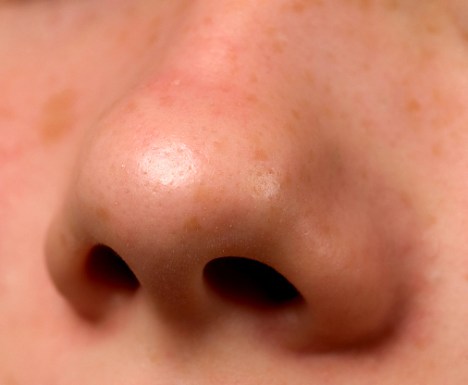
No, that’s not my nose: It looks too young. The picture is of a hijacked schnozzola. Today I’m channeling the great Eighteenth Century Scottish novelist Tobias Smollett. “Smelfungus” is the nickname that Laurence Sterne gave to Smollett after his grumbling descriptions in Travels Through France and Italy. Even more memorable, to my mind, are some of his descriptions in The Expedition of Humphry Clinker. Here, hero Matt Bramble describes a discussion about the health-giving waters at Bath:

I was t’other day much diverted with a conversation that passed in the Pump-room, betwixt him and the famous Dr L—n, who is come to ply at the Well for patients. My uncle was complaining of the stink, occasioned by the vast quantity of mud and slime which the river leaves at low ebb under the windows of the Pumproom. He observed, that the exhalations arising from such a nuisance, could not but be prejudicial to the weak lungs of many consumptive patients, who came to drink the water. The Doctor overhearing this remark, made up to him, and assured him he was mistaken. He said, people in general were so misled by vulgar prejudices that philosophy was hardly sufficient to undeceive them. Then humming thrice, he assumed a most ridiculous solemnity of aspect, and entered into a learned investigation of the nature of stink. He observed, that stink, or stench, meant no more than a strong impression on the olfactory nerves; and might be applied to substances of the most opposite qualities; that in the Dutch language, stinken signifies the most agreeable perfume, as well as the most fetid odour, as appears in Van Vloudel’s translation of Horace, in that beautiful ode, Quis multa gracilis, &c.—The words fiquidis perfusus odoribus, he translates van civet & moschata gestinken: that individuals differed toto coelo in their opinion of smells, which, indeed, was altogether as arbitrary as the opinion of beauty; that the French were pleased with the putrid effluvia of animal food; and so were the Hottentots in Africa, and the Savages in Greenland; and that the Negroes on the coast of Senegal would not touch fish till it was rotten; strong presumptions in favour of what is generally called stink, as those nations are in a state of nature, undebauched by luxury, unseduced by whim and caprice: that he had reason to believe the stercoraceous flavour, condemned by prejudice as a stink, was, in fact, most agreeable to the organs of smelling; for, that every person who pretended to nauseate the smell of another’s excretions, snuffed up his own with particular complacency; for the truth of which he appealed to all the ladies and gentlemen then present: he said, the inhabitants of Madrid and Edinburgh found particular satisfaction in breathing their own atmosphere, which was always impregnated with stercoraceous effluvia: that the learned Dr B—, in his treatise on the Four Digestions, explains in what manner the volatile effluvia from the intestines stimulate and promote the operations of the animal economy: he affirmed, the last Grand Duke of Tuscany, of the Medicis family, who refined upon sensuality with the spirit of a philosopher, was so delighted with that odour, that he caused the essence of ordure to be extracted, and used it as the most delicious perfume: that he himself (the doctor) when he happened to be low-spirited, or fatigued with business, found immediate relief and uncommon satisfaction from hanging over the stale contents of a close-stool, while his servant stirred it about under his nose; nor was this effect to be wondered at, when we consider that this substance abounds with the self-same volatile salts that are so greedily smelled to by the most delicate invalids, after they have been extracted and sublimed by the chemists.—By this time the company began to hold their noses; but the doctor, without taking the least notice of this signal, proceeded to shew, that many fetid substances were not only agreeable but salutary; such as assa foetida, and other medicinal gums, resins, roots, and vegetables, over and above burnt feathers, tan-pits, candle-snuffs, &c. In short, he used many learned arguments to persuade his audience out of their senses; and from stench made a transition to filth, which he affirmed was also a mistaken idea, in as much as objects so called, were no other than certain modifications of matter, consisting of the same principles that enter into the composition of all created essences, whatever they may be: that in the filthiest production of nature, a philosopher considered nothing but the earth, water, salt and air, of which it was compounded; that, for his own part, he had no more objections to drinking the dirtiest ditch-water, than he had to a glass of water from the Hot Well, provided he was assured there was nothing poisonous in the concrete. Then addressing himself to my uncle, ‘Sir (said he) you seem to be of a dropsical habit, and probably will soon have a confirmed ascites: if I should be present when you are tapped, I will give you a convincing proof of what I assert, by drinking without hesitation the water that comes out of your abdomen.’—The ladies made wry faces at this declaration, and my uncle, changing colour, told him he did not desire any such proof of his philosophy: ‘But I should be glad to know (said he) what makes you think I am of a dropsical habit?’ ‘Sir, I beg pardon (replied the Doctor) I perceive your ancles are swelled, and you seem to have the facies leucophlegmatica. Perhaps, indeed, your disorder may be oedematous, or gouty, or it may be the lues venerea: If you have any reason to flatter yourself it is this last, sir, I will undertake to cure you with three small pills, even if the disease should have attained its utmost inveteracy. Sir, it is an arcanum, which I have discovered, and prepared with infinite labour.—Sir, I have lately cured a woman in Bristol—a common prostitute, sir, who had got all the worst symptoms of the disorder; such as nodi, tophi, and gummata, verruca, cristoe Galli, and a serpiginous eruption, or rather a pocky itch all over her body. By the time she had taken the second pill, sir, by Heaven! she was as smooth as my hand, and the third made her sound and as fresh as a new born infant.’ ‘Sir (cried my uncle peevishly) I have no reason to flatter myself that my disorder comes within the efficacy of your nostrum. But this patient you talk of may not be so sound at bottom as you imagine.’ ‘I can’t possibly be mistaken (rejoined the philosopher) for I have had communication with her three times—I always ascertain my cures in that manner.’ At this remark, all the ladies retired to another corner of the room, and some of them began to spit.—As to my uncle, though he was ruffled at first by the doctor’s saying he was dropsical, he could not help smiling at this ridiculous confession and, I suppose, with a view to punish this original, told him there was a wart upon his nose, that looked a little suspicious. ‘I don’t pretend to be a judge of those matters (said he) but I understand that warts are often produced by the distemper; and that one upon your nose seems to have taken possession of the very keystone of the bridge, which I hope is in no danger of falling.’ L—n seemed a little confounded at this remark, and assured him it was nothing but a common excrescence of the cuticula, but that the bones were all sound below; for the truth of this assertion he appealed to the touch, desiring he would feel the part. My uncle said it was a matter of such delicacy to meddle with a gentleman’s nose, that he declined the office—upon which, the Doctor turning to me, intreated me to do him that favour. I complied with his request, and handled it so roughly, that he sneezed, and the tears ran down his cheeks, to the no small entertainment of the company, and particularly of my uncle, who burst out a-laughing for the first time since I have been with him; and took notice, that the part seemed to be very tender. ‘Sir (cried the Doctor) it is naturally a tender part; but to remove all possibility of doubt, I will take off the wart this very night.’

There is no chance that I can outdo Smollett on this score, but I’ll do my best. Ever since Ronald Reagan’s “Mo[u]rning in America,” the streets of Los Angeles have become crowded with mentally unbalanced homeless. There’s one such of indeterminate age who occupies a bus bench on Westwood Boulevard and builds a fort around himself consisting of silverfish-laden old cushions and shopping carts filled with various items of detritus. As he has not bathed since the 1980s, he is surrounded by a pungent cloud of indeterminate size. Usually, I can avoid inhaling within thirty feet of him; but today I got a whiff of him after I ended a long exhale while passing him. Fifty-sixty feet! Yechhh! Yes, I feel sorry for him: I just don’t particularly feel like breathing in his vicinity.

I don’t know if there is any cause/effect relationship, but I got a nosebleed after lunch while blowing my nose. The onset of winter weather in Los Angeles means that the air is getting much drier. That, plus possibly the bum-effluvia, made me blow a capillary.

With luck, there will be no more nose news this week, except perhaps for the smell of turkey and all the fixings tomorrow.

Have a Happy Thanksgiving!

 

Lost in the Twitterverse

Johannes Gutenberg

Johannes Gutenberg (1399-1468)

It being the fiftieth anniversary of The New York Review of Books, I read a great article by Timothy Garton Ash entitled “From the Lighthouse: The World and the NYR After Fifty Years.” There is no one I would trust more to write such an article, as Garton Ash is the author of History of the Present: Essays, Sketches, and Dispatches from Europe in the 1990s. Shortly after the collapse of Russian Communism, he traveled across the continent interviewing all the major players and trying (rather successfully, I thought) to put it all into perspective.

Probably what I remember most from the NYR article is his term “Post-Gutenberg.” That hit me right between the eyes and brought a whole lot of images into mind. I was sitting down at Bibigo in Westwood  drinking a cup of hot barley tea when a young co-ed asked me a question. I was so startled that I couldn’t hear a word she said. She inhabited a different universe than I did, a universe defined by smart phones, Twitter, and various other digital accoutrements. I couldn’t imagine a person young enough to be my granddaughter even addressing me directly in the first place, unless she held a clipboard and was soliciting long-term donations for some charity. (Part of the problem was a combination of the restaurant’s noise level and partial hearing loss caused by Ménières Disease.)

Getting back to that term “Post-Gutenberg.” If anyone is a Gutenbergian, I am one. Even though I have read three books on a Kindle e-reader this month alone, I do most of my reading in print form. In the morning, I scan through the Los Angeles Times. During lunch, I read either The New Yorker or The New York Review of Books, with resulting damage to my shirtfronts as various sauces attach themselves to me. During the working day, I visit various news websites, such as those of CNN, NBC, The Raw Story, Salon.Com, and Truthdig.Com. Home from work, I cook or warm up our dinner; and, while Martine watches television, I read a good deep-dish book.

In other words, a rather substantial portion of my day is concerned with the written word: usually in print, but occasionally in digital format. I thought  briefly of signing up for Twitter, but then I realized that my congenital verborrhea prevents me from limiting myself to 140 characters. And, being the dinosaur that I am, I prefer to use complete sentences and unabbreviated terms. Hell, I’m even a nut about the exact diacritical marks when quoting foreign words and names. (Like Ménières Disease in the first paragraph.)

So here I am, a Gutenbergian in a Post-Gutenberg universe—a Twitterverse, as it were. You know what? I am not only a Gutenbergian, but an unregenerate one at that. If you want to change me, you’ll have to send me to a cultural re-education camp where I will be forced to finger-f*ck with a smartphone all my waking hours—like everybody else.

Judging a Book by Its Cover

In 1960, This Looked Ultra-Cool

In 1960, This Looked Ultra-Cool

It is always a good idea to re-examine from time to time a book or movie that had particularly impressed you. I decided yesterday to re-read A. E. Van Vogt’s Empire of the Atom (1957), which I first read around 1960, and twice subsequently. Its hero, Lord Clane is a mutant as a result of exposure to radioactivity. The time is at some remote point in the future, presumably after a nuclear war. All of Earth is under control of the House of Linn, which rules the planet as if it were the Roman Empire.

So very much, in fact, like the Roman Empire that the first half of the book was cribbed from Robert Graves’s 1934 classic I, Claudius. There is a one-to-one correspondence between Van Vogt’s characters and Graves’s Romans: Clane is Claudius; Creg, Germanicus; the Lord Leader, Augustus; Lydia, Augustus’s wife Livia; and Lord Tews, Livia’s son Tiberius. Only about 60% into the story does Van Vogt escape from his slavish borrowing. At least he doesn’t try to muddy his story by introducing an equivalent to Caligula. It bothers me that I did not notice all this when I re-read the book in 1990, years after I had read the Graves books and seen the BBC I, Claudius TV series.

Still, even with the plagiarism, there are numerous incongruities. The Linns have spaceships with which they conduct wars on Venus and Mars; yet their main weapons are bows and arrows, lances, and swords. They use nuclear energy, but regard it as a “gift from the gods.” Their gods, in fact, are Uranium, Plutonium, Radium, and Ecks (“X”?).

Well, then, what was it that drew me to this book? Pure and simple, I loved the cover (shown above). As a teen, I was a rather sickly individual with frequent headaches—by this time I already was suffering from the pituitary tumor (chromophobe adenoma) that was to reach a climax six years later. Clane was actually a handsome man provided he wore the flowing temple robes that hid his deformities:

After re-reading the message, [Clane] walked slowly to the full-length mirror in the adjoining bathroom, and stared at his image.

He was dressed in the fairly presentable reading gown of a temple scientist. Like all his temple clothing, the cloth folds of this concealed the “differences” from casual view. An observer would have to be very acute to see how carefully the cloak was drawn around his neck, and how tightly the arm ends were tied together at his wrists.

Whoever was responsible for the book’s dust jacket was a genius. Man, I wouldn’t have minded being a mutant if I had a face like that! But, like many teens, especially short, chubby ones, I used fantasy to escape the realities of my situation. Now, half a century and more onward, it doesn’t seem to matter as much any more. I am what I am, and I do not look unkindly on what and who I have become.

Never the Twain Shall Meet

Cincinnati? Isn’t That Part of the Confederacy?

Cincinnati? Isn’t That Part of the Confederacy?

I was born in Cleveland, Ohio, and spent the first seventeen years of my life there. During that whole time, and even since then, I have never known a Clevelander who has been to Cincinnati. By air, the two cities are a mere 217 miles (or 349 km) apart. That really isn’t very far, considering that there is a good deal greater distance between Los Angeles and San Francisco. And yet Angelenos travel to San Francisco, Portland, Seattle, and Vancouver (and vice versa) a good deal more than Clevelanders travel to Cincinnati.

Why do you suppose that is? I thought about it for a while and came to the conclusion that Ohio is somewhat like Iraq or Syria, where two or more cultures co-exist (when they are not killing one another). Northeastern Ohio, where Cleveland lies, is pretty much a blue state kind of area, heavily into unions and the Democratic Party; whereas Southern Ohio is solidly Republican.

For instance, Ohio’s 8th Congressional District, currently represented by John Boehner, has not sent a Democrat to Congress since 1937.

Yesterday, while Martine and I were eating lunch at Jerry’s Deli in Marina Del Rey, the TV monitors were televising a game between the Cincinnati Bengals and the Baltimore Ravens. I’d be willing to bet there are more Bengal fans in Los Angeles than there are in Cleveland. It’s almost as if the inhabitants of “The Mistake on the Lake” (as Cleveland is known to those who, ulp, love her) think they are part of the Confederate States of America. And, in a way, they are….

Rocking with the Hungarians

Members of the Kárpátok Hungarian Folk Enesemble

Members of the Kárpátok Hungarian Folk Ensemble

Last Sunday, Martine and I went to the First Hungarian Reformed Church of Los Angeles in Hawthorne for their annual harvest festival. It was a good opportunity to catch up with L.A.’s Hungarians, who are all spread across the landscape of Southern California. And it was a great opportunity to have some home-cooked Magyar dishes (kolbasz and hurka) and enjoy the energetic dancing of the Kárpátok Hungarian Folk Ensemble (pictured above).

I am always pleasantly surprised to find out how musically talented my people are. (And me with a tin ear!) In addition to the dancing, there are always several musicians playing musical instruments from the accordion to the violin. The small church hall fairly rocked with all the musical acts.

Although I do not belong to the Hungarian Reformed church, my mother did. My Mom and Dad had an agreement between themselves that any sons in the family would be brought up as Catholics, and any daughters as Protestants. Well, it turned out there were only my brother Dan and me. We were both were baptized Catholic and attended Catholic elementary and secondary schools. For some reason, the Hungarian Catholics in L.A. don’t seem to have any festivals—at least, none of which I am aware. As a result, Martine and I usually hang out with the Protestants.

Martine may have been born in France, but she loves Hungarian food and music. And she loves Hungarian pastries. So these few local church events are high points in our year.

She Makes Her Uncle Proud

Hilary Paris at her Graduation from Cal State Long Beach in 2008

Hilary Paris at her Graduation from Cal State Long Beach in 2008

Time passes quickly. Just five years ago, I was attending her graduation from California State University at Long Beach. Today, I find she is engaged to be married. Hilary Paris has always done her father and me proud. She is a yoga instructor in the Seattle area, speaks fluent Spanish and Portuguese (that was her college major), and is in general an attractive young woman with  more poise and good judgment than most of her peers. You can find out more about her from her Yoga Blaze website.


I Am a Jonah

No, It’s Not Me ... But It Could Be!

No, It’s Not Me … But It Could Be!

I usually take lunch by myself at 11:45 am, just before the rush begins. I like to find myself virtually alone in a restaurant, deeply buried in my copy of The New Yorker or The New York Review of Books, with a glass of plain, unsweetened iced tea in front of me. Sometimes, I think that I am something of a Jonah to the dining establishments I frequent: Not for me the gay, bubbling crowds. I like it quiet so that I can read. What restaurant can long survive an influx of diners such as me?

Today, I read reviews of books about Hugh Trevor-Roper and Simon Leys, wondering to myself whether I could craft a blog out of these articles. Not without difficulty, because I have read nothing by the former and only one novel by the latter. I thought instead I would write about my lone wolf lunches during the work week. They give me a chance to catch up on the two magazines that mean the most to me, and they preserve my freedom of choice to eat at a place which would not send my glucose reading soaring skyward. ( Anyway the rest of the staff usually takes lunch about an hour after I do.)

Because I am a sort of back-room character at the accounting firm where I work, I rarely have “business lunches,” which is fine with me. I don’t like having to explain a diabetic meal regimen to strangers if I can help it.

Diabetes really doesn’t have much to do with it. Even forty years ago, I liked to lunch alone. It was around then that I discovered The New York Review of Books, which was on sale at the drugstore next to Marshall’s Coffee Shop at the corner of Olympic and Barrington. That building has since collapsed in the 1994 Northridge Earthquake. It was mostly a medical building. I remember reading in the L.A. Times that the doctors were unable to evacuate their medical records because the building was likely to pancake without notice. I wonder what happened to those records….

When it comes time for me to retire, I will probably eat almost all of my lunches with Martine, as I do now with my suppers. That would be fine with me: The quiet reading time won’t be necessary for me then as it is now in the crazed atmosphere of a Westwood accounting firm.


At Oak Glen

Martine Feeding the Goats the the Oak Tree Village Petting Farm

Martine Feeding the Goats at the Oak Tree Village Petting Farm

Although she had not been feeling well the last couple of days, Martine insisted that today was a good day to drive the hundred miles to Oak Glen in the foothills around Mount San Gorgonio, not far from Palm Springs. For me, the main attraction were the Honeycrisp apples from Snow-Line Orchard. For Martine, it was a chance to have some of the best apple pie (and accompanying American comfort food) on this planet, and a chance to spend time at the little petting zoo in Oak Tree Village, feeding the goats, pigs, llamas, alpacas, zebus, emus, and other exotic and no-to-exotic animals. Except for the three hours of solid freeway driving, it was a win/win situation all round.

At the petting zoo, Martine returns to her childhood. She feeds the animals, admonishes the goats from butting into each other, urging the animals to pick up the corn kernels she is feeding them from the ground (she is afraid of putting her hands to their mouths). When she ran out of corn, she picked up pieces from the ground that other people—mostly children—had dropped, and tossing them into the cages for the animals to eat.

When she does this, I fade into the background, find a bench in the shade, and watch her enjoy herself—all the while imagining what she must have been like as a child. Martine has had a miserable year: Ever since January, she has been bedeviled by a combination of roaming muscular back aches and a lack of sleep. It has been variously diagnosed as chronic fatigue syndrome, fibromyalgia, or one of several related ailments. Her doctor is not quite sure what it is, and none of the medications prescribed have done much but result in a regular orgy of bad drug reactions. She was unable to go to Iceland with me in June, and is afraid of going anywhere where she has to sleep in a soft bed. At home, with have an extra firm mattress and an extra firm sofa in the living room.

So I like to indulge Martine whenever possible, and Oak Glen is close to being a plenary indulgence.