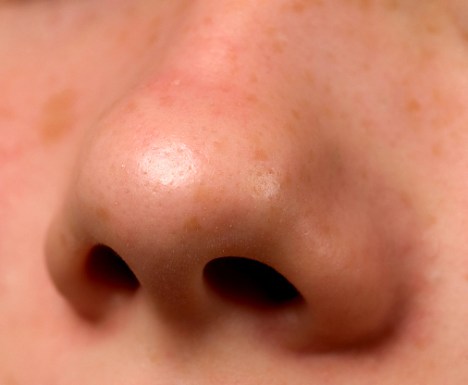
Yes, It’s All About My Nose
No, that’s not my nose: It looks too young. The picture is of a hijacked schnozzola. Today I’m channeling the great Eighteenth Century Scottish novelist Tobias Smollett. “Smelfungus” is the nickname that Laurence Sterne gave to Smollett after his grumbling descriptions in Travels Through France and Italy. Even more memorable, to my mind, are some of his descriptions in The Expedition of Humphry Clinker. Here, hero Matt Bramble describes a discussion about the health-giving waters at Bath:
I was t’other day much diverted with a conversation that passed in the Pump-room, betwixt him and the famous Dr L—n, who is come to ply at the Well for patients. My uncle was complaining of the stink, occasioned by the vast quantity of mud and slime which the river leaves at low ebb under the windows of the Pumproom. He observed, that the exhalations arising from such a nuisance, could not but be prejudicial to the weak lungs of many consumptive patients, who came to drink the water. The Doctor overhearing this remark, made up to him, and assured him he was mistaken. He said, people in general were so misled by vulgar prejudices that philosophy was hardly sufficient to undeceive them. Then humming thrice, he assumed a most ridiculous solemnity of aspect, and entered into a learned investigation of the nature of stink. He observed, that stink, or stench, meant no more than a strong impression on the olfactory nerves; and might be applied to substances of the most opposite qualities; that in the Dutch language, stinken signifies the most agreeable perfume, as well as the most fetid odour, as appears in Van Vloudel’s translation of Horace, in that beautiful ode, Quis multa gracilis, &c.—The words fiquidis perfusus odoribus, he translates van civet & moschata gestinken: that individuals differed toto coelo in their opinion of smells, which, indeed, was altogether as arbitrary as the opinion of beauty; that the French were pleased with the putrid effluvia of animal food; and so were the Hottentots in Africa, and the Savages in Greenland; and that the Negroes on the coast of Senegal would not touch fish till it was rotten; strong presumptions in favour of what is generally called stink, as those nations are in a state of nature, undebauched by luxury, unseduced by whim and caprice: that he had reason to believe the stercoraceous flavour, condemned by prejudice as a stink, was, in fact, most agreeable to the organs of smelling; for, that every person who pretended to nauseate the smell of another’s excretions, snuffed up his own with particular complacency; for the truth of which he appealed to all the ladies and gentlemen then present: he said, the inhabitants of Madrid and Edinburgh found particular satisfaction in breathing their own atmosphere, which was always impregnated with stercoraceous effluvia: that the learned Dr B—, in his treatise on the Four Digestions, explains in what manner the volatile effluvia from the intestines stimulate and promote the operations of the animal economy: he affirmed, the last Grand Duke of Tuscany, of the Medicis family, who refined upon sensuality with the spirit of a philosopher, was so delighted with that odour, that he caused the essence of ordure to be extracted, and used it as the most delicious perfume: that he himself (the doctor) when he happened to be low-spirited, or fatigued with business, found immediate relief and uncommon satisfaction from hanging over the stale contents of a close-stool, while his servant stirred it about under his nose; nor was this effect to be wondered at, when we consider that this substance abounds with the self-same volatile salts that are so greedily smelled to by the most delicate invalids, after they have been extracted and sublimed by the chemists.—By this time the company began to hold their noses; but the doctor, without taking the least notice of this signal, proceeded to shew, that many fetid substances were not only agreeable but salutary; such as assa foetida, and other medicinal gums, resins, roots, and vegetables, over and above burnt feathers, tan-pits, candle-snuffs, &c. In short, he used many learned arguments to persuade his audience out of their senses; and from stench made a transition to filth, which he affirmed was also a mistaken idea, in as much as objects so called, were no other than certain modifications of matter, consisting of the same principles that enter into the composition of all created essences, whatever they may be: that in the filthiest production of nature, a philosopher considered nothing but the earth, water, salt and air, of which it was compounded; that, for his own part, he had no more objections to drinking the dirtiest ditch-water, than he had to a glass of water from the Hot Well, provided he was assured there was nothing poisonous in the concrete. Then addressing himself to my uncle, ‘Sir (said he) you seem to be of a dropsical habit, and probably will soon have a confirmed ascites: if I should be present when you are tapped, I will give you a convincing proof of what I assert, by drinking without hesitation the water that comes out of your abdomen.’—The ladies made wry faces at this declaration, and my uncle, changing colour, told him he did not desire any such proof of his philosophy: ‘But I should be glad to know (said he) what makes you think I am of a dropsical habit?’ ‘Sir, I beg pardon (replied the Doctor) I perceive your ancles are swelled, and you seem to have the facies leucophlegmatica. Perhaps, indeed, your disorder may be oedematous, or gouty, or it may be the lues venerea: If you have any reason to flatter yourself it is this last, sir, I will undertake to cure you with three small pills, even if the disease should have attained its utmost inveteracy. Sir, it is an arcanum, which I have discovered, and prepared with infinite labour.—Sir, I have lately cured a woman in Bristol—a common prostitute, sir, who had got all the worst symptoms of the disorder; such as nodi, tophi, and gummata, verruca, cristoe Galli, and a serpiginous eruption, or rather a pocky itch all over her body. By the time she had taken the second pill, sir, by Heaven! she was as smooth as my hand, and the third made her sound and as fresh as a new born infant.’ ‘Sir (cried my uncle peevishly) I have no reason to flatter myself that my disorder comes within the efficacy of your nostrum. But this patient you talk of may not be so sound at bottom as you imagine.’ ‘I can’t possibly be mistaken (rejoined the philosopher) for I have had communication with her three times—I always ascertain my cures in that manner.’ At this remark, all the ladies retired to another corner of the room, and some of them began to spit.—As to my uncle, though he was ruffled at first by the doctor’s saying he was dropsical, he could not help smiling at this ridiculous confession and, I suppose, with a view to punish this original, told him there was a wart upon his nose, that looked a little suspicious. ‘I don’t pretend to be a judge of those matters (said he) but I understand that warts are often produced by the distemper; and that one upon your nose seems to have taken possession of the very keystone of the bridge, which I hope is in no danger of falling.’ L—n seemed a little confounded at this remark, and assured him it was nothing but a common excrescence of the cuticula, but that the bones were all sound below; for the truth of this assertion he appealed to the touch, desiring he would feel the part. My uncle said it was a matter of such delicacy to meddle with a gentleman’s nose, that he declined the office—upon which, the Doctor turning to me, intreated me to do him that favour. I complied with his request, and handled it so roughly, that he sneezed, and the tears ran down his cheeks, to the no small entertainment of the company, and particularly of my uncle, who burst out a-laughing for the first time since I have been with him; and took notice, that the part seemed to be very tender. ‘Sir (cried the Doctor) it is naturally a tender part; but to remove all possibility of doubt, I will take off the wart this very night.’
There is no chance that I can outdo Smollett on this score, but I’ll do my best. Ever since Ronald Reagan’s “Mo[u]rning in America,” the streets of Los Angeles have become crowded with mentally unbalanced homeless. There’s one such of indeterminate age who occupies a bus bench on Westwood Boulevard and builds a fort around himself consisting of silverfish-laden old cushions and shopping carts filled with various items of detritus. As he has not bathed since the 1980s, he is surrounded by a pungent cloud of indeterminate size. Usually, I can avoid inhaling within thirty feet of him; but today I got a whiff of him after I ended a long exhale while passing him. Fifty-sixty feet! Yechhh! Yes, I feel sorry for him: I just don’t particularly feel like breathing in his vicinity.
I don’t know if there is any cause/effect relationship, but I got a nosebleed after lunch while blowing my nose. The onset of winter weather in Los Angeles means that the air is getting much drier. That, plus possibly the bum-effluvia, made me blow a capillary.
With luck, there will be no more nose news this week, except perhaps for the smell of turkey and all the fixings tomorrow.
Have a Happy Thanksgiving!









You must be logged in to post a comment.