My Toy Story

White Plastic Building Blocks

When I was young, I did not have many toys. My father worked in a factory as a machine tool builder, and my mother held various jobs including supermarket checker and assistant occupational therapist. We didn’t have much money.

Perhaps the fanciest toy I had was a Lionel O-Gauge model train I received for Christmas 1949. It ran on tracks with three rails and had several freight and passenger cars. My Dad must have felt financially secure that year to spend so much money on me. That train was used by my brother and me for approximately fifteen years.

1950s Vintage Lionel O-Gauge Train Set

What I probably played with more than anything else was a set of white pre-Lego plastic building blocks such as the ones illustrated above. I would build all kinds of structures and use them in conjunction with my pirate and military figurines.

I had a rich imagination as a boy and could play for hours imagining different situations. Do children whose toys are mostly electronic in nature have the same imagination? I think not.

Sawtelle Days

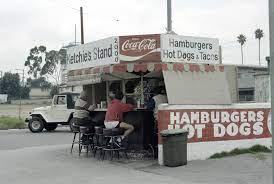
Ketchie’s Stand at Sawtelle and Missouri

The third place I lived in Los Angeles was the first that I had picked out for myself. The apartment on Sunset Boulevard was picked by my roommate and best friend, Peter; and my father picked out the hot-box on Darlington where I sweltered from a total lack of ventilation.

In the fall of 1967, I was diagnosed with idiopathic aseptic necrosis of the left femoral head. My orthopedist at UCLA thought I would be placed in traction for months, so I hightailed it back to Cleveland to stay with my parents. It turned out that the treatment was for me to be on crutches for a couple of years.

Around New Years of 1968, I returned to L.A. and, with the help of my friend Norm, found a studio apartment on Mississippi Avenue a half block west of Sawtelle Boulevard. It was and, to some extent, still is a Japanese neighborhood. And this was at a time that I was gaga over Japanese films and cuisine and culture. I dreamt of meeting some Nisei cutie who looked like Toho film star Mie Hama.

Toho Film Cheesecake Star Mie Hama

Of course, I didn’t—and, besides, what kind of dating scene can a guy on crutches have who doesn’t have either a car or a driver’s license? For me, that was still in the future….

But it was interesting living in a Japanese neighborhood and eating teriyaki and donburi regularly at the O-Sho Restaurant and the Futaba Café, which were right around the corner on Sawtelle. And there was Ketchie’s Stand at Missouri and Sawtelle where the friendly Okie chef cooked up some very creditable hamburgers and tacos.

I was still attending graduate school in film at UCLA and wound up taking two Santa Monica buses to and from classes, unless I just decided to walk the five blocks from Santa Monica Boulevard and Sawtelle.

Around this time, I joined my film friends from UCLA in making regular treks to the Japanese movie theaters in town. At the time, there were five of them: the Toho La Brea, which showed films from Toho; the Kokusai and Sho Tokyo, from Daiei Studio; the Kabuki, from Shochiku; and the Linda Lea, from Tohei. At the time, I think the Japanese film industry was consistently making the best films anywhere. Needless to say, those theaters are no more.

I lived in the Mississippi apartment for about a year before moving to the first of my two Santa Monica apartments on 12th and 11th Streets respectively. But that is a story for another time.

A Vanished Legacy

My Old Grade School—Since Renamed

Between September 1951 and June 1958, I attended Saint Henry Catholic School in Cleveland, Ohio. It was taught mostly by Dominican sisters who had a two-story convent on the premises. I started in second grade after having finished only half of first grade at Harvey Rice Elementary School in the old Buckeye Road neighborhood. My persistent nightmare is that someone will find out that a illegally skipped half a grade and force me to go back to Cleveland and sit at one of those tiny desks and spend my days trying to puzzle out phonics.

I suspect that we moved to the Harvard-Lee neighborhood primarily because, when I lived in the old Hungarian neighborhood, I didn’t speak English, which didn’t help my academic standing.

The good sisters at Saint Henry forced me to become more of an American (and less of a Hungarian). With my poor second grade marks, Sister Frances Martin O.P. (short for Ordinis Praedicatorum, or Order of Preachers) would sneak up behind me when I misbehaved, pull my ears and call me “cabbagehead.”

My grades improved, until in fifth grade I was considered less of a wiseacre and more of an “A” student. My seventh grade teacher, Sister Beatrice, was in her eighties when she taught my class. In eighth grade, I had Sister Rose Thomas.

Back at Saint Henry, we typically had an average of 55 students per class. At some point, the Harvard-Lee neighborhood became majority African American and (probably) Baptist. The church (whose entry is the door on the right in the above photo) was closed down; and in 1993 the school was renamed Archbishop Lyke School Saint Henry Campus, with an average of 17 students per class.

While I was in college, my parents joined the “White Flight” to the all-white community of Parma Heights on the West Side of Cleveland, where my brother attended Holy Family School.

When last I was in Cleveland—for my mother’s funeral in 1998—I couldn’t recognize the old Harvard-Lee neighborhood. The trees that were planted when the neighborhood was new right after the Second World War were now massive. We never had anything like that in the way of shade during the 1950s and 1960s.

Ablative Absolute

St Peter Chanel High School in Bedford, Ohio

The year was 1958. I began attending a new Roman Catholic high school which had opened the previous year. At the time, there were only a sophomore and freshman class. I was in the latter.

My most memorable teacher was the Rev. Gerard Hageman for English. He was super strict. Some years earlier, he has put together his own summary of grammatical rules which he distributed copies of to the class. Any violation of the rules, and the student received not only a flunking grade, but a zero. Since the numerical grades were averaged out—without any sort of bell curve adjustment—it was possible to get and stay in deep trouble insofar as your English grade was concerned.

Fortunately, I led the pack with an 89% average. I thrived in Father Hageman’s class. Even though I told everyone I wanted to be a nuclear physicist, at the time I did not know that I had no head for the sciences and only an indifferent head for mathematics.

I remember Father Hageman assigned us to write one page essays (graded either 0 or 100—nothing in between). Being a good Catholic, I wrote a whole series of essays on Jesus Christ standing before Pontius Pilate. My writing style was influenced largely by what I gleaned from William Faulkner after reading only The Sound and the Fury and by my class in Latin I.

The only thing I remember clearly is when I actually used an obscure Latin construction called an Ablative Absolute in one of my English essays. The opening phrase of the sentence in question was “Cold sweat covering his dolorous countenance” followed by what I conceived Pontius Pilate was thinking.

Prett6y fancy for a 14-year-old! I guess I’m still the same kind of writer, though I generally avoid obscure Latin grammar. On the other hand, by now I have read all of Faulkner’s novels; so I can copy him with some degree of confidence.

South and West

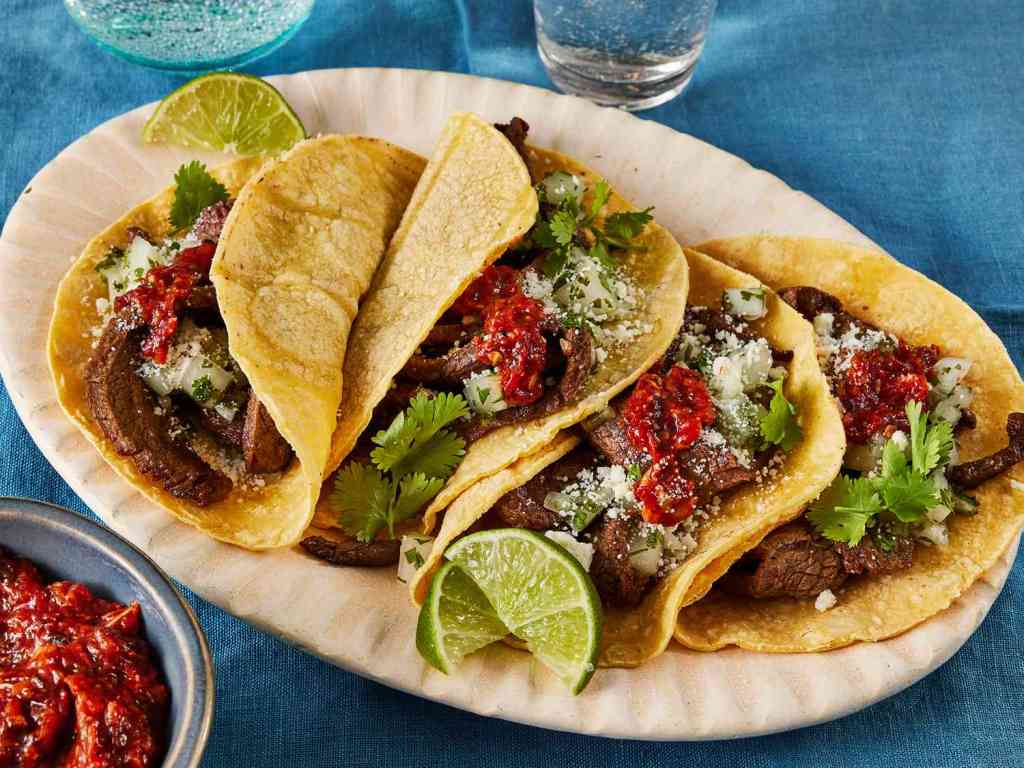
Plate of Tacos

Believe it or not, I first tasted Mexican food at the Mexico Pavilion of the 1964-1965 New York World’s Fair. The whole family had come to the Big Apple from Cleveland to help me decide where to go for graduate school. I was examining two possibilities: New York University (NYU) in Manhattan and UCLA in Los Angeles.

NYU turned out to be a complete washout. I talked to Professor Haig P. Manoogian of the NYU Film Department who did his best to convince me not to apply. Later, when I found that Martin Scorsese dedicated his film Raging Bull to Manoogian, all I could do was shrug my shoulders and blow a raspberry.

The taco that I ate at the World’s Fair was more of an indicator of where I was headed. From a childhood in Cleveland and four years of college in New Hampshire, I was headed south and west to UCLA. During the summer before my start at UCLA, I experimented with Mexican frozen food meals that were incredibly mediocre and inauthentic.

It did not take long for me to eat the real autentico item. When I was living in Santa Monica, I would have many a dinner at Castillo’s, a Mexican steam table deli on Wilshire Boulevard with a very cute server.

My tastes in food continues to go south and west: south to Mexico, and west to China, Japan, and India. Even today, I do not go much for Euro/American chow with its neatly separated meat, potato, and cooked vegetable (the exception being the Hungarian food of my youth, which I still love).

Today, I ate lunch after an early afternoon doctor appointment. I went to Kalaveras in Marina Del Rey and had a couple of carnita tacos and a bottle of draft Modelo beer. It was just what I needed, and it set me to thinking of my history with Mexican food.

Mérida Noviembre 1975

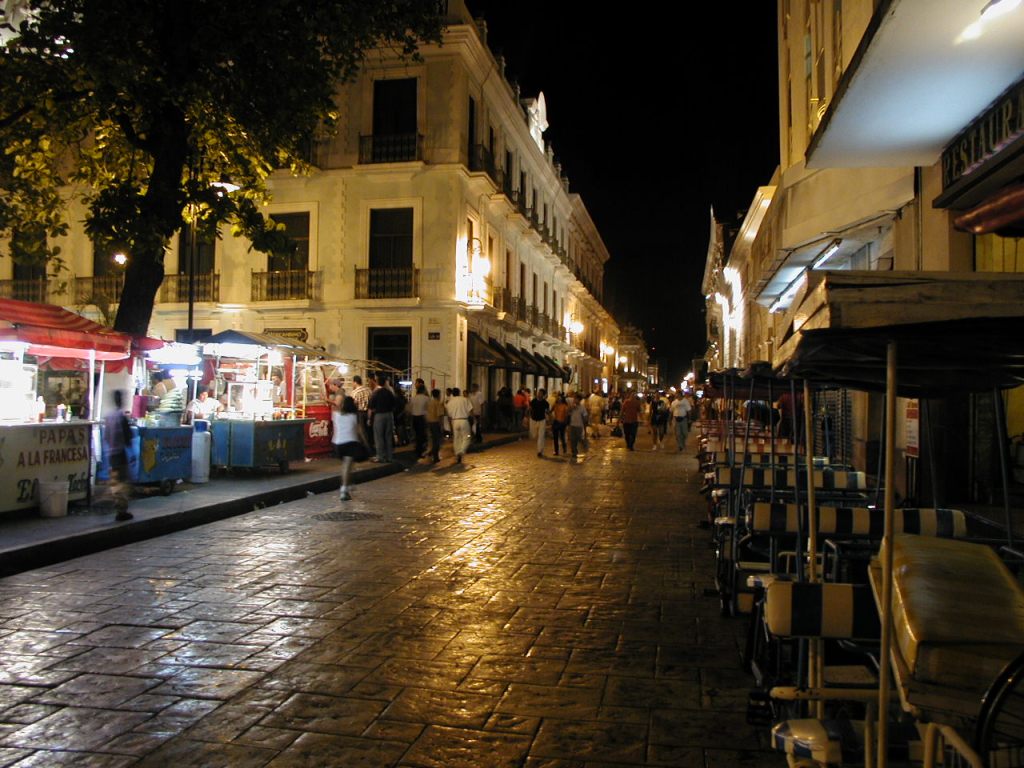
Street Scene at Night in Mérida, Yucatán

I had just landed on a Mexicana de Aviación direct flight from Los Angeles. I was thirty years old, yet this was my first trip alone that did not involve going “home” to Cleveland or going back and forth from Cleveland to college. The night was much darker than in a U.S. city, and the humid heat told me I was in the tropics. As the taxi sped to the center of town, we passed houses where I saw families seated at dinner in the dim light.

We passed a huge Coca Cola bottling plant that I later learned was the largest employer in the city.

The taxi pulled up to the Hotel Mérida on Calle 60 and I checked in. As soon as I dropped off my luggage, I took a walk down to the Plaza Grande and stopped in at several of the shops. I had a delicious meal at the Restaurant Express of Cochinita Pibil with a Cervéza Carta Clara.

Returning to my room, I finally bedded down for the night; but I couldn’t sleep. Several times, I rose from bed and looked out at the street from my ninth floor room at the Optica Rejón and other shops across the street, and a very different kind of foot traffic than I ever experienced in the States. Several times, I would stare at a Maya pedestrian dressed in the typical whites; and, knowing he was being watched, he would look up at me directly. How did he do that?

Eventually, I was able to calm down and get to sleep. Nonetheless I was up early the next morning, eager to acquaint myself with the city before branching out and visiting the Maya ruins on my schedule. I showed up at a local travel agency called Turistica Yucateca which was run by a helpful woman who didn’t know a word of English. Somehow I managed to book two trips with her using the same guide (Manuel Quinónes Moréno) who drove his own car.

The first trip was to the ruins of Dzibilchaltun just north of Mérida. The second was to the ruins of Acanceh and Mayapán, On my own, I managed to get to Uxmal and Chichén Itzá.

I was in seventh heaven. Almost nothing in this life had given me as much pleasure as that first trip on my own. As much as I have enjoyed all my journeys, that one was always special to me. It was the start of my travels. And now, as I approach the age of eighty, I still have the travel bug.

The Mobs of St. Pat’s

Robert Burns had it right when he wrote his poem “To a Mouse”:

 But Mousie, thou art no thy-lane,
In proving foresight may be vain:
The best laid schemes o’ Mice an’ Men
Gang aft agley,
An’ lea’e us nought but grief an’ pain,
For promis’d joy!

Today was St. Patrick’s day, supposedly a low-key holiday. Martine and I had a sudden yearning for corned beef, cabbage, and potatoes, so we decided to go to the Original Farmers’ Market at 3rd Street and Fairfax. We did not anticipate any hitches. More fool us!

It started with the trip to the restaurant we had picked, Magee’s, which was founded in 1917. We took the 10 Freeway to the Fairfax exit and slowly worked our way through heavy traffic which wiped out any advantage to taking the freeway.

Then, at the Farmers’ Market, there was a huge mob scene at Magee’s, with a long line waiting a place an order and an even longer line waiting for pickup. Most of the crowd were decked in various shades of green, while Martine and I were not. After waiting for the line to inch forward, we made the one good decision of the day, which was to get our corned beef and cabbage at DuPar’s.

There wasn’t even a big line at DuPar’s, which was strange as I think it is a better restaurant. Maybe it doesn’t sound Irish enough. In any case, we had a delicious meal.

If that was all that happened, I would have counted it as a good day. But then there was the trip home. Apparently, today was the day of the Los Angeles Marathon. Every year around this time, they take over the streets in a crescent-shaped swath from downtown to Santa Monica, forcing traffic from normally busy streets onto such parallel roads as Sunset, Olympic, and Pico. I had decided to take LaCienega to Olympic and head due west.

With me were thousands of other motorists. Inching forward and madly changing lanes every few feet. It took us an hour to get home. I did not entertain any kind wishes toward the marathoners. In fact, I was on the edge of cursing them with an old Hungarian anathema. Wisely, I refrained. They didn’t know I was going to venture into their bailiwick for corned beef and cabbage.

Jack Sprat

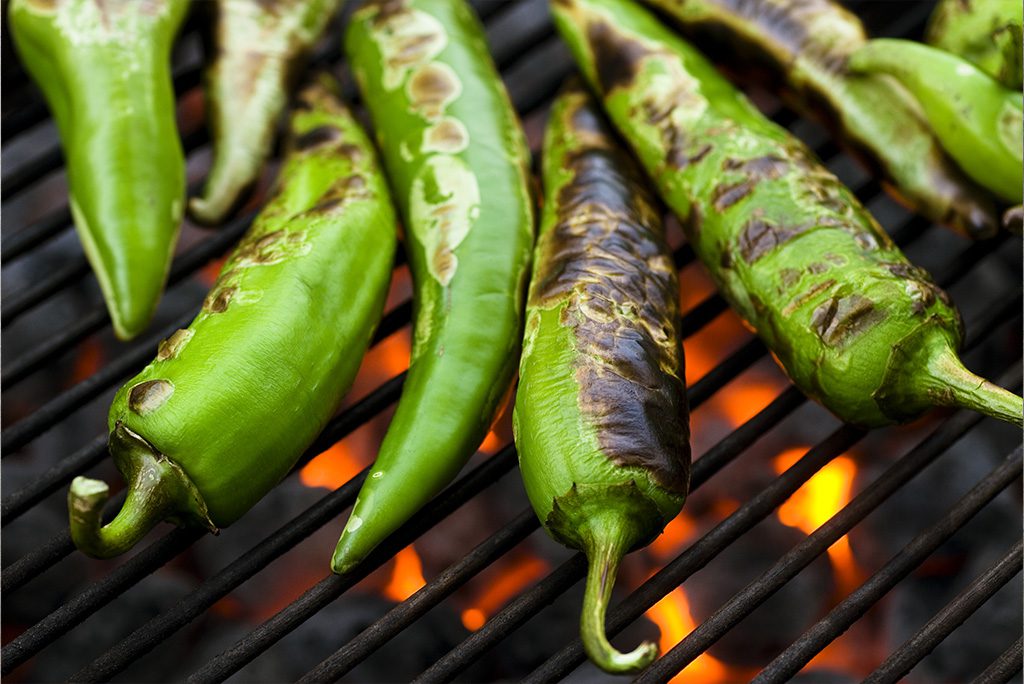
Hatch Chiles Being Roasted on a Grill

You have no doubt heard the old nursery rhyme:

Jack Sprat could eat no fat,
His wife could eat no lean.
And so between them both, you see,
They licked the platter clean.

Martine and I are similarly a study in contrasts. She’s a Republican; I’m an independent Libtard. She has irritable bowel syndrome (IBS), so she pretty much cannot eat anything that has a vowel in its name. I, on the other hand, love highly spiced foods, preferably including my favorite vegetable: hot chile peppers. Somehow we manage to get by despite the differences.

I think it all started with my childhood: My father was a member of the American Independent Party and a staunch supporter of George C. Wallace and his racist platform. I was originally a Democrat, but got tired of the whole circular firing squad thing. So I tend to vote Democratic—but not always on the local level and always as an Independent (No Party Affiliation)..

Somehow I think the contrasts help maintain our relationship, which has been going fairly steady for the last three decades or so. I won’t say it’s been going strong, but steady will do just fine, and I will accept it.

Riding the Error3 Bus

I had a strange dream last night. I was waiting for the bus to Siegmaringen. The name was clearly imprinted in my mind even though I don’t think I knew anything about the South German city. But then, that’s dream logic for you. That is to say, no logic.

A bus came by and stopped in front of me. The destination noted on the display above the front window of the bus said only “Error3.” I asked the driver whether it was headed for Siegmaringen. He nodded yes and I boarded. End of dream.

In many ways, that’s me all over. I wasn’t deterred by the “Error3” destination and forged ahead. Did I get there? Both the ride and my putative arrival in Siegmaringen were not part of the dream. So if you see me riding the Error3 bus, please don’t forget to wave.