Going South for the Winter

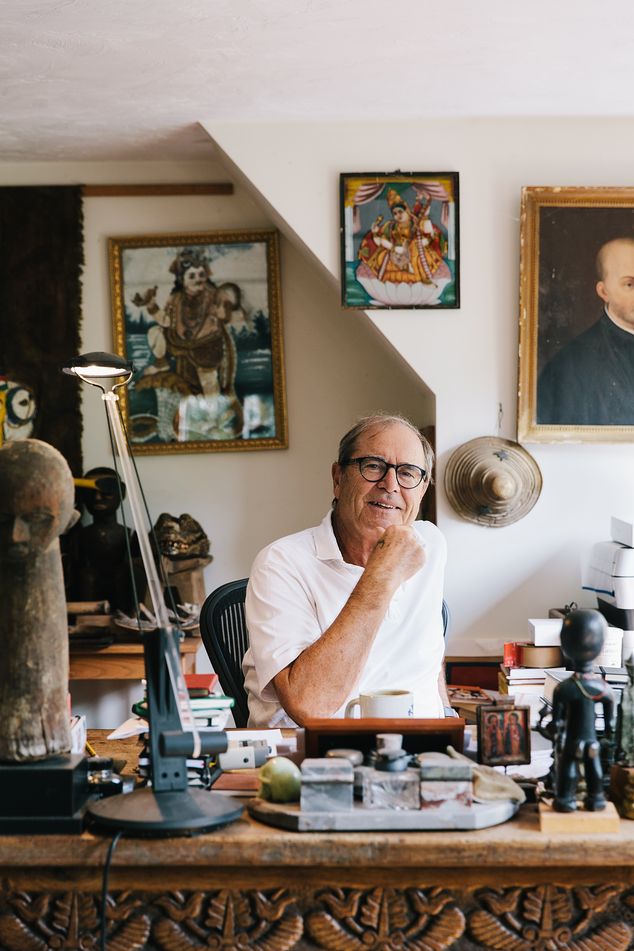
Novelist and World Traveler Paul Theroux

Paul Theroux has had an immense influence on my life. When I first read The Old Patagonian Express: By Train Through the Americas in 1981, I knew that I wanted to travel as he did. But I couldn’t: I was stuck in a demanding job, and many of the places I wanted to visit, such as Guatemala, Peru, and Argentina, were undergoing hard times; and travel there was not recommended by our State Department.

But the years have passed, and travel to Latin America is not so problematic any more. (Though, now, parts of Mexico are dangerous—including many cities, such as Veracruz, which I have visited.)

After writing books about traveling by rail through Asia and China, about traveling around the coasts of Britain and the Mediterranean, and about island-hopping in the South Pacific, Theroux spent four winters traveling through the Deep South, concentrating on poor small towns in Georgia, the Carolinas, Alabama, Mississippi, and Arkansas. His book, Deep South: Four Seasons on Back Roads, opened my eyes to why Trump won in 2016. Theroux’s South was a place where people were more civil to strangers than in other parts of the country. Yet there is a great deal of poverty, and many of its people feel they have been shunted aside by history, large corporations, and general neglect.

Theroux, the world traveler, spent those four winters dealing with people who, for the most part, never traveled abroad. He spent more time with Black Americans than with Whites. Both racists are as far apart as ever, yet there are glimmers of hope. And the hope is not from Washington and New York, where all the money is concentrated, but from local people who bring about incremental improvements rather than global change.

He is older and wiser after his forty-odd years of travel. “The greatest advantage to being an older traveler is being invisible, unregarded, ignored. This allows one to eavesdrop and to see much more of a place or a people. There is a detachment, too, in being older: You’re not looking for a new life, not easily tempted. So you see a place clearly. Perfect for writing.”

The travels that went into the making of this book took place before the electoral debacle of 2016, but one could see the widespread willingness to try something new, to talk to somehow who promised to “Make America Great Again.” Not that this administration will anything to help them. A trade war with China would hurt voters in Trump country far more than voters in the Northeast and West.


Jim Carrey Takes on the Trump Troll

I Scream, You Scream …

Actor Jim Carrey looks to be on the point of starting a brilliant new career, as an Anti-Trump Twitter Troll. The tweet that went with the above picture is:

Jim Carrey

@JimCarrey

 Dear Smithsonian National Portrait Gallery @NPG, I know it’s early but I’d like to submit this as the official portrait of our 45th President, Donald J. Trump. It’s called, ‘You Scream. I Scream. Will We Ever Stop Screaming?’

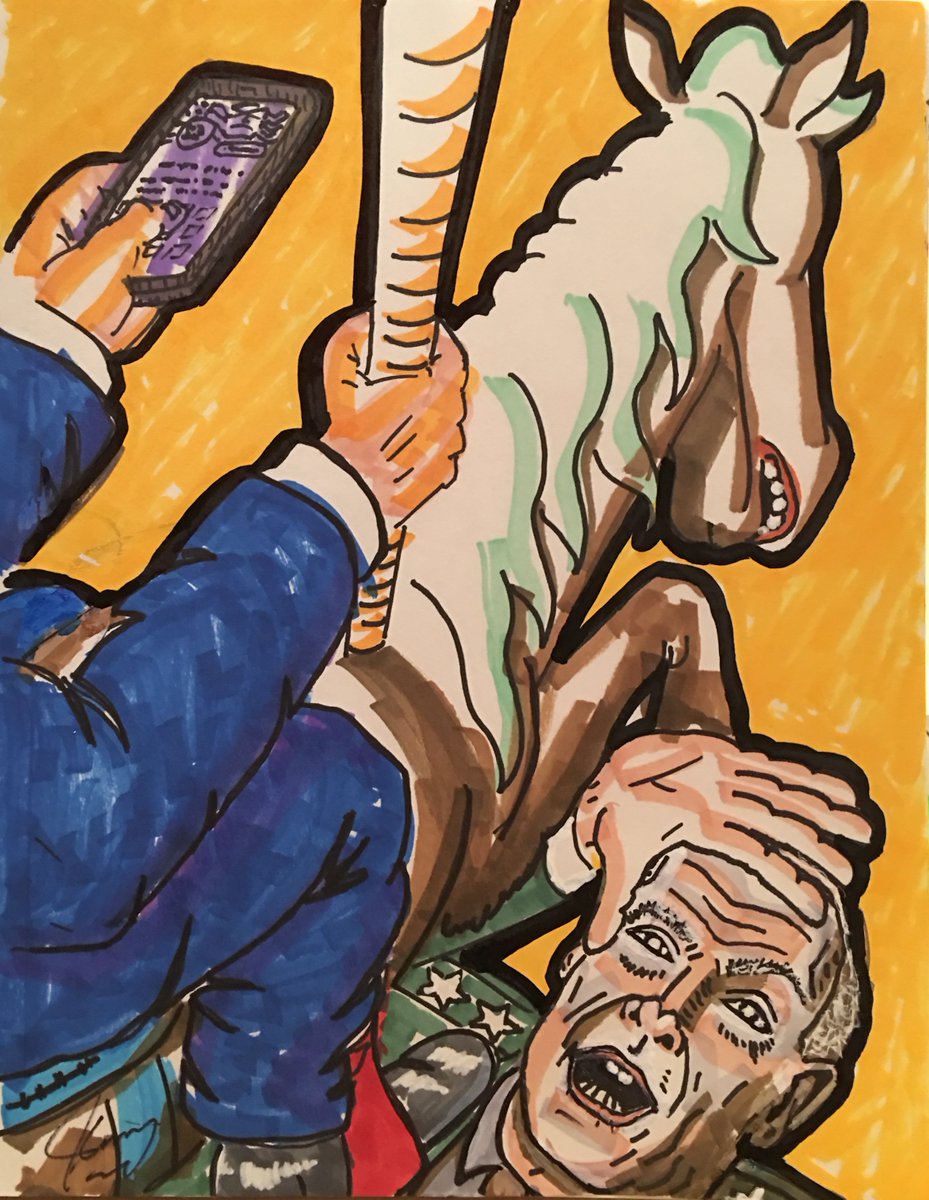
Even more artistic is this one about General Kelly:


Guess Who

The accompanying tweet reads as follows:

Jim Carrey

@JimCarrey

 All who enter his crooked carnival with integrity are doomed to leave without it. General Kelly has been trampled by his own compromise. Who dares be the next to ride the carousel of fools?! Muahahaha!!!

Finally, I couldn’t pass up this attack on the current Speaker of the House of Representatives:

Paul Ryan

And the tweet thereunto appertaining:

Jim Carrey

@JimCarrey

 Tone deaf Paul Ryan brags that his tax bill is going to make low income voters an extra $1.50 a week! That’s almost enough for a box of Band-Aids. Who needs healthcare? WAKE UP REPUBLICAN BASE! You are parked on the tracks, cheering for the train that’s about to run you down. ;^P

You can see all the pictures by clicking here.

June 16, 2015—Day of Infamy

Mark That Date in Your Book of Infamy

That was the day Donald Trumpf and his wife Melania rode that escalator at Trump Tower to announce his run for the presidency. And that was the day he decided to attack Mexican-Americans and promise to build a “big beautiful wall” for which Mexico would pay:

Donald Trump kicked off his presidential bid more than a year ago with harsh words for Mexico. “They are not our friend, believe me,” he said, before disparaging Mexican immigrants: “They’re bringing drugs. They’re bringing crime. They’re rapists. And some, I assume, are good people.”

And with that speech came an injection of open racial hate into American life from a presidential candidate. The hate continued to build until only the hard core of his supporters were exempted from being called “losers.”

Alas, on that day, we all became losers. Big time.


Making Withdrawals from the Rage Bank


There I was, sitting at Lee’s Kitchen in Torrance by my lonesome eating a plate of spicy Szechuan eggplant when it all suddenly fell into place for me. I have been struggling since election night in November 2016 to determine what suddenly happened to my country. It took a German philosopher named Peter Sloterdijk to point at a few things I have been missing. The article was in the February 26, 2018 issue of The New Yorker, entitled “A Celebrity Philosopher Explains the Populist Insurgency”:

Sloterdijk deplored the rise of the right, but he couldn’t resist seeing something salutary in the spectacle. “It’s been coming for a long time,” he said. “It’s also a sign that Germans are more like the rest of humanity than they like to believe.” He started talking about “rage banks,” his term for the way that disparate grievances can be organized into larger reserves of political capital.

He described this concept in his 2006 book Rage and Time, an examination of the loathing of liberal democracy by nativist, populist, anarchic, and terrorist movements. The book follows his usual detour-giddy historical method, comparing political uses of anger, and of related emotions such as pride and resentment, from Homer to the present. In premodern societies, he argues, vengeance and blood feuds provided ample outlet for these impulses. Later, loyalty to the nation-state performed a similar function, and international Communism managed to direct class rage into utopian projects. But modern capitalism presents a particular problem. “Ever more irritated and isolated individuals find themselves surrounded by impossible offers,” he writes, and, out of this frustrated desire, “an impulse to hate everything emerges.” It was this kind of rage, Sloterdijk believes, that was on display in the riots in the banlieues of Paris in 2005.

In Rage and Time, Sloterdijk writes that the discontents of capitalism leave societies susceptible to “rage entrepreneurs”—a phrase that uncannily foreshadows the advent of Donald Trump. When we spoke about Trump, Sloterdijk explained him as part of a shift in Western history. “This is a moment that won’t come again,” he told me. “Both of the old Anglophone empires have within a short period withdrawn from the universal perspective.” Sloterdijk went so far as to claim that Trump uses fears of ecological devastation in his favor. “The moment for me was when I first heard him say ‘America First,’ ” he said. “That means: America to the front of the line! But it’s not the line for globalization anymore, but the line for resources. Trump channels this global feeling of ecological doom.”

There is no doubt in my mind that this rage has been building for years and reached a peak during the two Obama terms. It became so intense to certain segments of society that have felt increasingly left out of the political process—by an uppity nigra no less—that they exercised their “impulse to hate everything.” The rickety Electoral College did the rest.

Since Trump has taken office, a new rage has been building, mostly in the states that voted for Clinton. It can be expressed in the T-Shirt from Redbubble that reads, “FUCK TRUMP AND FUCK YOU FOR VOTING FOR HIM.”

Tomorrow, when I take the train to go downtown to the Central Library, I plan to take out Sloterdijk’s book Rage and Time, if I can find it.

Things That Are Not News Any More

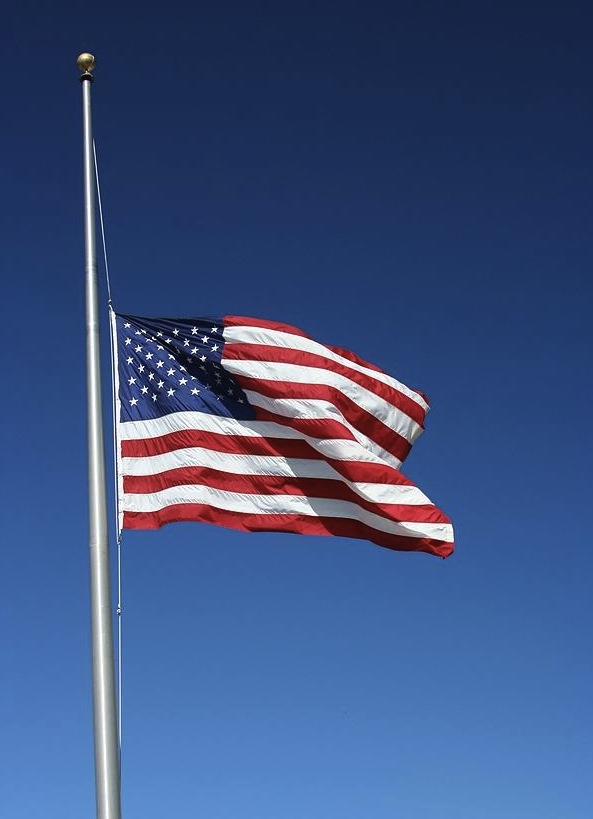
Flag at Half Mast for Depredations by Trumpf and His Minions

The following sources are no longer to be considered as newsworthy:

  • Anything appearing in a tweet, irrespective of from whom.
  • Anything said or tweeted by our current presidente.
  • Anything said by Alex Jones, Rush Limbaugh, Tami Lahren, Sean Hannity, Fox and Friends, Sarah Huckabee Sanders, Bill O’Reilly, Stephen Miller, Kellyanne Conway, and their ilk.
  • Any word that “The Internet” had just punished or shamed somebody, anybody, for what he, she, or it said.
  • Any predictions from any source.
  • Any descriptions of rants from anybody.
  • Any comments from Evangelical sources impinging on politics, or on anything for that matter.
  • Any agonized analyses of mass murderers employing gunfire.
  • Any thoughts or prayers regarding man-made calamities.
  • Any comments to social media posts.


No Respecter of Values

… And That Is the Problem!

We as a country have always prided ourselves on our values. But to me, that is a major problem. It’s not only why we elected a narcissistic boob to be our President, but why a sickeningly large percentage of the voter base continue to support him. In an article for Think, Derek Newton writes:

But the back of the Trump base is not likely to break any time soon, because Trump’s supporters aren’t beholden to politics or logic. Instead, they are creatures of a group psychology dynamic more commonly seen in religious and fraternal organizations.

In the “communion mode” authority structure, described by Andrew Gray, people’s recognition of legitimate authority is “based on an appeal to common values and creeds.”

“In this mode,” added Gray, “the legitimacy for actions lies in consistency with the understandings, protocols, and guiding values of shared frames of reference.”

Is this why Evangelical Christians tend to be so forgiving of infamy? In the news today, a man in Spartansburg, PA who was convicted of a felony sex crime against a 4-year-old girl was elected to a second term as chief of the town’s volunteer fire department. And look at our president’s sexual transgressions. He was probably right when, during the campaign, he said he could kill someone in cold blood on the streets of Manhattan and get away with it. (There is a certain feral wiliness to the man.)

Do I have values? Yes—but all my values are subject to revision If my choice for political office starts putting Jews in concentration camps or claiming there is a doctors’ plot against him or shooting down Rohingya or their families, I would in fact revise them. Yes, I would shitcan my values in an instant if I thought they left room for any sort of infamy.

Newton continues:

Communion governance structures rely on regular in-person meetings, call and response rituals (witness the continued usefulness of “Lock her up!” chants at Trump rallies, despite Hillary Clinton’s 2016 loss) and faith in shared values and experiences. Groups built around communion authority are tightly connected and very strong in part because, research shows, they display “homophily and parochialism directed to those outside the group.” (That is a scholarly way of saying that those in communion groups tend to associate and bond with people that are similar to themselves and view those who are not with suspicion and hostility.)

Perhaps our president’s supporters should be sent to other countries to do some research on why their values need to be changed. Preferably during election time.


Living in a Marmalade Nightmare

Here Are Some German Terms That Will You Understand the World Trumpf made

The following text appeared in Salon.Com, which was quoting a site from Alter.Net. Since Our Fuehrer’s family hails from the Vaterland, I thought it was appropriate to let you in on it.

1. Fernweh 

Fernweh, or “distance pain,” is like the opposite of homesickness. It’s the feeling of wanting to be elsewhere, anywhere but where you are at this moment. The fernweh many Americans feel today is a bit like wanderlust, minus the glamour, and with the added fear that you may be harshly judged as an American traveling abroad in the time of Trump.

2. Weltschmerz

Weltschmerz translates literally to “world pain,” and boy oh boy, does that say it all. It’s the state of weariness one feels at the state of the world. Some of us may have felt a constant state of weltschmerz since Nov. 9, 2016.

3. Kummerspeck

If your state of weltschmerz has been really getting to you, it’s possible you’ve put on a few extra pounds of kummerspeck, or literally, “grief bacon.” Know that you’re at least in good company: last year, Barbra Streisand, Judd Apatow and others complained they’d gained a “Trump 10” in the months following the election. Eat your feelings, indeed.

4. Kuddelmuddel

This wonderful heap of syllables evokes chaos or a hopelessly messy, unstructured state. Sounds like the White House as told by Michael Flynn.

5. Fuchsteufelswild

This is a state of unfiltered, primal rage. You may have felt it over the past year while listening to any White House press conference, hearing Trump describe Haiti, El Salvador and many African nations as “shithole countries,” seeing the president troll Sen. Kirsten Gillibrand on social media…or really, any time at all.

6. Fremdschaemen

Ever felt ashamed on behalf of a member of the Trump White House? Like the time Kellyanne Conway told Fox viewers to “go buy Ivanka’s stuff”? Or when Trump claimed his inauguration speech literally made the clouds part and the sun come out? That’s fremdschaemen.

7. Backpfeifengesicht

In German, this means “a face that deserves to be punched.” Insert your own joke here.

The Gang That Couldn’t Govern

Republican Stumblebums from the Senate and House (Except for the Kid: He’s Innocent)

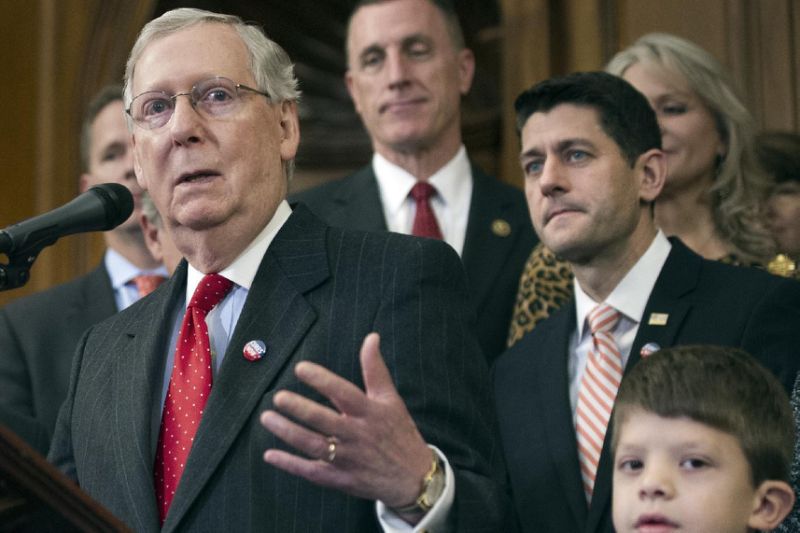
As the U.S. Government heads for another disastrous shutdown, one is led to wonder at the utter uselessness of the officials we have chosen to represent us in Congress. Senator Mitch McConnell (Ratf*ck—Kentucky) and Congressman Paul Ryan (Ratf*ck—Pennsylvania) should be made to swallow their U.S. Flag pins and commit ritual hara kiri on the steps of Congress.

I really don’t like writing about American politics. Heck, I don’t even like discussing politics with my friends. I feel soiled when I do.

Even though there will be an election this November, I have diminishing faith in the American voters who selected the present clowns in office. They will either be re-elected or replaced with other clowns who are attracted to the ways of power. When that power serves only to disgust not only the American people, but our allies (if any are left), and embolden our enemies (the list is growing).


Exercising Self-Restraint

I Could Easily Spend All My Time Attacking This Clown, But I Won’t

Again I was tempted when the Current Occupant talked about being a “Stable Genius.” I had found all these pictures of people shoveling horseshit in stables and was about to post them, indicating what type of “Stable Genius” I thought he was. But what’s the point? If you know me at all, you know what I feel about this Marmalade Nightmare, this Hairdo-from-Hell. I would rather share ingenious political cartoons which make the point ever so much more poetically than I can.

Sorry I had to put his face to this post, but know that I will try to exercise self-restraint rather than jumping to the attack all the time.


To the Barricades?

Vladimir Putin: A Man’s Man?

We have been enemies with Russia for a century now. What happens sometimes during these long sieges of enmity, we lose sight of who we are and who the Russians are. We have gone from the benign presidency of Obama to what looks to us like a would-be Tsar, the narcissistic Trumpf. Russia, in the meantime, traveled a much longer route: From Communism where there was some attempt to help the common people, to the kleptocracy under Yeltsin, to the quasi-dictatorship of Vladimir Putin, former KGB Chieftain. And this Putin had the nerve to try to influence our election!

There is no doubt that Russia under Putin is an amalgam of discipline and targeted cruelty. Enemies of Putin, such as  journalist Anna Politkovskaya, were ruthlessly murdered; and friends of Putin shared in the billionaires’ bounty of their leader. Do we want Russia to become a democracy like ours? Like ours under Trumpf?

According to Russian novelist Mikhail Shishkin:

To call people to the barricades in Russia is beautiful, but senseless…. We lived through all this already in the early ’90s. All revolutions take place in the same way—the best people rise up to fight for honor and dignity, and they die. On their corpses, thieves and bandits come to power, and everything comes full circle. The same thing happened during the Orange Revolution in Kiev. The same thing is happening right before our eyes in the Arab world. Apparently, in Russia a new generation has grown up who want to experience the barricades. All right. They will experience them. And they will be disappointed.

There is, to my mind, very little difference between Trumpf and Putin—except the difference in the two cultures. Trumpf would do the same things as Putin if he could. There still seem to be checks and balances in the United States, but for how long?