Short Story

Although I still read more novels by far, I have found myself increasingly drawn to the medium of the short story. This evening, I decided to take a quick look at my reading long during the past twelve years. As the period progressed, I noticed myself reading more and more short story collections.

I was surprised to find that there were relatively few women writers whom I thought had mastered the genre. In fact, the only ones who impressed me were Virginia Woolf (no surprise there!), the Argentinian Silvina Ocampo, and—closer to home—Joyce Carol Oates and Shirley Jackson. Why this is I do not know. It could be that they are out there, but to date I am not familiar with their work.

Another surprise was that the United States was well represented, what with writers like Faulkner, Hemingway, Fitzgerald, Poe, Hawthorne, Melville, Stephen Crane, Henry James, J. D. Salinger, Barry Gifford, Philip K. Dick, and Ray Bradbury.

Latin America has some outstanding representatives. Topping the list are Argentina’s Jorge Luis Borges and Mexico’s Juan Rulfo. Not far behind are Roberto Bolaño and Francisco Coloane from Chile, Gabriel García Márquez from Colombia, Adolfo Bioy Casares and Silvina Ocampo (who were married to each other) from Argentina.

Britain gave us Somerset Maugham, George Mackay Brown, G. K. Chesterton, and Graham Greene. In France, there was Guy de Maupassant. From Central Europe there was Franz Kafka and Bohumil Hrabal (Czechoslovakia) and Bruno Schulz (Poland).

The greatest Russian short story writer was Anton Chekhov, but there was also Leo Tolstoy, Varlam Shalamov, and Andrei Platanov.

I have just finished Barry Gifford’s The Cuban Club: Stories, and I find several other story collections in my TBR (To Be Read) pile. I guess I’m hooked.
The End of the Beginning

My Janus-Faced January Reading Program

As I wrote in my post dated January 1 of this year, I like to devote a whole month out of each year reading authors I have never read before. As this is the last day of my Januarius Project for January 2023, I thought I’d report on the authors I have discovered.

I have read eleven books this month. Six of them turned out to be excellent:

  • Thomas Hodgkin. Barbarian Invasions of the Roman Empire. I. The Visigothic Invasion. The first of eight volumes and 5,000 pages on the Barbarian Invasions. Excellent scholarship and exciting even!
  • Magda Szabo. The Door. A superb Hungarian novel about a writer and her domineering housekeeper.
  • Laszló F. Földényi. Melancholy. Another Hungarian author dealing with the history of melancholy in Western literature and civilization. Not an easy book to read, but worth the effort.
  • Lawrence Ferlinghetti. Writing Across the Landscape. Travel Journals 1960-2010. It’s always fascinating to see other places from a poet’s perspective.
  • Lucretius. The Nature of Things. An ancient Roman poet describes the science of his day—in verse. Reading Lucretius tells me we may have advanced in some respects, but not all.
  • Juan Rulfo. The Plain in Flames. Why have I not heard of this Mexican author before? Like John Webster, he could see the skull beneath the skin; and his short stories are powerful and gemlike.

The remaining five were merely really good:

  • Vilmos Kondor. Budapest Noir. A top-notch mystery set in the Budapest of the 1930s, on the track of a young woman’s murder.
  • Han Kang. The Vegetarian. A young woman goes from vegetarianism to pushing the envelope of what is human. The author is Korean.
  • Don Carpenter. Hard Rain Falling. A noir crime novel about a pool shark whose life goes from bad to worse. The beginning is particularly powerful.
  • Yu Miri. Tokyo Ueno Station. The author is a Japanese woman of Korean ancestry. A powerful look at urban homelessness in Tokyo.
  • Horacio Quiroga. 7 Best Short Stories. One for the kiddies. A Uruguayan author writes stories about the Argentinian jungle that are reminiscent of Kipling’s The Jungle Book.

I can see myself reading other works by Hodgkin, Szabo, Ferlinghetti, and Rulfo in the year to come.

Byways in Noir Fiction

For Me, It All Started With Film Noir

My friends Alain Silver and Jim Ursini, whose many books on the subject are in my library, introduced me to the joys of film noir. In time, I decided to investigate the fiction from which these films were adapted. I was already familiar with the triumvirate of greats—Raymond Chandler, Dashiell Hammett, and James M. Cain—but I decided to dig further.

Of the novelists who wrote two or more books that I read were:

  • David Goodis: Black Friday, Down There (Shoot the Piano Player), Of Tender Sin, Dark Passage, The Moon in the Gutter, The Burglar, Nightfall, Cassidy’s Girl, and Street of No Return
  • Jim Thompson: Numerous titles, the best being The Killer Inside Me, Pop. 1280, After Dark My Sweet, and A Swell Looking Babe
  • Cornell Woolrich (aka William Irish): I Married a Dead Man and The Bride Wore Black
  • Charles Willeford: Pick-Up, The High Priest of California, Understudy for Death, The Burnt Orange Heresy, and the four Hoke Moseley novels
  • Robert Edmond Alter: Carny Kill and Swamp Sister

Then there is the category which I refer to as Oddities and One-Shots, people who were either famous for a single work or, if they wrote more, I only read one of their books. They include, in no particular order: W. R. Burnett (High Sierra); Don Carpenter (Hard Rain Falling), Elliott Chaze (Black Wings Has My Angel); Horace McCoy (They Shoot Horses, Don’t They); Kenneth Fearing (The Big Clock); William Lindsay Gresham (Nightmare Alley); Patricia Highsmith (The Talented Mr. Ripley); and Chester Himes (The Real Cool Killers).

Reading these books, one becomes painfully conscious that the streets of America are not paved with gold. Life is not necessarily a walk through the park—unless it is night and the forces of evil are lurking in the shadows.

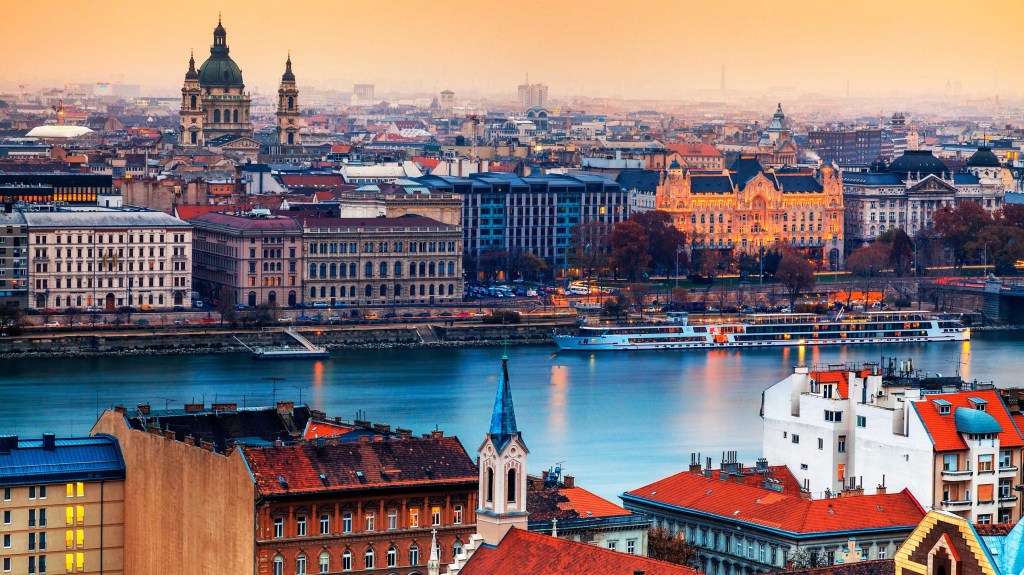
The Januarius Budapest Trifecta

Having finished my jaunt to the decaying Roman Empire during the Visigothic invasions, I decided to read three books in a row written by Hungarian authors:

  • Vilmos Kondor’s Budapest Noir (2008), a first novel about a murder on the streets of Budapest.
  • Magda Szabo’s The Door (1987), a novel about the relationship between two women, a writer and a peasant.
  • Laszló F. Földényi’s Melancholy (1984), a history of melancholy through the ages.

As we begin 2023, I find the farther I get from my own Hungarian roots, the more at loose ends I feel. There is a figure in Greek mythology called Antaeus, about whom Wikipedia writes:

Antaeus would challenge all passers-by to wrestling matches and remained invincible as long as he remained in contact with his mother, the earth. As Greek wrestling, like its modern equivalent, typically attempted to force opponents to the ground, he always won, killing his opponents. He built a temple to his father using their skulls. Antaeus fought Heracles as he was on his way to the Garden of Hesperides as his 11th Labour. Heracles realized that he could not beat Antaeus by throwing or pinning him. Instead, he held him aloft and then crushed him to death in a bear hug.

Returning to my Hungarian roots is like Antaeus renewing himself by touching the earth. (If, however, I run into Heracles, I will pointedly avoid wrestling with him.)

So far, I am on schedule with my Januarius reading program.

Rome in Eclipse

An 1836 Painting Showing the Sack of Rome by the Visigoths in AD 410

I have begun reading Thomas Hodgkin’s magisterial Italy and Her Invaders in the Folio Society edition, which has been retitled The Barbarian Invasions of the Roman Empire. The first volume covers the Visigoths and the Empire as it was from the death of Julian the Apostate in AD 363 to AD 414.

We entertain a false picture of the Roman Empire during the Fifth Century. In the late Third Century, the Emperor Diocletian decided that, insofar as administration was concerned, the Empire was too big for one man to control. He decided to divvy it up into four pieces, creating the Tetrarchy.

By the reign of Julian, the four pieces consisted of Gaul (including France, England, and Spain); Italy (including Italy, Austria, Yugoslavia, and North Africa); Illyricum (including Greece, Macedonia, and Ukraine); and the Orient (including Turkey, Bulgaria, Syria, and Egypt). Note that Egypt, which was the bread basket of the Empire, now shipped most of its grain to Constantinople, leaving Rome high and dry.

In fact, after Diocletian’s Tetrarchy, the city of Rome began to decline. The co-emperor ruled from either Milan or Ravenna. Both cities were closer to the Alps and the routes the Barbarians would take in attacking the Italian Peninsula.

The other “capitals” were Constantinople for the Orient; Augusta Treverorum, or Trier, for Gaul; and Thessalonika or Sirmium for Illyricum.

When I cam across this line in Hodgkin’s first volume, I realized that by this time Rome was toast:

Strange to say, during the whole preceding century, Rome had only four times seen an emperor within her walls, Constantine (312) after his victory over Maxentius, Constantius (357) four years after the overthrow of Magnentius, and Theodosius (389) after his defeat of maximus, and again (394) after his defeat of Eugenius.

Once the Barbarians started invading in numbers, Rome was just too far away from the action. Days were wasted getting to the top of the boot of Italy. So when Rome was sacked by the Barbarians, they were largely attacking a symbol rather than a seat of power.

Beginnings and Endings

My Januarius Project Is Named After the Roman God Janus

If you have been reading my blog for a long time, you may remember that I usually devote the month of January to reading writers I have never read before. According to one website:

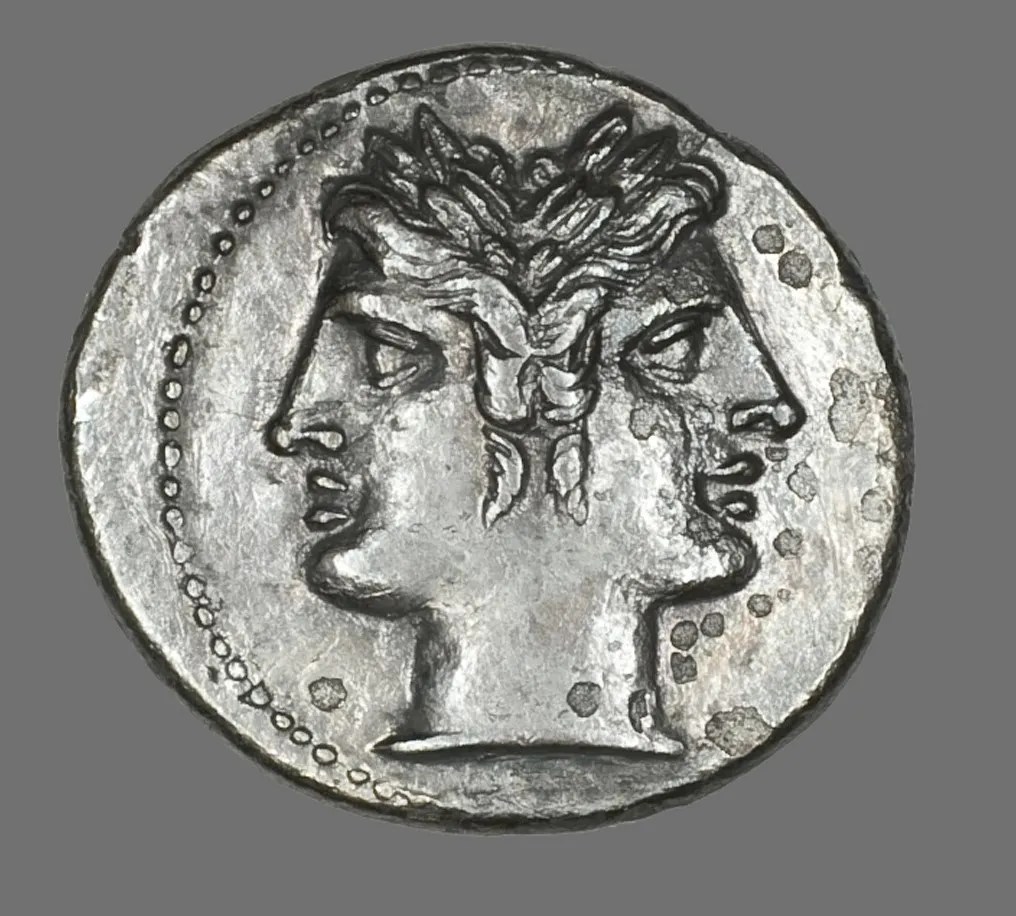
Janus presides over beginnings and endings, passages and transitions, doorways and gateways, whether physical entry points between home and the outside world, city and countryside, or invisible ones like the connection between human and divine through prayer. He was said to have invented coinage, and appears on a number of coins with his characteristic two faces.

In fact, I have started the month by beginning Thomas Hodgkin’s eight-volume The Barbarian Invasions of the Roman Empire (originally called Italy and Her Invaders). Volume I covers the Visigothic Invasion. I fully expect it will take a number of years to complete the 5,000 pages of Hodgkin’s magnum opus—perhaps even more years than I have left. In any case, I have made a beginning.

As it will take me upwards of a week to complete the first volume, I will hold off before telling you what other titles are in my To Be Read (TBR) pile.

The reason I do what I call the Januarius Project is to avoid letting myself get bogged down doing such things as reading the minor works of my favorite writers. I do not pretend to have discovered the best writers who have ever lived, and I probably never will, as many of them have never been translated into English.

One feature of the project for this year is to include some classical historians, such as Hodgkin, who wrote his series between 1870 and 1899. There was some great history written back then, such as John Lloyd Stephens on discovering Maya ruins, Samuel Prescott and the Spanish conquest of Mexico and Peru and Francis Parkman on the history of Canada to the French and Indian War and the opening of the American West.

Check back with me to see what I plan to read next.

From My Piblokto Madness Bed

William Gibson on Our Military-Influenced Fashions

There are few novelists currently working whom I like as much as William Gibson. His science fiction doesn’t go that far into the future, yet he constantly introduces concepts, which he doesn’t explain, and yet which fascinate me. One such is the Piblokto Madness bed in which her character Hollis Henry from Zero History sleeps at a posh London hotel. Looking up Piblokto on Wikipedia, I found this definition: “A culture-bound syndrome observed primarily in female Inuit and other arctic populations. Individuals experience a sudden dissociative period of extreme excitement in which they often tear off clothes, run naked through the snow, scream, throw things, and perform other wild behaviors.” Huh?

On another topic, Gibson is spot on, namely the civilian fashion of adopting military styles in one’s apparel:

“Sleight had arranged for us to have a look at a garment prototype. We’d picked up interesting industry buzz about it, though when we got the photos and tracings, really, we couldn’t see why. Our best analyst thinks it’s not a tactical design. Something for mall ninjas.”

“For what?”

“The new Mitty demographic.”

“I’m lost,”

“Young men who dress to feel they they’ll be mistaken for having special capability. A species of cosplay, really. Endemic. Lots of boys are playing soldier now. The men who run the world aren’t, and neither are the boys most effectively bent on running it next. Or the ones who’re actually having to be soldiers, of course. But many of the rest have gone gear-queer, to one extent or another.”

“Gear-queer?”

Bigend’s teeth showed. “We had a team of cultural anthropologists interview American soldiers returning from Iraq. That’s where we first heard it. It’s not wholly derogatory, mind you. There are actual professionals who require these things—some of them, anyway. Though they generally seem to be far less fascinated with them. But it’s that fascination that interests us, of course.”

“It is?”

“It’s an obsession with the idea not just of the right stuff, but of the special stuff. Equipment fetishism. The costume and semiotics of achingly elite police and military units. Intense desire to possess same, of course, and in turn to be associated with that world. With its competence, its cocksure exclusivity.”

An Enduring Masterpiece

Sam Weller and His Father Tony

Although I first read Charles Dickens’s The Pickwick Papers in the late 1960s, a number of its characters have remained fresh in my memory. Aside from Mr Pickwick himself, there was Sam Weller and his father Tony, Job Trotter, Sergeant Buzfuz, and Angelo Cyrus Bantam. I have always regarded this book as one of Dickens’s best, though I had the feeling in the back of my mind that I would not think so upon re-reading it.

Fortunately, I was wrong. I loved the book—again. It is one of those long picaresque shaggy-dog stories that sags in some places, but rises to incredible heights during such set pieces as the parliamentary election at Eatanswill, the trial of Mr Pickwick for breach of promise, the time spent in the Fleet debtors’ prison, and the Christmas festivities at Dingley Dell.

The book starts slowly with Pickwick and his three associates (Nathaniel Winkle, Augustus Snodgrass, and Tracy Tupman) as the main characters. Before long, however, we find that the real character of interest is Sam Weller, Pickwick’s manservant. Despite coming from the lower classes, his native wit is considerable, and before long he leaves everyone else in the shade. And he is 100% pure English: He almost defines Englishness.

As the book grinds to a halt, Dickens gives us a delirious ending:

Let us leave our old friend in one of those moments of unmixed happiness, of which, if we seek them, there are ever some, to cheer our transitory existence here. There are dark shadows on the earth, but its lights are stronger in the contrast. Some men, like bats or owls, have better eyes for the darkness than for the light. We, who have no such optical powers, are better pleased to take our last parting look at the visionary companions of many solitary hours, when the brief sunshine of the world is blazing full upon them.

In the end, we have been mightily entertained. There has been much humor and—a rarity in Dickens—very little extreme pathos.

Yes, indeed, this is still one of the great books!

Baker’s Dozen

Indian Novelist Anita Desai (Born 1937)

On this last day of November, I am happy to report that my month of reading only books by women authors was both highly successful and satisfying. In a post I made at the beginning of November, I wrote:

For the month of November, I will be reading only women writers, both fiction and non-fiction. Some of the authors will be new to me; some of the books will be re-reads.I began by reading a short story collection entitled Dead-End Memories by the Japanese author Banana Yoshimoto.When I finish, I will re-read Joan Didion’s Salvador.

From there, a number of possibilities present themselves, including Virginia Woolf, Edwige Danticat, Joyce Carol Oates, Wisława Szymborska, Dorothy B. Hughes, Patricia Highsmith, Freya Stark, Norah Lange, Dawn Powell, and Elizabeth Hardwick.I’ll just see where the spirit moves me. At the end of the month, I will summarize the discoveries I have made.

In the end, I came pretty close to my aim. Here is the final list:

  • Banana Yoshimoto, Dead-End Memories (short stories)
  • Joan Didion, Salvador (travel/history) – reread
  • Virginia Woolf, Jacob’s Room (fiction)
  • Jane Austen, Northanger Abbey (fiction) – reread
  • Freya Stark, Rome on the Euphrates: The Story of a Frontier (history)
  • Anita Desai, Journey to Ithaca (fiction)
  • Mary Austin, One-Smoke Stories (short stories)
  • Patricia Highsmith, Found in the Street (fiction)
  • Joyce Carol Oates, Wild Nights! Stories About the Last Days of Poe, Dickinson, Twain, James, and Hemingway (short stories)
  • Elizabeth Hardwick, Sleepless Nights (autobiography/fiction)
  • Norah Lange, The People in the Room (fiction) – reread
  • Edwidge Danticat, Create Dangerously: The Immigrant Artist at Work (autobiography/essays)
  • Dorothy B. Hughes, In a Lonely Place (noir fiction)

That makes a full baker’s dozen of thirteen books.

The best three were Jacob’s Room, Northanger Abbey, and Sleepless Nights. Writers I had never read before included Banana Yoshimoto, Elizabeth Hardwick (a real find!), and Edwidge Danticat.

I may well do this again next year. Too long I have been ignoring the real talent of great women authors.

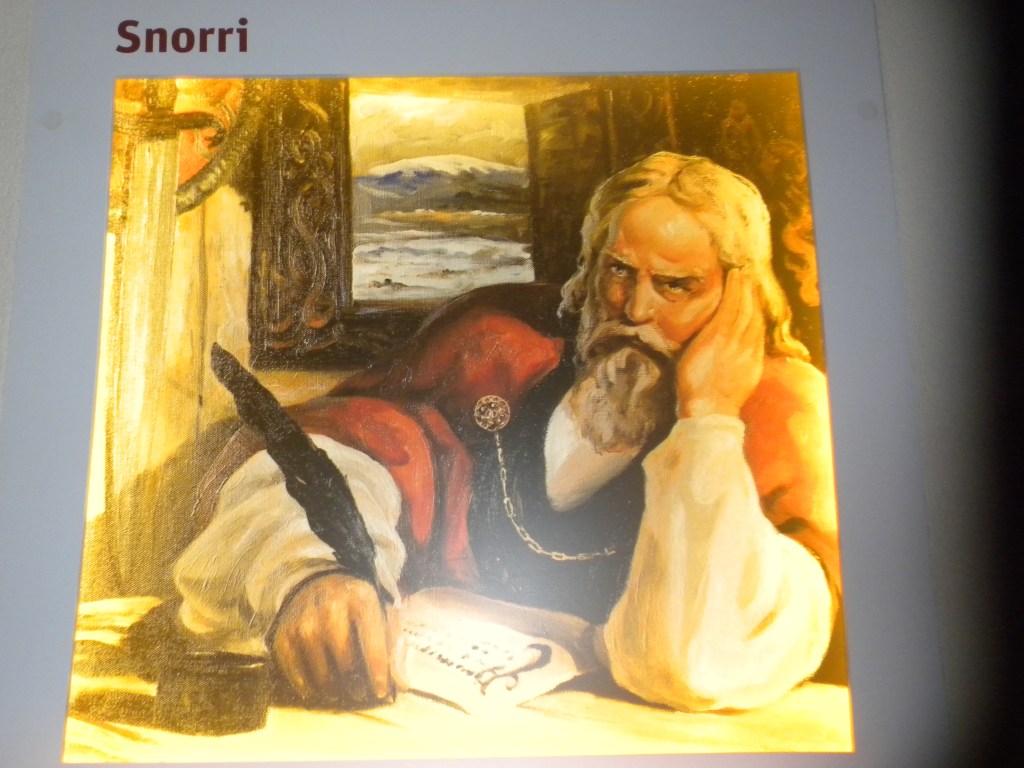
Snorri

Icelandic Writer of Sagas Snorri Sturluson (1179-1241)

One of the least-known great writers of the Middle Ages was an Icelander, Snorri Sturluson. When I was in Iceland in 2013, I visited Reykholt, where he was assassinated by thugs hired by Haakon IV, King of Norway. There is a museum on the site dedicated to his life and work.

He is known for having authored the Prose Edda, the Heimskringla (a history of Norwegian kings), and possibly Egils Saga, one of the greatest of the Icelandic family sagas. There are other great Icelandic sagas, but Snorri is the only writer of sagas whose name has come down to us.

There wasn’t much competition in the literature of the time. The Arthurian legends were just getting started with Geoffrey of Monmouth’s History of the Kings of Britain (ca 1136). Around the same time, little Iceland had a fully developed literature which told the stories of actual families who settled there and how they resolved disputes. Geoffrey’s book about Arthur, on the other hand, was mostly made out of whole cloth and is considered unreliable as history. The Icelandic sagas are mostly about real people.

Below is the pool at Snorri’s house in Reykholt where he was murdered on September 22, 1241: