In this month of reading only works by women authors, I have made an interesting discovery. The only works I have read this month that have the feeling of life itself are Virginia Woolf’s Jacob’s Room (1922) and Elizabeth Hardwick’s Sleepless Nights (1979). 1920s London and Postwar Manhattan come alive in these books in a way that even James Joyce’s Dublin in Ulysses failed to with all the literary allusions.
Woolf and Hardwick make us feel present in a simple and direct fashion. It is almost as if they were writing their own autobiographies as they lived their lives. Sleepless Nights even reads like an autobiography. For instance, she knew Billie Holiday and writes about her as if she were a close friend:
A genuine nihilism; genuine, look twice. Infatuated glances saying, Beautiful black star, can you love me? The answer: No.
Somehow she had retrieved from darkness the miracle of pure style. That was it. Only a fool imagined that it was necessary to love a man, love anyone, love life. Her own people, those around her, feared her. And perhaps she was often ashamed of the heavy weight of her own spirit, one never tempted to the relief of sentimentality.
She goes on for several pages about the singer, all of them more real and vivid than anything I have read about any performing artist.
In the same way, Virginia Woolf in Jacob’s Room and Mrs. Dalloway (1925) make the reader feel he or she is walking the streets of the London of George V. One does not feel one is in the past: She makes the past feel like the present.
Even Marcel Proust, whose description of the states of mind of his characters is without peer, cannot put the reader on the street running for a trolley and registering the sights and sounds of the city.
I am not sure I have expressed myself properly. I will have to investigate the matter more deeply. Stay tuned.
It was one of the most meaningful Twitter posts ever written when Maya Angelou said, “The desire to reach the stars is ambitious. The desire to reach hearts is wise and most possible.”
For the month of November, I will be reading only women writers, both fiction and non-fiction. Some of the authors will be new to me; some of the books will be re-reads.I began by reading a short story collection entitled Dead-End Memories by the Japanese author Banana Yoshimoto.When I finish, I will re-read Joan Didion’s Salvador.
From there, a number of possibilities present themselves, including Virginia Woolf, Edwige Danticat, Joyce Carol Oates, Wisława Szymborska, Dorothy B. Hughes, Patricia Highsmith, Freya Stark, Norah Lange, Dawn Powell, and Elizabeth Hardwick.I’ll just see where the spirit moves me. At the end of the month, I will summarize the discoveries I have made.
And there are sure to be discoveries. Already I love Banana Yoshimoto’s stories, which deal with subjects that men feel uncomfortable with. And that where the Maya Angelou quote comes into play.
The following is adapted from a post I made on the late unlamented Blog.Com on August 14, 2009.
I had not read one of Stanislaw Lem’s (1921-2006) novels for a number of years, remembering only that I always enjoyed them for their quirkiness and imagination. A few days ago, I picked up one of his books at random: It was Chain of Chance (1975).
Picture to yourself a series of murders or suicides of a seemingly random group of people. What they have in common is all are males in their fifties who were athletic in build, and all were visiting a spa in Naples, Italy. The victims consisted of both Americans and Europeans. Sent to investigate what happened in a washed-out American astronaut who calls himself Adams after one of the victims. He attempts to set himself up as a guinea pig doing what the average victim did and trying to see what happens. There were some strange occurrences, such as the collapse of a woman in a large shop where there are no visible employees on the Naples-Rome highway.
At the Rome airport, “Adams” survives a terrorist bomb blast and saves a young French girl’s life. Suspected as being in with the terrorists, he calls in his embassy; and matters get straightened out allowing him to proceed to Paris.
There he meets with Dr. Philippe Barth, a French computer scientist who served as a consultant for the Sûreté, the national security service. The story then suddenly sags as “Adams” describes in exhaustive detail what the victims had in common, what they did, and so on. I thought to myself at this point that perhaps I had picked up the first loser by Lem, but it took only a few pages for the author to recover and pose an ingenious demonstration.
At the Paris Orly airport, “Adams” begins feeling strangely demented and suicidal. In the nick of time, he handcuffs himself to some solid furniture and begins to take notes of what appears to be a series of attacks, culminating in unconsciousness.
I will not divulge Lem’s brilliant ending, except to drop one hint: There is a close tie-in with the subject of The Futurological Congress (1971), which remains my favorite of his books. One more clue. Here is the thinking of one of the people attending the security meeting with Barth, a mathematician named Saussure whom I think is a stand-in for the author:
Man wanted everything to be simple, even if mysterious: one God—in the singular, of course; one form of natural law; one principle of reason in the universe, and so on. Astronomy, for example, held that the totality of existence was made up of stars—past, present, and future—and their debris in the form of planets. But gradually astronomy had to concede that a number of cosmic phenomena couldn’t be contained within its scheme of things. Man’s hunger for simplicity paved the way for Ockham’s razor, the principle stating that no entity, no category can be multiplied unnecessarily. But the complexity that we refused to acknowledge finally overcame our prejudices. Modern physics has turned Ockham’s maxim upside down by positing that everything is possible. Everything in physics, that is; the complexity of civilizations is far greater than that of physics.
In the world of speculative fiction—and I regard him as more properly a writer of this rather than science fiction—few could approach the Pole in his inventive mind, humor, and psychological acuteness. Among his works that I have enjoyed are the following, all of which are still available in good English translations:
The Investigation (1959)
Return from the Stars (1961)
Solaris (1961), which was made into a great Russian film by Andrei Tarkovsky
Memoirs Found in a Bathtub (1961)
The Futurological Congress (1971)—my favorite among his works
Tales of Pirx the Pilot (1973) and More Tales of Pirx the Pilot (1973), published in Poland as a single work
One Human Minute (1986)
I see that I have read quite a few of Lem’s work—and at the same time, not nearly enough.
In his collection Seven Nights (1984), Jorge Luis Borges wrote:
I have two nightmares that often become confused with each other. I have the nightmare of the labyrinth, which comes, in part, from a steel engraving I saw in a French book when I was a child. In this engraving were the Seven Wonders of the World, among them the labyrinth of Crete. I believed when I was a child (or I now believe I believed) that if one had a magnifying glass powerful enough, one could look through he cracks and see the Minotaur in the terrible center of the labyrinth. My other nightmare is that of a mirror. The two are not distinct, as it takes only two facing mirrors to construct a labyrinth. I always dream of labyrinths or of mirrors. In the dream of the mirror another vision appears, another terror of my nights, and that is the idea of the mask. Masks have always scared me. No doubt I felt in my childhood that someone who was wearing a mask was hiding something horrible. These are my most terrible nightmares: I see myself reflected in a mirror, but the reflection is wearing a mask. I am afraid to pull the mask off, afraid to see my real face.
The Good Doctor Ruffled a Few Feathers, Including Mine
As part of my annual Halloween reading, I just finished the Oxford World’s Classics Tales of Terror from Blackwood’s Magazine. In the early decades of the 19th century, that’s where budding writing talents turned for examples of tales of horror. Among the most devoted readers were Charles Dickens, the Brontë sisters, Nathaniel Hawthorne, Robert Browning, and—most particularly—Edgar Allan Poe.
Of the seventeen stories in the collection, I had only heard of two of them before: Sir Walter Scott and James Hogg, a.k.a. the Ettrick Shepherd. The other writers (who were all new to me) were Patrick Fraser-Tytler, John Wilson,Daniel Keyte Sandford, John Galt, John Howison, William Maginn, Henry Thomson, Catherine Sinclair, Michael Scott, William Mudford, William Godwin the Younger, and Samuel Warren. All of their stories were first class.
Now I understand why Poe wrote him famous essay “How to Write a Blackwood Article.” And why Leigh Hunt wrote in 1819:
A man who does not contribute his quota of grim stories now-a-days seems hardly to be free of the republic of letters. He is bound to wear a death’s head, as part of his insignia. If he does not frighten every body, he is nobody.
Well, I could testify that I was frightened by this collection—by a bunch of “minor” writers who knew what they were doing. The credit for this collection goes to the two co-editors, Robert Morrison and Chris Baldick.
I was particularly entranced by the three selections from a long-running serial in Blackwood’s entitled Passages from the Diary of a Late Physician (appearing from 832-1837) by Samuel Warren (1807-1877).
Back when I was a student at UCLA, there was a considerably more successful student across the campus from the film department’s Melnitz Hall. I am thinking of Carlos Castaneda, who electrified the publishing world in 1968 with The Teachings of Don Juan: A Yaqui Way of Knowledge and its sequels.
Reading his work, I was hooked—believing every word he said. As time went on, I heard strange things about Carlos. He tried to start some sort of movement called Tensegrity and surrounded himself with several women who idolized him, and whom he claimed were brujas, or witches. When Carlos died in 1998, several of these women went missing and apparently committed suicide.
Negative articles started appearing, such as this one entitled “The Dark Legacy of Carlos Castaneda.” Now, after some soul-searching and a bit of re-reading, I am in the position of the psychiatrist in the anecdote which I quoted five years ago in a post about Castaneda:
There is an anecdote about a patient describing his life to a psychiatrist, who keeps nodding his head and saying, “That’s very interesting!” Finally, the patient gets angry and says, “Well, that’s all a pack of lies which I just made up. What do you think of that?” The psychiatrist does not miss a beat: “That’s even MORE interesting!” That, in the end, is my reaction to Castaneda. I think there are some fascinating truths to be found in his books, along with some things that were just made up.
Among the things that were made up were Don Juan Matus, Carlos’s Yaqui teacher—and in fact all the Yaqui material, which demonstrates that he did not know the first thing about Yaqui culture, places, or language.
And yet, and yet, a lot of the material that forms the teachings of Don Juan has the ring of truth to it. You have to look at it obliquely, perhaps, but there is a lot of wisdom there, whatever its point of origin. Castaneda was actually a Peruvian, and it could be that he joined some Peruvian mystical teachings to a fictional Mexican source.
The one thing that did not influence me at all was Castaneda’s emphasis on peyote, jimson weed, psilocybin, and other psychedelic substances. I had just survived brain surgery in 1966 and was not in any mood to experiment on myself.
I am currently re-reading A Separate Reality: Further Conversations with Don Juan. In the process, I keep bumping into my younger self. Very interesting.
When I was younger, Ernest Hemingway was considered a literary god. After his suicide in 1961, the colossus of his reputation began to be chipped away. After re-reading his Green Hills of Africa (1935), I begin to understand why.
Literary reputations are a tricky business. Who reads Thomas Wolfe any more? Is he even in print? What about James Jones and Herman Wouk? I can even foresee that my beloved William Faulkner’s rep might come in for revision by a younger generation less than enchanted by his difficulty.
What hurt Hemingway for me, especially as I developed a more adult taste in literature, was primarily his pose of machismo. In Green Hills of Africa, he is the Great White Hunter, even though it is one of his companions who kills the trophy rhino and kudu.
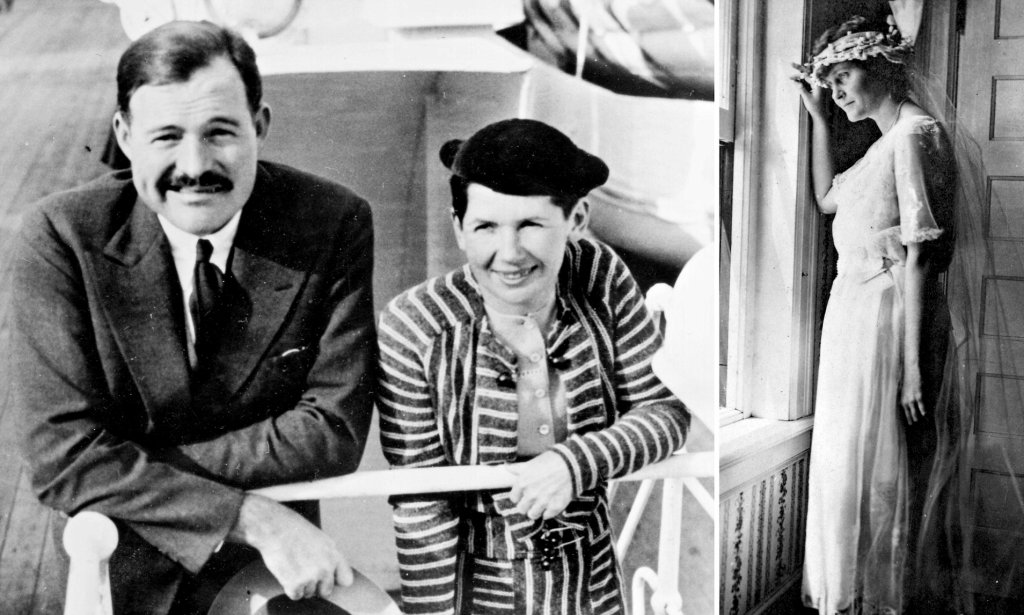
Even worse if Hem’s practice of never referring to his wife by name. If the edition I read did not rectify it in the captions to the illustrations, I would have known her only as P.O.M.—Poor Old Mama. What was poor about her? Pauline Pfeiffer Hadley Hemingway was bright and understanding. There were no bitter recriminations, even though the safari was mainly Ernest’s little red wagon.
PKT3042 – 208725
AUTHOR – ERNEST HEMINGWAY
1995
NOTED AUTHOR RETURNS FROM AFRICAN TRIP
New York: Mr. and Mrs. Ernest Hemingway shown as they arrived in New York, April 3, on the liner Paris. They have spent the last three months in East Africa hunting lions. Mr. Hemingway, the author of numerous books, states that Africa reminded him of Spain and that he would like to return.
But really, P.O.M. this and P.O.M. that? And never once Pauline or Hadley? If I were her, I would have knocked his teeth out with his own typewriter for refusing the acknowledge her individuality. It’s as if I would refer to Martine in my blogs as P.L.F.G.—Poor Little French Girl (she was born in Paris).
What Hemingway had going for him was his literary style. Joan Didion used to study his short stories as a model for her early writings. Until, that is, she surpassed him.
Of course, Hem refers to himself a couple of times as Poor Old Poppa, but not 100% of the time as he does with Pauline.
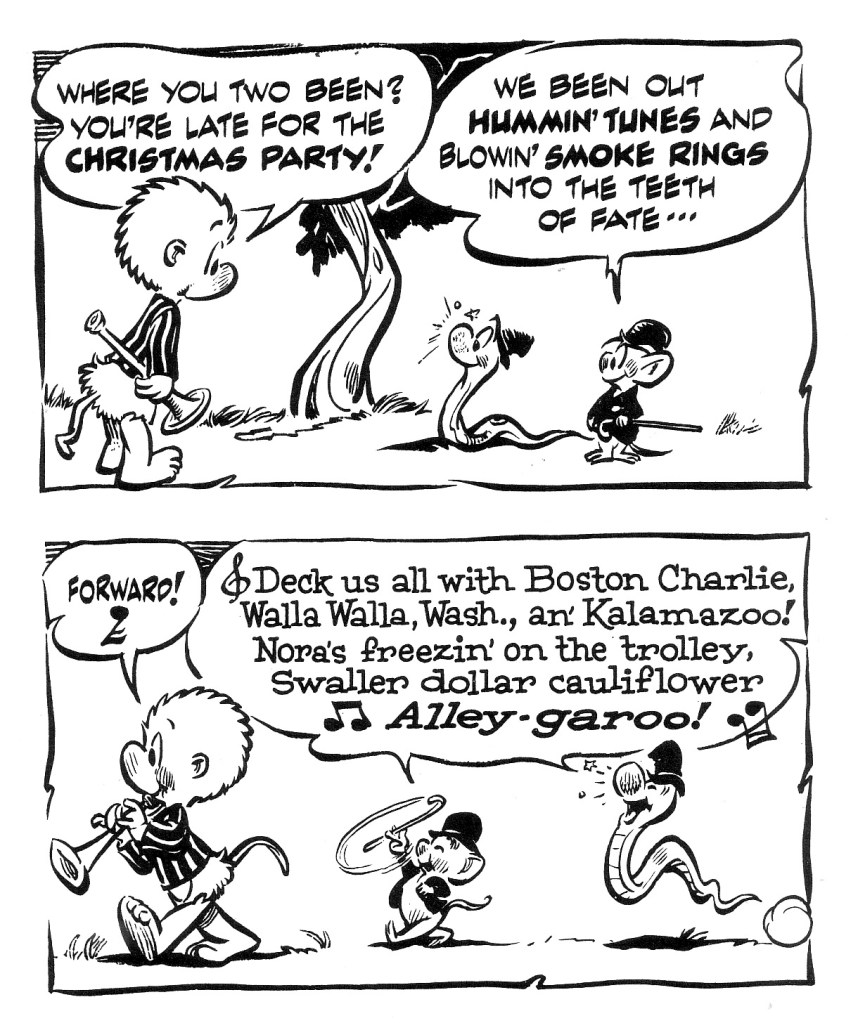
It is hard to believe that Pogo has not been a regular comic strip since July 1975. Since early childhood, I have been a big fan of newspaper comics; and Walt Kelly’s Pogo was one of my favorites. How is it that a cast of characters dwelling in Georgia’s Okefenokee Swamp could be so universal, even in our twisted times?
There was Pogo Possum himself, whom cartoonist Kelly described as “the reasonable, patient, softhearted, naive, friendly person we all think we are.” He is surrounded by such swamp buddies as the slow-witted Albert Alligator, generic expert Howland Owl, dim mud-turtle Churchill “Churchy” LaFemme, self-important canine Beauregard Bugleboy, misanthropic Porky Pine, and a host of others.
If I felt I could afford it, I would collect all the Pogo comic strip books and read them regularly. There aren’t too many current cartoon strips about which I could say that. It would be an activity best described as blowin’ smoke rings into the teeth of fate.
Eight years ago, I came across a strange book that I fell in love with. It was by a Ukrainian author who was born in Leningrad (1961) and writes in Russian. Death and the Penguin (1996), his first novel translated into English, became an international bestseller. According to Wikipedia:
The novel follows the life of a young aspiring writer, Viktor Alekseyevich Zolotaryov, in a struggling post-Soviet society. Viktor, initially aiming to write novels, gets a job writing obituaries for a local newspaper. The source of the title is Viktor’s pet penguin Misha, a king penguin obtained after the local zoo in Kyiv gave away its animals to those who could afford to support them. Kurkov uses Misha as a sort of mirror of (and eventual source of salvation for) Viktor. Throughout the story, Misha is also lost, unhappy and generally out of his element, literally and figuratively. One of the striking themes of the novel is Viktor’s tendency to go from justifiably paranoid appraisals of his increasingly dangerous position to a serene, almost childish, peace of mind.
From then, I went on to two other novels and a nonfiction work:
Penguin Lost (2005), a sequel to Death and the Penguin
The Case of the General’s Thumb (2000)
Ukraine Diaries: Dispatches from Kiev (2014)
I am currently most of the way through my favorite of his works: Grey Bees (2018) about a gentle Russian beekeeper who lives in a mostly deserted village in the contested “Grey Zone” between Ukraine and the Russian-occupied Donetsk “People’s Republic,” formerly part of Ukraine. During the course of the story, Sergey Sergeyich travels between zones and tries to survive the fragmentation and confusion that occurs because of Putin’s desire to rebuild the Russian empire as it was. And this was before Putin’s 2022 invasion of Ukraine.
It is not possible to read this book without falling in love with the author’s gentleness in spite of the world falling to pieces around his ears.
I have just finished reading all of Charles Willeford’s Hoke Moseley novels about a Miami police sergeant investigating homicides. Unfortunately, there are only four novels in the series:
Miami Blues (1984)
New Hope for the Dead (1985)
Sideswipe (1987)
The Way We Die Now (1988)
Hoke Moseley is a decidedly soft-edged detective. He soaks his false teeth in a glass, has no ambitions regarding promotion, is helping to take care of his two teenage daughters as well as his pregnant Cuban police partner (he was not the father), and is actually an all-around nice guy. He drinks beer, plays Monopoly, and is, in many ways, quite average. Very refreshing for a change!
If you like the Florida crazies in the novels of John D. MacDonald, Elmore Leonard, and Carl Hiaasen, you will love Willeford’s Hokester. It’s too bad that he wrote his best novels at the end of his career (he died in 1988) instead of earlier. That way, he could have written more of the Moseley saga.
I urge you to start with Miami Blues and continue with the other three titles. In fact, I couldn’t think of a better series for summer reading.









 Tarnmoor
You must be logged in to post a comment.