For the last few days, I have been re-reading the last two novels of William Gibson’s sci-fi Sprawl trilogy. The Sprawl is Gibson’s take on how the Boston to Washington DC corridor will develop in time to be the largest urban area in the world. The trilogy consists of:
Neuromancer (1984), in which the term cyberspace was first introduced
Count Zero (1986)
Mona Lisa Overdrive (1988)
The 1980s was a time when the United States was awed by the growth of the Japanese economy. Throughout the trilogy, the yakuza, or Japanese underworld, has a presence—along with Haitian Voodoo gods such as Baron Samedi and Papa Legba, who seem to have taken up residence in cyberspace.
I do not think it is possible to reprise the plot of any of these novels in a coherent way, and I am sure I will forget most of the details within a week or two. What I will not forget, however, is the wild imagination that Gibson displays in his work. For instance, many scenes in Mona Lisa Overdrive take place in a barren New Jersey rust belt area known as Dog Solitude.
One of the difficulties of summarizing any of these novels is that, typically, the action takes place in numerous locales with numerous characters, many of whom have numerous aliases.
For some reason, I have not read any Gibson for a number of years. Now I am hooked again.
Who is the great novelist of Hawaii? (If you say James Michener, deduct a thousand points and surf off a cliff.)
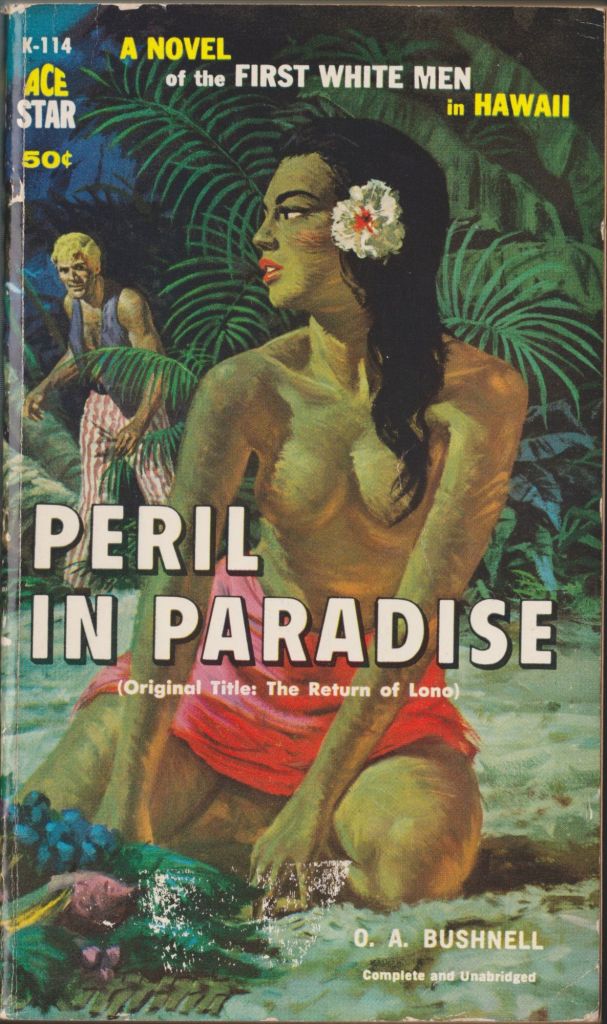
When Martine and I went to Hawaii in 1996, I did some research on the subject and came up with the name O. A. (short for Oswald Andrew) Bushnell. I promptly bought all five of his novels:
The Return of Lono (1956), about the death of Captain Cook on the Big Island of Hawai’i
Ka’a’awa: A Novel About Hawaii in the 1850s (1972)
Moloka’i (1975) about Father Damien and the leper colony at Kalaupapa
The Stone of Kannon (1979) and its sequel The Water of Kane (1980) about Japanese immigration to Hawaii
O. A. Bushnell (1913-2002)
I am ashamed to say that, to date, I have read only the first two books. Between now and our trip to Hawaii this fall, I will also add Moloka’i to my to-be-read pile.
What I find interesting about Bushnell is that he was a professor of microbiology at the University of Hawai’i at Manoa. In fact, he also wrote a book on the subject: Gifts of Civilization: Germs and Genocide in Hawaii (1993). Yet he was also a natural at writing fiction. Come to think of it, much of his novel Ka’a’awa dealt with the devastating smallpox and influenza epidemics of the 1850s
How to Make Serious Literature Look Cheap
I remember visiting the Los Angeles Times Book Fair around 2000 and coming upon a booth staffed by the University of Hawai’i Press. At the time, I had not yet read any of my Bushnell titles, but I asked about how the author was doing. “Ah, poor Ozzie!” came the answer. “He’s pretty ill, and we can only hope he pulls through.” Alas, he was to die shortly after.
But his work lives on, and it is definitely worth reading.
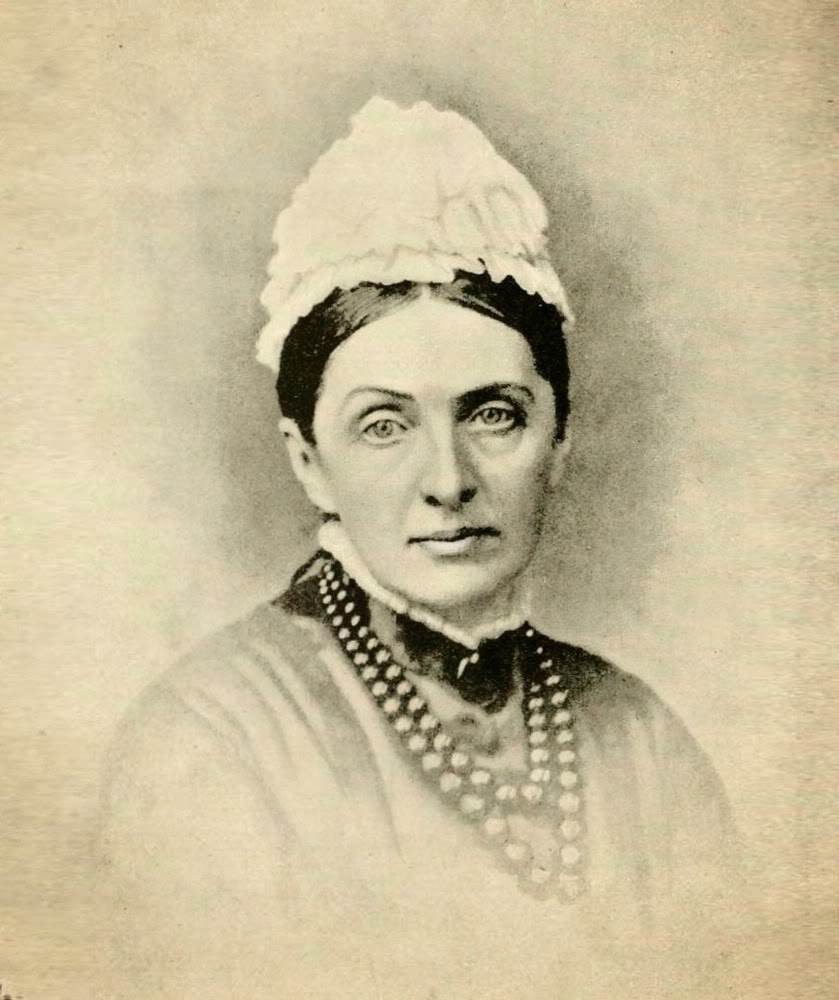
Were Victorian women really as fragile as depicted? Take the case of Isabella Lucy Bird, who is described in her Wikipedia entry as follows:
From early childhood Bird was frail, suffering from a spinal complaint, nervous headaches, and insomnia. The doctor recommended an open-air life, and consequently, Bird learned to ride in infancy, and later to row. Her only education came from her parents: her father was a keen botanist who instructed Bird in flora, and her mother taught her daughters an eclectic mix of subjects. Bird became an avid reader. However, her “bright intelligence, [and] an extreme curiosity as to the world outside, made it impossible for her brain and her nature generally to be narrowed and stiffened by the strictly evangelical atmosphere of her childhood.”
So what did this proper lady do for kicks? She traveled around the world for several decades, writing a series of creditable travel classics. I am currently reading Six Months in the Sandwich Islands, amongst the Palm Groves, Coral Reefs and Volcanoes (1874), which described her seven-month stay in the Hawaiian Archipelago.
Other books and articles describe her travels to Australia, the American West, Japan, Malaya, Greece, Persia, Tibet, China, Korea, and Morocco.
Isabella Bird was by no means the only woman solo traveler of her time. There was also Lady Florence Dixie (1855-1905), who wrote an excellent book about Patagonia; Frances Trollope (1779-1863), mother of novelist Anthony Trollope, who wrote of her travels in the United States; and Lady Hester Stanhope (1776-1839), who traveled extensively in the Middle East.
Dame Freya Stark (1893-1993)
Somewhat later, there was Dame Freya Stark, who traveled by herself among the Arabs and lived to the ripe old age of a hundred. I have read several of her books, which are uniformly excellent.
I can only look upon these women travelers with wonder and admiration.
There is no question in my mind that reading books can be a form of therapy. Not all books, but certainly those that make you think. Some books could be the opposite of therapeutic, like anything by Ayn Rand or Donald J. Trump.
I read incessantly. Only when I am ill do I not pick up a book. Since September 1998, I have read 2,750 books, ranging from literary classics to poetry to philosophy to history to travel.
Beginning in 1975, the year of my first real vacation (in Yucatán, Mexico), I decided to prepare several months in advance by reading books about my destination. They included archaeology, history, fiction, and descriptions of journeys. That way, when I finally reached my destination, I was there as a person who knew all sorts of things about where he was. That made me feel good about traveling. I didn’t feel like an ignorant interloper.
The therapeutic aspect was there, too. I came to the conclusion that the best philosophy books were written by the ancient Greeks and Romans. Cicero, Marcus Aurelius, and Epictetus had more to say about the human condition than the vast majority of academic philosophers, whose works were by and large unreadable. And it didn’t involve swallowing a whole lot of dogma administered by organized religion.
If you were to read the four dialogues of Plato about the death of Socrates (Euthyphro, Apology, Crito, and Phaedo), you will have read the greatest works of Western Philosophy ever written.
Also worth considering are some of the Hindu, Taoist, and Buddhist texts, such as The Bhagavad Gita, The Tao Te Ching, and the literature of Zen Buddhism. They taught me that desire is always accompanied by suffering. The less one desires, the happier one is. And happiness is not a lasting thing: It goes into hiding and manifests itself only at irregular intervals.
Now if I can only declare my book purchases as medical expenses….
Some months ago, I made a stab at re-reading Charles Dickens’s David Copperfield but gave up. Somehow, I was just not in the mood. (That happens, but fairly rarely.) Today, I made another attempt, with vastly improved results.
What got to me before was the character of Edward Murdstone and his sister Jane. Murdstone marries David’s mother, Clara, but begins raising David in an abusive even sadistic manner. But before the grim scenes of marriage, with Clara being forced to suppress her love for Davy, there intervenes the magical Chapter III, “I Have a Change.”
Magic is rare in fiction, but not with Dickens at his best. Davy goes with his mother’s maid Clara Peggotty to visit her family in Yarmouth on the Isle of Wight. There, he stays in an odd beach house built from an old boat, with Peggotty’s brother Daniel as head of household. In the boat house live Ham Peggotty, an orphaned nephew; Little Em’ly, an orphaned niece; and the morose Mrs Gummidge, widow of a fishing partner of Daniel’s. It is an odd mixed-up family that somehow seems to work.
It all starts with the first view of the boat house on the sands:
Ham carrying me on his back and a small box of ours under his arm, and Peggotty carrying another small box of ours, we turned down lanes bestrewn with bits of chips and little hillocks of sand and went past gas-works, rope-walks, boat-builders’ yards, shipwrights’ yards, caulkers’ yards, riggers’ lofts, smiths’ forges, and a great litter of such places, until we came out upon the dull waste I had already seen at a distance; when Ham said,
‘Yon’s our house, Mas’r Davy!’
I looked in all directions, as far as I could stare over the wilderness, and away at the sea, and away at the river, but no house could I make out. There was a black barge, or some other kind of superannuated boat, not far off, high and dry on the ground, with an iron funnel sticking out of it for a chimney and smoking very cosily; but nothing else in the way of a habitation that was visible to me.
‘That’s not it?’ said I. ‘That ship-looking thing?’
‘That’s it, Mas’r Davy,’ returned Ham.
If it had been Aladdin’s palace, roc’s egg and all, I suppose I could not have been more charmed with the romantic idea of living in it. There was a delightful door cut in the side, and it was roofed in, and there were little windows in it; but the wonderful charm of it was, that it was a real boat which had no doubt been upon the water hundreds of times, and which had never been intended to be lived in, on dry land. That was the captivation of it to me. If it had ever been meant to be lived in, I might have thought it small, or inconvenient, or lonely; but never having been designed for any such use, it became a perfect abode.
Davy stays in the boat house for a couple of weeks, allowing his mother to be married to the grim Murdstone and provide an unhappy surprise when Davy returns to The Rookery at Blunderstone, only to find Murdstone in charge as paterfamilias.
Until then, there are a couple of weeks of grace, during which little Davy falls in love with Little Em’ly, and is showered with kindnesses he was no longer able to receive at home.
I remember the chapter vividly from my own childhood, when I read an abridged edition of David Copperfield. Even in its mutilated form, it was magical then; and now, it’s still magical.
I am alternately in love with and terrified by Joan Didion. Behind that seeming fragility is a mountain of strength and eyes that cut through the obscuring fog. On one hand, the young Joan Didion was beautiful; but her marriage to John Gregory Dunne was a stormy one, and her relationship with him and her adopted daughter Quintana Roo was interrupted by their early deaths. I keep thinking of her heroine Maria Wyeth in Play It As It Lays:
She took his hand and held it. “Why are you here?”
“Because you and I, we know something. Because we’ve been out there where nothing is. Because I wanted—you know why.”
Joan was never a safe, sensible woman. She saw clearly to the heart of things, yet dulled herself with large amounts of alcohol and was rarely photographed without a cigarette in her hands. The daughter of a rancher, she was raised in Sacramento, a fifth-generation Californian, whose ancestors just escaped being part of the Donner Party in the winter of 1846-1847. There is in her eyes both wildness and clarity. She, too, has been out there where nothing is.
Though in one sense she terrifies me, I love her work. When she died last December, I felt that California had lost its muse.
I have spent half of the last week recovering from Covid-19, and half reading a superb novel about Bosnia in the early 19th century written by a Bosnian Serb named Ivo Andrić. Bosnian Chronicle describes life in the North Bosnian backwater town of Travnik when France opens a consulate there, and Austria follows suit, around 1807.
Described in loving detail by Andrić are the staffs of the two consulates and their families and aides; the three Ottoman Pashas in charge during the period covered and their aides; the local begs (first families) of the town; the religious leaders of the Islamic, Catholic, Jewish, and Orthodox Christian factions; the local doctors; and various peasants. The net result is a layered picture of Bosnian society and various French and Austrian “interlopers” during the height of the Napoleonic Era.
The book ends with Napoleon’s capture and exile on Elba, necessitating the closing of the French consulate, followed in short order by the closing of the Austrian consulate.
My Hungarian upbringing tends to make me more interested in Central and Eastern Europe than most other Americans. Fortunately, there is no lack of great literature east of Vienna: Ivo Andrić, for instance, a native of Travnik and a Bosniak himself, won the Nobel Prize for Literature in 1961 for The Bridge of the Drina. I have also read his Omar Pasha Latas: Marshal to the Sultan, which is available in a New York Review edition.
I turn to the East to look for literary treasures, and I have not been disappointed.
No work of literature is so closely tied in with painting than Marcel Proust’s In Search of Lost Time. In the first volume, Swann’s Way, Charles Swann finds himself in an obsessive relationship with Odette de Crécy. At one point, he compares his inamorata with Zipporah, Jethro’s daughter, in Sandro Botticelli’s “Life of Moses.”
On his way to the house, as always when he knew that they were to meet, he formed a picture of her in his mind; and the necessity, if he was to find any beauty in her face, of fixing his eyes on the fresh and rosy protuberance of her cheekbones, and of shutting out all the rest of those cheeks which were so often languorous and sallow, except when they were punctuated with little fiery spots, plunged him in acute depression, as proving that one’s ideal is always unattainable, and one’s actual happiness mediocre. He was taking her an engraving which she had asked to see. She was not very well; she received him, wearing a wrapper of mauve crêpe de Chine, which draped her bosom, like a mantle, with a richly embroidered web. As she stood there beside him, brushing his cheek with the loosened tresses of her hair, bending one knee in what was almost a dancer’s pose, so that she could lean without tiring herself over the picture, at which she was gazing, with bended head, out of those great eyes, which seemed so weary and so sullen when there was nothing to animate her, Swann was struck by her resemblance to the figure of Zipporah, Jethro’s Daughter, which is to be seen in one of the Sistine frescoes. He had always found a peculiar fascination in tracing in the paintings of the Old Masters, not merely the general characteristics of the people whom he encountered in his daily life, but rather what seems least susceptible of generalisation, the individual features of men and women whom he knew, as, for instance, in a bust of the Doge Loredan by Antonio Rizzo, the prominent cheekbones, the slanting eyebrows, in short, a speaking likeness to his own coachman Rémi; in the colouring of a Ghirlandaio, the nose of M. de Palancy; in a portrait by Tintoretto, the invasion of the plumpness of the cheek by an outcrop of whisker, the broken nose, the penetrating stare, the swollen eyelids of Dr. du Boulbon. Perhaps because he had always regretted, in his heart, that he had confined his attention to the social side of life, had talked, always, rather than acted, he felt that he might find a sort of indulgence bestowed upon him by those great artists, in his perception of the fact that they also had regarded with pleasure and had admitted into the canon of their works such types of physiognomy as give those works the strongest possible certificate of reality and trueness to life; a modern, almost a topical savour; perhaps, also, he had so far succumbed to the prevailing frivolity of the world of fashion that he felt the necessity of finding in an old masterpiece some such obvious and refreshing allusion to a person about whom jokes could be made and repeated and enjoyed to-day. Perhaps, on the other hand, he had retained enough of the artistic temperament to be able to find a genuine satisfaction in watching these individual features take on a more general significance when he saw them, uprooted and disembodied, in the abstract idea of similarity between an historic portrait and a modern original, whom it was not intended to represent. However that might be, and perhaps because the abundance of impressions which he, for some time past, had been receiving—though, indeed, they had come to him rather through the channel of his appreciation of music—had enriched his appetite for painting as well, it was with an unusual intensity of pleasure, a pleasure destined to have a lasting effect upon his character and conduct, that Swann remarked Odette’s resemblance to the Zipporah of that Alessandro de Mariano, to whom one shrinks from giving his more popular surname, now that ‘Botticelli’ suggests not so much the actual work of the Master as that false and banal conception of it which has of late obtained common currency. He no longer based his estimate of the merit of Odette’s face on the more or less good quality of her cheeks, and the softness and sweetness—as of carnation-petals—which, he supposed, would greet his lips there, should he ever hazard an embrace, but regarded it rather as a skein of subtle and lovely silken threads, which his gazing eyes collected and wound together, following the curving line from the skein to the ball, where he mingled the cadence of her neck with the spring of her hair and the droop of her eyelids, as though from a portrait of herself, in which her type was made clearly intelligible.
He stood gazing at her; traces of the old fresco were apparent in her face and limbs, and these he tried incessantly, afterwards, to recapture, both when he was with Odette, and when he was only thinking of her in her absence; and, albeit his admiration for the Florentine masterpiece was probably based upon his discovery that it had been reproduced in her, the similarity enhanced her beauty also, and rendered her more precious in his sight. Swann reproached himself with his failure, hitherto, to estimate at her true worth a creature whom the great Sandro would have adored, and counted himself fortunate that his pleasure in the contemplation of Odette found a justification in his own system of aesthetic. He told himself that, in choosing the thought of Odette as the inspiration of his dreams of ideal happiness, he was not, as he had until then supposed, falling back, merely, upon an expedient of doubtful and certainly inadequate value, since she contained in herself what satisfied the utmost refinement of his taste in art. He failed to observe that this quality would not naturally avail to bring Odette into the category of women whom he found desirable, simply because his desires had always run counter to his aesthetic taste. The words ‘Florentine painting’ were invaluable to Swann. They enabled him (gave him, as it were, a legal title) to introduce the image of Odette into a world of dreams and fancies which, until then, she had been debarred from entering, and where she assumed a new and nobler form. And whereas the mere sight of her in the flesh, by perpetually reviving his misgivings as to the quality of her face, her figure, the whole of her beauty, used to cool the ardour of his love, those misgivings were swept away and that love confirmed now that he could re-erect his estimate of her on the sure foundations of his aesthetic principles; while the kiss, the bodily surrender which would have seemed natural and but moderately attractive, had they been granted him by a creature of somewhat withered flesh and sluggish blood, coming, as now they came, to crown his adoration of a masterpiece in a gallery, must, it seemed, prove as exquisite as they would be supernatural.
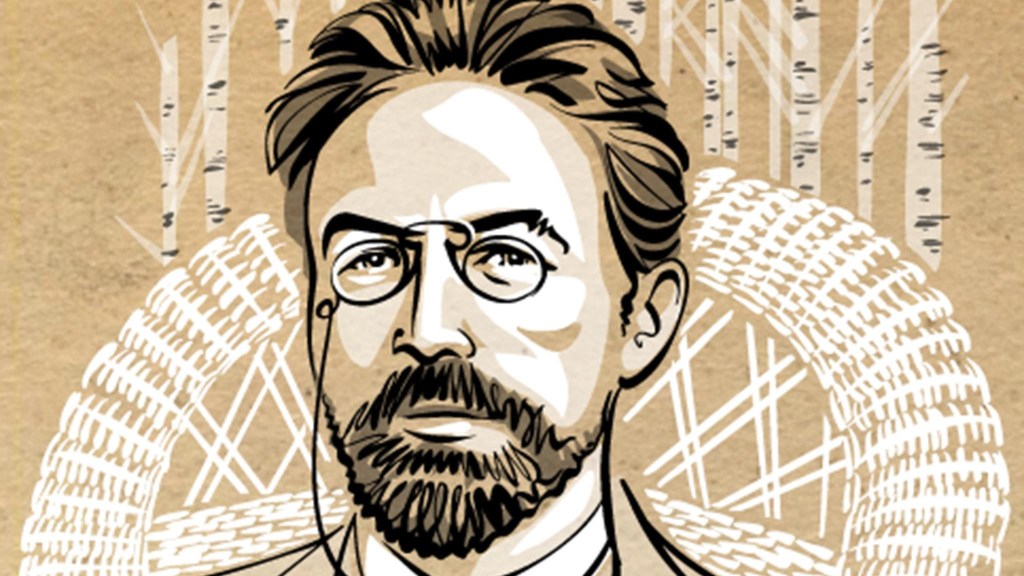
I have just finished a collection of short stories by Anton Chekhov (1860-1904) entitled The Wife and Other Stories which has been, by far, the best book I have read so far this year. Even though her translations are being increasingly considered as clunky and slightly archaic, I really enjoyed Constance Garnett. The following discussion on happiness vs. unhappiness is from a story entitled “Gooseberries.”
I saw a happy man whose cherished dream was so obviously fulfilled, who had attained his object in life, who had gained what he wanted, who was satisfied with his fate and himself. There is always, for some reason, an element of sadness mingled with my thoughts of human happiness, and, on this occasion, at the sight of a happy man I was overcome by an oppressive feeling that was close upon despair. It was particularly oppressive at night. A bed was made up for me in the room next to my brother’s bedroom, and I could hear that he was awake, and that he kept getting up and going to the plate of gooseberries and taking one. I reflected how many satisfied, happy people there really are! What a suffocating force it is! You look at life: the insolence and idleness of the strong, the ignorance and brutishness of the weak, incredible poverty all about us, overcrowding, degeneration, drunkenness, hypocrisy, lying…. Yet all is calm and stillness in the houses and in the streets; of the fifty thousand living in a town, there is not one who would cry out, who would give vent to his indignation aloud. We see the people going to market for provisions, eating by day, sleeping by night, talking their silly nonsense, getting married, growing old, serenely escorting their dead to the cemetery; but we do not see and we do not hear those who suffer, and what is terrible in life goes on somewhere behind the scenes…. Everything is quiet and peaceful, and nothing protests but mute statistics: so many people gone out of their minds, so many gallons of vodka drunk, so many children dead from malnutrition…. And this order of things is evidently necessary; evidently the happy man only feels at ease because the unhappy bear their burdens in silence, and without that silence happiness would be impossible. It’s a case of general hypnotism. There ought to be behind the door of every happy, contented man some one standing with a hammer continually reminding him with a tap that there are unhappy people; that however happy he may be, life will show him her laws sooner or later, trouble will come for him—disease, poverty, losses, and no one will see or hear, just as now he neither sees nor hears others. But there is no man with a hammer; the happy man lives at his ease, and trivial daily cares faintly agitate him like the wind in the aspen-tree—and all goes well.
I am currently reading Tracy Daugherty’s biography of Joan Didion entitled The Last Love Song. Halfway through the book, I feel as if I had relived the 1960s and the 1970s. I had never realized what a key literary figure that Joan Didion (as well as her friend Eve Babitz) were in my life. While Eve represented to me the world of L.A. celebrities, Joan’s wide screen writings took in the whole local and even international picture.
If one lives in the West L.A. area over a number of years, one finds oneself on the fringes of history. On June 5, 2004, for instance, Martine and I were turned away from the Ronald Reagan Presidential Library in the Simi Valley because the ex-president had just died. The funeral home that handled his body was within walking distance of my apartment, at 26th Street and Arizona in Santa Monica.
The scene of the crime when O. J. Simpson killed his wife and Ron Goldman was only five blocks north of me on Bundy Drive. (It building got so many visitors that they demolished the building.)
On June 25, 2009, I had difficulty getting home from work because thousands of people had showed up at the UCLA Hospital when they heard that Michael Jackson had died.
One of our clients at the accounting firm where I worked was the actor Richard Anderson, who lived at 10130 Cielo Drive, right next door to the house in which Sharon Tate and her friends were slaughtered by the Manson Family.
Joan Didion
While I never met Joan Didion, I always felt a curious parallelism between her works and my life. Not because I was a successful writer or filmmaker, but because she tracked life in Southern California the way I did. For the most part, what interested her interested me. I suspect that if I had met her, she and I would not have seen eye to eye: I am not interested in the kind of active social life she lived, or in heavy drinking, or raising a child (at which she self-admittedly failed).
The fact remains that, in following her works, especially in the 1960s and 1970s, I feel as if I am reliving my life during the formative years of my early adulthood. So much so that it is almost eerie at times.








 Tarnmoor
You must be logged in to post a comment.