The Man Who Wanted to Change the World

Aldous Huxley Pictured on Cover of One of My Books

Aldous Huxley Pictured on Cover of One of My Books

When I was a young man in my twenties and thirties, I regarded Aldous Huxley as one of my gurus. I read his novels and essays and treasured quotes from him, such as “I wanted to change the world. But I found that the only thing one can be sure of changing is oneself.” Then there was this one: “A child-like man is not a man whose development has been arrested; on the contrary, he is a man who has given himself a chance of continuing to develop long after most adults have muffled themselves in the cocoon of middle-aged habit and convention.”

In time, I found that Huxley was a very good novelist and an even better essayist. But he was a human being like all of us and, as much as he tried, turned out not to be the universal guru. One of the fun things about going back and re-reading his works is encountering my young self when I was most vulnerable: after my brain surgery in 1966 and in the twenty years that followed.

Last night, I finished reading Huxley’s short novel The Genius and the Goddess, about a young man, himself a scientist, who joins the household of a Nobel prizewinner, as I described in my Goodreads.Com review:

John Rivers is a young scientist who idolizes Nobel-Prize-winning scientist Dr. Henry Maartens, and jumps at the chance to not only work with him, but to join his household, including his Goddess-like wife Katy and children Tim and Ruth. Rivers puts Katy on a pedestal, but circumstances bring her to his bed when Maartens is ailing and the children are staying with a relative. Alternately crushed and ecstatic, Rivers finally comes out of his funk; and circumstances take an odd turn, leaving him to wonder at this early encounter late in his life.

I concluded my review:

I will continue to read Huxley and like him, but he is no longer the guru I once thought of him as being when I myself was equally torn and conflicted about love, wondering whether it would ever “happen” to me. It did, and continues to do so; but the experience is much more complex and mixed than I would ever have predicted.

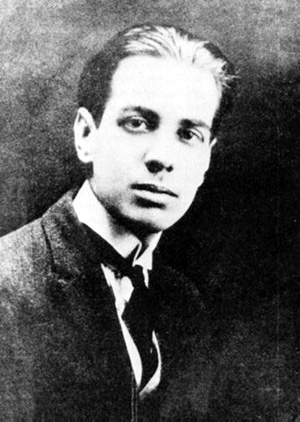
On an entirely different note, I noticed a strange “separated at birth” coincidence based on the photo above. In it, Huxley looks almost exactly like George Bancroft, who played Marshal Curly Wilcox in John Ford’s masterpiece Stagecoach (1939):
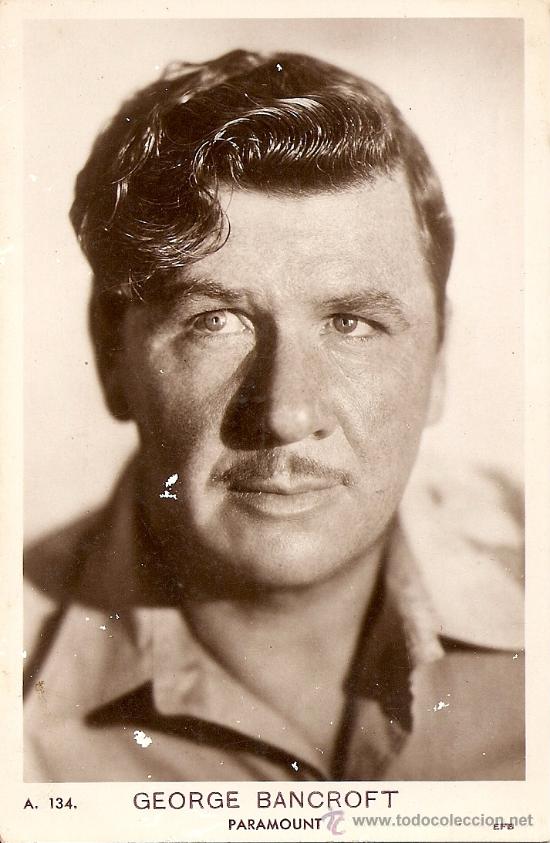
George Bancroft

George Bancroft

The only difference is that Huxley was a bit thinner, but the faces are amazingly close.

It’s Good To Be King

An Ode to the Carnie Lifestyle

An Ode to the Carny Lifestyle

After a lifetime of hating Stephen King—not that I ever gave him much of a chance—I picked up Joyland chiefly because I thought the cover illustration by Glenn Orbik (above) was hot. It showed a scene that was not even in the book: a red-headed Erin Cook (a co-worker of the book’s hero) screaming in fear while casually wielding a Speed Graphic camera which, if she had ever made a regular practice of doing so, would have left her with a forearm like Popeye’s.

So, what did I think? Actually, I liked the book. Partly because I am drawn to the whole carny world after reading William Lindsay Gresham’s Nightmare Alley, and partly because I thought King exercised admirable restraint in crafting the novel. I wasn’t quite sure about the action scenes at the end, and there were a couple of connections I never quite understood, but I liked the tone of the whole thing.

Devin Jones is a twenty-one-year-old college student who spends a summer working for a North Carolina amusement park called Joyland. He is a man who has been discarded by his apathetic girlfriend Wendy, who, once she parts from him, consigns him to oblivion posthaste. He likes the carny lifestyle, makes friends easily, discovers he has a talent for entertaining “zamps” (small children), and doesn’t object to some of the less desirable tasks around the midway.

He is drawn by the mystery of a young woman named Linda Gray who had been killed by an unknown assailant in the scary funhouse. In fact, he drops out of college and hangs on into the fall, when the only work is preparing the park for the next summer. During that time, he makes the acquaintance of a young mother with a severely disabled son—one who can foretell the future. You can bet this figures in the plot. Devin finally loses his virginity—to Annie Ross, the mother—and becomes a favorite of her son.

Stephen King

Stephen King

Finally, it all comes together for Devin. The killer is … someone Devin knows who calls him at home minutes after his discovery and lures him to the park, where King suddenly goes into overt mode. Perhaps one of the reasons I haven’t liked King all these years is that I thought he was too overt and not sufficiently psychological. But Joyland strikes a nice balance.

Also, I loved all the carny slang, which King took from this website. Maybe, I’ll read some more King: I always liked Kubrick’s film version of The Shining. Perhaps I’ll read that, or Dolores Claiborne, as suggested by my friend Lynette.

Strange Joy

Be Afraid! Be Very Afraid!

Be Afraid! Be Very Afraid!

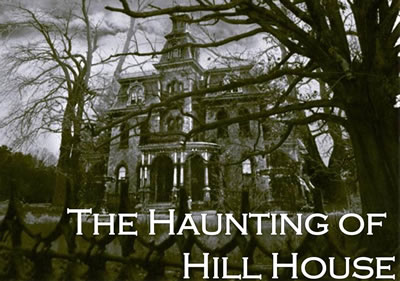
Every October, in honor of Halloween, I love to read classic horror stories. This last week, I read Hugh Lamb’s Dover collection of rare finds entitled A Bottomless Grave and Other Victorian Tales of Terror. Last year at this time, I read We Have Always Lived in the Castle, but this year I ventured on Shirley Jackson’s other famous novel, The Haunting of Hill House, which is equally spellbinding. (What I do not bother to read are the Stephen King and Dean Koontz type of novels that go in strictly for crude shocks.)

Usually, haunted house novels like to go in for crude effects. In contrast Jackson’s The Haunting of Hill House is delicately nuanced. Does this haunted house really do any damage with all its noise and strange writing on the walls and apparent destruction of one lady’s wardrobe? Actually, it does only one thing: It recognizes in Eleanor Vance, a spinster who is one of the party investigating the house, a kindred spirit. And it wants her. Badly.

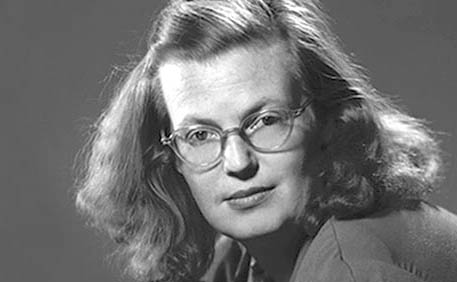
Shirley Jackson (1916-1965)

Shirley Jackson (1916-1965)

The real terror is not external, it resides within the human breast. Eleanor had spent her adult life as a nursemaid to her mother, who has died before the action of the story begins. She has, as the saying goes, no life of her own. The one line that keeps running through her mind during the course of the book is, “Journeys end in lovers meeting.”

For Shirley Jackson to see into the tortured heart of Eleanor Vance—and through all the flummery of haunted houses and planchettes—makes her one of the great writers of horror fiction. And this after Eleanor’s initial response to the house, which is one of horror and loathing. At the risk of giving the whole shooting match away, I will continue the quote that ends the last paragraph:

Journeys end in lovers meeting; I have spent an all but sleepless night, I have told lies and made a fool of myself, and the very air tastes like wine. I have been frightened half out of my foolish wits, but I have somehow earned this joy; I have been waiting for it for so long.

This book deserves on the same shelf with that other great psychological story of haunting, Henry James’s The Turn of the Screw.

Tarnmoor’s ABCs: Marcel Proust

He Went As Far As One Could Go with a Cookie

           He Went About As Far As One Could Go with a Cookie

I was so very impressed by Czeslaw Milosz’s book Milosz’s ABC’s. There, in the form of a brief and alphabetically-ordered personal encyclopedia, was the story of the life of a Nobel Prize winning poet, of the people, places, and things that meant the most to him. Because his origins were so far away (Lithuania and Poland) and so long ago (1920s and 1930s), there were relatively few entries that resonated personally with me. Except it was sad to see so many fascinating people who, unknown today, died during the war under unknown circumstances.

My own ABCs consist of places I have loved (Iceland), things I feared (Earthquakes), writers I have admired (Chesterton, Balzac, and Borges); things associated with my past life (Cleveland and Dartmouth College), people who have influenced me (John F. Kennedy), and things I love to do (Automobiles and Books). This blog entry is my own humble attempt to imitate a writer whom I have read on and off for thirty years without having sated my curiosity. Consequently, over the months to come, you will see a number of postings under the heading “Tarnmoor’s ABCs” that will attempt to do for my life what Milosz accomplished for his. To see my other entries under this category, hit the tag below marked “ABCs”. I don’t guarantee that I will use up all 26 letters of the alphabet, but I’ll do my best. Today, we’re at the letter “M,” for Marcel Proust, whose In Search of Lost Time I am now reading for the third time.

There are many literary giants of the Twentieth Century—writers such as James Joyce, Fernando Pessoa, William Faulkner, Jorge Luis Borges, Gabriel García Marquez, Graham Greene, G. K. Chesterton, Ryonosuke Akutagawa, Eugene O’Neill, Bertolt Brecht, Thomas Mann, Italo Svevo, Mikhail Bulgakov … the list stretches on and on. One who has had a particular role to play in my life is Marcel Proust. It seems I cannot let a year pass by without re-reading another installment of his massive In Search of Lost Time, which consists of seven full-sized novels:

  • Swann’s Way
  • In the Shadow of Young Girls in Flower (originally translated as Within a Budding Grove)
  • The Guermantes Way
  • Sodom and Gomorrah (originally translated as Cities of the Plain)
  • The Prisoner
  • The Fugitive (originally translated as The Sweet Cheat Gone)
  • Finding Time Again (originally translated as The Past Recaptured)

The first four volumes were completely edited by Proust during his lifetime. The last three received their final proofing from others (but are still great).

Quite frankly, it is not easy to read Proust. Some sentences seem to go on for pages. It requires intense concentration not to go astray, even within an individual paragraph. One old friend, who is a high school English teacher, abandoned Swann’s Way in the first section.

Why do I so highly regard a not-particularly-successful gay social climber whose world has so little in common with mine? For one thing, Proust writes about not so much memory as of the shimmering obsessions that monopolize so much of our attention yet, in the long run (the series spans decades), fall by the wayside as life goes on.

I have already had my fourth reading of Swann’s Way. When I return from Peru, I plan to re-read In the Shadow of Young Girls in Flower for the third time. If God is good to me, there will be a fourth and—who knows—maybe even a fifth reading of the series in the time that remains to me.

Slipping Off the Pedestal

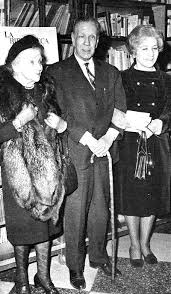
Jorge Luis Borges Flanked by His Mother and His Wife Elsa

Jorge Luis Borges Flanked by His Mother and His Wife Elsa

It was bound to happen sooner or later: After worshiping the man for over forty years, I am finally beginning to have my doubts about Jorge Luis Borges the man. But not, by any means, of Borges the poet and writer of short stories and essays. I still think he deserved the Nobel Prize for Literature on merit alone, but I begin to understand why he cheesed off the liberal-minded Nobel Prize Selection Committee.

Perhaps my favorite translator of Borges is Norman Thomas di Giovanni, whose book Georgie and Elsa: Jorge Luis Borges and His Wife, The Untold Story has just recently been published. Di Giovanni worked closely with Borges during the 1960s, shortly after he married Elsa Astete Millán, and through the divorce. What Di Giovanni discovered was that Borges was fatally naive when it came to women, politics, and social life. In fact, he was incredibly feckless in many ways. Di Giovanni writes:

[I]n later years, he travelled to Chile to receive a medal from the hands of Augusto Pinochet. This was one of the worst decisions of his life. But, he maintained, in his digging-his-heels-in mode that no one was going to tell him what he could or could not do. I imagine that it would never have occurred to Borges to question and be horrified by Pinochet’s well-oiled programme of eliminating Communists and other left-wingers. Borges was so universally condemned for his action that I think he came to realize his colossal mistake. But to justify it and himself, when I mentioned his folly to him, he said, ‘But I thought the medal was a gift of the Chilean people.’

Equally, if not more disastrous, was Borges’s marriage to Elsa. Years earlier, he had mooned over her; but, typically, someone else married her. (“Georgie” was not prime marriage material, as he lived with his mother well into his old age.) Then, one day, he met her again and—discovering that she was now widowed—took up with her again. By now, Borges was a famous literary figure; and, Elsa, being a social climber, thought that she was now about to enter the high life.

Her behavior during visits to the United States was execrable. She would steal silverware and other “souvenirs” from Borges’s friends and associates. During a visit to the Rockefellers, she insisted in photographing every room and asking about all the furnishings. It got to the point that people stopped inviting Borges lest Elsa come along. When she accidentally left a nutria coat in Cambridge after one trip, she made the return of the coat into an international incident involving U.S. and Argentinian ambassadorial and consular staffs.

Not that Borges was an ideal husband. He was an elderly blind man who happened to be impotent (which Elsa had known earlier) and incredibly old fashioned, a sort of Anglo-Argentinian who was neither all one thing or all the other. Finally, with di Giovanni’s help, Borges divorced her. He later re-married, with Maria Kodama, who now controls his esate.

Di Giovanni’s book is mandatory reading to supplement all the hagiographical biographies of the author who never quite get at the man’s character.


Tarnmoor’s ABCs: Jorge Luis Borges

Jorge Luis Borges in 1921

Jorge Luis Borges in 1921

I was so very impressed by Czeslaw Milosz’s book Milosz’s ABC’s. There, in the form of a brief and alphabetically-ordered personal encyclopedia, was the story of the life of a Nobel Prize winning poet, of the people, places, and things that meant the most to him. Because his origins were so far away (Lithuania and Poland) and so long ago (1920s and 1930s), there were relatively few entries that resonated personally with me. Except it was sad to see so many fascinating people who, unknown today, died during the war under unknown circumstances.

My own ABCs consist of places I have loved (Iceland), things I feared (Earthquakes), writers I have admired (G. K. Chesterton and Honoré de Balzac); things associated with my past life (Cleveland and Dartmouth College), and things I love to do (Automobiles and Books). This blog entry is my own humble attempt to imitate a writer whom I have read on and off for thirty years without having sated my curiosity. Consequently, over the months to come, you will see a number of postings under the heading “Tarnmoor’s ABCs” that will attempt to do for my life what Milosz accomplished for his. To see my other entries under this category, hit the tag below marked “ABCs”.I don’t guarantee that I will use up all 26 letters of the alphabet, but I’ll do my best. Today, we’re at the letter “J,” for Jorge Luis Borges.

Ever since I first learned about Jorge Luis Borges (1899-1986), I have been hooked. By now, I have read just about everything that has been translated into English, sometimes two or three times. He has guided my reading for over forty years: Without him, I would never have discovered Iceland or the works of G. K. Chesterton. Without him, I would never have gone to Argentina twice, once in 2006 and once in 2011. His City of Buenos Aires has become one of the ineluctable geographies of my dreams.

Of his works, I recommend most highly Labyrinths, Ficciones, Other Inquisitions, and, of course, his magnificent poetry. Below, from the recent Penguin anthology entitled Poems of the Night, I have excerpted one poem entitled “Sleep” as translated by Stephen Kessler:

SLEEP

The night assigns us its magic
task. To unravel the universe,
the infinite ramifications
of effects and causes, all lost
in that bottomless vertigo, time.
Tonight the night wants you to forget
your name, your elders and your blood,
every human word and every tear,
what you would have learned from staying awake,
the illusory point of the geometricians,
the line, the plane, the cube, the pyramid,
the cylinder, the sphere, the sea, the waves,
your cheek on the pillow, the coolness
of the fresh sheets, the Caesars and Shakespeare
and the hardest thing of all, what you love.
Oddly enough, a pill can
erase the cosmos and erect chaos.

Most people who know of Borges know only that he was blind. For the last half of his life, he was a kind of Teiresias. That’s why I wanted to reproduce above a photograph of the poet in his twenties. The other thing many people know is that he was singled out by the Swedish Academy to be passed over for the Nobel Prize for Literature, primarily because one member of the selection committee disagreed with his politics. This was supposedly because he accepted an award from Chilean dictator General Augusto Pinochet Ugarte. I do not care a fig if Borges’s politics are to the right of mine: All that counts is that he has had a benign, lasting, and ever growing influence on the person I have become.

Television IS News?

Look What’s Popping Up on TV News Websites?

Look What’s Popping Up on TV News Websites?

It was bound to happen sooner or later. Now that the same corporations that own television news also own popular television series.One can’t look at CNN.com or NBCNews.com without running into articles about the latest developments in “Man Men,” “Breaking Bad,” or even the dwindling “American Idol.” That never used to happen before. Even Salon.Com, which insofar as I know, is unaffiliated with any entertainment producers, is heavily interlarded with references to popular shows.

Since I have deliberately abandoned television programming over ten years ago, all these references in the news mean nothing to me. They end up as descriptions of cultural phenomena that are meaningless to me. In no case do I ever become interested enough to see what all the hoopla is about. I think the last time I tried was a few years ago when I rented the first season of “The Sopranos” from Netflix. I thought it was all right, but not good enough to maintain my interest.

Instead of television series, it would be interesting to see more news articles about books. That occasionally happens on Salon.Com, but almost never on the mainstream media websites. Oh, well, you can always come here and look at what I am reading. You are bound to encounter quite a few books. I have made a commitment to Goodreads.Com to read 106 books this year. So far, I am 16 books ahead on my goal. Maybe I should alert CNN?

The Man in the High Castle

Prague Castle, Seat of the Czech Government

Prague Castle, Seat of the Czech Government

No, this isn’t about the Philip K. Dick novel of that name, but about a nation’s president who came to the world’s notice after many years as a jailed dissident and as a playwright of international renown. I am referring to Václav Havel, the last president of Czechoslovakia and (after Slovakia decided to go its own way) the first president of the Czech Republic.

I have just finished reading his informal memoir, To the Castle and Back: Reflections on My Strange Life as a Fairy Tale Hero. Written after he left office in 2003, this book consists of three interleaved sequences:

  1. Reflections written mostly in 2005 during a protracted visit to the United States
  2. A series of memos to his staff dating from 1993-2003 that he found on his computer
  3. An ongoing interview with Czech writer Karel Hvizd’ala about his experiences running a country that had suddenly cast off the yoke of Communism

It also shows some of the small issues that endlessly plagued him, such as the following:

In the closet where the vacuum cleaner is kept, there also lives a bat. How to get rid of it? The lightbulb has been unscrewed so as not to wake it up and upset it.

At other times, Havel had to complain to his staff about the ugliest old telephones being in the most prominent places, about the length of the watering hose used in the gardens, and why the good silverware was not being used for state dinners.

I was curious to discover that Havel, despite being a well-known writer, was petrified whenever he had to begin writing anything. And he appears to have written all his own speeches! (And well, too.)

Czech President Václav Havel

Czech President Václav Havel

Particularly impressive was Havel’s answer as to Hvizd’ala as to what his credo was as the President of the Republic:

I think that the moral order stands above the legal, political, and economic orders, and that these latter orders should derive from the former, and not be techniques for getting around its imperatives. And I believe this moral order has a metaphysical anchoring in the infinite and the eternal.

Can you imagine any of our own leaders being so candid, to the point, and right at the same time?

Despite the book’s informality, I find it that To the Castle and Back gives probably the best picture of what the transition from Communism to Capitalism was like in one country, and the perils of what Havel calls “postcommunism,” in which the former Communist leaders, being still in a position of power and with all the right connections, loot the country.


Tarnmoor’s ABCs: Honoré de Balzac

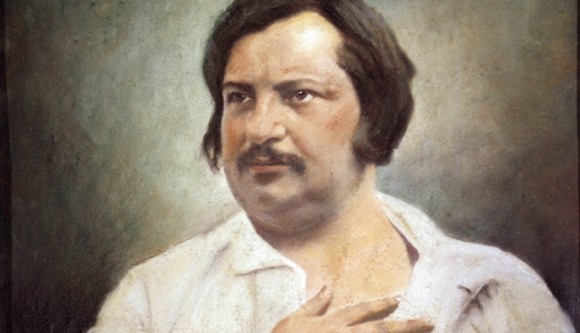
Honoré de Balzac (1799-1850)

Honoré de Balzac (1799-1850)

I don’t even remember what it was that led to me read Honoré de Balzac’s Père Goriot around 1970. It was a Penguin paperback with a cover illustration of the last chapter’s funeral scene at Père Lachaise cemetery in muted colors. The scene, quoted below, showed the book’s young hero Eugène de Rastignac, poor scion of a good family, seeing the virtually unattended obsequies of an old man, who, like King Lear, gave everything to his daughters. Except there was no Cordelia in this tale:

But just as the coffin was put in the hearse, two empty carriages, with the armorial bearings of the Comte de Restaud and the Baron de Nucingen, arrived and followed in the procession to Père-Lachaise. At six o’clock Goriot’s coffin was lowered into the grave, his daughters’’ servants standing round the while. The ecclesiastic recited the short prayer that the students could afford to pay for, and then both priest and lackeys disappeared at once. The two grave diggers flung in several spadefuls of earth, and then stopped and asked Rastignac for their fee. Eugène felt in vain in his pocket, and was obliged to borrow five francs of Christophe. This thing, so trifling in itself, gave Rastignac a terrible pang of distress. It was growing dusk, the damp twilight fretted his nerves; he gazed down into the grave and the tears he shed were drawn from him by the sacred emotion, a single-hearted sorrow. When such tears fall on earth, their radiance reaches heaven. And with that tear that fell on Father Goriot’s grave, Eugène Rastignac’s youth ended. He folded his arms and gazed at the clouded sky; and Christophe, after a glance at him, turned and went—Rastignac was left alone.

He went a few paces further, to the highest point of the cemetery, and looked out over Paris and the windings of the Seine; the lamps were beginning to shine on either side of the river. His eyes turned almost eagerly to the space between the column of the Place Vendome and the cupola of the Invalides; there lay the shining world that he had wished to reach. He glanced over that humming hive, seeming to draw a foretaste of its honey, and said magniloquently:

“Henceforth there is war between us.”

And by way of throwing down the glove to Society, Rastignac went to dine with Mme. de Nucingen.

At the time, I was only about 25 years old myself, and I felt myself, like de Rastignac, to be a creature of destiny. The years have shown that I was deluding myself, but that wasn’t Balzac’s fault.

Over the years, Balzac has continued to cast his spell on me. By now, I have read virtually everything Balzac published under his own name, as well as two works written under the pseudonym Horace de Saint-Aubin. I am a member of a reading group dedicated to Balzac under Yahoo!—a group which at one time read and discussed all of the author’s books over a period of several years.

Interestingly, Balzac is a rare example of a great writer who is not a consistently good writer. He was remarkably slapdash about composing and editing his works, yet he always entranced the reader by the breadth of his imagination which, to this day, has never been approached by any other writer, not even Marcel Proust. He is like a candle burning at both ends, a creature of soaring ambition, poor spending habits, and a remarkable understanding of how people interact in what is a material world. At his worst, he is a tedious dimestore philosopher in Seraphita and the second half of Louis Lambert.

Ah, but at his best, he is sublime. Even when all the pieces don’t add up, the following works are among the most powerful works ever penned:

  • The Wild Ass’s Skin (1831)
  • Colonel Chabert (1832)
  • Père Goriot (1835), his masterpiece
  • Lost Illusions (1843)
  • Cousin Bette (1846)
  • Cousin Pons (1847)
  • A Harlot High and Low (1847)

If you have a Kindle or other e-reading device, you can pick up Balzac’s complete work, translated into English, for free or for mere pennies. And be sure to visit La Comédie Humaine by Balzac, which was put together by members of the Yahoo! Balzac group, and which includes dozens of reviews and summaries written by me and others.


“Not More Foolish Than Any Other Love”

Books

Books

The love of books is really a commendable taste. Bibliophiles are often made fun of, and perhaps, after all, they do lend themselves to raillery. But we should rather envy them, I think, for having successfully filled their lives with an enduring and harmless pleasure. Detractors think to confound them by declaring they never read their books. But one of them had his answer pat: “And you, do you eat off your old china?” What more innocent hobby can a man pursue than sorting away books in a press? True, it is very like the game the children play at when they build sand castles on the seashore. They are mighty busy, but nothing comes of it; whatever they build will be thrown down in a very short time. No doubt it is the same with collections of books and pictures. But it is only the vicissitudes of existence and the shortness of human life that must be blamed. The tide sweeps away the sand castles, the auctioneer disperses the hoarded treasures. And yet, what better can we do than build sand castles at ten years old, and form collections at sixty? Nothing will remain in any case of all our work, and the love of old books is not more foolish than any other love.—Anatole France, The Garden of Epicurus