Report: Januarius 2024

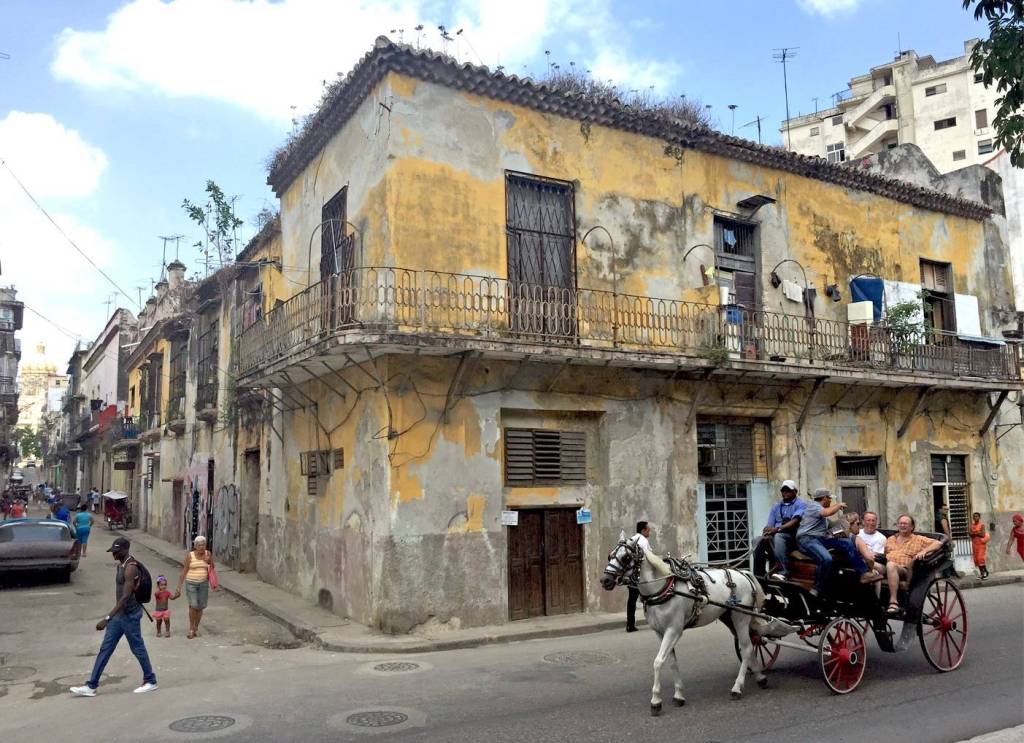
Havana Street Scene

As I mentioned at the beginning of January, I typically read books in this first month of the year written by authors I have not read before. Well, last month’s total was eleven books:

  • Maxim Osipov: Rock, Paper, Scissors and Other Stories (Russia)
  • Dorothy Parker: “Men I’m Not Married To” (USA) – short story
  • Llewelyn Powys: Earth Memories (Britain)
  • George MacDonald: The Princess and Curdie (Scotland)
  • Alejo Carpentier: Explosion in a Cathedral (Cuba)
  • Olga Tokarczuk: House of Day, House of Night (Poland)
  • Joseph Joubert: Notebooks of Joseph Joubert (France)
  • Pedro Juan Gutiérrez: Dirty Havana Trilogy (Cuba)
  • Fleur Jaeggy: Sweet Days of Discipline (Switzerland)
  • Luis Vaz de Camoens: The Lusiads (Portugal)
  • Leonardo Padura: Havana Red (Cuba)

Three of the books were by Cuban authors, and I enjoyed all three of them. Only three were originally published in English. Three of the authors were women, most particularly Olga Tokarczuk, whose House of Day, House of Night was by far the best book I read last month. Second best was Carpentier’s Explosion in a Cathedral, followed by Powys’s Earth Memories.

Were there any clunkers? I am pleased to say “No, not a one!”

Joubert’s Notebooks

French Thinker Joseph Joubert (1754-1824)

To understand where we are today, I believe it is important to go back in time and read works written in the more distant past. In the middle of reading The Notebooks of Joseph Joubert: A Selection (New York Review Books, 2005), I am confronted by the philosophical fragments of a man who never published during his lifetime. He kept copious notes, however, which were published after his death. During his lifetime, he was best known as Napoleon’s inspector general of French universities.

Following are a number of his maxims which struck my eyes as I was reading his book.

It is not facts but rumors that cause emotions among the people. What is believed creates everything.

All truths are double or doubled, or they all have a front and a back.

What comes through war is given back through war. All spoils will be retaken, all plunder will be dispersed, All victors will be defeated and every city filled with prey will be sacked in its turn.

Clarity of mind is not given in all centuries.

When men are imbeciles, the one who is mad dominates the others.

The only good in man is his young feelings and his old thoughts.

Everything is double and is made up of a soul and a body.

You have searched in vain, you have found nothing but envelopes. Open a hundred, open a thousand, you will always be stopped before opening the last. You think you have touched the essence when you take off the outer skins. You take the homunculus for the animal. But it is much deeper…. In each drop is a drop, in each point another point.

With the Cutlers

They suddenly appear on Page 207 of Olga Tokarczuk’s House of Day, House of Night (1988), a strange sect known for sharp knives:

They spent their days singing psalms and making knives. They made blades better than anyone in the whole of Silesia and fitted them with carefully polished handles made of ash wood, which every human hand fell in love with instantly. They sold them once a year in early autumn when the apples were ripening on the trees. They held a sort of fair, which attracted people from all over the district; they each bought several knives, sometimes as many as a dozen, in order to sell them on at a profit. During these fairs people forgot that the Cutlers were of a different faith and believed in a different God, and that it would have been easy to produce evidence and drive them away. For who would make such good knives then?

Whenever they bore a child they mourned instead of rejoicing. Whenever someone died, they undressed him, laid his naked corpse in a hole in the ground and danced around the open grave.

About forty pages later appears this poem, called “The Cutlers’ Psalm”:

Futility on all the earth
blessed be barren wombs
holy be all sterility
sacred is decay, desirous is decline
wondrous the fruitlessness of winter
the empty shells of nuts
logs burnt to ashes that still keep the shape of the tree
seeds that fall on to stony ground
knives gone blunt
streams run dry
the beat that devours another’s offspring
the bird that feeds on another’s eggs
war that is always the start of peace
hunger that is the beginning of repletion
Sacred old age, daybreak of death,
time trapped in the body,
death sudden, unexpected.
death downtrodden like a path in the grass
To do, but have no results
to act, but stir nothing
to age, but change nothing
to set off, but never arrive
to speak, but not give voice

Whew!

Currer, Ellis, and Acton

The Brontë Sisters as Painted by Their Brother Patrick

When the Brontë sisters began publishing their novels in the early 19th century, they did not use their original names. They figured they would find greater acceptance if they used men’s names. Consequently, Charlotte published under the name Currer Bell; Emily, under the name Ellis Bell; and Anne, under the name Acton Bell.

For most of history, there have been precious few women writers whom we know by name. Among the ancient Greeks of the 6th Century BCE, there was Sappho of Lesbos. Then we have to skip forward to the Middle Ages to find Christine de Pizan. In the 17th and 18th centuries, there were a handful of names, including Aphra Behn, Mary Shelley, Jane Austen, Anne Radcliffe, Charlotte Lennox, and Charlotte Smith in England as well as Mme. de Lafayette and Mme. de Staël in France.

In the first thirty years of the Nobel Prize in Literature, there were only three women: Selma Lagerlöf, Grazia Deledda, and Sigrid Undset. More recently, the distribution of Nobels is more equitable. Partly, that is because good literature is becoming increasingly female. I am currently reading Polish author Olga Tokarczuk’s House of Day, House of Night. In the recent past, I have enjoyed the work of Wisława Szymborska (Poland), Svetlana Alexievich (Belarus), Annie Ernaux (France), and Toni Morrison (U.S.A.)—all winners of the Nobel Prize.

No doubt about it, the future of literature is looking ever more female.

Glimmers

The Archangel Raphael in the Style of the Cuzco School of Painting

Currently, I am reading Olga Tokarczuk’s House of Day, House of Night, an early (1988) novel by the 2018 winner of the Nobel Prize in Literature. I came across the following passage and thought I would like to share it with you:

Quite out of the blue a bizarre and compelling idea came into my head today: that we have ended up as human beings through forgetfulness, through lack of attention, and that in reality we are creatures participating in a vast, cosmic battle that has probably been going on since time immemorial, and which, for all we know, may never end. All we see of it are glimmers, in blood-red moons, in fires and gales, in frozen leaves that fall in October, in the jittery flight of a butterfly, in the irregular pulse of time that can lengthen a night into infinity or come to a violent stop each day at noon. I am actually an angel or demon sent into the turmoil of one life on a sort of mission, which is either carrying itself out without my help, or else I have totally forgotten about it. This forgetfulness is part of the war—it’s the other side’s weapon, and they have attacked me with it so that I’m wounded, invalided out of the game for a while. As a result, I don’t know how powerful or weak I am—I don’t know anything about myself because I can’t remember anything, and that’s why I don’t try to look for either weakness or power in myself. It’s an extraordinary feeling—to imagine that somewhere deep inside, you are someone completely different from the person you always thought you were. But it didn’t make me feel anxious, just relieved, finally free of a kind of weariness that used to permeate my life.

“A Butterfly Secret”

Bats Head in Dorset

I have just finished reading the essays in Earth Memories by Llewelyn Powys (1884-1939), one of three literary giants in a family that included John Cowper Powys (1872-1063) and T. F. Powys (1875-1953). The essays in the book are mostly nature studies with an occasional jaunt into the philosophical implications of his everyday reality. The following is from his essay “A Butterfly Secret”:

And, indeed, as one walks over these downs at nighttime, under the fathomless pricked dome of infinity, one receives but one answer, The matter is as plain as a child’s sum in a dame’s school. Life is its own justification. There is no other aim to it, no other meaning, no other purpose, and if we think otherwise, we are foolish. Let the truth be spoken. Each one of us, each intellectual soul among us, advances steadily and surely toward the grave. Abdel Krim and his Rifis, General Feng and his soldiers, are all marching down the same road—a road that leads to oblivion and that for a thousand years has been trodden by a procession of all nations. Every religion is as brittle as an empty snail shell in dry weather, as quick to disappear as cuckoo-spit in a summer hedge that conceals at its center no green fly. The secret to be remembered is that nothing matters, nothing but the momentary consciousness of each individual as he opens his eyes upon a spectacle that knows nought of ethics.

Let us, as best we may, reconcile our minds to the fact that all our self-imposed tasks, our political engineering, our brave talk have actually, under the shadow of Eternity, no consequence. Our idealism is treacherous. It is a moonshine path over a deep sea. We are cursed souls each one of us and resemble nothing so much as jackdaws flying about he radiant cliffs of God pretending to be seagulls.

And yet there is no cause to despair. Merely to have come to consciousness at all constitutes an inestimable privilege. The past is nothing, the future is nothing, the eternal now alone is of moment. This is understood well enough by every living creature but man.

The Tadzhik Woman

RUSSIA – CIRCA 1984: shows Tadzhik Soviet Socialist Republic flags and arms, circa 1984

I am currently reading a book of stories by the Russian writer Maxim Osipov entitled Rock, Paper, Scissors and Other Stories. In the title story is an incredible Tadzhik woman who kills an official of a small rural town in Russia who tries to rape her. Her name is Ruhshona Ibragimovma. Although working in a menial position at a restaurant, she is a highly educated woman, which, in the position she finds herself, becomes increasingly unimportant to her.

[D]eath’s omnipresence is no accident, no unhappy mistake. Everyone fears death, just as they fear misfortune, yet death is inescapable, which means it is real. And that we did not invent it. At this very moment Ruhshona begins to see death as the most important thing that can exist within a person. She views those who don’t carry death within themselves—who don’t live by it—as empty, like wrapping paper, like candy wrappers. Hollow, soulless people. She can pick them out at a glance.

Januarius/Gennaro

The Dried Blood of St Januarius (AKA San Gennaro)

He is the patron saint of Naples. At the church named for him, the dried blood of Saint Januarius (or Gennaro) is supposed to liquefy three times a year:

  • September 19, the saint’s feast day
  • December 16
  • The first Saturday in May

When the miracle fails to occur, it portends “imminent disaster including war, famine or disease,” according to one website. Apparently, the miracle occurred again in September, but I have not been able to find whether the December 16 miracle occurred on schedule.

Januarius was a third century bishop of Benevento, Italy, who was martyred during the persecutions of the Emperor Diocletian.

For a number of years, I have pre-empted the name of Januarius to refer to my practice of using the first month of the year to read only authors I have never read before. My reasoning for this is to constantly broaden my horizons. For example, this year I plan to read several Cuban novels.

One result of my Januarius project is also that I read more women authors, which I had not done so much heretofore.

I will report back to you probably in early February if I have made any finds worth noting. (I probably will.)

To Prince or Not To Prince

Statue of Niccolò Machiavelli in Florence’s Uffizi Gallery

Will the real Niccolò Machiavelli please stand up. For over five hundred years, his name has been synonymous with cruelty and immorality in governance. But is that the real Machiavelli, or was his work The Prince not meant to be taken seriously?

Even Jean-Jacques Rousseau in The Social Contract had his doubts:

Machiavelli was a proper man and a good citizen; but, being attached to the court of the Medici, he could not help veiling his love of liberty in the midst of his country’s oppression. The choice of his detestable hero, Cesare Borgia, clearly enough shows his hidden aim; and the contradiction between the teaching of The Prince and that of the Discourses on Livy and the History of Florence shows that this profound political thinker has so far been studied only by superficial or corrupt readers. The Court of Rome sternly prohibited his book. I can well believe it; for it is that Court it most clearly portrays.

I am currently reading Machiavelli’s The Discourses and find it entirely different from The Prince, Instead of advice to princes to be evil, he comes across as altogether more reasonable. For instance:

All writers on politics have pointed out, and throughout history there are plenty of examples which indicate, that in constituting and legislating for a commonwealth it must needs be taken for granted that all men are wicked and that they will always give vent to the malignity that is in their minds when opportunity offers.

And: “Men never do good unless necessity drives them to it; but when they are too free to choose and can do just as they please, confusion and disorder become everywhere rampant.” It certainly does not look as if the writer were urging confusion and disorder on the people of Florence. In fact, everything he wrote other than The Prince shows him to be a loyal and responsible citizen of Florence.

Could it be that The Prince was written as a warning to his readers of what happens when their leaders are cruel and uncaring?

On Foot in Pinkville

U.S. Troops in Vietnam

“Pinkville” is the name that the soldiers who fought on the ground gave to the villages around My Lai, site of the 1968 massacre in which hundreds of Vietnamese civilians were killed in 1968. It is an area well described by Tim O’Brien, whose books on the Vietnam War from the point of view of the troops on the ground are probably the best books to read about the war as it was fought.

O’Brien started in 1975 with his own experiences in the war, set forth in a book entitled If I Die in a Combat Zone, Box Me Up and Ship Me Home. He asks “Can the foot soldier teach anything important about war, merely from having been there? I think not. He can tell war stories.”

And that’s exactly what O’Brien does. The stories are all true in his first book, with only the names of characters being changed.

Then, in 1978, he wrote Going After Cacciato, the first of two fictional works about the war. This was followed in 1990 by The Things They Carried, which is my favorite of his books.

Whether writing fiction or straight memoir, O’Brien is a powerful writer. In If I Die in a Combat Zone, there is a chapter entitled “Step Lightly” about the different kinds of land mines used by the Viet Cong. The most horrifying of these is the Bouncing Betty:

The Bouncing Betty is feared most. It is a common mine. It leaps out of its nest in the earth, and when it hits its apex, it explodes, reliable and deadly. If a fellow is lucky and if the mine is in an old emplacement, having been exposed to the rains, he may notice its three prongs sticking out of the clay. The prongs serve as the Bouncing Betty’s firing device. Step on them, and the unlucky soldier will hear a muffled explosion ; that’s the initial charge sending the mine on its one-yard leap into the sky. The fellow takes another step and begins the next and his backside is bleeding and he’s dead. We call it “ol’ step and a half.”

Yipes!