Clarity and Emptiness

Lute Player (After Frans Hals)

From time to time, I love to read books of original source material on Eastern Religions. The following is taken from the Visuddhi Maga as quoted in a collection edited by Anne Bancroft entitled The Pocket Buddha Reader (Boston: Shambhala, 2001):

When a lute is played, there is no previous store of playing that it comes from. When the music stops, it does not go anywhere else. It came into existence by way of the structure of the lute and the playing of the performer. When the playing ceases, the music goes out of existence.

In the same way all the components of being, both material and nonmaterial, come into existence, play their part, and pass away.

That which we call a person is the bringing together of components and their actions with one another. It is impossible to find a permanent self there. And yet there is a paradox. For there is a path to follow and there is walking to be done, and yet there is no walker. There are actions but there is no actor. The air moves, but there is no wind. The idea of a specific self is a mistake. Existence is clarity and emptiness.

Taking Stock

An All-But-Abandoned Park in Santa Monica

This was for me a day of taking stock and meditating. It all started with a fortune cookie I received at lunch from Siam Chan: “You can only live once, but if you do it right, once is enough.”

When I got home, I decided to take a walk to a little park at 26th Street and Broadway in Santa Monica. I grabbed my copy of Dhammapada: The Sayings of the Buddha and set out. It’s a nice little park which is all but abandoned on weekends. (On weekdays, the surrounding office buildings are crowded with folk.)

Arriving there, I grabbed a chair and started to read. As usual, Buddha hit the nail on the head:

And yet it is not good conduct
That helps you on the way,
Nor ritual, nor book learning,
Nor withdrawal into the self,
Nor deep meditation.
None of these confers mastery or joy.

O seeker!
Rely on nothing
Until you want nothing.

Again and again, it is he stifling of desire that is the key:

Death overtakes the man
Who gathers flowers
When with distracted mind and
     thirsty senses
He searches vainly for happiness
In the pleasures of the world.
Death fetches him away
As a flood carries off a sleeping village.


The Master

Gautama Buddha

The following is a section from the Shambhala Pocket Classics edition of Dhammapada: The Sayings of the Buddha as translated by Thomas Byrom. It is called “The Master.”

At the end of the way
The master finds freedom
From desire and sorrow—
Freedom without bounds.

Those who awaken
Never rest in one place.
Like swans, they rise
And leave the lake.

On the air they rise
And fly an invisible course,
Gathering nothing, storing nothing.
Their food is knowledge.
They live upon emptiness.
They have seen how to break free.

Who can follow them?
Only the master.
Such is his purity.

Like a bird,
He rises on the limitless air
And flies an invisible course.
He wishes for nothing.
His food is knowledge.
He lives upon emptiness.
He has broken free.

He is the charioteer.
He has tamed his horses,
Pride and the senses.
Even the gods admire him.

Yielding like the earth,
Joyous and clear like the lake,
Still as a stone at the door,
He is free from life and death.

His thoughts are still.
His words are still.
His work is stillness.
He sees his freedom and is free.

The master surrenders his beliefs.
He sees beyond the end and the beginning.

He cuts all ties.
He gives up all his desires.
He resists all temptations.
And he rises.

And wherever he lives,
In the city or in the country,
In the valley or in the hills,
There is great joy.

Even in the empty forest
He finds joy 
Because he wants nothing.

Mullah Nasruddin

Islam Is Not All Fundamentalist

Originally, there was a historical Mullah Nasruddin. He was born in Turkey and lived between 1208 and 1284. Stories multiplied about him, and eventually he was widely known between the Balkans and China. In the 20th Century, Idries Shah published a charming series of books featuring anecdotes about the Mullah. Here are two of them:

TWO IN ONE

Nasruddin was taking a shortcut home through the cemetery, where a burial was in progress. As he walked past the group of mourners, he overheard one of them saying: “Today is a sad day for us all. We have buried an honest man and a politician.”

A sad day indeed, Nasruddin thought to himself. I didn’t realise that the situation was so dire that they are now compelled to bury two people in the same grave!

GOD’S WISDOM

One hot summer’s day, Nasruddin was relaxing in an orchard under the shade of an apricot tree. Looking around him, and marvelling at nature’s bounty, he wondered why apples, cherries, and other small fruit grew on trees, while large melons and pumpkins grew on vines at ground level.

Sometimes it is hard to understand god’s ways, he pondered. Imagine letting apricots, cherries, and apples grow on tall trees while large melons and pumpkins grow on delicate vines!

At that precise moment, the mullah’s reverie was interrupted by an unripe apricot falling from the tree and bouncing off his bald head. Roused from his musings, Nasruddin stood up, raised his hands and face towards heaven, and said humbly: “Forgive me, god, for questioning your wisdom. You are all-knowing and all-powerful. I would have been in a sorry state now if melons grew on trees.”

You can find out more about Idries Shah at the website for The Idries Shah Foundation, which contains a list of his books.

Space Aliens and Christianity

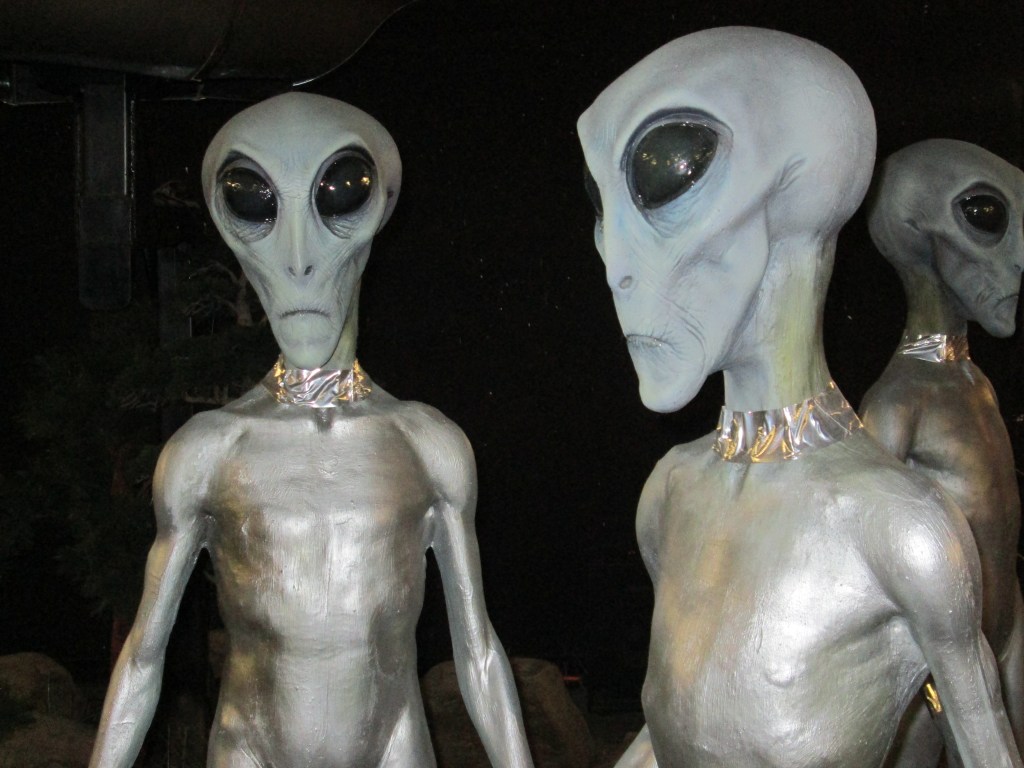
Space Aliens from Roswell, NM UFO Museum

What happens to Christianity if space aliens from another world were to make contact with us? What would they made of the Garden of Eden, the Incarnation, the Crucifixion and a thousand other details that are part and parcel of Christianity? What are the chances that any of the space aliens would ever convert to Christianity?

In fact, all the major monotheistic religions would come across as quaint and primitive. That includes Judaism and Islam. The life experience of creatures from another world would be so radically different that they in turn would affect how (and whom) earthlings worshiped.

I do not necessarily believe that we will ever contact space aliens, but I do wonder what would be the result of such a contact. At worst, it would be like that famous Twilight Zone episode from Season Three of that show entitled “To Serve Man.” (At the end of the episode, it is revealed that the “To Serve Man” book the aliens carried was not an altruistic guide, but a cookbook!) At best, there is the movie The Day the Earth Stood Still (1951) with Michael Rennie’s Klaatu come to warn Earth that it is in danger of destroying itself.

Myself, I am more inclined to think of any space invaders as Conquistadores come to enslave the planet and mine it for its riches.

Journey to the East

Indian Holy Man

In many ways, most of my life has been a “Journey to the East.” I was raised as a Roman Catholic, going to Catholic schools from the 2nd through the 12th grades. Even at Dartmouth College, I was a worshiper at the Newman Club. In fact, when I fell into a coma in September 1966, it was Father William Nolan, the Catholic chaplain at Dartmouth, who urged the school’s medical insurance program to keep covering me, even though my coverage had officially lapsed at the beginning of the month. So my family and I owe a debt of gratitude to the Catholic Church.

One does not undergo a massive physical trauma without affecting the way one thinks and believes. That September, I was getting ready to take the train to Los Angeles to start graduate school in film history and criticism at UCLA. I had to delay my film classes until the winter quarter to allow me to recuperate.

What was the first book I read when I arrived in Los Angeles? It was Hermann Hesse’s Siddhartha, closely followed by Paul Reps’s Zen Flesh Zen Bones. I had begun my own Journey to the East, mostly in my reading.

Why did I never fly to Asia to experience Hinduism, Taoism, and Buddhism directly? Strangely—especially for someone who was visited so much of Latin America—I was afraid that I wouldn’t survive the experience. Among my fellow Clevelanders who attended Dartmouth College was a student by the name of Noel Yurch. I was shocked to find out from the alumni magazine after I had graduated from college that he had gone to India and died of some gastrointestinal disease.

Curiously, my niece Hilary went to India and studied Yoga at an ashram without suffering any major adverse effects. Today, she is a yoga instructor in the Seattle area. But I was convinced it would be fatal for me. Was it nothing but funk? Perhaps.

Today, I still read many books about the Eastern religions. I consider myself to be a strange combination of Catholic, Hindu, Taoist, and Buddhist. Although I do not go to church on Sundays, I do not consider myself to be an Atheist or even an Agnostic. And when I visit Mexico or South America, I spend hours visiting Catholic churches and even attending Mass. But I no longer buy the whole package.

So in my so-called Journey to the East, I still have one foot in the Catholic Church, or at least one or two toes.

Is and Is Not

Scene from Sesshu Toyo’s Long Scroll

The following is from Sam Hammill’s translation of Lao Tzu’s Tao Te Ching written some 2,500 years ago:

Beauty and ugliness have one origin.
Name beauty, and ugliness is.
Recognizing virtue recognizes evil.

Is and is not produce one another.
The difficult is born in the easy,
long is defined by short, the high by the low.
Instrument and voice achieve one harmony.
Before and after have places.

That is why the sage can act without effort
and teach without words,
nurture things without possessing them,
and accomplish things without expecting merit:

only one who makes no attempt to possess it
cannot lose it.

Allhallowtide

If you were to look closely at the word Halloween, you may notice that it means the Eve of All Hallows Day, November 1, which is also called All Saints’ Day. In fact, the period from October 31 through November 2 is sometimes referred to as Allhallowtide. In a way, the period is a kind of liturgical trifecta, in that November 2 is All Souls’ Day, also known as the Day of the Dead.

The idea of All Saints’ Day was primarily to commemorate the nameless martyrs who died for their faith at the hands of certain Roman emperors who persecuted them. Perhaps the largest single group is the Theban Legion, commanded by Saint Maurice, who was ordered by the Emperor Maximian to defeat rebels in what is now Switzerland and, in the process, to make sacrifices to pagan gods. Maurice and his men refused. As punishment, Maximian ordered the legion to be decimated, that is, to have every tenth man executed. After two rounds of decimation, it was decided to execute the entire legion, which consisted of some 6,700 legionaries. Their martyrdom took place in AD 286.

Above is a painting by Fra Angelico of various saints and martyrs, not including the entire Theban Legion. In fact, none of the saints depicted look particularly like Roman legionaries.

All Saints’ Day (November 1) is still considered a Holy Day of Obligation in the Catholic Church, during which all Catholics are required to attend Mass or commit a mortal sin for failure to comply.

Although I continue to hold warm feelings about my Catholic upbringing, I am pretty much a lapsed Catholic and am probably doomed to the fires of Heck.

Thirty-Six Streams

The following selection on desire is taken from the sayings of Gautama Buddha known as The Dhammapada:

If you sleep
Desire grows in you
Like a vine in the forest.

Like a monkey in the forest
You jump from tree to tree,
Never finding the fruit—
From life to life,
Never finding peace.

If you are filled with desire
Your sorrows swell
Like the grass after the rain.

But if you subdue desire
Your sorrows fall from you
Like drops of water from a lotus flower.

This is good counsel
And it is for everyone:
As the grass is cleared for the fresh root,
Cut down desire
Lest death after death crush you
As a river crushes the helpless reeds.

For if the roots hold firm,
A felled tree grows up again.
If desires are not uprooted,
Sorrows grow again in you.

Thirty-six streams are rushing toward you!
Desire and pleasure and lust ...
Play in your imagination with them
And they will sweep you away.
Powerful streams!
They flow everywhere.

The Missionary and the Space Alien

My Guess: Even This Space Alien Is Too Humanoid

In science fiction films, there tends to be two views on encounters with space aliens. One is the romantic view, as exemplified by Close Encounters of the Third Kind, E.T., and Cocoon. In these films, the space aliens are benevolent and almost humanoid. Then there is the realistic vision of War of the Worlds. In this film, we don’t even get a good look at the aliens because they come out shooting from the get-go.

What with all the recent press about UFOs espied by military planes (see picture below), the subject has come up: What is the first encounter going to be like? I don’t think we are likely to encounter humanoids or anything even resembling them. They are probably not even likely to breathe our atmosphere.

I have this picture in my mind of a Christian missionary attempting to convert space aliens to his religion. How is that conversation likely to go? Will the space aliens crucify the missionary because that’s what they think he wants? How would the Christian religion look to a completely alien mind associated with a non-biped without the usual eyes, ears, nose, hands, and feet? I would think space aliens would laugh at what we would consider to be organized religion.

It would certainly sober up many Evangelicals in particular. But then, they are used to not believing in the evidence of their senses, given their political preference.

The image from video provided by the Department of Defense labelled Gimbal, from 2015, an unexplained object is seen at center as it is tracked as it soars high along the clouds, traveling against the wind. “There’s a whole fleet of them,” one naval aviator tells another, though only one indistinct object is shown. “It’s rotating.” The U.S. government has been taking a hard look at unidentified flying objects, under orders from Congress, and a report summarizing what officials know is expected to come out in June 2021. (Department of Defense via AP)

The interesting question is this: How would one go about reconciling the beliefs of space aliens with those of Earthlings, of whatever religious background? Oh to be a fly on the wall of that “conversation”!