
“We Died for the Revolution”

Female Russian Honor Guard, 2018 Victory Day Parade

I have been slowly making my way through Svetlana Alexievich’s Secondhand Time: The Last of the Soviets, in which she interviews everyday Russians about how their lives have changed since the fall of Communism. Alexievich did something it is not even possible to do in America today: She interviewed people of all political stripes, including even those who sided with the Nazis during the Great Patriotic War of 1941-1945. Imagine a book in the U.S. that interviewed not only liberal Democrats, but qAnon and Oath Keeper supporters who showed up in Washington on January 6. I don’t think such a book can be written.

The following passage is from an embittered supporter of Communism:

In my day, people didn’t ask those kind of questions. We didn’t have questions like that! We … imagined a just life without rich or poor. We died for the Revolution, and we died idealists. Wholly uninterested in money … My friends are long gone, I’m all alone. None of the people I used to talk to are around anymore. At night, I talk to the dead … And you? You don’t understand our feelings or our words: “grain confiscation campaign,” “food-groups,” “disenfranchisee,” “committee of the poor,” … “repeater,” … “defeatist.” It’s Sanskrit to you! Hieroglyphics! Old age means, first and foremost, loneliness. The last old man I knew—he lived in the adjacent courtyard—died five years ago, or maybe it’s been even longer … seven years ago … I’m surrounded by strangers. People come from the museum, the archive, the encyclopedia ,,, I’m like a reference book, a living library! But I have no one to talk to … Who would I like to talk to? Lazar Kaganovich [one of Stalin’s henchmen] would be good … There aren’t many of us who are still around, and even fewer who aren’t completely senile. He’s even older than me, he’s already ninety. I read in the papers … [He laughs.] In the newspaper, it said that the old men in his courtyard refuse to play dominoes with him. Or cards. They drive him away: “Fiend!” And he weeps from the hurt. Ages ago, he was a steel-hearted People’s Commissar. He’d sign the execution lists, he sent tens of thousands of people to their deaths. Spent thirty years by Stalin’s side. But in his old age, he doesn’t even have anyone to play dominoes with … [After this, he speaks very quietly. I can’t tell what he’s saying. I only catch a few words.] It’s scary … Living too long is scary.

Serendipity: A Night in the Woods

The Maine Woods

Originally published after its author’s death, Henry David Thoreau’s The Maine Woods is a classic. Take, for instance, this description of a night in the woods:

About nine o’clock we reached the river, and ran our boat into a natural haven between some rocks, and drew her out on the sand. This camping-ground McCauslin had been familiar with in his lumbering days, and he now struck it unerringly in the moonlight, and we heard the sound of the rill which would supply us with cool water emptying into the lake. The first business was to make a fire, an operation which was a little delayed by the wetness of the fuel and the ground, owing to the heavy showers of the afternoon. The fire is the main comfort of the camp, whether in summer or winter, and is about as ample at one season as at another. It is as well for cheerfulness as for warmth and dryness. It forms one side of the camp; one bright side at any rate. Some were dispersed to fetch in dead trees and boughs, while Uncle George felled the birches and beeches which stood convenient, and soon we had a fire some ten feet long by three or four high, which rapidly dried the sand before it. This was calculated to burn all night. We next proceeded to pitch our tent; which operation was performed by sticking our two spike-poles into the ground in a slanting direction, about ten feet apart, for rafters, and then drawing our cotton cloth over them, and tying it down at the ends, leaving it open in front, shed-fashion. But this evening the wind carried the sparks on to the tent and burned it. So we hastily drew up the batteau [boat] just within the edge of the woods before the fire, and propping up one side three or four feet high, spread the tent on the ground to lie on; and with the corner of a blanket, or what more or less we could get to put over us, lay down with our heads and bodies under the boat, and our feet and legs on the sand toward the fire. At first we lay awake, talking of our course, and finding ourselves in so convenient a posture for studying the heavens, with the moon and stars shining in our faces, our conversation naturally turned upon astronomy, and we recounted by turns the most interesting discoveries in that science. But at length we composed ourselves seriously to sleep. It was interesting, when awakened at midnight, to watch the grotesque and fiend-like forms and motions of some one of the party, who, not being able to sleep, had got up silently to arouse the fire, and add fresh fuel, for a change; now stealthily lugging a dead tree from out the dark, and heaving it on, now stirring up the embers with his fork, or tiptoeing about to observe the stars, watched, perchance, by half the prostrate party in breathless silence; so much the more intense because they were awake, while each supposed his neighbor sound asleep. Thus aroused, I, too, brought fresh fuel to the fire, and then rambled along the sandy shore in the moonlight, hoping to meet a moose come down to drink, or else a wolf. The little rill tinkled the louder, and peopled all the wilderness for me; and the glassy smoothness of the sleeping lake, laving the shores of a new world, with the dark, fantastic rocks rising here and there from its surface, made a scene not easily described. It has left such an impression of stern, yet gentle, wildness on my memory as will not soon be effaced. Not far from midnight we were one after another awakened by rain falling on our extremities; and as each was made aware of the fact by cold or wet, he drew a long sigh and then drew up his legs, until gradually we had all sidled round from lying at right angles with the boat, till our bodies formed an acute angle with it, and were wholly protected. When next we awoke, the moon and stars were shining again, and there were signs of dawn in the east. I have been thus particular in order to convey some idea of a night in the woods.

Sir Vidia Takes on Politics

Nobel Prize Laureate V.S. Naipaul

I have just finished reading V.S. Naipaul’s sixth novel, The Mimic Men (1967)—a semi-autobiographical work about what it is like to win fame and renown while coming from a place like the island of Trinidad, which he calls Isabella in the book. About fifty pages in, I came across his musings on politics and politicians, which I excerpt here:

Politicians are people who truly make something out of nothing. They have few concrete gifts to offer. They are not engineers or artists or makers. They are manipulators; they offer themselves as manipulators. Having no gifts to offer, they seldom know what they seek. They might say they seek power. But their definition of power is vague and unreliable. Is power the chauffeured limousine with fine white linen on the seats, the men from Special Branch outside the gates, the skilled and deferential servants? But this is only indulgence, which might be purchased by anyone at any time in a first-class hotel. Is it the power to bully or humiliate or take revenge? But this is the briefest sort of power; it goes as quickly as it comes; and the true politician is by his nature a man who wishes to play the game all his life. The politician is more than a man with a cause, even when this cause is no more than self-advancement. He is driven by some little hurt, some little incompleteness. He is seeking to exercise some skill which even to him is never as concrete as the skill of the engineer; of the true nature of this skill he is not aware until he begins to exercise it. How often we find those who after years of struggle and manipulation come close to the position they crave, sometimes indeed achieving it, and then are failures. They do not deserve pity, for among the aspirants to power they are complete men; it will be found that they have sought and achieved fulfilment elsewhere; it takes a world war to rescue a Churchill from political failure. Whereas the true politician finds his skill and his completeness only in success. His gifts suddenly come to him. He who in other days was mean, intemperate and infirm now reveals unsuspected qualities of generosity, moderation and swift brutality. Power alone proves the politician; it is ingenuous to express surprise at an unexpected failure or an unexpected flowering.

In the Court of the Lion of Judah

The Emperor Haile Selassie of Ethiopia, the Lion of Judah

He was short and somewhat frail, yet Haile Selassie managed to reign as Emperor of Ethiopia for some 44 years, from 1930 to 1974, when his government was toppled by a revolution. Although his book about Selassie, entitled The Emperor, has come under fire for certain inaccuracies, Ryszard Kapuściński leaves us an unforgettable portrait which is probably mostly true. Take, for instance, the following excerpt:

His Majesty spent the hour between nine and ten in the morning handing out assignments in the Audience Hall, and thus this time was called the Hour of Assignments. The Emperor would enter the Hall, where a row of waiting dignitaries, nominated for assignment, bowed humbly. His Majesty would take his place on the throne, and when he had seated himself I would slide a pillow under his feet. This had to be done like lightning so as not to leave Our Distinguished Monarch’s legs hanging in the air for even a moment. We all know that His Highness was of small stature. At the same time, the dignity of the Imperial Office required that he be elevated above his subjects, even in a strictly physical sense. Thus the Imperial thrones had long legs and high seats, especially those left by Emperor Menelik, an exceptionally tall man. Therefore a contradiction arose between the necessity of a high throne and the figure of His Venerable Majesty, a contradiction most sensitive and troublesome precisely in the region of the legs, since it is difficult to imagine that an appropriate dignity can be maintained by a person whose legs are dangling in the air like those of a small child. The pillow solved this delicate and all-important conundrum.

I was His Most Virtuous Highness’s pillow bearer for twenty-six years. I accompanied His Majesty on travels all around the world, and to tell the truth—I say it with pride—His Majesty could not go anywhere without me, since his dignity required that he always take his place on a throne, and he could not sit on a throne without a pillow, and I was the pillow bearer. I had mastered the special protocol of this specialty, and even possessed an extremely useful, expert knowledge: the height of various thrones. This allowed me quickly to choose a pillow of just the right size, so that a shocking ill fit, allowing a gap to appear between the pillow and the Emperor’s shoes, would not occur. I had fifty-two pillows of various sizes, thicknesses, materials, and colors. I personally monitored their storage, constantly, so that fleas—the plague of our country—would not breed there, since the consequences of any such oversight could lead to a very unpleasant scandal.

A Thin Slice of Watermelon

A Great Writer? The Jewish-Ukrainian-Brazilian Clarice Lispector (1920-1977)

As my month of reading only women authors comes to an end, I find I have made a number of discoveries, especially Clarice Lispector, who was born Chaya Pinkhasivna Lispector in Chechelnyk, Ukrainian SSR in 1920. As a child, she emigrated with her family to the Northeast of Brazil, moving eventually to Rio de Janeiro. I am currently reading her last work before she died of ovarian cancer at the age of 57, a novelette entitled The Hour of the Star, from which the following is taken:

That girl didn’t know she was what she was, just as a dog doesn’t know it’s a dog. So she didn’t feel unhappy. The only thing she wanted was to live. She didn’t know for what, she didn’t ask questions. Maybe she thought there was a little bitty glory in living. She thought people had to be happy. So she was. Before her birth was she an idea? Before her birth was she dead? And after her birth she would die? What a thin slice of watermelon.

Also:

She thought she’d incur serious punishment and even risk dying if she took too much pleasure in life. So she protected herself from death by living less, consuming so little of her life that she’d never run out. This savings gave her a little security since you can’t fall farther than the ground.

The portraits of Lispector haunt me, with her high cheekbones. And her writing haunts me. I can see myself reading everything I can find by her.

Three Modern Day Gods

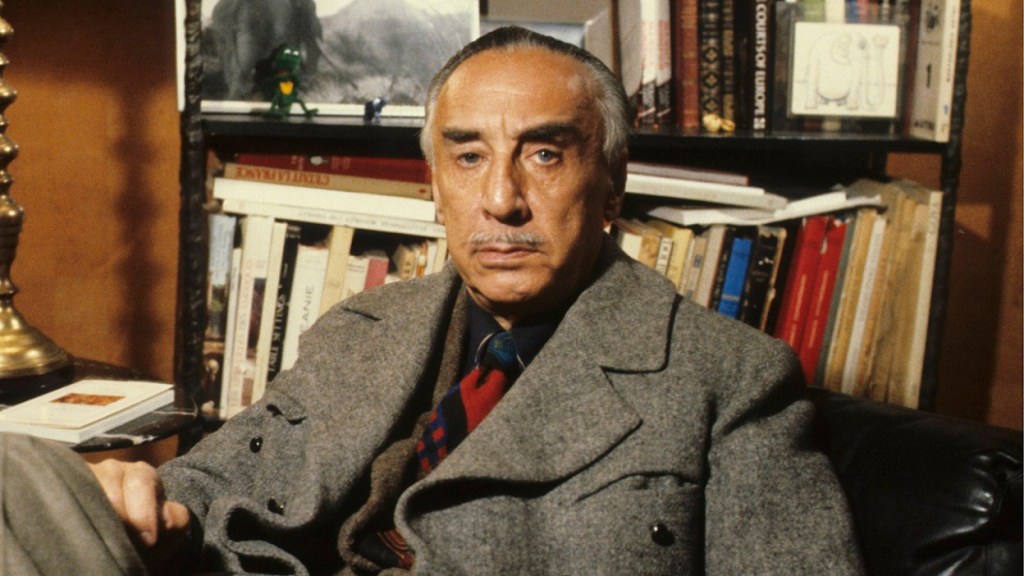
Romain Gary (1914-1980), French writer, at his place the day before his suicide. Paris, on December 1st, 1980.

There I was, reading the August 21, 2020 issue of the Times Literary Supplement in an article on the Franco-Lithuanian novelist Romain Gary, I suddenly came upon a new pantheon for our times:

  • Totoche, the god of stupidity
  • Merzavka, the god of absolute ideas
  • Filoche, the god of bigotry

The article goes into greater detail:

Totoche is a red-arsed monkey, adored by all who hurry humanity towards destruction: dim politicians who thump tubs, pure scientists who release genies from bottles, social psychologists who lead us up blind alleys, and demagogues who shout and bully. Merzavka is a cossack who stands gleefully, horsewhip in hand, on heaps of corpses industrially produced by concentration camps and torture chambers. Half of us lick his boots and the other half live or die by the religious, political and moral ideologies by which he rules and kills. Filoche is a concierge waiting to pounce on petty infringements of house rules, a hyena scavenging for scraps of racism, intolerance and orthodoxy with which to justify lynchings, holy wars and persecution.

The article, entitled “Brought to Book,” was written by David Coward.

In many ways, Gary’s invented deities were to perfectly describe the United States during the Trump Administration, even though Gary himself had long since (1980) passed on.

The Vast Armies of the Benighted

A Scene from the Merchant Ivory Production of A Room with a View (1986)

I have never ceased to marvel how some homosexual authors as Marcel Proust were so brilliant at translating their knowledge of relationships into a more “acceptable” heterosexual context. This is also true of E. M. Forster, whose A Room with a View I have recently read. The following is taken from Chapter Seventeen of that novel:

It did not do to think, nor, for the matter of that, to feel. She gave up trying to understand herself, and joined the vast armies of the benighted, who follow neither the heart nor the brain, and march to their destiny by catch-words. The armies are full of pleasant and pious folk. But they have yielded to the only enemy that matters—the enemy within. They have sinned against passion and truth, and vain will be their strife after virtue. As the years pass, they are censured. Their pleasantry and their piety show cracks, their wit becomes cynicism, their unselfishness hypocrisy; they feel and produce discomfort wherever they go. They have sinned against Eros and against Pallas Athene, and not by any heavenly intervention, but by the ordinary course of nature, those allied deities will be avenged.

“Something Buried Somewhere in the Book”

G. K. Chesterton Holding Book and Pen

I can think of few authors who can be read and re-read with as much pleasure as G. K. Chesterton (1874-1936). I am currently re-reading his Autobiography, which is less an autobiography than a collection of essays on various themes suggested by his life. If there is any vestige remaining within me of the Catholicism with which I was raised and educated, it is owing largely to Chesterton and such writers as Trappist Monk Thomas Merton. What Chesterton says here about a soi-disant biography he wrote about Robert Browning applies equally to his own autobiography.

Finally, a crown of what I can only call respectability came to me from the firm of Macmillan; in the form of a very flattering invitation to write the study of Browning for the English Men of Letters Series. It had just arrived when I was lunching with Max Beerbohm, and he said to me in a pensive way: “A man ought to write on Browning while he is young.” No man knows he is young while he is young. I did not know what Max meant at the time; but I see now that he was right; as he generally is. Anyhow, I need not say that I accepted the invitation to write a book on Browning. I will not say that I wrote a book on Browning; but I wrote a book on love, liberty, poetry, my own views on God and religion (highly undeveloped), and various theories of my own about optimism and pessimism and the hope of the world; a book in which the name of Browning was introduced from time to time, I might almost say with considerable art, or at any rate with some decent appearance of regularity. There were very few biographical facts in the book, and those were nearly all wrong. But there is something buried somewhere in the book; though I think it is rather my boyhood than Browning’s biography.

A Portuguese Plague Diary

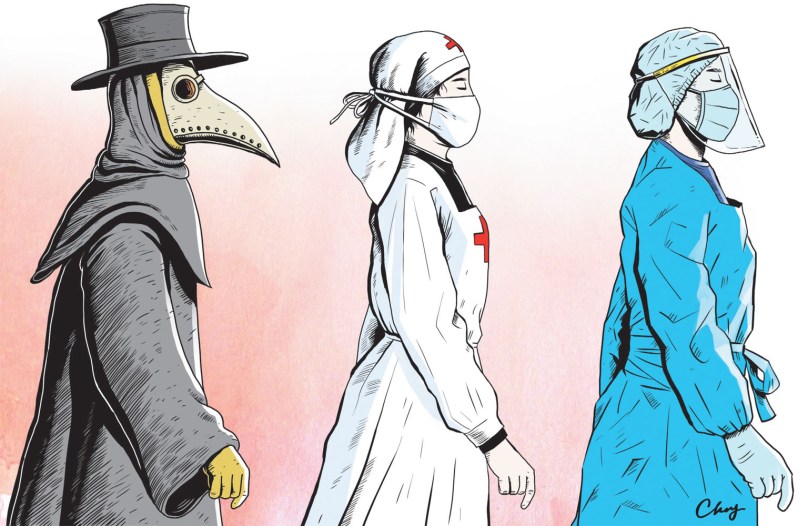
The Costumes Might Be Different, But It’s the Same Thing

The following are quoted from Gonçalo M. Tavares’s “My Plague Diary,” excerpts of which were published in the June 5, 2020 issue of the Times Literary Supplement:

For days, a violent poster campaign on the streets of the capital: if you are reading this, our condolences. You don’t want to be shut up at home, but in a coffin instead.

This poster worries more about your family than you do.

If you go out, you kill. If you go out, you die. If you go out and get sick, don’t complain. In any case, you won’t be able to complain.

If you have just gone out to visit your family, say goodbye to them.

At the entrance to the Metro: here’s hoping you don’t read me, here’s hoping you don’t die.

A lot of Brazilian prisoners are writing goodbye letters to their families. They say they’re getting sick. Coughing, fever, cries for help in a number of cells.

A picture from two weeks ago, jackals in the streets of Tel Aviv. They are hungry and they’ve lost their fear. Because they are hungry they’ve lost their fear. They need to go back to having fear or food, somebody says.

A friend from Brazil writes to me: “I wish I had a loudspeaker, like this guy in Ipanema.” They say he’s on the tenth floor, opposite the beach, and he’s set his speaker up on the balcony. And from all the way up there he was issuing warnings through his loudspeaker: Hey, lad in the blue shirt, the one on the bike, yeah, you! You’re going to get coronavirus, you know. Hey, lady in the flowery swimsuit, with your hair done and the red lipstick, yes you! You’re going to get coronavirus, you know…! She lives in Rio. She’s terrified.

Unemployment reaches 1929 Great Depression levels in the USA, and in Guatemala, women on the side of the road are holding a white flag. They wave the white flag when a car or a motorbike passes. They are unemployed, they ask anyone who stops for food.

Maria Branyas, aged 113, is now the oldest person to beat the novel coronavirus.

Dizziness, I’ve got to check this out. Too many days like this. Lying down, I’m fine, but sometimes it’s good to be on two feet. They don’t seem like days—but days in the middle of something. As if the day even when it is finished were not complete. It is always between one thing and another. These days are always the middle sibling. A need for lightness; feeding the dogs organizes my time; without their hunger I would surely be having more dizzy spells.

Two actions of resistance. You must wait or clean. How long does evil remain on a surface? Think about evil that can be eliminated by cleaning.

Doesn’t matter what you think, what matters is what you do.

Serendipity: Wounded Bear

No, Not Donald Trump—This Time

The following consists of the opening paragraphs of novelist Trygve Gulbranssen’s Beyond Sing the Woods (1933), set in 18th century Norway. The novel reads almost like an old Icelandic saga. It is a pity that it is not better known.

The crags above the depths of Maiden Valley were deepening to blue and their lines softening in the raw air of the autumn evening. Behind them the sky flamed, with a streak of blood where the sun was setting. Upon the outermost crag a bear stood, dark as the rock itself, and sniffed towards the Broad Leas where mist lay over tarn and water-way.

His head was lean and sharp, his neck long and scraggy and sparsely covered with fur. These last few autumns he had been late in hibernating; for all his plundering and devouring the comfortable, lazy, autumnal heaviness of his younger days was slower every year in coming, and this year there was something gravely wrong. Somewhere in his body pain snarled at him, and meat had lost its savor. The greater part of every carcass he left lying, and when he gulped a little warm blood, half-living hearts, and other such light fare, he could eat no more.

No longer could he stalk elk in the forest, for his body soon stiffened and wearied, and the pain had gnawed ever since that dread reëchoing bang came at him from the man away to the north in the Björndal woods. The bang had torn its way into his flank so that the blood gushed, and the wound ached and gnawed at him long afterwards. But though he could no longer go after elk, he had felled cattle and stolen many sheep.

This autumn people had housed their animals too early. On one or two evenings he had had to venture as far as their dwellings under cover of dusk, and break in the cattle-shed doors to find blood and meat. Men had come after him with yells and shouts, but he had dashed his paw at one of them so that he fell and lay still. After that they had followed him no further.

Both men and dogs down here in the Broad Leas were different from those northward in Björndal, where he had raided in his young days. There they had hounds that hurtled upon one, and yapped and barked and drove one out of one’s wits, while the men came quietly without yells or shouts, and one was not aware of them until they were close—then would come a bang shivering through guts and bones, leaving a pain that stayed. Down here in the Leas dogs slunk scared behind the men, and there was only noise and uproar, and no bangs. He would stay here, and in the evening when the lights were out make his way down to the byres.

He remained standing for a long time, pitch-black against the sky now darkening to blood and night. His head stood out sharply, his ragged neck stretched at a slant from his powerfully built body, shrunken now, with pointed shoulder-blades sticking up under his coat.