
A One-Man Band

Did I say one-man band? Actually, he was a one-man symphony orchestra. Fernando Pessoa (1888-1935) was not only a poet, writer, translator, and philosopher. He was eighty poets, writers, translators, and philosophers. Born (and died) in Lisbon, Portugal, Pessoa wrote under approximately eighty heteronyms.

These heteronyms were like pseudonyms, except that each wrote in a different style. In a way, Pessoa constituted an entire literary movement. The work for which he is best known, The Book of Disquiet, is a collection of fragments in no particular order—and probably one of the greatest works of the Twentieth Century.

There are several editions of The Book of Disquiet. I have read the Penguin edition translated by Richard Zenith.

Today, while eating lunch at the Mitsuwa Marketplace in Mar Vista, I was reading an old New York Review of Books and came across this passage in a new translation by Margaret Jull Costa:

To say things! To know how to say things! To know how to exist through the written voice and the intellectual image! That’s what life is about: the rest is just men and women, imagined loves and fictitious vanities, excuses born of poor digestion and forgetting, people squirming beneath the great abstract boulder of a meaningless blue sky, the way insects do when you lift a stone.

I first learned about Pessoa when IO read José Saramago’s The Year of the Death of Ricardo Reis (1984). It turns out that Ricardo Reis was a poet and prose writer, author of Odes and texts on the work of Alberto Caeiro. Interestingly, Reis and Caeiro were merely two heteronyms of Fernando Pessoa.

The man constituted an entire literary movement in his person!

Obviously, I had to get to know more about Pessoa. I plan to read more of his work if I had world enough and time.
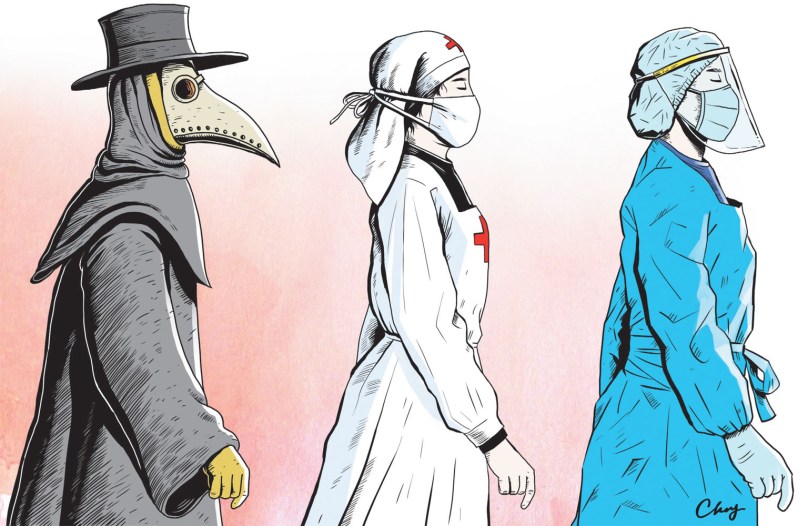
A Portuguese Plague Diary

The Costumes Might Be Different, But It’s the Same Thing

The following are quoted from Gonçalo M. Tavares’s “My Plague Diary,” excerpts of which were published in the June 5, 2020 issue of the Times Literary Supplement:

For days, a violent poster campaign on the streets of the capital: if you are reading this, our condolences. You don’t want to be shut up at home, but in a coffin instead.

This poster worries more about your family than you do.

If you go out, you kill. If you go out, you die. If you go out and get sick, don’t complain. In any case, you won’t be able to complain.

If you have just gone out to visit your family, say goodbye to them.

At the entrance to the Metro: here’s hoping you don’t read me, here’s hoping you don’t die.

A lot of Brazilian prisoners are writing goodbye letters to their families. They say they’re getting sick. Coughing, fever, cries for help in a number of cells.

A picture from two weeks ago, jackals in the streets of Tel Aviv. They are hungry and they’ve lost their fear. Because they are hungry they’ve lost their fear. They need to go back to having fear or food, somebody says.

A friend from Brazil writes to me: “I wish I had a loudspeaker, like this guy in Ipanema.” They say he’s on the tenth floor, opposite the beach, and he’s set his speaker up on the balcony. And from all the way up there he was issuing warnings through his loudspeaker: Hey, lad in the blue shirt, the one on the bike, yeah, you! You’re going to get coronavirus, you know. Hey, lady in the flowery swimsuit, with your hair done and the red lipstick, yes you! You’re going to get coronavirus, you know…! She lives in Rio. She’s terrified.

Unemployment reaches 1929 Great Depression levels in the USA, and in Guatemala, women on the side of the road are holding a white flag. They wave the white flag when a car or a motorbike passes. They are unemployed, they ask anyone who stops for food.

Maria Branyas, aged 113, is now the oldest person to beat the novel coronavirus.

Dizziness, I’ve got to check this out. Too many days like this. Lying down, I’m fine, but sometimes it’s good to be on two feet. They don’t seem like days—but days in the middle of something. As if the day even when it is finished were not complete. It is always between one thing and another. These days are always the middle sibling. A need for lightness; feeding the dogs organizes my time; without their hunger I would surely be having more dizzy spells.

Two actions of resistance. You must wait or clean. How long does evil remain on a surface? Think about evil that can be eliminated by cleaning.

Doesn’t matter what you think, what matters is what you do.

Everything and Nothing

Portuguese Novelist and Poet Fernando Pessoa (1888-1935)

Portuguese Novelist and Poet Fernando Pessoa (1888-1935)

Come on, ’fess up! When was the last time you ever read any Portuguese literature?

Chances are, you probably never dipped into José Saramago, Eça de Queirós, or—greatest of all—Fernando Pessoa. The author of The Book of Disquiet, an amorphous work that is one of the masterpieces of 20th century literature, wrote under some seventy different names. Below is a sample of his poetry, which he wrote under the name of Álvaro de Campos, entitled “The Tobacco Shop.” Like all of his work, it is simultaneously about everything and nothing.

I’m nothing.
I’ll always be nothing.
I can’t want to be something.
But I have in me all the dreams of the world.

Windows of my room,
The room of one of the world’s millions nobody knows
(And if they knew me, what would they know?),
You open onto the mystery of a street continually crossed by people,
A street inaccessible to any and every thought,
Real, impossibly real, certain, unknowingly certain,
With the mystery of things beneath the stones and beings,
With death making the walls damp and the hair of men white,
With Destiny driving the wagon of everything down the road of nothing.

It is only with the fourth line of the second stanza that Pessoa mentions the tobacco shop, a prosaic place opening onto a street fronting onto the world of “stones and beings.”

Pessoa might seem to have had a weak sense of personhood, but he left behind a rich and multifarious literary reality which cries out to be mined.