A One-Man Band

Did I say one-man band? Actually, he was a one-man symphony orchestra. Fernando Pessoa (1888-1935) was not only a poet, writer, translator, and philosopher. He was eighty poets, writers, translators, and philosophers. Born (and died) in Lisbon, Portugal, Pessoa wrote under approximately eighty heteronyms.

These heteronyms were like pseudonyms, except that each wrote in a different style. In a way, Pessoa constituted an entire literary movement. The work for which he is best known, The Book of Disquiet, is a collection of fragments in no particular order—and probably one of the greatest works of the Twentieth Century.

There are several editions of The Book of Disquiet. I have read the Penguin edition translated by Richard Zenith.

Today, while eating lunch at the Mitsuwa Marketplace in Mar Vista, I was reading an old New York Review of Books and came across this passage in a new translation by Margaret Jull Costa:

To say things! To know how to say things! To know how to exist through the written voice and the intellectual image! That’s what life is about: the rest is just men and women, imagined loves and fictitious vanities, excuses born of poor digestion and forgetting, people squirming beneath the great abstract boulder of a meaningless blue sky, the way insects do when you lift a stone.

I first learned about Pessoa when IO read José Saramago’s The Year of the Death of Ricardo Reis (1984). It turns out that Ricardo Reis was a poet and prose writer, author of Odes and texts on the work of Alberto Caeiro. Interestingly, Reis and Caeiro were merely two heteronyms of Fernando Pessoa.

The man constituted an entire literary movement in his person!

Obviously, I had to get to know more about Pessoa. I plan to read more of his work if I had world enough and time.

Seeing vs Thinking

Fernando Pessoa (1888-1935) Painted by Almada Negreiros

We tend sometimes to forget that Portugal even exists, yet the tiny country at the left edge of the Iberian Peninsula has a way of grabbing our intention, especially with its literature. Fernando Pessoa was such a rich trove that he split himself into some some seventy-five heteronyms, or authorial entities. The following excerpt from “The Keeper of Sheep” is by one of his most prominent heteronyms, Alberto Caeiro.

My gaze is clear like a sunflower.
It is my custom to walk the roads
Looking right and left
And sometimes looking behind me,
And what I see at each moment
Is what I never saw before,
And I’m very good at noticing things.
I’m incapable of feeling the same wonder
A newborn child would feel
If he noticed that he’d really and truly been born.
I feel at each moment that I’ve just been born
Into a completely new world...

I believe in the world as in a daisy,
Because I see it. But I don’t think about it.
Because to think is not to understand.
The world wasn’t made for us to think about it
(To think is to have eyes that aren’t well)
But to look at it and be in agreement.

I have no philosophy, I have senses...
If I speak of Nature it’s not because I know what it is
But because I love it, and for that very reason,
Because those that love never know what they love
Or why they love, or what love is.
Love is innocence,
And the sum of innocence is not thinking...

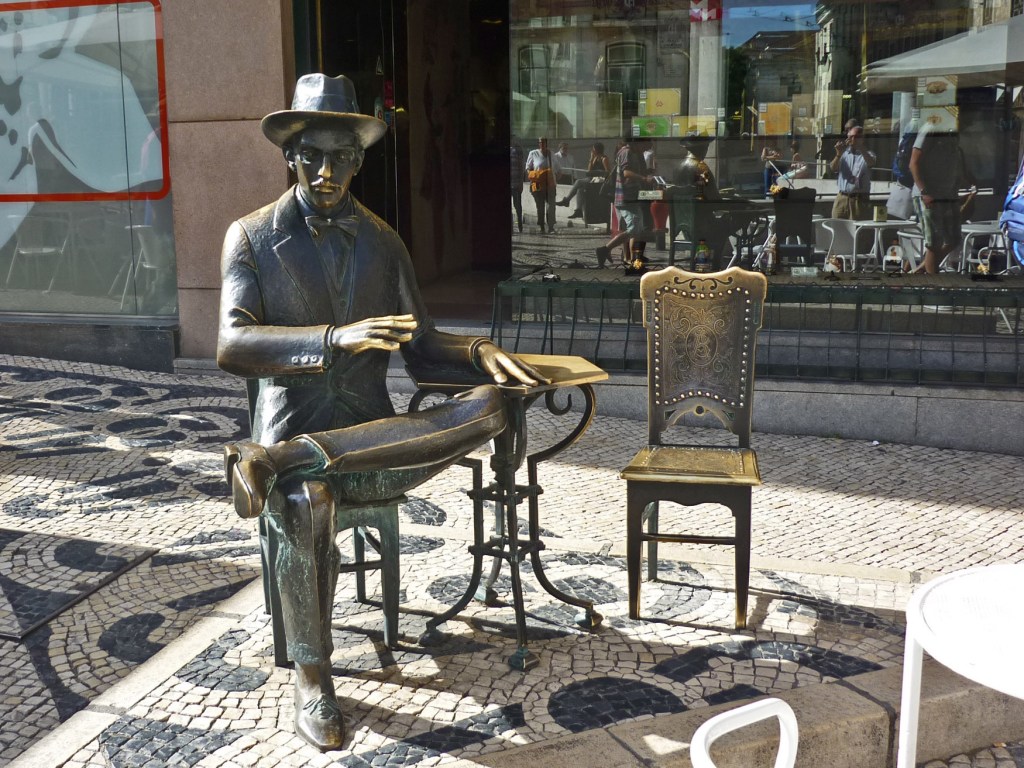
Statue of Fernando Pessoa in Lisbon

In a mock interview with “Alberto Caeiro,” Pessoa wrote:

I’m not a materialist or a deist or anything else. I’m a man who one day opened the window and discovered this crucial thing. Nature exists. I saw that the trees, the rivers and the stones are things that truly exist. No one had ever thought about this.

I don’t pretend to be anything more than the greatest poet in the world. I made the greatest discovery worth making, next to which all other discoveries are games of stupid children. I noticed the Universe. The Greeks, with all their visual acuity, didn’t do as much.

The poem and the quote come from the Pessoa collection entitled A Little Larger Than the Entire Universe: Selected Poems translated by Richard Zenith.

Everything and Nothing

Portuguese Novelist and Poet Fernando Pessoa (1888-1935)

Portuguese Novelist and Poet Fernando Pessoa (1888-1935)

Come on, ’fess up! When was the last time you ever read any Portuguese literature?

Chances are, you probably never dipped into José Saramago, Eça de Queirós, or—greatest of all—Fernando Pessoa. The author of The Book of Disquiet, an amorphous work that is one of the masterpieces of 20th century literature, wrote under some seventy different names. Below is a sample of his poetry, which he wrote under the name of Álvaro de Campos, entitled “The Tobacco Shop.” Like all of his work, it is simultaneously about everything and nothing.

I’m nothing.
I’ll always be nothing.
I can’t want to be something.
But I have in me all the dreams of the world.

Windows of my room,
The room of one of the world’s millions nobody knows
(And if they knew me, what would they know?),
You open onto the mystery of a street continually crossed by people,
A street inaccessible to any and every thought,
Real, impossibly real, certain, unknowingly certain,
With the mystery of things beneath the stones and beings,
With death making the walls damp and the hair of men white,
With Destiny driving the wagon of everything down the road of nothing.

It is only with the fourth line of the second stanza that Pessoa mentions the tobacco shop, a prosaic place opening onto a street fronting onto the world of “stones and beings.”

Pessoa might seem to have had a weak sense of personhood, but he left behind a rich and multifarious literary reality which cries out to be mined.