Life and Mushrooms

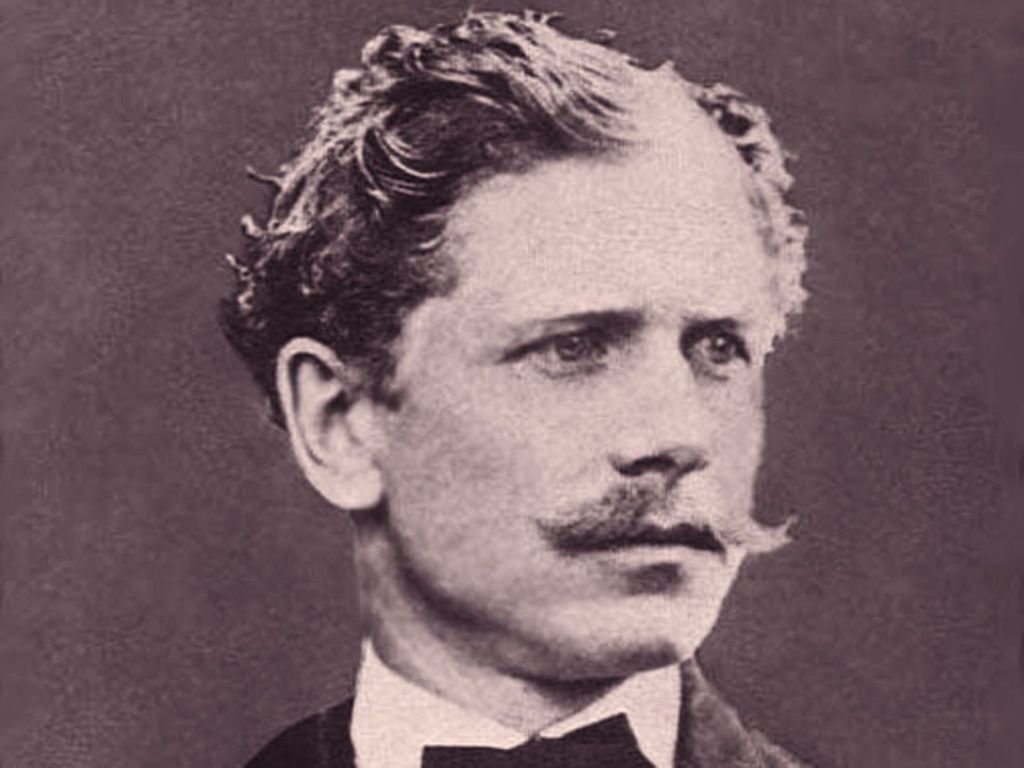
Count Leo Tolstoy (1828-1910)

In the last year of his life, Count Leo Tolstoy was subjected to unusual stresses. He was frequently ill with fevers, stomach ailments, constipation, and colds. His long-time marriage to Sofia Andreyevna was characterized by hysteria and mutual recriminations. Finally, his estate at Yasnaya Polyanka was constantly besieged with friends, relatives, petitioners, crackpots, and celebrity hounds. Yet, in his Diaries, he managed to keep his eyes on the main topics, as this entry on May 1, 1910, the last year of his life attests::

One of the main causes of suicides in the European world is the false teaching of the Christian Church about heaven and hell. People don’t believe in heaven and hell, but all the same the idea that life should be either heaven or hell is so firmly fixed in their heads that it doesn’t permit of a rational understanding of life as it is—namely neither heaven nor hell, but struggle, unceasing struggle, unceasing because life consists only of struggle; only not a Darwinian struggle of creatures and individuals, but a struggle of spiritual forces against their bodily restrictions. Life is a struggle of the soul against the body. If life is understood in this way, suicide is impossible, unnecessary and senseless. The good is only to be found in life. I seek the good; how then could I leave this life in order to attain the good? I seek mushrooms. Mushrooms are only to be found in the forest. How then can I leave the forest in order to find mushrooms?

Tolstoy on the 2024 Election

Count Leo Tolstoy (1828-1910)

Well, of course Tolstoy did not write anything about our upcoming presidential election, but what he said back over 125 years ago can still resonate with Americans today. Below is an excerpt from his diary entry for February 7, 1895.

The situation of the majority of people educated in true brotherly love and now oppressed by the deceit and cunning of those who wield power and who force the majority to ruin their own lives—this situation is terrible and seems to offer no way out. Only two ways out present themselves and both are barred: one is to break violence by violence, terror, dynamite bombs and daggers as our nihilists and anarchists did, to smash the conspiracy of governments against peoples, without our participation; the other is to enter into agreement with the government, make concessions to it and, by taking part in it, gradually unravel the net which holds the people fast and free it….

Dynamite and daggers, as experience shows us, only provoke reaction and destroy the most valuable power, the only power in our control—public opinion; the other way out is barred by the fact that governments have already come to know how far to tolerate the participation of people who want to reform them. They only tolerate what doesn’t destroy the essentials, and are very sensitive about what is harmful to them, sensitive because it concerns their very existence. They do tolerate people who don’t agree with them and want to reform the government, not only to satisfy the demands of these people, but also for their own sakes, for the sake of the government. These people would be dangerous for governments if they remained outside these governments and rose up against them; they would strengthen the one weapon which is stronger than governments—public opinion—and so they need to make these people safe, win them over by means of concessions made by the government, render them harmless like microbe cultures—and then use them to serve the aims of governments, i.e., the oppression and exploitation of the people.

Both ways out are firmly and impenetrably barred. What then remains? You can’t break violence by violence—you increase reaction; nor can you join the ranks of government. Only one thing remains: to fight the government with weapons of thought, word and way of life, not making concessions to it, not joining its ranks, not increasing its power oneself.

Ancient Peruvian Warfare

Wait a Sec! Pre-Columbian Warriors Had No Iron or Steel

I have been reading (and enjoying) Hugh Thomson’s A Sacred Landscape: The Search for Ancient Peru. In it, he discusses the nature of warfare during the Sechin culture (1800-1300 BC).

Before coming to Sechin I had talked to Henning Bischof, the distinguished German archaeologist now in his late sixties who had done pioneering work at Cerro Sechin between 1979 and 1984. Together with Peruvian colleagues, he had been the first to establish an accurate radiocarbon figure for the site, when they had found a wooden post supporting one wall and dated it around 1500 BC. I asked him about the intense debate on the meaning of the frieze [depicting human sacrifice].

What you have to remember,” said Henning in slightly accented but perfectly grammatical English, “is what was happening to Peru when all these different interpretations were being made.” He argued that Peruvian archaeology reflected political events far more than has ever been acknowledged. While the military governments of the sixties and seventies held sway, they welcomed a purely military interpretation of the frieze—Peru’s great military past, so to speak, which they were inheriting—“and that interpretation is precisely what the archaeologists gave them.”

But as Henning pointed out, there was a real problem with any interpretation of the frieze as military: without iron, the weapons available for actual warfare to the people of Sechin would never have been able to achieve such clean-cut savagery, Speaking in his precise German accent, Henning said: “It would have been impossible to cut off limbs in combat. You must remember that it is time-consuming work to disassemble a human body.” Any warfare would have been a far cruder process of slings and battering stones.

One That Got Away

Enroute to Mexico with Neal Cassady in On The Road, Jack Kerouac falls for a young woman he sees briefly in Michigan. Considering Kerouac’s dismal track record with women, maybe it was a good thing she didn’t join him.

I took up a conversation with a gorgeous country girl wearing a low-cut cotton blouse that displayed the beautiful sun-tan on her breast tops. She was dull. She spoke of evenings in the country making popcorn on the porch. Once this would have gladdened my heart but because her heart was not glad when she said it I knew there was nothing in it but the idea of what one should do. “And what else do you do for fun?” I tried to bring up boy friends and sex. Her great dark eyes surveyed me with emptiness and a kind of chagrin that reached back generations and generations in her blood from not having done what was crying to be done—whatever it was, and everybody knows what it was. “What do you want out of life?” I wanted to take her and wring it out of her. She didn’t have the slightest idea what she wanted. She mumbled of jobs, movies, going to her grandmother’s for the summer, wishing she could go to New York and visit the Roxy, what kind of outfit she would wear—something like the one she wore last Easter, white bonnet, roses, rose pumps, and lavender gabardine coat. “What do you do on Sunday afternoons?” I asked. She sat on her porch. The boys went by on bicycles and stopped to chat. She read the funny papers, she reclined on the hammock. “What do you do on a warm summer’s night?” She sat on the porch, she watched the cars in the road. She and her mother made popcorn. “What does your father do on a summer’s night?” He works, he has an all-night shift at the boiler factory, he’s spent his whole life supporting a woman and her outpoppings and no credit or adoration. “What is he aching to do? What are we all aching to do? What do we want?” She didn’t know. She yawned. She was sleepy. It was too much. Nobody could tell. Nobody would ever tell. It was all over. She was eighteen and most lovely, and lost.

Tolstoy’s Journal

Count Leo Tolstoy (1828-1910)

Toward the end of his life, Count Leo Tolstoy wrote entries in a journal. He was a desultory writer by this time, frequently skipping days, weeks, and even months. Many entries end with the expression “If I Live,” highlighting to Tolstoy that he was approaching the end of his life. Most of his entries are about man’s relationship with his Creator and frequently end with short criticisms of what he wrote, such as “Stupid,” “Not clear and not what I want to say,” “I have not succeeded,” “Again, not what I want to to say,” and “I feel that there is something in this, but I can not yet express it clearly.” But then, even when he is struggling, Tolstoy is worth reading. Following are several excerpts from the first 80 pages.

Oh, not to forget death for a moment, into which at any moment you can fall! If we would only remember that we are not standing upon an even plain (if you think we are standing so, then you are only imagining that those who have gone away have fallen overboard and you yourself are afraid you will fall overboard), but that we are rolling on, without stopping, running into each other, getting ahead and being got ahead of, yonder behind the curtain which hides from us those who are going away, and will hide us from those who remain. If we remember that always, then, how easy and joyous it is to live and roll together, yonder down the same incline, in the power of God, with Whom we have been and in Whose power we are now and will be afterwards and forever. I have been feeling this very keenly.

§

I am alive, but I don’t live…. I lay down to sleep, but could not sleep, and there appeared before me so clearly and brightly, an understanding of life whereby we would feel ourselves to be travellers. Before us lies a stage of the road with the same well-known conditions. How can one walk along that road otherwise than eagerly, gaily, friendly, and actively together, not grieving over the fact that you yourself are going away or that others are going ahead of you thither, where we shall again be still more together.

§

I was going from the Chertkovs on the 5th of July. It was evening, and beauty, happiness, blessedness, lay on everything. But in the world of men? There was greed, malice, envy, cruelty, lust, debauchery. When will it be among men as it is in nature? Here there is a struggle, but it is honest, simple, beautiful. But there it is base. I know it and I hate it, because I myself am a man.

Water from the Limpopo

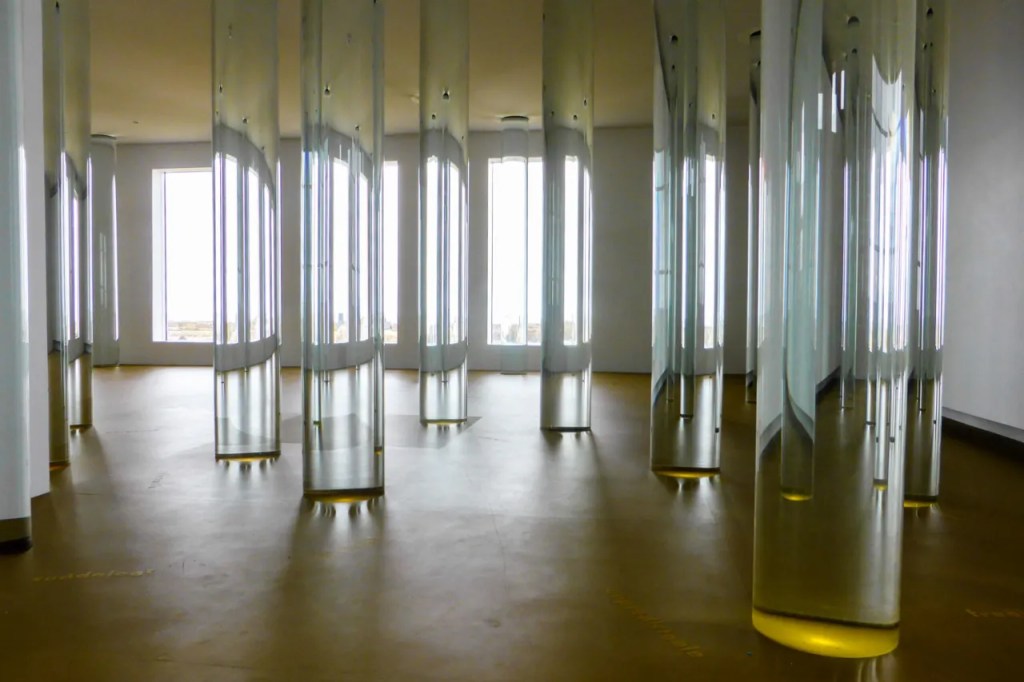
The Library of Water in Stykkishólmur, Iceland

I have just finished reading the first volume of Konstantin Paustovsky’s Story of a Life. In Chapter 14, we are introduced to a geography teacher at the high school Kostik (short for Konstantin) attends in Kyiv named Cherpunov. Paustovsky describes his collection:

Bottles filled with yellowish water, corked and sealed with sealing wax, stood in rows on the classroom table. They had labels, inscribed in an uneven elderly hand: ‘Nile,’ ‘Limpopo,’ ‘Mediterranean.’

There were bottles of water from the Rhine, the Thames, Lake Michigan, from the Dead Sea and the Amazon, but however long we looked at them they all remained equally yellow and uninteresting.

Curiously, there is one such collection in Stykkishólmur, Iceland, on the Snæfellsness Peninsula. It is called the Library of Water. Although I have been in Stykkishólmur twice, I have never bothered to visit it. Perhaps because I suspected what Paustovsky was to find out after Cherpunov’s young wife ran off and the old teacher quit.

‘Do you remember Cherpunov?’

‘Yes, of course.’

‘Well, I can tell you now that there was never anything in his bottles except ordinary water from the tap. You’ll ask me why he lied to you. He rightly believed that he was stimulating your imagination. He attached great value to it. I remember him telling me that it was all that distinguished man from the beasts. It was imagination, he said, that had created art, it expanded the boundaries of the world and of the mind, and communicated the quality we call poetry to our lives.’

On the Rue de l’Aude

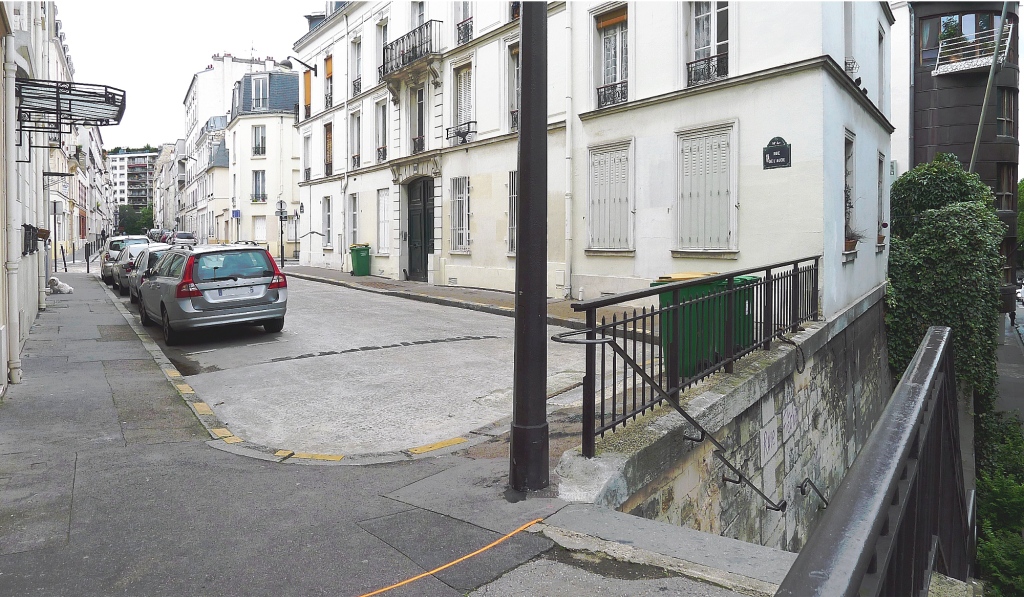
The Rue de l’Aude in the XV Arrondissement of Paris

I am fatally in love with the novels of Patrick Modiano. This evening, I re-read his The Black Notebook, published in France in 2012 as L’Herbe des nuits. His fatally lost characters end up wandering the streets of Paris, trying to recover lost memories. Meanwhile, I try following their path using an old copy of Paris Pratique par Arrondissement.

The following is from page 75 of my Houghton-Mifflin edition:

And I was afraid I would be waiting for her in vain that night. Then again, I often waited without knowing if she’d show. Or else she would come by when I wasn’t expecting her, at around four in the morning. I would have fallen into a light sleep, and the sound of the key turning in the lock would startle me awake. Evenings were long when I stayed in my neighborhood to wait for her, but it seemed only natural. I felt sorry for people who had to record appointments in their diary, sometimes months in advance. Everything was prearranged for them, and they would never wait for anyone. They would never know how time throbs, dilates, then falls slack again; how it gradually gives you that feeling of vacation and infinity that others seek in drugs, but that I found just in waiting. Deep down, I felt sure you would come sooner or later.

The Saddest City

Bucharest in Winter

I am reading a great Romanian novel by Mircea Cărtărescu entitled Solenoid. In it, I found the following description of Bucharest, the country’s capital:

More probably, like all of Bucharest, the saddest city on the face of the earth, the factory had been designed as a ruin from the start, as a saturnine witness to time devouring its children, as an illustration of of the unforgiving second law of thermodynamics, as a silent, submissive, masochistic bowing of the head in the face of the destruction of all things and the pointlessness of all activity, from the effort of carbon to form crystals to the effort of our minds to understand the tragedy in which we live. Like Brasilia, but more deeply and more truly, Bucharest was born on a drawing board from a philosophical impulse to imagine a city that would most poignantly illustrate human destiny: a city of ruin, decline, illness, debris, and rust. That is, the most appropriate construction for the faces and appearances of its inhabitants. The old factory’s production lines, driven by long-immobile motors had produced—and perhaps, in a quiet isolation beyond humanity, continued to produce—the fear and grief, the unhappiness and agony, the melancholy and suffering of our life on Earth, in sufficient quantities for the surrounding neighborhood.

Oops! I’m Running for President!

The Residence of the President of Iceland (Center)

I read an amusing story in the current edition of the Reykjavík Grapevine. It appears that it is so easy to run for the presidency of Iceland using a handy website that a number of people accidentally put their names in for nomination. According to the Grapevine article:

As the upcoming presidential elections draw near, more and more viable candidates are entering the race. Potential contenders need to collect at least 1500 signatures before April 26 to be eligible for election. This is the first time the entire process is conducted online, leading some people to unintentionally run for president on island.is with the push of a button.

On March 24, approximately 80 people had put their names forward, formally entering the presidential race. RÚV [the Icelandic English-language news service] reports that 40 candidates subsequently removed their submissions, with at least six individuals unknowingly entering the 2024 presidential race. The National Election Board has remedied the technical glitch.

53 candidates are currently in the process of collecting signatures, with voters choosing the next President of Iceland on June 1.

this and That

No, the lower-case “t“ in the above title is not an error. It is explained by Polish/Ukrainian philosopher and author Sigizmund Krzhizhanovsky (1887-1950) in a 1918 essay entitled “Argo and Ergo.”

All the things in my world I divide into these and Those.

These have worn out my eyes; they have rubbed my hands sore; they are covered with layers of my touches; they surround me, chafing my very eyes, my skin, they are all right here and here. I know them to the finest flexure—point—mark; they have all been counted and recounted.

Whereas Those things: are not within my grasp, my eye cannot reach, but I believe: they are the essence: beyond all distances, outside all tangencies, where lines of sight have come to an end and colors faded away.

To think is to transpose things: from these into Those, from Those into these.

Some people rejoice if, having taken this thing right here at hand, they can remove it to That: we shall call them this-into-Thaters. This sort of person is usually drawn to poetry, music, and so on. People who would rather, on reaching for Those distant things, bring them as close as possible to eye and brain, we shall call That-into-thisers: their minds, attracted by science, by the exactitude of definitions, like to “reveal”mysteries and “discover” secrets,