I am reading a great Romanian novel by Mircea Cărtărescu entitled Solenoid. In it, I found the following description of Bucharest, the country’s capital:
More probably, like all of Bucharest, the saddest city on the face of the earth, the factory had been designed as a ruin from the start, as a saturnine witness to time devouring its children, as an illustration of of the unforgiving second law of thermodynamics, as a silent, submissive, masochistic bowing of the head in the face of the destruction of all things and the pointlessness of all activity, from the effort of carbon to form crystals to the effort of our minds to understand the tragedy in which we live. Like Brasilia, but more deeply and more truly, Bucharest was born on a drawing board from a philosophical impulse to imagine a city that would most poignantly illustrate human destiny: a city of ruin, decline, illness, debris, and rust. That is, the most appropriate construction for the faces and appearances of its inhabitants. The old factory’s production lines, driven by long-immobile motors had produced—and perhaps, in a quiet isolation beyond humanity, continued to produce—the fear and grief, the unhappiness and agony, the melancholy and suffering of our life on Earth, in sufficient quantities for the surrounding neighborhood.
The Residence of the President of Iceland (Center)
I read an amusing story in the current edition of the Reykjavík Grapevine. It appears that it is so easy to run for the presidency of Iceland using a handy website that a number of people accidentally put their names in for nomination. According to the Grapevine article:
As the upcoming presidential elections draw near, more and more viable candidates are entering the race. Potential contenders need to collect at least 1500 signatures before April 26 to be eligible for election. This is the first time the entire process is conducted online, leading some people to unintentionally run for president on island.is with the push of a button.
On March 24, approximately 80 people had put their names forward, formally entering the presidential race. RÚV [the Icelandic English-language news service] reports that 40 candidates subsequently removed their submissions, with at least six individuals unknowingly entering the 2024 presidential race. The National Election Board has remedied the technical glitch.
53 candidates are currently in the process of collecting signatures, with voters choosing the next President of Iceland on June 1.
No, the lower-case “t“ in the above title is not an error. It is explained by Polish/Ukrainian philosopher and author Sigizmund Krzhizhanovsky (1887-1950) in a 1918 essay entitled “Argo and Ergo.”
All the things in my world I divide into these and Those.
These have worn out my eyes; they have rubbed my hands sore; they are covered with layers of my touches; they surround me, chafing my very eyes, my skin, they are all right here and here. I know them to the finest flexure—point—mark; they have all been counted and recounted.
Whereas Those things: are not within my grasp, my eye cannot reach, but I believe: they are the essence: beyond all distances, outside all tangencies, where lines of sight have come to an end and colors faded away.
To think is to transpose things: from these into Those, from Those into these.
Some people rejoice if, having taken this thing right here at hand, they can remove it to That: we shall call them this-into-Thaters. This sort of person is usually drawn to poetry, music, and so on. People who would rather, on reaching for Those distant things, bring them as close as possible to eye and brain, we shall call That-into-thisers: their minds, attracted by science, by the exactitude of definitions, like to “reveal”mysteries and “discover” secrets,
I am in the middle of reading a great novel by British author John Cowper Powys, namely Wolf Solent (1929). In 1960, he added a preface to the Macdonald & Company edition which summarizes what I am coming to see as one of the preeminent works of the last century:
What might be called the purpose and essence and inmost being of this book is the necessity of opposites. Life and Death, Good and Evil, Matter and Spirit, Body and Soul, Reality and Appearance have to be joined together, have to be forced into one another, have to be proved dependent upon each other, while all solid entities have to dissolve, if they are to outlast their momentary appearance, into atmosphere. And all this applies to the difference between our own ego, the self within us, the being of which we are all so vividly aware as something under the bones and ribs and cells and vessels of our physical body with which it is so closely associated. Here we do approach the whole mysterious essence of human life upon earth, the mystery of consciousness. To be conscious: to be unconscious: yes! the difference between these is the difference between life and death for the person, the particular individual, with whom, whether it be ourself or somebody else, we are especially concerned.
They suddenly appear on Page 207 of Olga Tokarczuk’s House of Day, House of Night (1988), a strange sect known for sharp knives:
They spent their days singing psalms and making knives. They made blades better than anyone in the whole of Silesia and fitted them with carefully polished handles made of ash wood, which every human hand fell in love with instantly. They sold them once a year in early autumn when the apples were ripening on the trees. They held a sort of fair, which attracted people from all over the district; they each bought several knives, sometimes as many as a dozen, in order to sell them on at a profit. During these fairs people forgot that the Cutlers were of a different faith and believed in a different God, and that it would have been easy to produce evidence and drive them away. For who would make such good knives then?
Whenever they bore a child they mourned instead of rejoicing. Whenever someone died, they undressed him, laid his naked corpse in a hole in the ground and danced around the open grave.
About forty pages later appears this poem, called “The Cutlers’ Psalm”:
Futility on all the earth blessed be barren wombs holy be all sterility sacred is decay, desirous is decline wondrous the fruitlessness of winter the empty shells of nuts logs burnt to ashes that still keep the shape of the tree seeds that fall on to stony ground knives gone blunt streams run dry the beat that devours another’s offspring the bird that feeds on another’s eggs war that is always the start of peace hunger that is the beginning of repletion Sacred old age, daybreak of death, time trapped in the body, death sudden, unexpected. death downtrodden like a path in the grass To do, but have no results to act, but stir nothing to age, but change nothing to set off, but never arrive to speak, but not give voice
The Archangel Raphael in the Style of the Cuzco School of Painting
Currently, I am reading Olga Tokarczuk’s House of Day, House of Night, an early (1988) novel by the 2018 winner of the Nobel Prize in Literature. I came across the following passage and thought I would like to share it with you:
Quite out of the blue a bizarre and compelling idea came into my head today: that we have ended up as human beings through forgetfulness, through lack of attention, and that in reality we are creatures participating in a vast, cosmic battle that has probably been going on since time immemorial, and which, for all we know, may never end. All we see of it are glimmers, in blood-red moons, in fires and gales, in frozen leaves that fall in October, in the jittery flight of a butterfly, in the irregular pulse of time that can lengthen a night into infinity or come to a violent stop each day at noon. I am actually an angel or demon sent into the turmoil of one life on a sort of mission, which is either carrying itself out without my help, or else I have totally forgotten about it. This forgetfulness is part of the war—it’s the other side’s weapon, and they have attacked me with it so that I’m wounded, invalided out of the game for a while. As a result, I don’t know how powerful or weak I am—I don’t know anything about myself because I can’t remember anything, and that’s why I don’t try to look for either weakness or power in myself. It’s an extraordinary feeling—to imagine that somewhere deep inside, you are someone completely different from the person you always thought you were. But it didn’t make me feel anxious, just relieved, finally free of a kind of weariness that used to permeate my life.
I have just finished reading the essays in Earth Memories by Llewelyn Powys (1884-1939), one of three literary giants in a family that included John Cowper Powys (1872-1063) and T. F. Powys (1875-1953). The essays in the book are mostly nature studies with an occasional jaunt into the philosophical implications of his everyday reality. The following is from his essay “A Butterfly Secret”:
And, indeed, as one walks over these downs at nighttime, under the fathomless pricked dome of infinity, one receives but one answer, The matter is as plain as a child’s sum in a dame’s school. Life is its own justification. There is no other aim to it, no other meaning, no other purpose, and if we think otherwise, we are foolish. Let the truth be spoken. Each one of us, each intellectual soul among us, advances steadily and surely toward the grave. Abdel Krim and his Rifis, General Feng and his soldiers, are all marching down the same road—a road that leads to oblivion and that for a thousand years has been trodden by a procession of all nations. Every religion is as brittle as an empty snail shell in dry weather, as quick to disappear as cuckoo-spit in a summer hedge that conceals at its center no green fly. The secret to be remembered is that nothing matters, nothing but the momentary consciousness of each individual as he opens his eyes upon a spectacle that knows nought of ethics.
Let us, as best we may, reconcile our minds to the fact that all our self-imposed tasks, our political engineering, our brave talk have actually, under the shadow of Eternity, no consequence. Our idealism is treacherous. It is a moonshine path over a deep sea. We are cursed souls each one of us and resemble nothing so much as jackdaws flying about he radiant cliffs of God pretending to be seagulls.
And yet there is no cause to despair. Merely to have come to consciousness at all constitutes an inestimable privilege. The past is nothing, the future is nothing, the eternal now alone is of moment. This is understood well enough by every living creature but man.
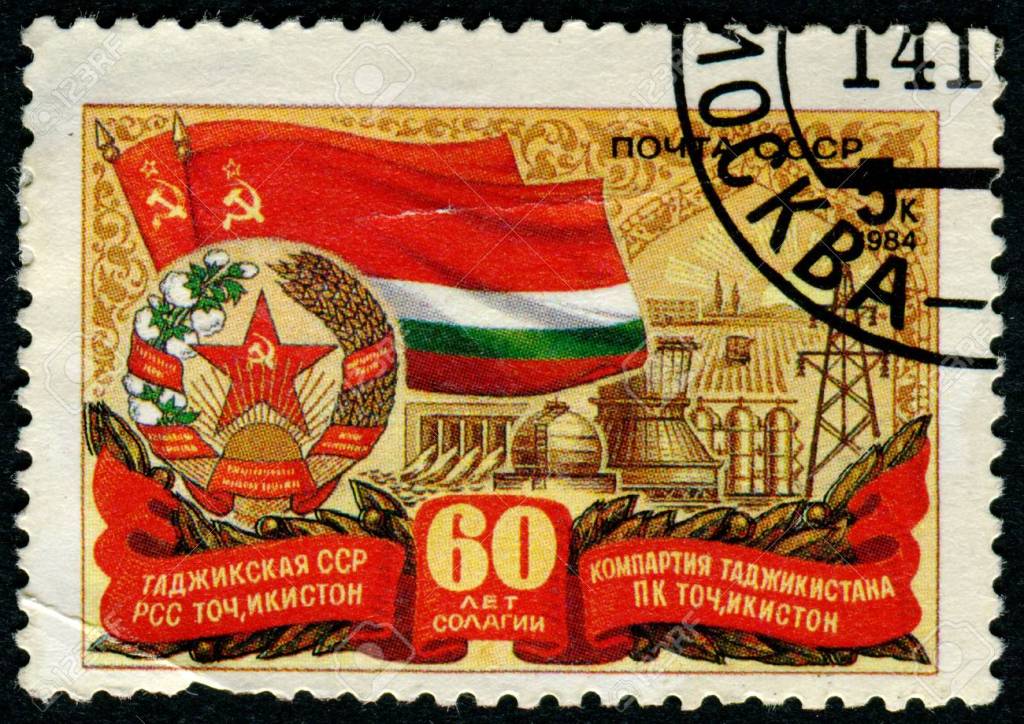
RUSSIA – CIRCA 1984: shows Tadzhik Soviet Socialist Republic flags and arms, circa 1984
I am currently reading a book of stories by the Russian writer Maxim Osipov entitled Rock, Paper, Scissors and Other Stories. In the title story is an incredible Tadzhik woman who kills an official of a small rural town in Russia who tries to rape her. Her name is Ruhshona Ibragimovma. Although working in a menial position at a restaurant, she is a highly educated woman, which, in the position she finds herself, becomes increasingly unimportant to her.
[D]eath’s omnipresence is no accident, no unhappy mistake. Everyone fears death, just as they fear misfortune, yet death is inescapable, which means it is real. And that we did not invent it. At this very moment Ruhshona begins to see death as the most important thing that can exist within a person. She views those who don’t carry death within themselves—who don’t live by it—as empty, like wrapping paper, like candy wrappers. Hollow, soulless people. She can pick them out at a glance.
This short tale by Jorge Luis Borges (1899-1986) is, to my mind, the most incredible tale ever told about the power of poetry. It is told here in its entirety. It and many equally wonderful poems and stories can be found in Dreamtigers (in Spanish, El Hacedor).
That day, the Yellow Emperor showed the poet his palace. They left behind, in long succession, the first terraces on the west which descend, like the steps of an almost measureless amphitheater, to a paradise or garden whose metal mirrors and intricate juniper hedges already prefigured the labyrinth. They lost themselves in it, gaily at first, as if condescending to play a game, but afterwards not without misgiving, for its straight avenues were subject to a curvature, ever so slight, but continuous (and secretly those avenues were circles). Toward midnight observation of the planets and the opportune sacrifice of a turtle permitted them to extricate themselves from that seemingly bewitched region, but not from the sense of being lost, for this accompanied them to the end. Foyers and patios and libraries they traversed then, and a hexagonal room with a clepsydra, and one morning from a tower they descried a stone man, whom they then lost sight of forever. Many shining rivers did they cross in sandalwood canoes, or a single river many times. The imperial retinue would pass and people would prostrate themselves. But one day they put in on an island where someone did not do it, because he had never seen the Son of Heaven, and the executioner had to decapitate him. Black heads of hair and black dances and complicated golden masks did their eyes indifferently behold; the real and the dreamed became one, or rather reality was one of dream’s configurations. It seemed impossible that earth were anything but gardens, pools, architectures, and splendrous forms. Every hundred paces a tower cleft the air; to the eye their color was identical, yet the first of all was yellow, and the last, scarlet, so delicate were the gradations and so long the series.
It was at the foot of the next-to-last tower that the poet—who was as if untouched by the wonders that amazed the rest—recited the brief composition we find today indissolubly linked to his name and which, as the more elegant historians have it, gave him immortality and death. The text has been lost. There are some who contend it consisted of a single line; others say it was a single word. The truth, the incredible truth, is that in the poem stood the enormous palace, entire and minutely detailed, with each illustrious porcelain and every sketch on every porcelain and the shadows and the light of the twilights and each unhappy or joyous moment of the glorious dynasties of mortals, gods, and dragons who had dwelled in it from the interminable past. All fell silent, but the Emperor exclaimed, “You have robbed me of my palace!” And the executioner’s iron sword cut the poet down.
Others tell the story differently. There cannot be any two things alike in the world; the poet, they say, had only to utter the poem to make the palace disappear, as if abolished and blown to bits by the final syllable. Such legends, of course, amount to no more than literary fiction. The poet was a slave of the Emperor and as such he died. His composition sank into oblivion and his descendants still seek, nor will they find, the one word that contains the universe.
I have been reading Niccolò Machiavelli’s The Discourses, in which he writes about governance and warfare in his day (around AD 1517). In Book II, he gives an anecdote about how not to negotiate with Alexander the Great:
When the whole East had been overrun by Alexander of Macedon, the citizens of Tyre (then at the height of its renown, and very strong from being built, like Venice, in the sea), recognizing his greatness, sent ambassadors to him to say that they desired to be his good servants, and to yield him all obedience, yet could not consent to receive either him or his soldiers within their walls. Whereupon, Alexander, displeased that a single city should venture to close its gates against him to whom all the rest of the world had thrown theirs open, repulsed the Tyrians, and rejecting their overtures set to work to besiege their town. But as it stood on the water, and was well stored with victual and all other munitions needed for its defence, after four months had gone, Alexander, perceiving that he was wasting more time in an inglorious attempt to reduce this one city than had sufficed for most of his other conquests, resolved to offer terms to the Tyrians, and to make them those concessions which they themselves had asked. But they, puffed up by their success, not merely refused the terms offered, but put to death the envoy sent to propose them. Enraged by this, Alexander renewed the siege, and with such vigour, that he took and destroyed the city, and either slew or made slaves of its inhabitants.





 Tarnmoor
You must be logged in to post a comment.