
Niflheim

Poet and Novelist Thomas Hardy (1840-1928)

I was looking for information on the Internet about Thomas Hardy when I came upon an interesting article on the Paris Review website. The opening paragraphs captured my attention:

Are you enjoying yourself at the moment? Please stop. It’s Thomas Hardy’s birthday, and he will wipe the smile right off your smug, contented, life-affirming face. You’re dealing with a man who knew how to deploy the word Niflheim, defined by the OED as “the region of eternal darkness, mist, and cold inhabited by those who died from old age or illness.” Hardy uses it to dispirited perfection in The Woodlanders, relating a kind of failure to connect: “But he continued motionless and silent in that gloomy Niflheim or fog-land which involved him, and she proceeded on her way.” Actually, The Woodlanders is full of an evocative, despondent murkiness. It extends even to the tiny twigs on the ground, which Hardy takes care to describe as they’re destroyed by a passing carriage: “they drove on out of the grove, their wheels silently crushing delicate-patterned mosses, hyacinths, primroses, lords-and-ladies, and other strange and common plants, and cracking up little sticks that lay across the track.”

Hardy wrote with a special zeal for death, and his sense of the morbid often lapsed into tone deafness. He witnessed two executions when he was a boy—maybe that had something to do with it. One of them was the hanging of Elizabeth Martha Brown, who was convicted of murdering her husband. By his own account, Hardy, then only sixteen, stood close enough to the gallows to hear her gown rustling; the hanging left an indelible mark on him such that seventy years later, in 1926, he could render it vividly in a letter to Lady Pinney, casting Brown’s final seconds in an unmistakably erotic light:

I am ashamed to say I saw her hanged, my only excuse being that I was but a youth and had to be in the town at that time for other reasons … I remember what a fine figure she showed against the sky as she hung in the misty rain, and how the tight black silk gown set off her shape as she wheeled half-round and back.

He added later:

The hanging itself did not move me at all. But I sat on after the others went away, not thinking, but looking at the figure … turning slowly round on the rope. And then it began to rain, and then I saw—they had put a cloth over the face—how as the cloth got wet, her features came through it. That was extraordinary. A boy had climbed up into a tree nearby, and when she dropped he came down in a faint like an apple dropping from a tree. It was curious the two dropping together.

Nothing Has To Be Done

I have been reading a rare book of humor from the old Soviet Union. It is The Anti-Soviet Soviet Union by Vladimir Voinovich, who, for his pains, was expelled from the Soviet Writers’ Union in February 1974. Unable to make a living as a writer in Russia, he naturally fled to the West. The following excerpt from the book describes an amusing visit to the KGB (Soviet State Security) in Moscow.

During my last years in Moscow, a beginning writer would visit me from time to time when he was in town from the provinces. He’d complain of not being published and gave me his novels and stories, of which there were a great number, to see what I thought of them. He was certain that his works weren’t being published because their content was too critical. And indeed they did contain criticism of the Soviet system. But they had another major flaw as well: they lacked even the merest glimmer of talent. Sometimes he would request, and sometimes demand, that I send his manuscripts abroad and help get them published over there. I refused. Then he decided to go to the KGB and present them with an ultimatum: either they were immediately to issue orders that his works be published in the USSR or he would leave the USSR at once.

Apparently, it went something like this.

As soon as he had entered the KGB building, someone walked over to him and said: “Oh, hello there. So you’ve finally come to see us.!”

“You mean you know me?” asked the writer.

“Is there anyone who doesn’t?” said the KGB man, spreading his hands. “Have a seat. What brings you here? Do you want to tell us that you don’t like the Soviet system?”

“That’s right, I don’t,” said the writer.

“But what specifically don’t you kike about it?”

The writer replied that, in his opinion, there was no freedom in the Soviet Union, particularly artistic freedom. Human rights were violated, the standard of living was steadily declining—and he voiced other critical remarks as well. Good for about seven years in a camp.

Having listened politely, the KGB man asked: “But why are you telling me all this?”

“I wanted you to know.”

“We know. Everyone knows all that.”

“But if everyone knows, something should be done about it.”

“That’s where you’re wrong. Nothing has to be done about it!”

Surprised by that turn in the conversation, the writer fell silent.

“Have you said everything you wanted to?” asked the KGB man politely.

“Yes, everything.”

“Then why are you still sitting there?”

“I’m waiting for you to arrest me.”

“Aha, I see,” said the KGB man. “Unfortunately, there’s no way we can arrest you today. We’re too busy. If the desire doesn’t pass, come see us again, and we’ll do everything we can to oblige you.” And he showed the writer out.

The writer visited me a few more times before he disappeared. I think he finally may have achieved his goal and gotten someone to give him the full treatment for dissidence.

From My Piblokto Madness Bed

William Gibson on Our Military-Influenced Fashions

There are few novelists currently working whom I like as much as William Gibson. His science fiction doesn’t go that far into the future, yet he constantly introduces concepts, which he doesn’t explain, and yet which fascinate me. One such is the Piblokto Madness bed in which her character Hollis Henry from Zero History sleeps at a posh London hotel. Looking up Piblokto on Wikipedia, I found this definition: “A culture-bound syndrome observed primarily in female Inuit and other arctic populations. Individuals experience a sudden dissociative period of extreme excitement in which they often tear off clothes, run naked through the snow, scream, throw things, and perform other wild behaviors.” Huh?

On another topic, Gibson is spot on, namely the civilian fashion of adopting military styles in one’s apparel:

“Sleight had arranged for us to have a look at a garment prototype. We’d picked up interesting industry buzz about it, though when we got the photos and tracings, really, we couldn’t see why. Our best analyst thinks it’s not a tactical design. Something for mall ninjas.”

“For what?”

“The new Mitty demographic.”

“I’m lost,”

“Young men who dress to feel they they’ll be mistaken for having special capability. A species of cosplay, really. Endemic. Lots of boys are playing soldier now. The men who run the world aren’t, and neither are the boys most effectively bent on running it next. Or the ones who’re actually having to be soldiers, of course. But many of the rest have gone gear-queer, to one extent or another.”

“Gear-queer?”

Bigend’s teeth showed. “We had a team of cultural anthropologists interview American soldiers returning from Iraq. That’s where we first heard it. It’s not wholly derogatory, mind you. There are actual professionals who require these things—some of them, anyway. Though they generally seem to be far less fascinated with them. But it’s that fascination that interests us, of course.”

“It is?”

“It’s an obsession with the idea not just of the right stuff, but of the special stuff. Equipment fetishism. The costume and semiotics of achingly elite police and military units. Intense desire to possess same, of course, and in turn to be associated with that world. With its competence, its cocksure exclusivity.”

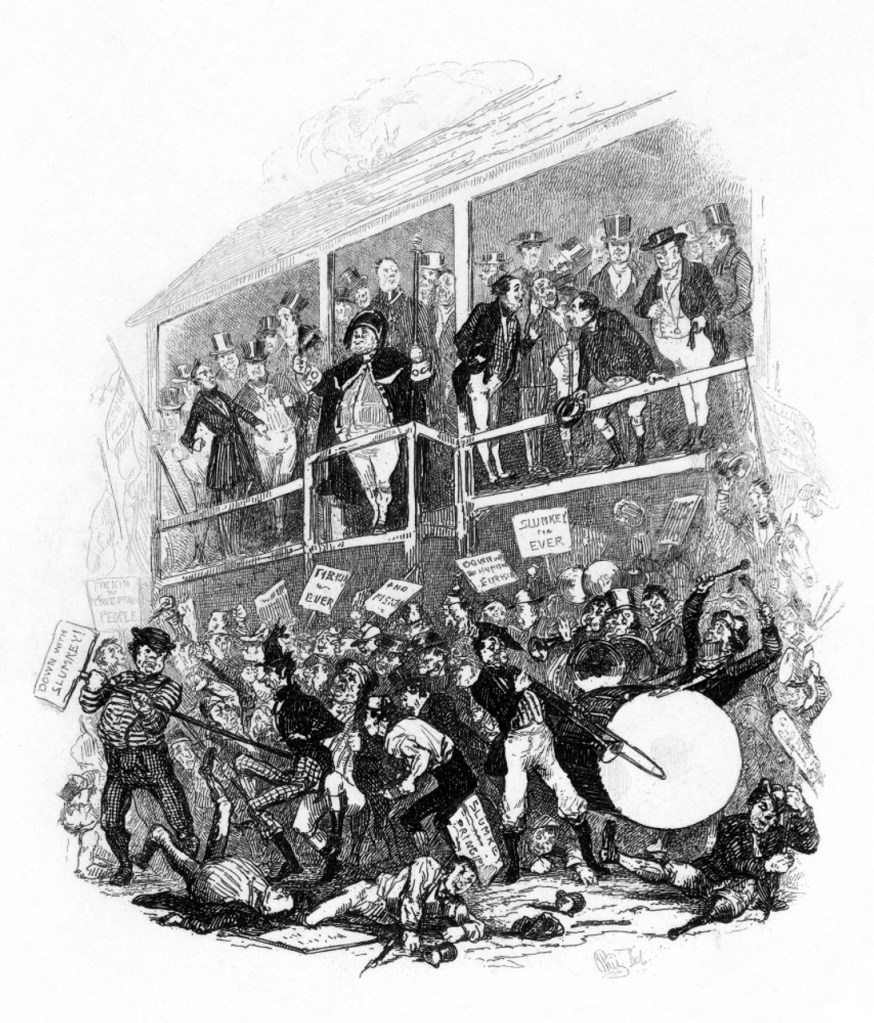
The Parliamentary Election at Eatanswill

Illustration by “Phiz” for The Pickwick Papers by Charles Dickens

If you think the political division between the Democrats and Republicans is a new think, you should read Charles Dickens’s The Posthumous Papers of the Pickwick Club (1837), particularly in the scenes describing the parliamentary election at Eatanswill (“Eat and Swill”), one of the most savage satires by the British writer. Here is his masterful description of the state of things at Eatanswill:

It appears, then, that the Eatanswill people, like the people of many other small towns, considered themselves of the utmost and most mighty importance, and that every man in Eatanswill, conscious of the weight that attached to his example, felt himself bound to unite, heart and soul, with one of the two great parties that divided the town—the Blues and the Buffs. Now the Blues lost no opportunity of opposing the Buffs, and the Buffs lost no opportunity of opposing the Blues; and the consequence was, that whenever the Buffs and Blues met together at public meeting, town-hall, fair, or market, disputes and high words arose between them. With these dissensions it is almost superfluous to say that everything in Eatanswill was made a party question. If the Buffs proposed to new skylight the market-place, the Blues got up public meetings, and denounced the proceeding; if the Blues proposed the erection of an additional pump in the High Street, the Buffs rose as one man and stood aghast at the enormity. There were Blue shops and Buff shops, Blue inns and Buff inns—there was a Blue aisle and a Buff aisle in the very church itself.

Of course it was essentially and indispensably necessary that each of these powerful parties should have its chosen organ and representative: and, accordingly, there were two newspapers in the town—the Eatanswill Gazette and the Eatanswill Independent; the former advocating Blue principles, and the latter conducted on grounds decidedly Buff. Fine newspapers they were. Such leading articles, and such spirited attacks!—‘Our worthless contemporary, the Gazette’—‘That disgraceful and dastardly journal, the Independent’—‘That false and scurrilous print, the Independent’—‘That vile and slanderous calumniator, the Gazette;’ these, and other spirit-stirring denunciations, were strewn plentifully over the columns of each, in every number, and excited feelings of the most intense delight and indignation in the bosoms of the townspeople.

The Medicine of Bow-Returning

An Excerpt from a Short Story by Mary Austin

Some of the best books about the American West were written by Mary Hunter Austin (1868-1934). In the last year of her life, she published a collection of short stories entitled One-Smoke Stories, in which the following appears:

So Taku-Wakin, who was afterward called Bow-Returning, went toward the mountain called Going-to-the-Sun for his fast, and as he went he felt the thoughts of his mother push him. He went far, climbed the high mountains and bathed in the sacred lakes, keeping holy science. On the mountain, when by fasting he was removed from himself, his eyes were opened. He saw all the earth and the sky as One Thing, even as the bow is one thing and the cord of the bow which draws it. Even so he saw the thoughts of men pulling at the corners of the world as the cord pulls at the bow, and the bow bending and returning. In the silence he heard in his heart the One-Who-Walks-in-the-Sky talking.

‘This is true medicine, Taku-Wakin. All things are one, man and the mire, the small grass and the mountain, the deer and the hunter pursuing, the thing that is made and the maker, even as the bow and the cord are one thing. As the bow bends to the cord, so all things bend and return, and are opposed and together. The meaning of the medicine is that man can hurt nothing without also hurting himself.’ Thus said the One-Who-Walks-in-the-Sky to Taku-Wakin….

After long seeking he heard the voice of the Sky-Walker. Then said Bow-Returning: ‘This is my medicine, that everything is One Thing, and in this fashion I have kept it. Meat I have taken for my needs according to the law of food-taking, but I have hurt no man. Neither the flower in the field have I crushed, nor trodden on the ant in my pathway. How is it, then, that my wife is dead, my son given to another, and my medicine is gone from me?’

Then said the One-Who-Walks-in-the-Sky to Bow-Returning, ‘Did I not also make woman?’

“Ineffable”

I have just finished reading Joan Didion’s short book on the right-wing death squad violence in El Salvador forty years ago. Back in 1964, she had voted for Barry Goldwater for President. A rancher’s daughter from Sacramento, she did not really personally encounter the disconnect between what Ronald Reagan was saying in Washington and what Roberto D’Aubuisson and his adherents were doing to the people of El Salvador.

Here Joan talks about something that shocked her about the availability of “actual information”:

Actual information was hard to come by in El Salvador, perhaps because this was not a culture in which a high value was placed on the definite…. All numbers in El Salvador tended to materialize and vanish and rematerialize in a different form, as if the numbers denoted only the “use” of numbers, an intention, a wish, a recognition that someone, somewhere, for whatever reason, needed to hear the ineffable expressed as a number. At any given time in El Salvador a great deal of what goes on is considered ineffable, and the use of numbers in this context tends to frustrate people who try to understand them literally, rather than as a proposition to be floated, “heard,” “mentioned.” There was the case of the March 28, 1982 election, about which there continued into that summer the rather scholastic argument first posed by Central American Studies, the publication of the Jesuit university in San Salvador: Had it taken an average of 2.5 minutes to cast a vote or less? Could each ballot box hold 500 ballots, or more? The numbers were eerily Salvadoran. There were said to be 1.3 million people eligible to vote on March 28, but 1.5 million people were said to have voted. These 1.5 million people were said, in turn, to represent not 115 percent of the 1.3 million eligible voters but 80 percent (or, on another float, “62-68 percent”) of the eligible voters….

Two Nightmares

In his collection Seven Nights (1984), Jorge Luis Borges wrote:

I have two nightmares that often become confused with each other. I have the nightmare of the labyrinth, which comes, in part, from a steel engraving I saw in a French book when I was a child. In this engraving were the Seven Wonders of the World, among them the labyrinth of Crete. I believed when I was a child (or I now believe I believed) that if one had a magnifying glass powerful enough, one could look through he cracks and see the Minotaur in the terrible center of the labyrinth. My other nightmare is that of a mirror. The two are not distinct, as it takes only two facing mirrors to construct a labyrinth. I always dream of labyrinths or of mirrors. In the dream of the mirror another vision appears, another terror of my nights, and that is the idea of the mask. Masks have always scared me. No doubt I felt in my childhood that someone who was wearing a mask was hiding something horrible. These are my most terrible nightmares: I see myself reflected in a mirror, but the reflection is wearing a mask. I am afraid to pull the mask off, afraid to see my real face.

Impact

Now that NASA may have a solution to the problem, it’s interesting to see how, some 200 years ago, people viewed the possibility of a comet or asteroid crashing into the earth. The quote below comes from Tales of Terror from Blackwood’s Magazine from a story by Samuel Warren entitled “The Thunder-Struck.”

“Great God, Dr ——!” said he, laying his hand suddenly on my arm, his great black eyes gleaming with mysterious awe—“Think, only think! What if, at the moment we are talking together, a comet, whose track the peering eye of science has never traced—whose very existence is known to none but God, is winging its fiery way towards our earth, swift as the lightning, and with force inevitable! Is it at this instant dashing to fragments some mighty orb that obstructed its progress, and then passing on towards us, disturbing system after system in its way?—How—when will the frightful crash be felt? Is its heat now blighting our atmosphere?—Will combustion first commence, or shall we be at once split asunder into innumerable fragments, and sent drifting through infinite space?—Whither—whither shall we fly! what must become of our species?—Is the Scriptural JUDGMENT then coming? Oh, Doctor, what if all these things are really at hand?

Not Buk’s Cup of Tea at All

I encountered the following paragraph in Jean-François Duval’s Bukowski and the Beats: A Commentary on the Bet Generation:

It was Jack’[Kerouac’s] matinee idol looks that irritated Hank [Bukowski]. “He was even better looking than Marlon Brando,” Joyce Johnson, one of his girlfriends, said of him. As a good-looking rodeo rider and actor, Jack was too handsome to be “real,” authentic in the Bukowskian perspective (which was ever tinged with humor). Jack was lacking in ugliness that, according to Bukowski, allows a truer contact with the reality of the world more than beauty; ugliness is a safe conduct for hell and, as such, is infinitely closer to the truth. In fact, beauty is not even real to Buk’s eyes, beauty doesn’t make sense at all. As he said to [his friend] Sean Penn, “There is no such thing as beauty … it’s kind of a mirage of generalizations.” In Buk’s opinion, Kerouac seemed like a cheap Roy Rogers whose work gets lost in a swirl of glitter and illusions where the word “wonderful” crops up every three sentences. Jack went wrong in trying to go with “heart’s songs” and the illusions attached: hope of salvation on the road, faith in an idealized America, poetically fantasized, escape into an uncertain mysticism, oscillating between Buddhism and Catholicism. This was not Buk’s cup of tea at all.

Worse Than Murder?

Thomas De Quincey (1785-1859)

To put it simply, Thomas De Quincey was an opium addict. There were times when he wrote like an angel. Other times, reading him could be heavy slogging. Oft times you will find both in the same book, or even in the same essay. I have just finished reading his long essay “On Murder, Considered as One of the Fine Arts.” His description of the crimes of serial murderer John Williams is detailed and ghastly. Yet earlier in the essay is the following light touch:

For, if once a man indulges himself in murder, very soon he comes to think little of robbing, and from robbing he comes next to drinking and Sabbath-breaking, and from that to incivility and procrastination. Once begun on this downward path, you never know where you are to stop. Many a man has dated his ruin from some murder or other that perhaps he thought little of at the time.