Where the Streets Have No Name

David Hockney’s “Pearblossom Highway, 11-18 April 1986, #2”

This the way I remember it: the way it was decades ago. Yesterday, Martine and I took a road trip to Littlerock, California. Why? We were looking for smoked Hungarian sausage (füstölt kolbász) which was no longer available from our usual source, as the Alpine Village Market in Torrance was no more. I had a distant memory of the Valley Hungarian Sausage & Meat Company in Littlerock, where I had purchased some good kolbász years ago, when my mother was still alive. Then I heard from my brother Dan of a place called Tibor’s that sold kolbász somewhere in the Antelope Valley.

So I took a chance and drove along California 14 (the Antelope Valley Freeway) with its vanishing lanes past the Vasquez Rocks where Captain Kirk battled the reptilian Gorn on Cestus III, past the Red Rover Mine Road and Acton, until we got yo California 138, the Pearblossom Highway, which runs from the 14 all the way to the I-15 at Victorville.

“Where did all those people come from?” I wondered as I saw all the suburban developments that have sprung up in what is now called Canyon Country. I continued asking the same question as I saw how the Pearblossom Highway was no longer “Where the Streets Have No Name,” as Bono and the U2 sang.

Well, the Streets Now Have Names

On the way to Tibor’s, we stopped at Charlie Brown Farms—also in Littlerock—to have lunch and browse around. We quickly realized several characteristics common to the people who now lived in the area:

  1. Everyone was at least thirty pounds overweight, even the kiddies
  2. If they had any discretionary income, it was spent at the local tattoo parlor
  3. To a man, woman, and child, they looked liked bad ass wannabes

We located Tibor’s easily: It was the same as the old Valley Hungarian Sausage & Meat Company. Unfortunately, it was not well stocked. When asked for füstölt kolbász, they said they didn’t have any in stock. That’s kind of like finding no tortillas in a Mexican food store or pasta in an Italian deli. We bought some other kolbász, which turned out to be good. But it was an awfully long drive for slim pickings.

Still, it got Martine out of the house, and she enjoyed the drive to an area she had never seen before. And the California poppies along the road were like golden explosions of faerie light.

Atmospheric Rivers

The Engine That Created California’s Storms This Year

Climate change is giving us a whole new language to describe the giant rain/snowstorms that have pummeled California since November 2022. Originally, there were the Pineapple Expresses which dumped large amounts of precipitation. There were maybe one or two in a rainy season, and just as likely none. Now the term Atmospheric River is used by the National Oceanic and Atmospheric Administration (NOAA). And then there are the Bomb Cyclones, fast-developing storms that occur when atmospheric pressure drops at least 24 millibars over a 24-hour period. Sometimes, all three terms are used to describe the same storm.

This year, California has experienced thirteen Atmospheric River storms this rainy season, dumping a record amount of precipitation in the form of rain and snow. I was watching a news report from Mammoth Lakes today which claimed that over 700 inches of snow have fallen in the area so far.That’s over 58 feet in all. Fortunately, it didn’t all fall at one time.

I suspect that we are probably at or near the end of these storms for this rainy season. These events have convinced me that there is risk entailed by siting a house in a low river valley or by a non-rocky hillside. Or by living in a trailer park.

The good news is that California agriculture will probably recover stronger than ever, except for those crops that don’t like too much water.

Worrying About the Next Glass of Water

Lake Mead Continues to Shrink

The Sierra snowpack that is California’s main source of water is deeper this year than at any time within memory. We cannot say, unfortunately, that the long drought is finally over. We began this rainy season in the red as a result of overpumping groundwater. Somehow, we would have to restore the groundwater that has been pumped in the last several drought years. It’s like making a deposit in the bank for the lean years to come.

In Southern California, most of our water comes from two sources. First is the California Aqueduct which draws water from the Sierra snowpack and sends it some 400 miles (640 km) to the reservoirs that supply Los Angeles. The second source is another aqueduct which brings water west from the Colorado River. That source is problematical because the Rocky Mountains have not had a particularly good year; and the states along the Colorado River are feuding with one another over water rights.

The above photo shows graphically how the water level of Lake Mead has shrunk over the last few years. What used to be a rush of water through the spillways is now a mere trickle. I wonder how much winds up crossing the border into Mexico and the Gulf of California.

Is our wet winter something we are likely to experience in future years? And will the Rockies share in the wealth? Or will the present greenery turn bone dry and feed the wildfires of the future?

Visiting the Jurassic

The Museum of Jurassic Technology in Culver City, California

I spent several hours this afternoon visiting a storefront in Culver City, right near the corner of Bagley Avenue and Venice Boulevard, that goes by the name the Museum of Jurassic Technology. Why Jurassic? Does it contain only exhibits relating to the earth between 201 and 145 million years ago? Was there any technology to be found during that period? Were there even any humans extant during that period?

Whatever may be implied by the name, it was a real museum in that it was a collection of wonders, concentrating on smaller exhibits given the size of the property. The St. Patrick’s Day crowd consisted almost exclusively of millennials, who wandered the dark and twisting corridors of the museum peering at such exhibits as miniatures by an Armenian artist named Hagop Sandaldjian, such as this representation of Snow White and the Seven Dwarves atop the horizontal eye of a needle:

There was an unusual collection of objects gathered from various Los Angeles Mobile Home Parks, together with an attempt to account for a philosophy of trailer living as a form of reaction to the expanding universe. The museum website quotes an Estonian historian named Ants Viires on the subject:

[T]ime ravages everything, our person, our experience, our material world. In the end everything will be lost. In the end there is only the darkness. …and despite the apparent fullness and richness of our lives there is, deposited at the core of each of us, a seed of this total loss of this inevitable and ultimate darkness.

Another miniaturist on display is the work of Henry Dalton (1829-1911) consisting of images created from diatoms and the scales of butterfly wings, such as the following:

To view these works, it was necessary to view them through a microscope. There were about eight of them in a row, each pointed at a separate microminiature.

On the second floor of the museum is a little courtyard where tea and cookies are served amid the cooing of doves and the gurgling of a small fountain.

It was a fun place to visit. Not all the exhibits worked, but then that is true pretty much everywhere. I walked out of the museum with a sense of wonderment that was quickly dispelled by the rush hour traffic on Venice Boulevard.

The Snowcapped Mountains of L.A.

The San Gabriel Mountains Seen from Altadena

This has been the coldest winter I can remember since I first moved to Southern California in 1966. It has been wet, too—but not quite the wettest. That honor belongs to several winters in the 1970s and early 1980s, and most particularly the winter of 2004-2005.

As I drove to the Original Farmers Market at 3rd and Fairfax, I saw the peaks of the San Gabriel Mountains covered with a heavy mantle of snow. The mercury stood in the low 50s Fahrenheit (or low teens Celsius).

Southern California winters usually consist of periods of cold interspersed with several warm spells, where the temperature can go as high as the 80s and 90s Fahrenheit (or 30s Celsius). For the last few months, however, I have been wearing long-sleeves shirts, a wool vest or sweater, and a windbreaker. In December, my gas bill topped $365.00—a new record!

I feel sorry for tourists who come to L.A. to bask in the sunshine and spend some time tanning at the beach. They will likely encounter icy winds and blowing sand.

A Grier-Musser Valentine

Valentine’s Day Memorabilia at the Grier-Musser Museum

On Sunday, Martine and I stopped in at the Grier-Musser Museum in the shadow of Downtown L.A. to see their Valentine’s Day memorabilia. Of late, Susan and Rey Tejada have been concentrating on paper in the form of old-fashioned images on postcards, greeting cards, and books—especially with pop-up illustrations.

There’s something about seeing this type of material in the Victorian mansion on Bonnie Brae Street that sends you back in time. Afterwards, we sat down with Rey and Susan over cookies and punch and talked for a couple of hours.

Although I got Martine a card for Valentine’s Day, we both decided to go out for lunch on the day after, when we were less likely to run into crowds. So tomorrow we will have a nice English lunch at Ye Olde King’s Head in Santa Monica. It is a great place to have fish and chips or bangers and mash or Cornish pasties. Fortunately, one is not likely to encounter such downmarket English cuisine items as spaghetti sandwiches or baked beans on toast.

Martine and I hope you enjoyed this little gem of a holiday. Why do I call it that? I would rather honor the love I feel than some bogus political or historical event, such as Columbus “discovering” America. After all, wasn’t he met at the beach by the local residents?

Hockney’s Pearblossom Highway

One of my favorite pieces of art is David Hockney’s “Pearblossom Highway, 11-18 April 1986, #2.” It is an almost perfect image of the Antelope Valley along the northern slope of the San Gabriel Mountains. I have driven that road a number of times on my way to Devil’s Punchbowl County Park, and even as far as Victorville—when I didn’t want to face traffic on the I-10 or the Pomona Freeway.

I am not always a fan of Hockney’s work, but this particular photo montage, in its own way, gives a better idea of the terrain than any single photograph would. It was originally created for Vanity Fair out of 800 photographs to support a story about the road trip that Vladimir Nabokov’s Lolita and Humbert Humbert took to Death Valley. For the story of the creation of this image, click on this website by the Los Angeles County Museum of Art.The actual site being depicted is the intersection of the Pearblossom Highway with 165th Street. The stop sign is no longer there, as a street light has replaced it. Also, the highway at this point has been widened to four lanes.

The Antelope Valley is still a desolate place, even though some half million people now live there, mostly along California Highway 14 as it wends north to join U.S. 395. The Pearblossom Highway (California 138) connects the Antelope Valley Freeway (California 14) with the I-15 at Victorville.

It’s a long and lonely haul, especially if one is behind a loaded big rig. But then, that is a good description of the L.A. experience.

Fiercely Unhuggable

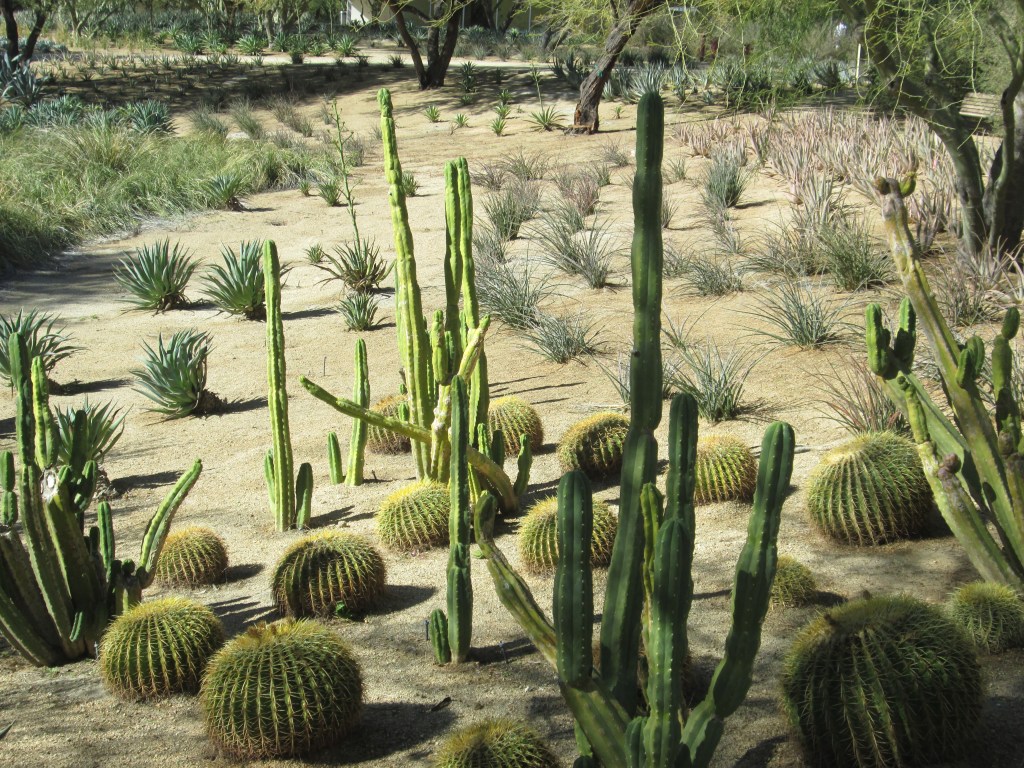
It’s Hard to Be a Tree Hugger in the Desert

This Friday, I will be driving to Palm Desert in the Coachella Valley to visit my brother and sister-in-law. Consequently, I will probably not post here again until Monday January 30—and then only if I feel up to it.

This is supposed to be a nice weekend, except for the possibility of rain on Sunday and Monday. Fortunately, I noticed this week that my right front windshield wiper was starting to fall to pieces, so I had it replaced. The driver’s side windshield wiper (which on a Subaru Forester is two inches longer than the passenger side wiper) is on order.

Usually, most Southern Californians bet that whatever rain is predicted will spend itself in the mountains and leave us high and dry. Not this year, however.

It’s always fun to spend time with Dan and Lori, and I am looking forward to it.

So hasta la vista!

RIP P-22

Mountain Lion P-22 in Better Days

He could not express what he felt But when Mountain Lion P-22 was captured and euthanized a couple of days ago, Los Angeles suddenly woke up to the fact that it had lost a hero of sorts. He had survived for years on the fringes of urban civilization, feasting on kitties and obnoxious Yorkies. He had name recognition. In the end, though, it all caught up with him.

According to CNN:

The department said the “compassionate euthanasia” was unanimously recommended by the medical team at San Diego Zoo Safari Park and conducted under general anesthesia.

P-22 was given an “extensive evaluation” which “showed significant trauma to the mountain lion’s head, right eye and internal organs, confirming the suspicion of recent injury, such as a vehicle strike,” said the department. “The trauma to his internal organs would require invasive surgical repair.”

The 12-year-old mountain lion also had “significant pre-existing illnesses, including irreversible kidney disease, chronic weight loss, extensive parasitic skin infection over his entire body and localized arthritis,” according to the release.

He was in poor health overall and “may also have had additional underlying conditions not yet fully characterized by diagnostics,” said the department.

Over the years, we kept hearing about P-22’s exploits, how he was suddenly seen in somebody’s back yard or how he callously chomped on Fluffy. The point is: He survived under difficult circumstances. It’s a pity they felt they had to kill him: They should have put him out to stud.

The People Under the Bridge

The Homeless Encampment Under the I-10 Bridge Over Centinela Avenue in West L.A.

There is no monolithic group which falls under the term “homeless.” It includes a wide variety of people, some of whom are in transition to a better life, some of whom are out of their gourds, some of whom want to be able to take drugs and drink excessively without police interference, and some of whom are psychotic criminals.

In Los Angeles, they are begging for “spare change” by every freeway onramp and in front of virtually every convenience store. Many of them have sad stories to tell, some of which are partially true. They stretch out on bus seats and commuter trains and ride back and forth all day, occasionally hassling the other riders. The police are reluctant to deal with them because so many are vectors of communicable diseases. (I once worked with a secretary who was married to a U.S. Marshal who contracted tuberculosis from escorting a prisoner.)

Unlike the terminally Woke, my attitude toward the homeless is not: “Oh, the poor homeless!” In my mind, I separate the ones who are capable of being re-housed and following rules regarding behavior, booze, and drugs from those who actually prefer to live and die on the streets. It is my belief that most of the homeless fall into this latter category. I regard them as intractable bums who should be locked up.

Most bum encampments are surrounded by piles of trash of no earthly use to anyone. Martine and I have seen some bums emptying trash cans into the street or even setting fire to them. I am not inclined to be gentle with such rapscallions. Unless these sociopathic types are incarcerated, setting up a tent on the sidewalk will become an attractive alternative to anyone who is not interested in anything but destroying their minds and bodies.