Beware: Raindrops!

Rain Predicted for Los Angeles! Flee to the Hills!

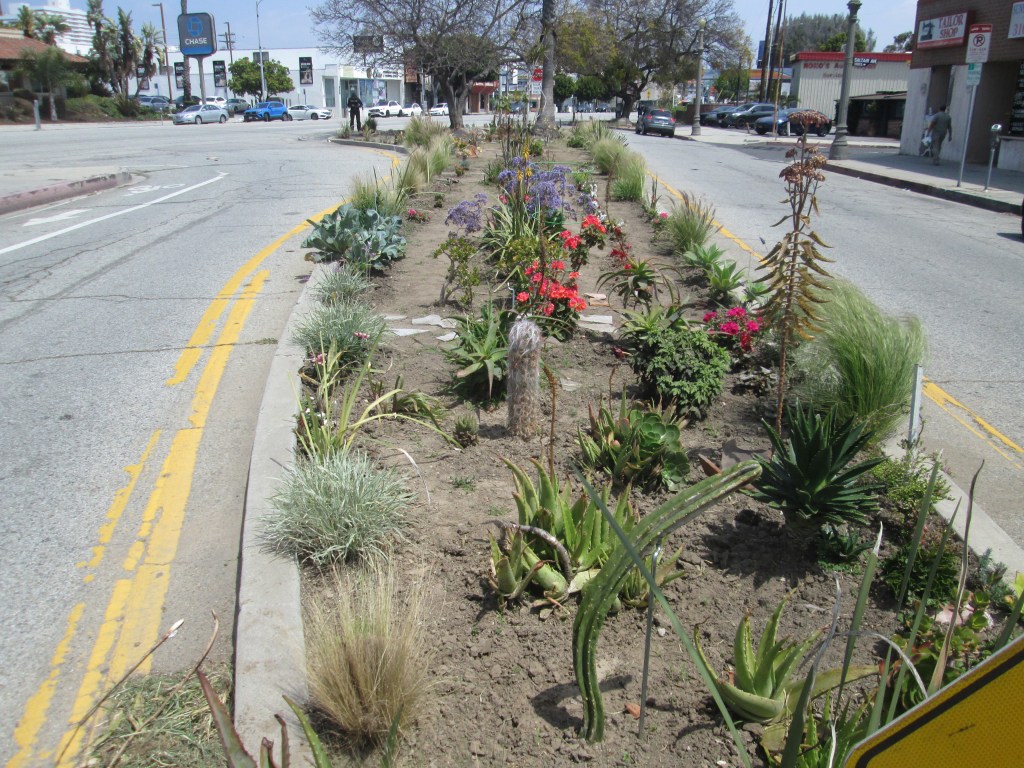
The dire warnings have been appearing on the news for several days now: Rain is coming to Los Angeles. The city of brown lawns (watering of which is forbidden) is about to entertain a soaker. In a city unused to rain, the water that turns everything green and fills the reservoirs is also a present danger.

For one thing, drivers don’t seem to be able to modify their motoring to accommodate wet roads and flooded street corners. (What, I wonder, would they do in the icy streets of Cleveland?) I always slow down when it rains. It helps that my vehicle is an all-wheel-drive Subaru Forester.

Weather forecasting in a region of mountain ranges, valleys, and dry rivers with concrete banks is a chancy thing. Undoubtedly, some areas will get several inches of rain—mostly in the mountains; but in our neck of the woods, we rarely get as much as the news forecasts. At least in the last several decades, there is been a palpable drying trend. I remember some rainstorms of the 1970s and 1980s that did significant damage and dumped large amounts of precipitation.

I actually like the rain—even when it tends to fall on the weekends. Now that I’m retired, that’s no longer an issue.

Here Kitty, Kitty

David Letterman had it right about Thanksgiving when he said, “Thanksgiving is the day when you turn to another family member and say, ‘How long has Mom been drinking like this?’’ My Mom, after six Bloody Marys looks at the turkey and goes, ‘Here, kitty, kitty.’”

I am not a great fan of Thanksgiving, nor of any holiday. I find that Americans use holidays to increase tension and kowtow to complicated and unnecessary pressures. And I don’t generally care for turkey, certainly not as it is cooked in the United States. In Yucatán, I love Sopa de Lima and Pavo en Relleno Negro.

What I do like about holidays is getting together with our friends. This year it was not in the cards, because my friend who invited us was hospitalized for a stroke. (Fortunately, she is recovering nicely.)

The main event for us this holiday will be attendance at the Three Stooges film festival at the Alex Theater in Glendale. Martine loves the Stooges, and we have been in attendance about a dozen times over the last few years. What makes it particularly special for Martine is that we usually have lunch at Sevan Chicken, an Armenian rotisserie chicken restaurant in Glendale, and dinner at Elena’s Greek and Armenian Restaurant. (Not being a bird eater, I go vegetarian at the Sevan and get lamb at Elena’s.)

For this reason, I will probably not post a blog on Saturday.

Among the Dead

Day of the Dead Participants

This is kind of a coda to yesterday’s post entitled “Dia de los Muertos.” Many of the attendees at the Day of the Dead Festival in Canoga park wore nifty costumes and frequently had very professional face painting jobs. There was a booth at the festival where most of the work was probably done.

As much as Martine felt intimidated by the size of the crowd, I wound up enjoying the artistry of the costumes and makeup, and the obvious sincerity of the ofrendas (the little altars to a family’s dead).

A Gathering of Skeletons

I will probably have to go by myself, but I wouldn’t mind traveling to other Day of the Dead observances next year. As much as I like Halloween, I also admire the Mexicans’ celebratory confrontation of their own future demise.

Dia de los Muertos

Although the Mexican Day of the Dead actually occurred on November 2, All Souls Day in the Catholic liturgy, the neighborhood of Canoga Park decided to hold their festival today. Martine and I were to meet a friend at the festival, but there was the usual problem with cell phones: It was too loud to here the telephone ring.

That was the first thing that set Martine off. Second was the size of the crowd. Neither of us positively like crowds, but her dislike of them approaches the realm of phobia. Thirdly, she abhors skeletons and costumes that suggest death. Finally, there were a lot of classical cars on display; but they were all tricked out as Mexican low-riders.

Only the first two things set me off, but I was interested in the costumes people wore and the cars. Many of the cars had ofrendas, little memorials to loved ones who have passed on.

An Ofrenda Occupying the Trunk of a Low-Rider

Where Martine did not particularly like Mexican customs, I, on the other hand, have many years of traveling in the Republic and admiring from afar these same customs. I remember one bus ride I had back in the 1980s on the Dia de los Muertos between Mazatlán and Durango. The bus was filled with Mexican families on their way to have a picnic at the cemetery by the grave of their loved ones. I thought it was a splendid custom, and I helped out by holding a baby for a few miles while the young mother who sat next to me was otherwise occupied.

In the end, I knew I had to make it up to Martine. I could have made a scene and called her too thin-skinned, but instead I bought her her first cotton candy in sixty years. Then, on the way home, we stopped at Bea’s Bakery in Reseda for some of their first class pastries.So, in the end, she had some good things to remember.

Cold Nights

Fall Has Finally Begun in Southern California

Even with global warming, there are cold nights in Southern California, usually beginning in October or November. That doesn’t mean there won’t be any torrid days during the winter: It’s just that they may be bookended between nights when the mercury descends into the 50s or even the 40s.

This presents a problem for Martine and me, because due to rent control, we are persona non grata to the owners of the apartment building in which we live. The owners would love to charge between $3,000 and $5,000 a month for our two-bedroom apartment, but by law they can’t unless they can convince us to move. Under “vacancy decontrol,” they can charge whatever they want from the next tenants.

As part of their policy, they do not readily respond to requests for building repairs. For instance, the wire connecting our thermostat to our gas heater is the original post World War II wire, so that sometimes our heater goes on, and sometimes we freeze. I am no electrician, so I would not venture to make the repairs myself.

This morning I called the apartment management company but have not heard back from them. This is very typical of our interaction with them. They can be counted on to do as little as possible, preferably nothing at all if they can get away with it. So I have to do a little dance, making sure that the wiring is replaced without giving the owners an excuse to get us out of here.

Calcutta on the Pacific

Bus Stop at Bundy and Santa Monica

When I first arrived in Southern California at the tail end of 1966, I was pleasantly surprised by how crisp and clean it looked. Coming from grungy red-brick Cleveland, coated with decades of industrial grime, I really felt I was making a new beginning.

Cut to today. The city is crawling with bums (excuse me, “the homeless”) who think nothing of spreading garbage all around. The trash cans are all filled to overflowing, and alleyways are festooned with human excrement.

It seems that every year there are more men living in tents and ratty looking old Winnebago RVs parked up and down the streets. There has been a bum encampment now for upwards of ten years right across the street from my apartment. When I go to the local Seven-Eleven, there are scruffy men asking for “spare change.”

There are also a few women in these encampments, but their appearance usually begins a new round of competition for their favors, marked with nights of cursing and violence.

I still love L.A., but am dismayed that politicians don’t seem to want to face the problems that confront them. On one side, they face opposition from woke liberals who think they should be left alone, and the majority of the population, which would rather see them housed somewhere else. Considering that most bums are not into following rules regarding alcohol and recreational drugs, or any kind of personal hygiene, the latter is not a viable option.

Times are tough when vagrancy is considered the norm.

My Lizard Life

Gecko and Opuntia Cactus

As the heat dome over the Western US continues, I continue to make like a lizard. Unlike a lizard, however, I seek shady cool places rather than sunny rocks or cacti for my perch. Today, I even went to see a movie: Bullet Train with Brad Pitt was no winner—but at least I sat for three hours in air-conditioned comfort while the people outside the theater looked decidedly wilted.

My dinners lately were very appropriate to a desert dweller. Several days ago, I went to the Persian market across the street and purchased Persian lavash flatbread, French feta cheese, and Turkish pickled vegetables (2 varieties). For breakfast today, I made two quesadillas with flour tortillas, Monterey Jack cheese, and pickled rajas de jalapeño. Despite the hot morning, I had my usual cup of hot Indian black tea with honey and a squeeze of lime.

Tomorrow, while Martine braves the dead hot air of downtown LA, I will probably make my way once again to Burton W. Chace Park in Marina Del Rey to catch stray breezes while reading O. A. Bushnell’s 1963 novel Molokai, about the Hawaiian leper colony. During that time I will constantly hydrate myself with mineral water to keep from getting dehydrated.

This weather is no fun.

With Saints and Angels in Long Beach

Saint George Slaying the Dragon

With the continuing heat dome over Southern California, Martine and I took a chance and went to the Long Beach Greek Festival at the Assumption of the Blessed Virgin Church. Although it was as hot as Hades, I’m glad we went. The food was good, there were tons of tasty Greek pastries, and the church itself was outstanding.

The church was not as wealthy as Saint Sophia in downtown L.A. or Saint Nicholas in Northridge, but it was beautifully painted with what seemed to be hundreds of saints and angels. And, unlike many Greek Orthodox churches, most of them were identified in both Greek and English.

There were a few surprises, the most prominent one being an Eskimo—actually an Aleut—called Saint Peter the Aleut:

Saint Peter the Aleut, aka Cungagnaq

For an Aleut to be a Greek Orthodox martyr requires a leap of faith. And for Cungagnaq, it came in 1815 when the Spanish, who were uneasy about the Russian occupation of Alaska, captured him near San Francisco and had him put to death at the instigation of some Catholic priests who were upset that he was a heretic. Read about it on Wikipedia.

Just about every square inch of the Assumption of the Blessed Virgin church was covered with images of Christ, Mary, and the saints and angels. The effect was quite stunning. Martine and I spent an hour studying the sacred images.

I might be an indifferent lapsed Catholic, but the simplicity and sincerity of the church held my respect and even awe.

Make Like a Lizard

Peruvian Wood Lizard

I have discovered that the best way to survive a hot spell in Southern California is to make like a lizard. We have neither insulation nor air conditioning in the 75-year-old apartment in which we live. All day long, the hot sun heats up the building, and the building holds the heat until just before dawn. We have fans, but use them primarily in the evening, when the inside temperature spikes.

So how does one make like a lizard? For starters, don’t be in much of a hurry—about anything. While Martine went downtown, where it is even hotter, I drove to Trader Joe’s in the Marina, put together a simple picnic lunch, and parked at the end of Mindanao Way at Chace Park. At the peninsula on which the park sits, there is always a cool breeze, a breeze that suddenly disappears a few hundred feet inland.

I sat in a shaded pavilion at a picnic table, ate my lunch, and re-read Ernest Hemingway’s Green Hills of Africa. I managed to be comfortable while, in the next pavilion, a group of loud ex-con types were laughing and shouting. They made a snarky comment about my straw hat, which did not faze me because a good straw hat from Latin America is also part of making like a lizard.

Am I beginning to resemble a lizard? I don’t think so, not yet anyhow. What’s more, I have no interest in sitting atop a rock in the hot sun as lizards are wont to do. The species to which I belong seeks the shade.

Little Landers

Bolton Hall, Clubhouse of Los Terrenitos (“Little Landers”)

Bolton Hall was named after a man called Bolton Hall. It was built in 1913 in Tujunga as the clubhouse of a utopian community called Los Terrenitos, or Little Landers. It was one of two communities inspired by the teachings of William E. Smythe. (The other was at San Ysidro, just across the fence from Tijuana, Mexico.)

According to a prospectus issued by Smythe in 1913:

The Little Lander is his own boss. His notion is not an acre nor half an acre, but “so much land as one individual or family can use to the highest advantage without hiring help.” No landlords or tenants, no employers or hired hands! Men work lovingly for themselves, while the best of them work but grudgingly for others. In moments of exaltation the Little Lander loves to think of himself as the Spiritual Man of the Soil—the man who works in conscious partnership with God in finishing the world. His own man on his own place, he works more in the spirit of the artist than of the farmer.

Bolton Hall Clubhouse As It Was in the Beginning

Any agricultural surplus from the small plots was donated to a cooperative: “The wagon calls to collect his vegetables, fruit, flowers, eggs, poultry—whatever he has to sell—and ship it to town, where it is received by the market manager and disposed of direct to consumers…..”

In many ways, the Little Landers were kin to the Distributists in England who followed the writings of G.K. Chesterton and the Catholics influenced by Leo XIII’s 1891 encyclical Rerum Novarum. Unfortunately, like almost all utopian communities, the Little Landers of Los Angeles lasted only for a few years. In 1917, Little Landers Incorporated was disestablished for failure to pay taxes. By 1925, almost all of the original settlers had left.

Unfortunately, the soil of the Tujunga area was not conducive to farming, so the dreams of small-plot farming did not come to pass, not here anyway.

Today all that remains is the Bolton Hall Clubhouse, which is a fascinating museum of local life. Martine and I spent an afternoon chatting with the docents inside the stone building, which was surprisingly cool considering the external temperature (90º Fahrenheit or 32º Celsius).

If you have any feeling for the area in which you live, I recommend supporting small local museums, which usually have fascinating stories to tell of the people who first settled an area and how their descendants fared.