Road Trip

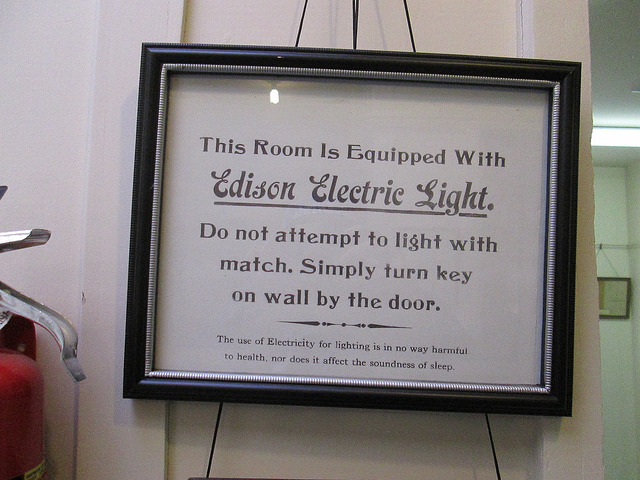
Sign in Fillmore Historical Society’s Museum

Sign in Fillmore Historical Society’s Museum

State Highway 126 runs roughly from Six Flags Magic Mountain in Santa Clarita to the Pacific Ocean around Ventura. During much of its length, it is prime agricultural country and contains miles of fruit orchards, especially in the old Spanish Sespe Rancho.

Ostensibly, we went to take the Fillmore & Western Railroad from Fillmore to Bennett’s Honey Farm in nearby Piru. There I sampled several types of honey and bought a big 3-pound jar of their Topanga Quality Wildflower honey, my favorite. Today was the 5th Annual California Honey Harvest Festival and BBQ Championship. We didn’t try any of the barbecue, mostly because neither Martine nor I really care for barbecued meat—too much sugar! Instead we ate at a little Mexican Restaurant called La Fondita on Central.

The train ride to the honey farm took half an hour in each direction. The train ran forward to get there, and backed up all 6-7 miles to return to the station.

While in Fillmore, we visited the Fillmore Historical Museum, where we saw the amusing sign above and had an interesting discussion with some of the volunteers. Then, on the way back home, we stopped at the Cornejo Produce Stand just outside of Fillmore for some really delicious looking apricots and strawberries.

It was a fun road trip and gave me ideas for several more in the area. Keep tuned to this space for further details.

99¢ Triple Features—All Night

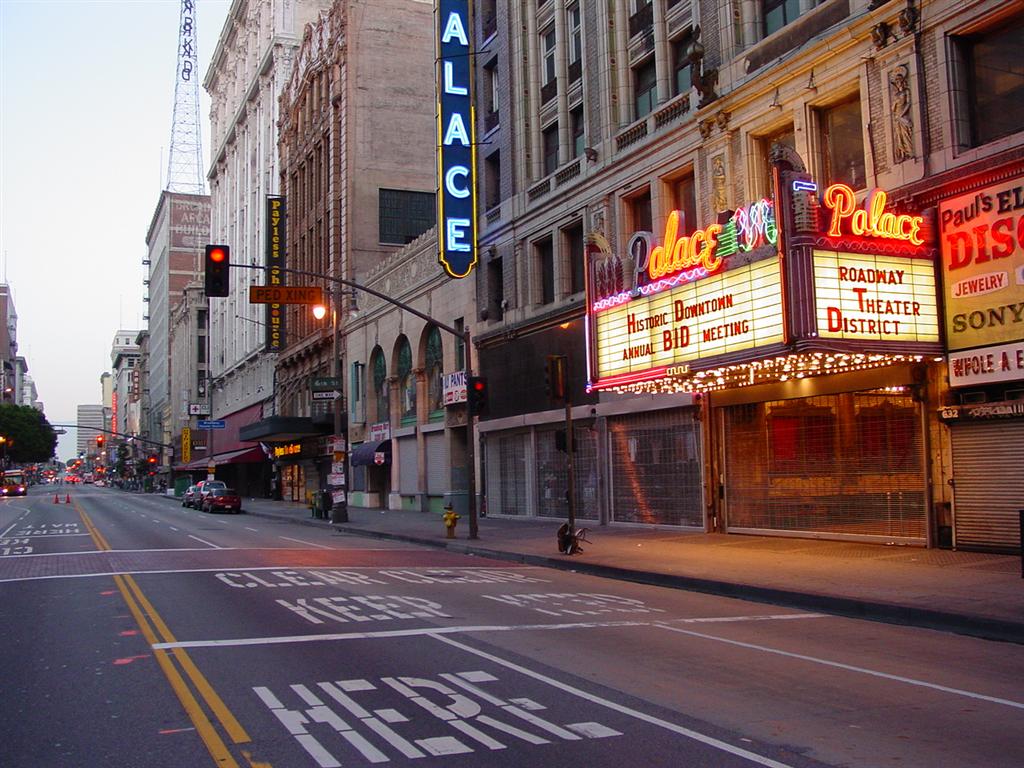
The Palace Theater on Broadway

The Palace Theater on Broadway

During the late 1960s, when I was a film student at UCLA, I felt I had to catch up fast in my knowledge of American films. After all, it was foreign films like Carl Dreyer’s Day of Wrath (1948) and Akira Kurosawa’s Seven Samurai (1957) that introduced me to what the film medium could do.

So I went with my late friend Norm Witty to see the 99¢ triple features at the remaining movie theaters on Broadway downtown. Most of these theaters are no longer showing films, though at one time it represented the highest concentration of movie theaters in the U.S.; it was called the Broadway Theater District. It included the Cameo, the Tower, the Palace, the Los Angeles, the Arcade, the Roxie, and the Olympic theaters (though the last one was located on West 8th Street). Most of them ran movies all day and all night, usually as triple features.

Even back then, most of the patrons were just intent on getting a good night’s sleep in a theater seat that wasn’t too sticky or dirty. The rest rooms were something of a horror, and the refreshments were pretty disgusting. The worst of all was the Arcade, which we went to only once.

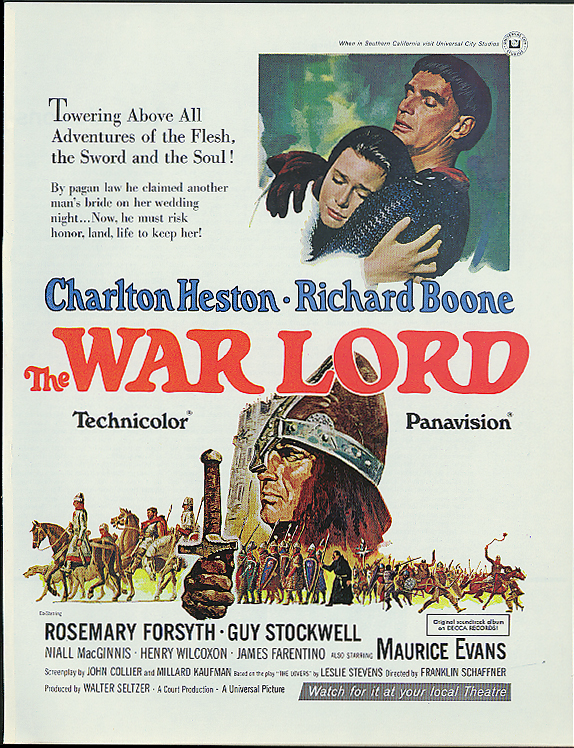
Poster for Universal’s The War Lord (1965)

Poster for Universal’s The War Lord (1965)

Probably the best film I saw on these all-night excursions was a Universal picture starring Charlton Heston, Richard Boone, and a radiant Rosemary Forsyth called The War Lord (1965). Heston and Boone are two Norman knights who take control of a Saxon village. Heston falls in love with Rosemary Forsyth, a Saxon maiden who is betrothed to another villager. When he exercises the jus primae noctis (“the right of the first night”) and demands the right to bed her before her betrothed, the Saxons begin to mutter. But then Heston decides to keep her, and war breaks out. Franklin Schaeffner directed the film, which is still worth seeing when it comes around.


LA Writer: Eve Babitz

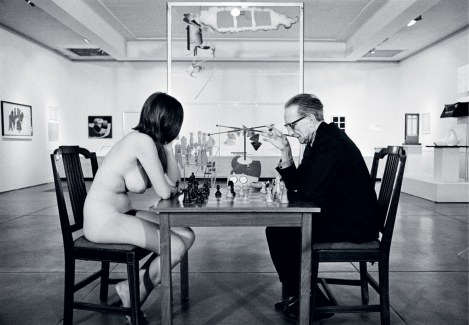
Eve Babitz Plays Chess with Marcel Duchamp

Eve Babitz Plays Chess with Marcel Duchamp

This is the start of a new series of blogs by me to be called “LA Writer.” Los Angeles has its own literary scene, some native born, some expatriate, and some just passing through. I plan to make at least one entry in this series each month.

You are a famous French painter and chess master named Marcel Duchamp. It is October 1963, and you are at the Pasadena Art Museum to attend the opening of a show dedicated to your work, mostly from the earlier part of the century. You are seated at a chessboard. Across from you is a nude 20-year-old who is, in many ways, the numero uno L.A. babe of the 1960s. Her name? Eve Babitz.

All you could say? “Alors!

Eve didn’t win the chess game, but she won the match. It didn’t take long before she was widely known. Her boyfriends included Jim Morrison of the Doors, Ed Rucha, Harrison Ford, Steve Martin, and practically everyone who was anyone in the world of art and entertainment. The chess game was just a start.

She is also the author of a semi-autobiographical, semi-fictional memoir entitled Eve’s Hollywood, which shows her to have been wide awake in a decade in which many were half-asleep at best. Not only is she an excellent writer: She designed scores of album covers for rock bands—and you know that album covers of the time are some of the most memorable icons of the 60s.
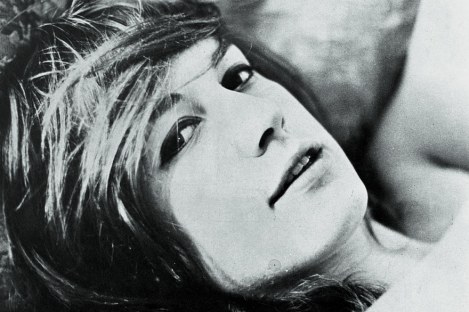
Eve Batitz by Ed Rucha

Eve Batitz by Ed Rucha

Eve’s style is all her own. It’s the way a beautiful and confident young woman who was on top of the world—but who had a serious brain—would write. For example, about the city of her birth:

Culturally, L.A. has always been a humid jungle alive with seething L.A. projects that I guess people from other places just can’t see. It takes a certain kind of innocence to like L.A., anyway. It requires a certain plain happiness inside to be happy in L.A., to choose it and be happy here. When people are not happy, they fight against L.A. and say it’s a “wasteland” and other helpful descriptions.

That leaves out Woody Allen.

Take, for example, this description as to why quit being a Brownie:

In grammar there is a noun and there are adjectives. Adjectives modify the noun, they alter it and cramp its style. I didn’t want to be a Brownie girl. So I quit the Brownies.

And how’s this for a mission statement:

What I wanted, although at the time I didn’t understand what the thing was because no one ever tells you anything until you already know it, was everything.

Eve Babitz was a gorgeous young woman at the top of the world who knew what she liked and was not afraid to talk about it in a way that was both interesting and all her own. She writes with a supreme confidence in a slightly unorthodox, yet highly workable style, that is highly engaging.

In my review of Eve’s Hollywood for Goodreads.Com, I wrote:

When I arrived in Los Angeles between Christmas and New Years in 1966, I was fully prepared to “put up with” the place while my heart remained in … Cleveland, for God’s sake! I am sad to say it took a number of years before I woke up and let the magic of the place begin to work on me. Those first few years I now regard as “the lost years.” I studied film history and criticism at UCLA, saw thousands of movies, but was oblivious to the flower-scented air, redolent with night-blooming jasmine.

Now I have found a writer who has helped reconcile me to my own past: It is Eve Babitz, whose book Eve’s Hollywood covers my black-out years. Eve was born in L.A. of artistic parents and lived in Hollywood, living life to the fullest—sleeping with the likes of Jim Morrison of the Doors, artist Ed Rucha, and numerous other males known for beauty and/or brains.

Eve’s Hollywood is available in a paperback edition published by New York Review Books.


The Bradbury

The Replicant Pris in Blade Runner

The Replicant Pris in Blade Runner

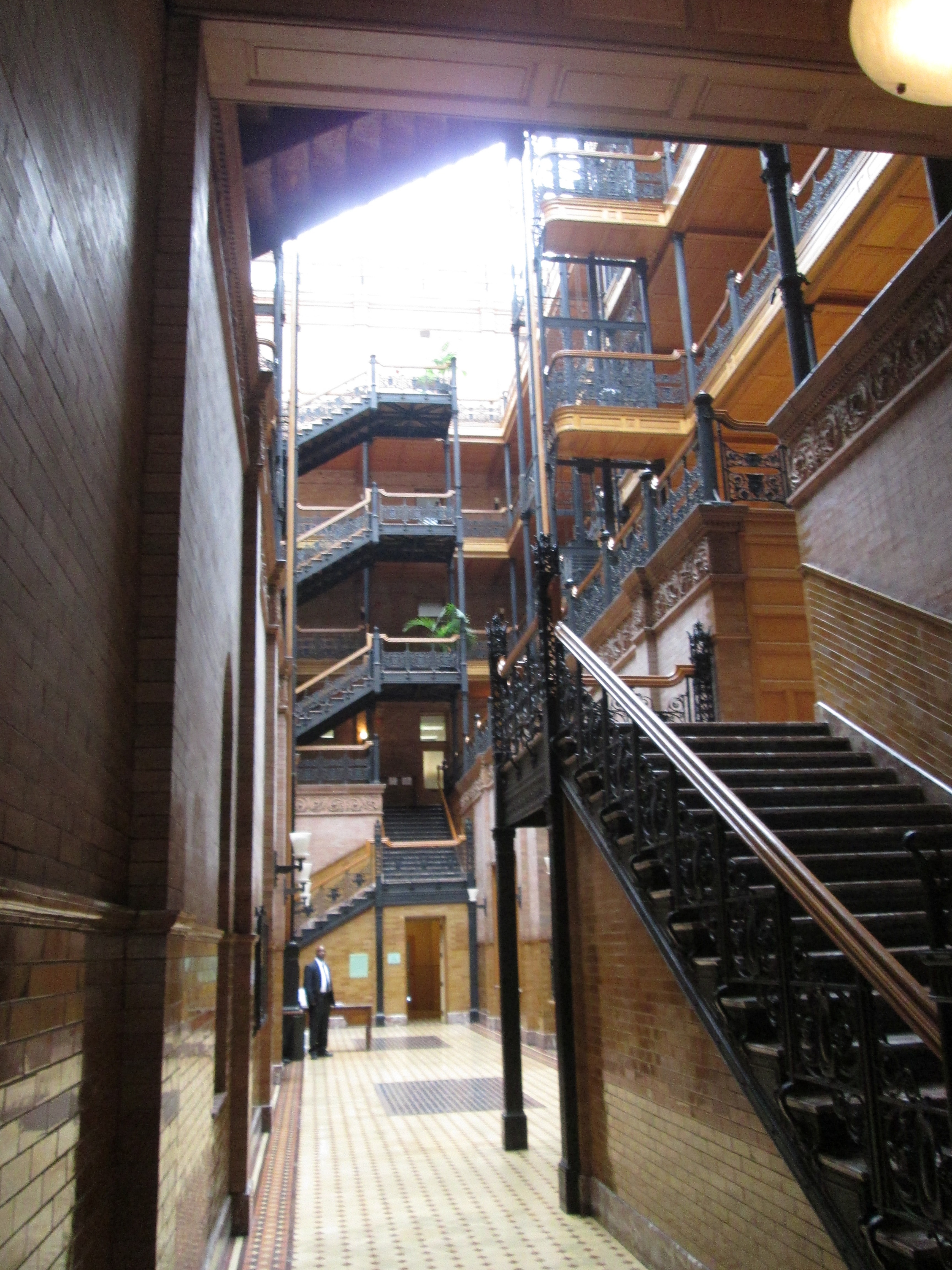
The Bradbury Building at 304 South Broadway has a list of Hollywood credits that would do any shooting location proud:

  • Blade Runner (1982) is the most famous, where it serves as J. F. Sebastian’s apartment where the replicant Pris catches up with him.
  • Shockproof (1949)
  • D.O.A. (1950)
  • I, the Jury (1953)
  • M (the American remake, 1951)
  • Good Neighbor Sam (1964)
  • Marlowe (1969)
  • Chinatown (1974)

That’s just to name a few of the movies shot there. There were also numerous made for TV movies and television programs set there.

Interior of the Bradbury Building

Interior of the Bradbury Building

Last Thursday, Martine and I stopped in to visit the 1893 office building, which is still filled with business tenants. Because of that, tourists are limited to the ground floor atrium and the first landing on the stairs leading to the upper floors. No matter: It took no time at all to see that the Bradbury is one of Los Angeles’s architectural treasures.


Grand Central Market

Lunch at L.A.’s Grand Central Market

Lunch at L.A.’s Grand Central Market

The description below is from Eve Babitz’s Eve’s Hollywood:

At the bottom of Angel’s Flight [a funicular that no longer exists], you turned right and went a block and came to Central Market. This market covered an entire city block and had entrances on two streets at either end, Hill and Broadway, I think. In Central Market there are about 50 stalls. Unlike the Farmers Market [at 3rd and Fairfax], where tourists and Angelenos get cheerfully gypped daily, Central Market sells fresh produce and fresh fish and every kind of edible that could appeal to any faction of population minority that is in L.A., cheap. It’s like Baghdad [without the improvised explosive devices (IEDs)].

That was written more than forty years ago. Now there’s a heavy Mexican food presence, which is AOK with me.


Books Are Dangerous

Bookmarks from The Last Bookstore

Bookmarks from The Last Bookstore

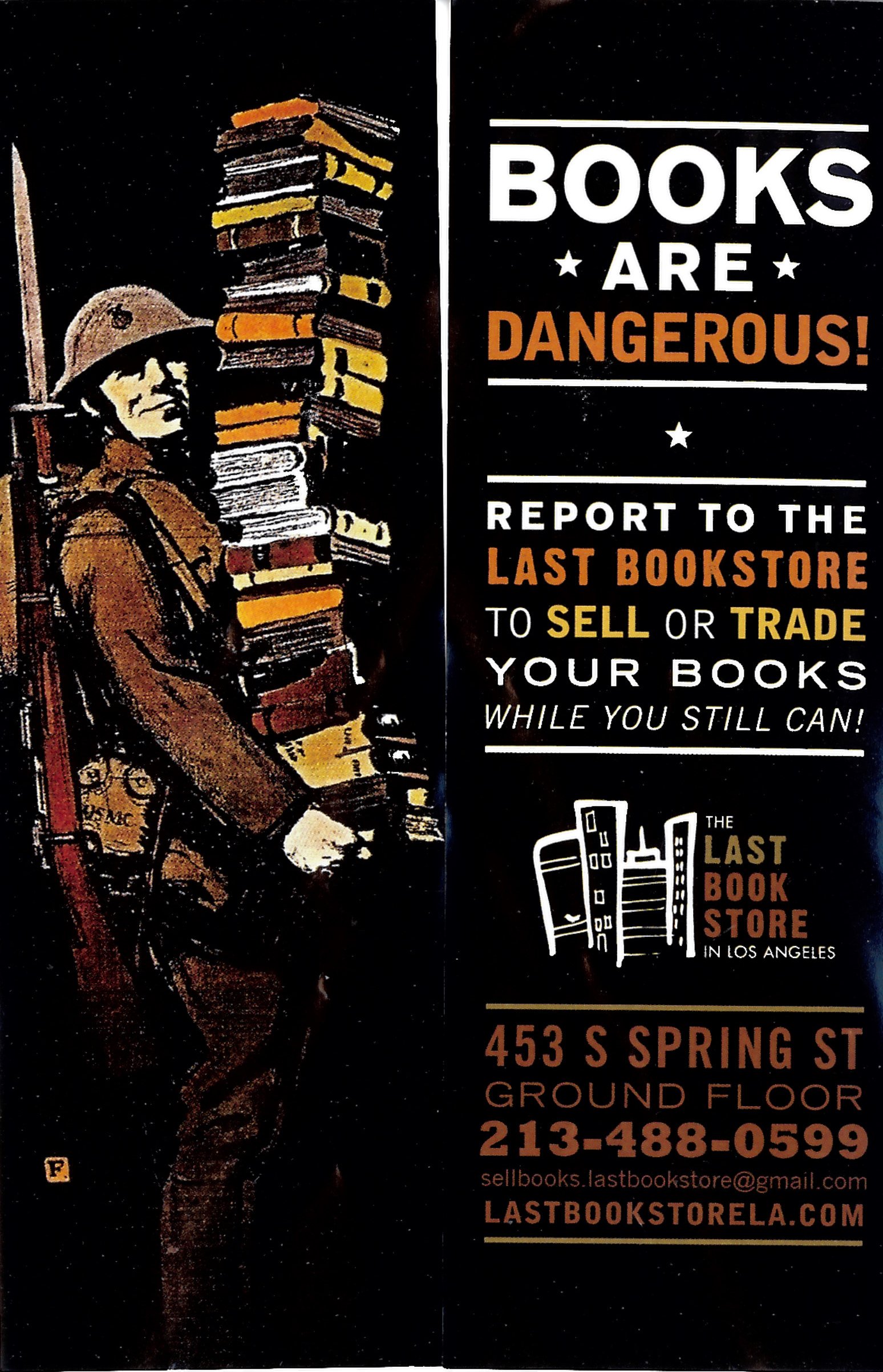
The wording is ominous:

Books are dangerous!
Report to The Last Bookstore
To sell or trade your books
While you still can!

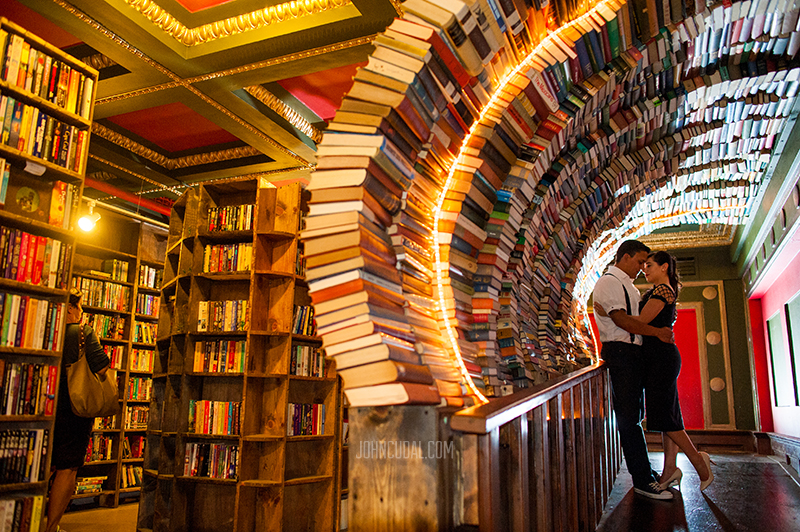
Founded in 2005, The Last Bookstore claims to be California’s largest bookstore, and it may very well be. “What are you waiting for?” its website asks. “We won’t be here forever.”

This is what I call a Filboid Studge marketing campaign, based on the Saki short story entitled “Filboid Studge: The Story of a Mouse That Helped.” I’ve included a link because the story is very short and outrageously hilarious.

The bookstore at the corner of West 5th and Spring Streets in Downtown Los Angeles was one of the highlights of yesterday’s safari by Martine and me. I took eleven books to donate to the store and wound up buying four titles, including Eve Babitz’s Eve’s Hollywood, which I am currently reading with great excitement.

Interior of The Last Bookstore (2nd Floor)

Interior of The Last Bookstore (2nd Floor)

I have been in Los Angeles for half a century now, and I look back at my time here with all the pleasurable hours I spent in bookstores that, for the most part, are no more. There was Papa Bach’s at Santa Monica and Sawtelle; the Westwood Book Company, Butler Gabriel, Campbell’s, Brentano’s, and Borders—all in Westwood; Martindale’s in Santa Monica; Zeitlin & Verbrugge on the West Side; Acres of Books in Long Beach; Brand Books in Glendale; and Pickwick in Hollywood.

They are all gone now. People stare intently at their smart phones and pretend to communicate—but really don’t. They say they could read books on their devices, but never seem to. Perhaps the whole idea of the book is dying while a new generation willfully enslaves itself to a handheld electronic device.

So kudos to The Last Bookstore. Be defiant! Be a dinosaur! Wave your standard proudly!


O Brave New World!

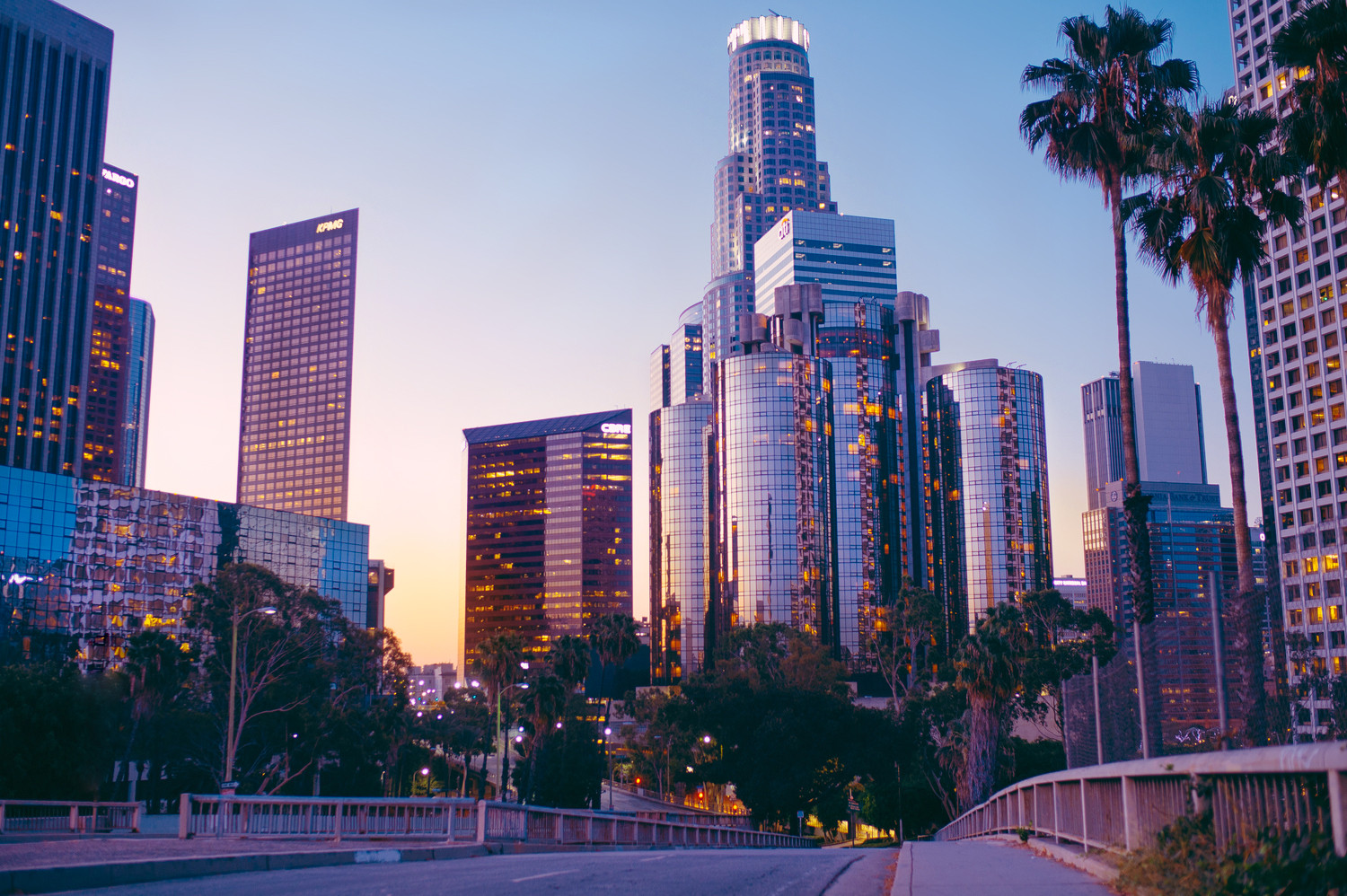
Downtown L.A. Financial District

Downtown L.A. Financial District

Don’t let anyone tell you he or she knows Los Angeles. Why? Because there’s too much for one person to know. There are broad swaths of the county which I have never seen, mostly to the Southwest, all those weird little communities along Interstate 5 like Hawaiian Gardens, Downey, Lynwood, Paramount, Bell Gardens, and Santa Fe Springs.

But thanks to today’s little safari, Martine and I know a little more about the area immediately to the Northeast of Pershing Square. We had three destinations and hit them all:

  • The tantalizingly named The Last Bookstore at West 5th & Spring with its grim motto: “What are you waiting for? We won’t be here forever.
  • The Grand Central Market at West 3rd & Broadway, which I’ve always wanted to visit but never got the chance to.
  • Across the street from the GCM is The Bradbury Building, built in 1893 and the location for scores of Hollywood movies, most notably Blade Runner (1982).

The big surprise was Union Station, where I arrived in Los Angeles on December 28, 1966, on the Santa Fe Railroad’s El Capitan train service. For decades, the station fell into disrepair and disuse as Amtrak hit the skids. But then the city decided to add a substantial suburban rail system called Metrolink, a growing network of subways and light rail lines, and a bus hub. Now its a busy place with new shops opening and crowds of people on the way to and from somewhere.

Tomorrow, the Expo Line will link Santa Monica to downtown L.A. with the nearest stop being a few blocks south of me at Bundy just south of Olympic.

It’s nice to know that, in this day and age, I can find something positive to write about without having to grit my teeth.


Huggable Death

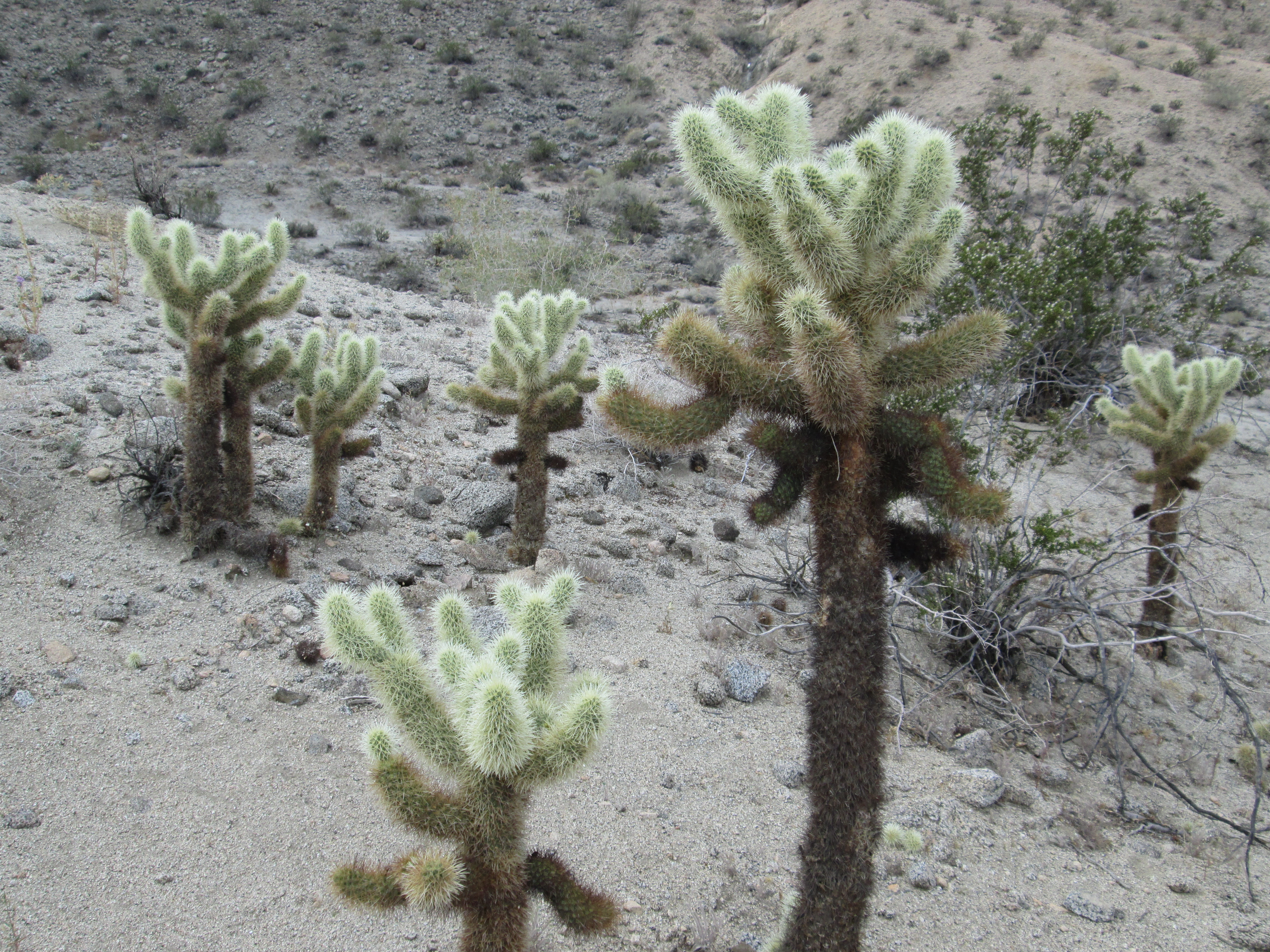
“Teddy Bear” Cholla Cactus

“Teddy Bear” Cholla Cactus

Their scientific name is Cylindropuntia, and they are beautiful but deadly. I am referring to what are commonly called cholla cactus (pronounced CHO-yah). One finds them all over the deserts of the Southwest, particularly in California, and in parts of Mexico’s Sonora desert.

On one hand, chollas can be astonishingly beautiful. Even on a cloudy day, their silvery green spines shine as if from an inner light. One almost wants to hug them. Beware: The spines are barbed. In no time at all, the desert neophyte can sport almost as many spines as the cactus.

There are many varieties of cholla: The above looks like the notorious Teddy Bear or Jumping Cholla (based on the false perception that the spines jump onto their victim even if the victim does not quite brush against them.)

They make wonderful photographic subject—just so long as you remember to keep your distance.

Back from the Desert

Me on the Randall Henderson Trail in Palm Desert

Me on the Randall Henderson Trail in Palm Desert

I had a great time in Palm Desert with my brother and sister-in-law. While Lori worked on Saturday, Dan and I hiked the Randall Henderson Trail off Highway 74 in Palm Desert. My brother took the picture with his cell phone.

Fortunately, my legs were in the picture. As my Dad always used to say, if you don’t include the legs in the picture, people will think that I have no legs. Well, now you know…. And my Dad, looking down on us from the heavens, will be gratified.

In my right hand, I am holding my own digital camera against the belt holster I use for carrying it.

After the hike, Dan took me to a great Mexican place on Date Palm Drive in Cathedral City. It had the best tacos el pastor that I have ever tasted. I loaded it down with pickled jalapeño chiles and a hot green salsa. The burning stopped only when I took a sip from a giant cup of horchata. If you are in the area and want to try it, look up El Tarasco at 34481 Date Palm Drive. It’s a bit of a dive, and you are not likely to run into any gringos there. Be sure to order the tacos al pastor.

Once When Things Were Different ….

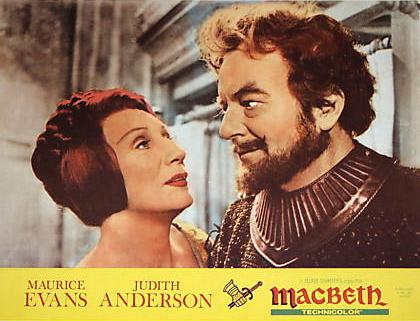
Maurice Evans as MacBeth and Judith Anderson as Lady MacBeth

Maurice Evans as Macbeth and Judith Anderson as Lady Macbeth

There was a time when there were only a few television channels, and one could see wonderful material that presupposed a literate audience. In honor of Shakespeare’s birthday on April 23, the Paley Center for Media put on screenings of six of Shakespeare’s plays on Saturday and Sunday of this weekend. It was my good fortune to see two of the plays.

The better of the two was a Hallmark Hall of Fame production of Macbeth fist aired on November 20, 1960. It was directed by George Schaefer and starred Maurice Evans as Macbeth, Judith Anderson as Lady Macbeth, Michael Hordern as Banquo, and Ian Bannen as Macduff. It was shot in technicolor on location in Scotland.

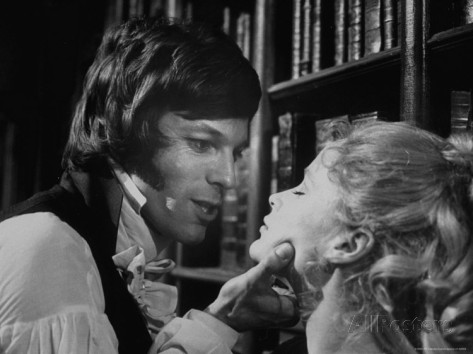
Richard Chamberlain as Hamlet and Ciaran Madden as Ophelia

Richard Chamberlain as Hamlet and Ciaran Madden as Ophelia

Also produced for the Hallmark Hall of Fame was a 1970 Hamlet directed by Peter Wood and starring Richard Chamberlain as Hamlet, Michael Redgrave as Polonius, Margaret Leighton as Gertrude, and Richard Johnson as Claudius. John Gielgud had a walk-on role as the Ghost.

Both productions were highly professional. So professional that I was stunned seeing the two great tragedies one after the other. I thought to myself, “What would it take to have something like this on cable television today?” I would say close to zilch. Perhaps if Ophelia were in the nude and we saw a slo-mo close-up of Banquo being knifed in the head, but otherwise, no.

I think we may have to assume that the audience for these two great 1960 and 1970 productions no longer exists, or else they don’t allow patients in nursing homes to watch anything quite so exciting. Not when Lawrence Welk and Matlock reruns are available.

It’s strange that I have to drive to the Paley Center in Beverly Hills to see what television can do. As for my own television, I’d rather read a good book.