On a Clear Day, You Can See Catalina

Saturday Was That Perfect Day

Saturday Was That Perfect Day

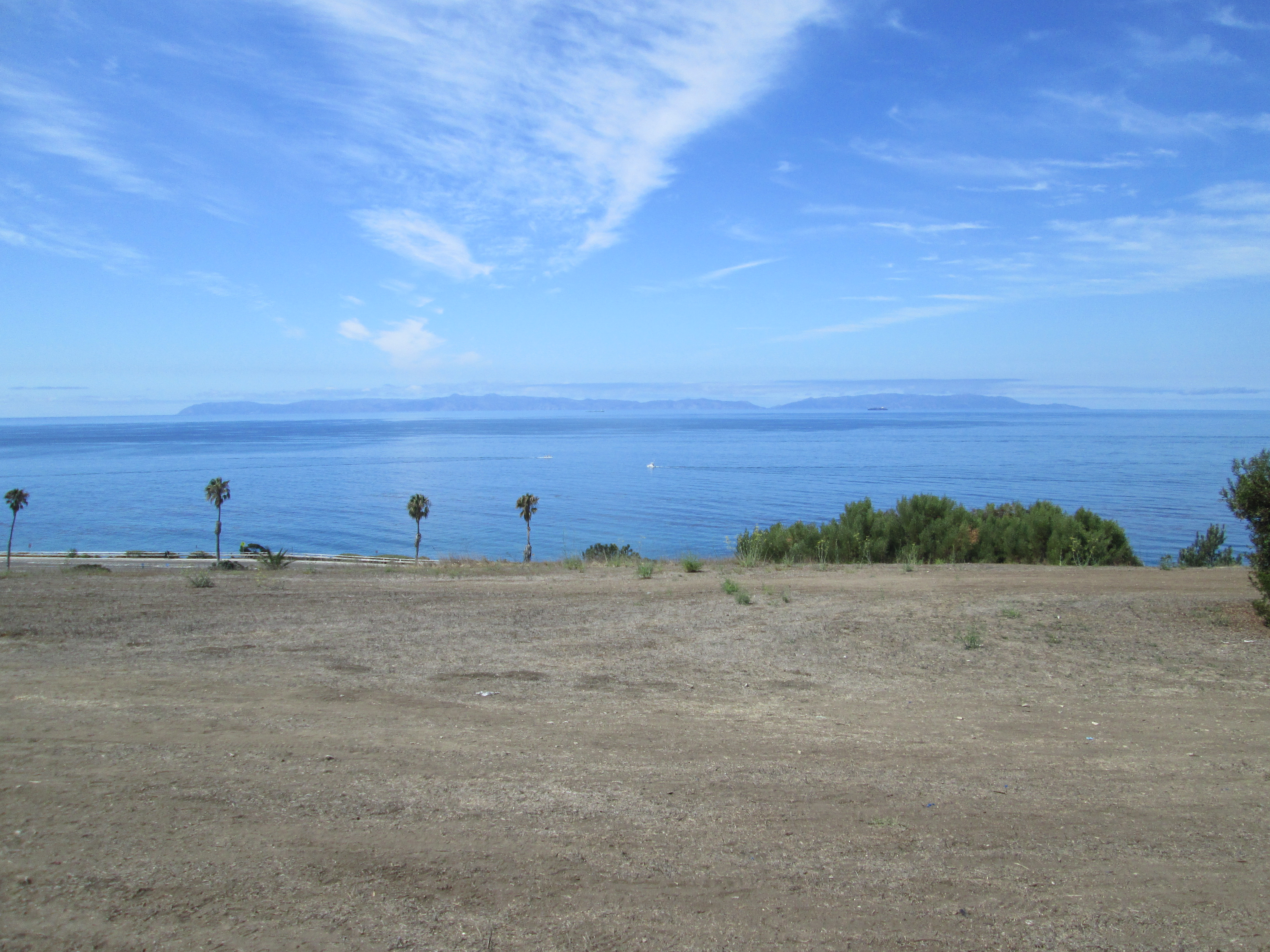
When Martine and I were at Old Fort MacArthur on Saturday, we had a perfect view of Catalina. It was the first time in all my years in Southern California that I was able to see the entire island at once from the mainland. That indentation toward the right of the island is the Two Harbors area, which came across crystal clear.

The island not only looked clearer, but also closer, almost ten miles closer than it usually does. The point from which I took the above picture is probably the closest point on the mainland, give or take a few hundred feet, to the island, which is some twenty-odd miles off shore.


Four Warriors

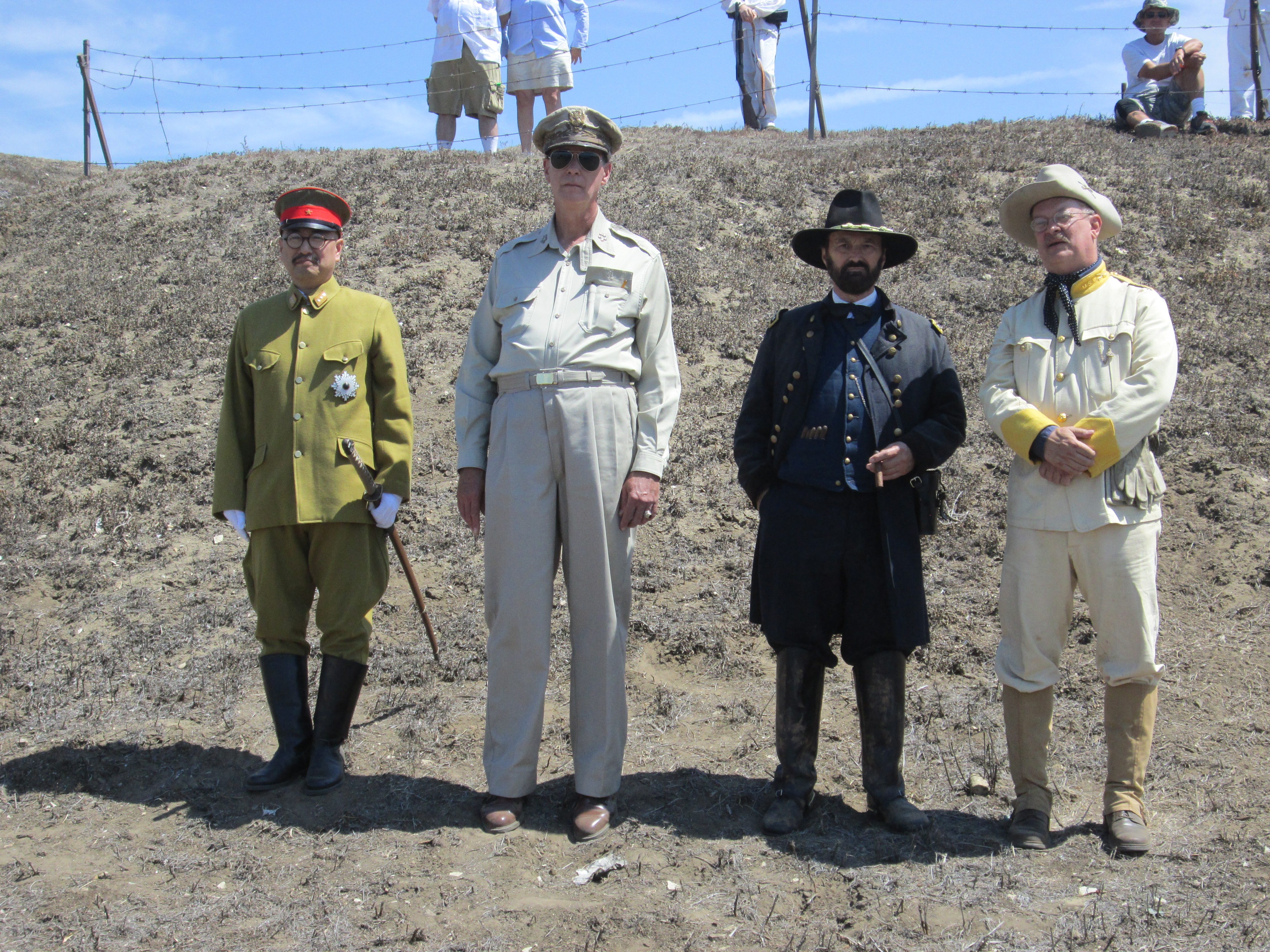
From Left to Right: Hideki Tojo, Douglas MacArthur, Ulysses S Grant, and Teddy Roosevelt

From Left to Right: Hideki Tojo, Douglas MacArthur, Ulysses S Grant, and Teddy Roosevelt

One would never expect to run into the above four gentlemen in 2015 unless it were at a military re-enactment such as the annual one at Old Fort MacArthur Days in San Pedro, California.

There are several reasons why I am interested in attending this event:

  1. I am a history aficionado who delights in learning. As a result of a visit to the West Cork Flying Column of the IRA, I have begun reading Tom Barry’s Guerilla Days in Ireland (1949).
  2. Many of the units impersonating groups before the days of heavy armaments in war also practice ironwork, weaving, herbal medicine, obscure musical instruments, and other arts that have disappeared in this post-industrial world … with interesting results.
  3. Many of the groups really get into the role they are supposed to be playing, such as the World War Two Russian troops with their cans of CPAM (Spam) from Lend-Lease and the various Roman legion groups, one with the Emperor Hadrian and the other with the Emperor Vespasian.

What I do not like are the actual battle re-enactments, which are noisy, smelly, and not terribly realistic. But then I would not like to see real bodies littering the hillside. Instead, Martine and I like to circulate among the different groups and talk to the enactors at their encampments.

Martine, for instance, spent some time talking to the ladies from the Salvation Army, circa 1917-1918, as they offered donuts to the doughboys. I spent much of my time with the Clan MacColin (about which more in a future posting), the West Cork Flying Column (from the Irish Rebellion), and various Civil War groups.


In Amongst the Enemy

The Tomb of President Ronald Reagan

The Tomb of President Ronald Reagan

Today I was surrounded by hundreds of Republicans as I visited the library of their sanctified hero, Ronald Wilson Reagan, 40th President of the United States.

While he was Governor of California and President of the United States, I hated him with a white-hot heat. With hundreds of fellow UCLA students, I jeered him at an illegal screening of Bedtime for Bonzo (1951), in which the widely disliked Governor of California was paired with a chimpanzee.

But times have changed. Although I disagreed with him on a number of counts, especially the Iran-Contra affair and the sending of U.S. troops to be blown up by one of the first suicide bombers in Lebanon. And yet, I would prefer him to any of the Klown Kar GOP candidates for 2016. There was a certain intelligence and sincerity to him that I would now find refreshing. He could also whip them all in a debate with his hand (and tongue) tied behind his back.

The words on his tomb (above) read: “I know in my heart that man is good, that what is right will always eventually triumph, and there is purpose and worth to each and every life.” That’s not a bad line to be remembered by.

Curiously, Martine and I showed up at the Reagan Library on June 5, 2004, the day Mr. Reagan died. We were interviewed by the Press (though I never saw my interview on TV). At that time, I said I thought that, although I did not agree with many of his policies, I thought he was a superb communicator. I still stand by that opinion.


Princesses of the Dance

Beauty, Grace, and Danger

Beauty, Grace, and Danger

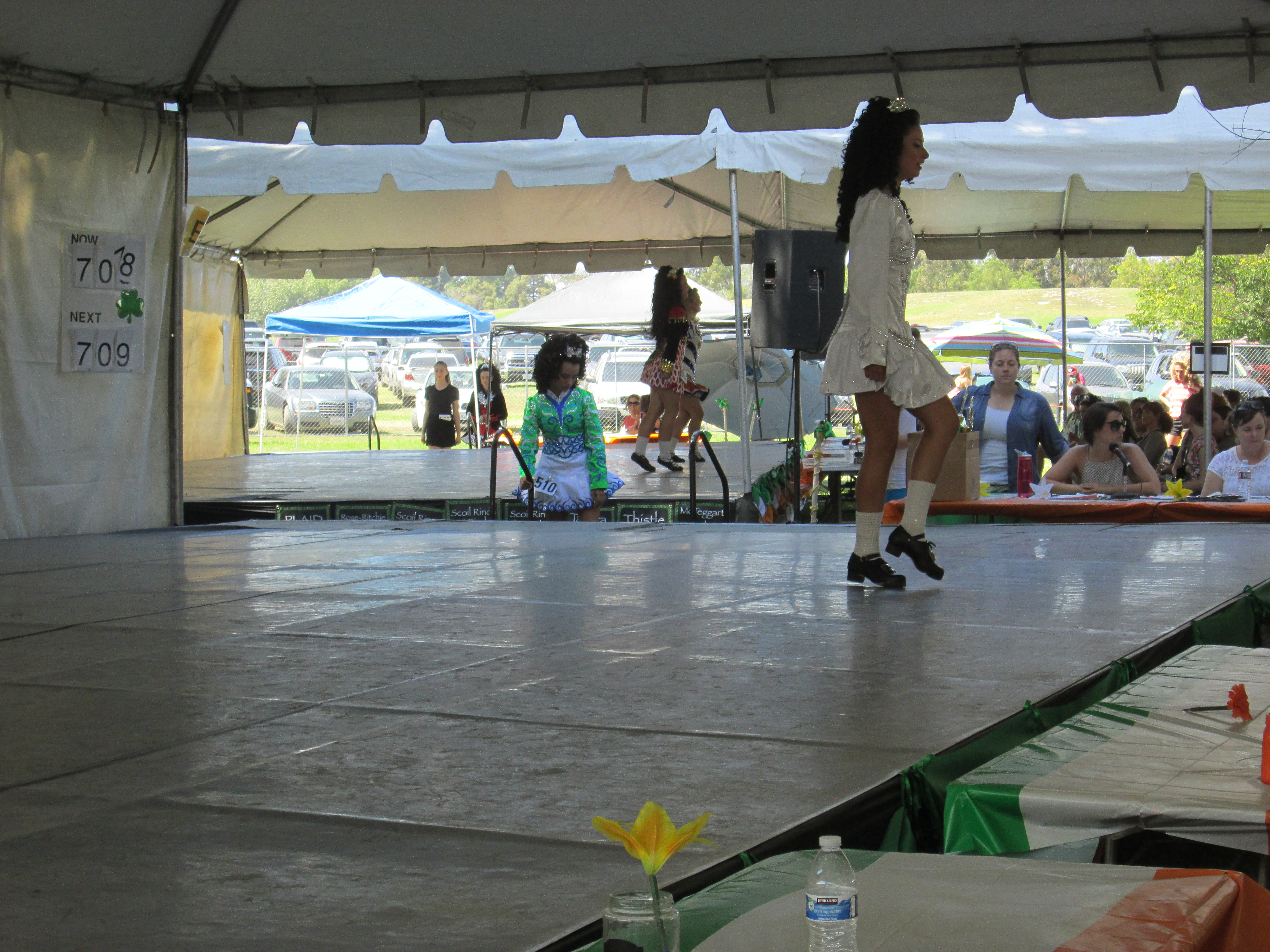
This weekend was the 40th Annual Big Irish Fair and Musicfest, which was held at El Dorado Park in Long Beach. One of the highlights, especially for a dirty old man such as myself, is watching the young girls compete in traditional Irish stepdancing.  With their hands held rigidly at their sides, they went into an astonishing series of high kicks.

As I told Martine, most of these girls could kick me in the balls twenty-five times before I had time to react to the initial kick.

The dancer pictured above was particularly good. I would be very surprised if she didnt leave with a handful of trophies. Below is a photo of her in motion:

On Stage

On Stage

You may remember not too many years ago the fame of one Michael Flatley, who toured the world doing stepdancing in shows entitled “Riverdance” and “Lords of the Dance.” Today, he is retired with severe injuries to his cervical, thoracic and lumbar vertebrae, not to mention his sacroiliac. I wonder how far these lovely young women have to go before encountering similar injuries.

In the Swamp

I Thought This Was a Desert Here!

I Thought This Was a Desert Here!

For most of the year, Southern California is a desert. In June and July, however, it turns into a swamp. Mexican hurricanes send moisture across the border and make the air sticky and wet.This condition leaves local weather forecasters nonplussed, if only because they do not acknowledge weather that sneaks over the border. Thanks to my friend, Bill Korn, there is a website that shows the Canadian and Mexican effects on our climate.

IThis morning, I felt as if I had slept in a swamp. I just could not get up until around one in the afternoon. Although I am at work now, I still do not feel very good and will probably leave early. Humid weather just never agrees with me.


Sliced Off at the Knees

The Weather Stops at El Border

The Weather Stops at El Border?

On many counts (almost too numerous to mention) the news is a partial and usually misleading travesty. Take the weather, as represented by this morning’s precipitation map off the Weather Channel’s weather.com. We are approaching the time of year when our weather comes not from the west or north, but from Mexico.

Even as I write this, Hurricane Bianca is threatening the State of Baja California Sur. What does that mean for Southern California? It means that we get the northern edge of whatever monsoonal weather is hitting Northwest Mexico. Stray clouds, winds, and precipitation do occasionally sneak across the fence at the border and make their way to El Ciudad de Los Angeles.

So what use is it to us when we get a weather report that ignores everything south of the line? No, the earth does not change color at that point, and the weather does move around by laws that do not respect national boundaries.

Over the next few weeks, we expect humid weather with possible light showers—not sufficient to rain on our parade or affect the drought in any significant way. But it nonetheless is a factor we should not ignore.

The Dance Goes On

Little Girls in Greek Costumes

Little Girls in Greek Costume

Yesterday afternoon, Martine and i went to the Valley Greek Festival at St. Nicholas in North Hills. It was a cool overcast day, but people came from all over the Valley to party. Unfortunately, there were some signs of increased organization and decreased quality, especially in the food service area. But it’s still fun, what with all the music and Greek dancing. (No, I didn’t dance: I was not born with the ability to move in time to music without causing pain to my dancing partners’ feet.)

We took our usual tour of the church. Greek Orthodox churches can be pretty spectacular, and St. Nicholas is one of them. In case you were wondering, yes, it’s Saint Nick, Santa Claus, after whom the church is named. For some reason, this year there was no Question and Answer session with one of the parish priests, which I rather miss. Although I was raised a Catholic, I have a lingering admiration for Orthodoxy.

Doctrinally, the major difference between Catholicism and Orthodoxy is a single word—filioque—in the Nicene Creed. Also, their priests can be married; whereas Roman Catholic clergy must remain celibate. Curiously, there are several different rites of he Catholic Church, under Papal jurisdiction, in which marriage is also permitted.


Down On His Luck

From a New Book on LA Crime Scene Photos from 1953

From a New Book on LA Crime Scene Photos from 1953

Crime writer James Ellroy has come out with a new book of crime scene photos from 1953. The book is called, simply, LAPD ’53. The victim is one Jésus Fernández Muñoz, who, according to Ellroy’s description, was “a good guy down on his luck. The coroner’s register one-sheet is perfunctory. It’s an accidental death. He was walking on or sleeping on a concrete beam below the Aliso Street bridge.” He suddenly dropped 50 feet to the hard surface of the L.A. River, which in that area is a concrete flood channel.

I always loved Ellroy’s L.A. detective novels, especially the so-called L.A. Quartet, consisting of:

  • The Black Dahlia (1987)
  • The Big Nowhere (1988)
  • L.A. Confidential (1990)
  • White Jazz (1992)

I’ve read a few others, but need to read more, as I think he is one of the best working today. And his picture of Southern California is right on the money. I understand he is working on a new series set in L.A.


Short Line

Our Train Pulling Up to the Gate

Our Train Pulling Up to the Gate

In Ventura County’s Santa Clara River Valley, there is a railroad line that runs roughly between Piru and Santa Paula, with Fillmore as its base. Most trains run on Saturdays and some Sundays, with most trains running from Fillmore to Santa Paula, stopping for sufficient time for passengers to see the Santa Paula Agricultural Museum or the California Oil Museum. On the way back, there is a stop at the Loose Caboose, where one can buy locally grown fruit, olives, and honey as well as see cockatiels, parakeets, peacocks, koi, and goats.

We got an acceptable lunch on the Powhatan Dining Car on the train, and sat back as we rolled past hundreds of fruit orchards. (Santa Paula considers itself the citrus capital of the United States.)

The Fillmore & Western Railway is essentially a fun enterprise. If you’re expecting 100% authenticity or haute luxury, you will be disappointed. Your four-hour journey will be restful and low-key. Many of our fellow passengers seemed to be retired farmers, who had interesting things to say about the farmland through which we passed.

Fillmore and Santa Paula are only about a dozen miles apart, but Martine and I had a good time and would consider coming back.

Tarnmoor’s ABCs: Venice

A Million Miles from St. Mark’s

A Million Miles from the Adriatic

All the blog posts in this series are based on Czeslaw Milosz’s book Milosz’s ABC’s. There, in the form of a brief and alphabetically-ordered personal encyclopedia, was the story of the life of a Nobel Prize winning poet, of the people, places, and things that meant the most to him.

My own ABCs consist of places I have loved (Iceland, Patagonia, Quebec, Scotland), things I feared (Earthquakes), writers I have admired (Chesterton, Balzac, Proust, and Borges); locales associated with my past life (Cleveland, Dartmouth College, and UCLA), people who have influenced me (John F. Kennedy), foods I love (Olives and Tea), and things I love to do (Automobiles and Books). This blog entry is my own humble attempt to imitate a writer whom I have read on and off for thirty years without having sated my curiosity. Consequently, over the weeks to come, you will see a number of postings under the heading “Tarnmoor’s ABCs” that will attempt to do for my life what Milosz accomplished for his. To see my other entries under this category, hit the tag below marked “ABCs”. I don’t guarantee that I will use up all 26 letters of the alphabet, but I’ll do my best. The fact that I made it as far as the letter “V” makes me wonder sometimes.

Los Angeles has been described as a varying number (depending on who’s doing the quoting) of suburbs in search of a city. After all, what is the real difference between Sherman Oaks and Encino, Mar Vista and Palms, or Rancho Park and West L.A.? Some of the communities in the county are distinctive because of their ethnicity, such as Monterey Park (Chinese), East L.A. (Mexican), Gardena (Japanese), Pico-Union (Central American), and Glendale (Armenian).

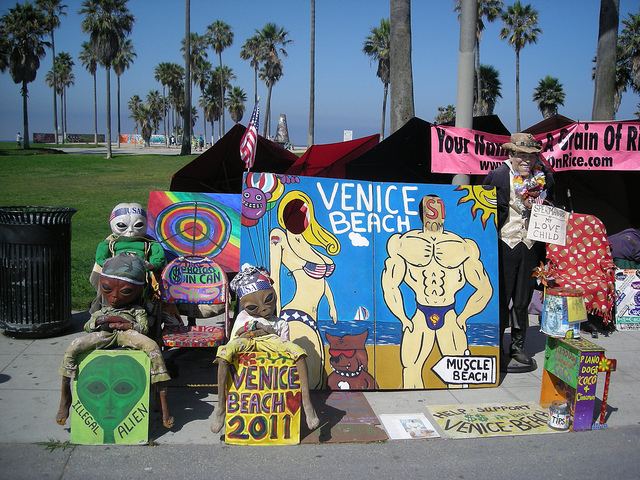
One neighborhood that is known more for its culture than its ethnicity is Venice. When Abbot Kinney first thought of the idea of artificial canals in a community bordering the ocean in 1905, naturally, the name “Venice” popped into his head. In the 1960s, the area was known as Los Angeles’s answer to Haight-Ashbury. Charles Manson and his gang hung around the area. Jim Morrison and the Doors advertised itself at first as a Venice band.

At the same time that the Hippies became the predominant population, some prominent artists also set up shop in the area, such as Charles and Ray Eames. Others associated with Venice included Charles Arnoldi, Jean-Michel Basquiat, John Baldessari, Larry Bell, Dennis Hopper, and Ed Ruscha. Abbot Kinney Boulevard is dotted with art galleries.

You can get your name on a grain of rice, buy any number of T-shirts with funny sayings, eat funnel cakes (whatever those are), or order sausages from Jody Maroni’s Sausage Kingdom.

I frequently walk along the Boardwalk where it begins just south of Venice Boulevard to Small World Books, one of the best remaining independent bookstores in Southern California. Frankly, I enjoy the sleaziness of the area—perhaps not enough to hang out there after the sun sets.