A Nice Surprise

I Kept It a Surprise Until the Last Minute

I Kept It a Surprise Until the Last Minute

Martine has had a rough time of it ever since the New Year. It seems more and more likely that she is suffering from fibromyalgia, which is not only painful but exhausting, inasmuch as it robs her of a full night’s sleep. This coming week, she has an appointment with a local rheumatologist to prescribe a course of treatment for her pain and sleeplessness.

Because she has not only felt bad, but felt guilty because she felt she “was a burden to me” in her present condition, I planned to surprise her. There is nothing that Martine likes more than chicken. So I discussed the options with my friends at work, and they recommended Mrs. Knotts Chicken Dinner Restaurant in Buena Park, which has been serving fried chicken dinners since 1934, and doing it the old-fashioned way with all the traditional trimmings.

It was not until we were a mile away from our destination that Martine remembered my recommending Mrs. Knotts to her a couple of months ago. Now that tax season is over, I had to time to drive 68 miles round trip for lunch.

I, myself, am not a chickenholic like my little girl, but I had a great spicy chicken salad in which the meat was clearly superior. So even with my diabetes regiment, I felt that I did well. Uh, I did, however, eat a couple of biscuits. (So kill me!)

The Knotts Berry Farm Amusement Park is adjacent to the restaurant, but neither of us felt like being shaken and jarred into insensibility. That was for the mobs of teenagers waiting in line to get in.

It was a long drive, but the surprise was worth it; and we both had a good time.


Oasis

An Oasis of Tranquillity: The SRF’s Lake Shrine in Pacific Palisades

An Oasis of Tranquility: The SRF’s Lake Shrine in Pacific Palisades

Even in hectic Southern California, there are oases of tranquility. One of the most surprising is the Self Realization Fellowship’s Lake Shrine on Sunset Boulevard near where it meets the Pacific Ocean.

The property on which it sits had a rich history. It used to be part of Santa Ynez Canyon, where Producer Thomas H. Ince’s Inceville, the first modern studio, was located. Here William S. Hart made his silent cowboy films beginning in 1915. After Ince died in a suspicious accident aboard William Randolph Hearst’s yacht in 1924, surrounded by early Hollywood luminaries.

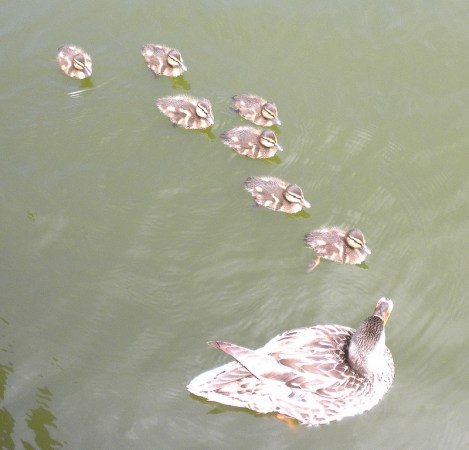
Eventually, in 1950, the property was sold to Paramahansa Yogananda, the founder and first leader of the Self Realization Fellowship (SRF). Today it serves as a unique meditation garden with a floral walkway around a central lake, upon which swans, ducks, and turtles abound. Usually, there are also koi, but they seemed to be in hiding today.

Martine has gone through the mill with the onset of her fibromyalgia early this year. Of late, she has been feeling better; and I thought that a visit to a peaceful place like the Lake Shrine would do her good. It did that.


A Hungarian Interlude

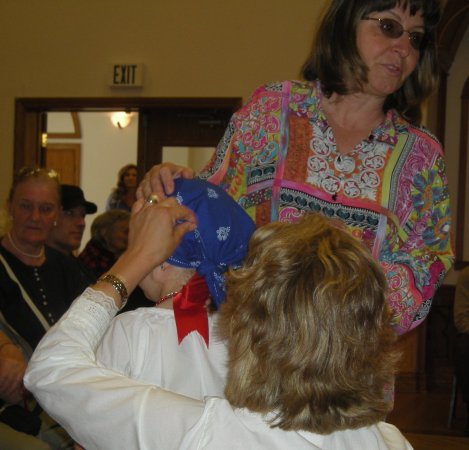
Stage Mother Putting the Finishing Touches on Her Daughter

Stage Mother Putting the Finishing Touches on Her Daughter’s Costume

Today was the annual Majális-Tavaszi (May Day-Spring) Fesztival at the Grace Hungarian Reformed Church in Reseda. Martine and I headed there early so as to have one of their authentic Magyar lunches. I had Gulyás Leves (Goulash Soup), while Martine ate Stuffed Cabbage Rolls. The main event for Martine was the arrival of the pastries, which resulted in a large and ravenous line.

Even longer was the line for langós, which is Hungarian fry bread (very much like Navajo Indian Fry Bread), on which people put grated cheese, sour cream, and minced garlic. For some reason I have never been able to determine, this is considered one of the most desirable Hungarian foods.

The church puts on a children’s program of folk dancing, singing, and a recitation in the hall.  Afterwards, the parish’s superb a capella choir sings in the church proper.

While it won’t help my diabetes any, it’s always good on occasion to reconnect with my roots. It is fun for Martine as well, as she is one French girl who prefers Hungarian food to the food of her native land.


Turtles and Rain

The Navajo Indians Think that Turtles Bring Rain

The Navajo Indians Think that Turtles Bring Rain

As Southern California is currently engulfed in several mammoth wind-driven brush fires, I think of how the Navajo and other Indian tribes believe that turtles are instrumental in bringing rain. They draw the outline of a turtle in the sand. The stick that is used to draw the figure is then driven into the ground through the back of the turtle. This supposedly brings rain, some say immediately, some say within a few days.

It is supposed to rain a little tomorrow, but given the time of year, I think it will be what a call a “dirty drizzle”—good for nothing but spotting the windshield of my car.

I have a small collection of turtle figurines I’ve purchased in years past driving through the Navajo Reservation in Arizona and New Mexico. Since we get an average of 15 inches of rainfall a year (this year we have only a third the amount), we need all the help we can get. I’m counting on my turtles to open the floodgates of the heavens.

The picture above was taken at Mulberry Pond at Descanso Gardens last week.


Leaves and Concrete

My Preferred Walking Surface

My Preferred Walking Surface

One of my meditations at Descanso Gardens related to the type of surface we walk on. For us city-dwellers, most of our lives are spent walking on artificial surfaces such as concrete, asphalt, wood, or padded carpets. Yesterday, I cut through the 150-acre wood consisting mostly of oak trees and camellias, roughly from a point just south of the lilac garden to the cactus garden on the other side of the park.

During most of that time, I was treading on a lush carpet of dead leaves and fallen camellia blossoms as pictured above. It was the most resilient surface on which I have ever walked. So much death all around me! But was it really? How much of our skin and hair do we slough off every day of our lives? Yet they are renewed (well, except maybe the hair), as are the leaves and camellia blossoms. It is a little death among so much life. And it made me think that, perhaps, we ourselves are like leaves or blossoms of a much larger living entity.

We hardly ever see ourselves that way, what with our gimme gimme now now lives and somewhat tawdry needs. Going to Descanso always makes me think about our role in the larger life of the planet. We have destroyed so many of the green spaces that make us realize our part in the universe; and, as a result, we have become unhappier and more disconnected.

Eschscholzia californica

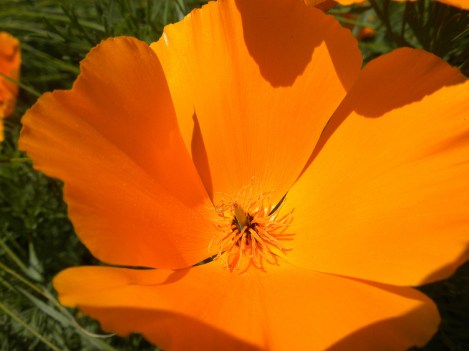
Macro Image of a California Poppy

Macro Image of a California Poppy (Eschscholzia californica)

We got an extra day off from work today, so Martine and I drove to Descanso Gardens in La Cañada-Flintridge, perched in the hills above Glendale. We have always associated the gardens with peace of mind, and today was no exception. Martine and I usually split off for a couple of hours and meet at the front gate just before closing time. While she wanders to her favorite sites, I look to get lost on the lesser known trails and perhaps do a bit of meditation.

The plethora of California poppies—the official state flower—kept distracting me. I took a number of close-ups, including the picture above, There is something so simple and yet so splendid about these blossoms that they kept interrupting my meditations. One never knows when one will run into a clump of these.

If it weren’t for tax season, I would have made a point of visiting the Antelope Valley California Poppy Preserve about fifteen miles west of Lancaster. Some 1,745 acres are full of California poppies and other native wildflowers, and there is a small visitor center maintained by the California Department of Parks and Recreation. (Of course, with the state’s current budgetary problems, I don’t even know if the park is still being funded.)


Islands of Peace

The Church at Mission Santa Barbara

The Church at Mission Santa Barbara with Martine in the Foreground

The California Missions are probably the state’s best claim to a rich history going back to the eighteenth and nineteenth centuries. I find it nothing less than amazing that most if not all of Franciscan Father Junipero Serra’s missions are still in existence, after all the earthquakes, fires, and other disasters to which California is prone.

Mission Santa Barbara is one of four missions dedicated to converting and regimenting the Chumash Indians of the area (the others are La Purisima in Lompoc, Santa Ynez in Solvang, and San Buenaventura in Ventura). Although Father Serra was declared beatified by Pope John Paul II in 1988, there are still unresolved issues regarding mistreatment of the Indians. Each of the missions also contained Spanish military barracks for troops enforcing the political dictates of the Spanish Viceroys. So it is not uncommon to find stories where the Indians were both helped and repressed by the Missions and their dual religious and political functions.

Chumash Painting of St. Francis

Chumash Painting of St. Francis

Whatever really happened at these missions, today they are, collectively, a cultural treasure—islands of peace dotted along the California coast from San Diego to San Francisco Solano in Sonoma. I have visited perhaps ten of them so far and hope to see the rest of them eventually.

Martine and I visited Mission Santa Barbara (for the third or fourth time) on Saturday during our recent trip to the area.


Back from the Dead

The Luftwaffe Drew This Card Too Often

The Luftwaffe Drew This Card Too Often

I have always enjoyed visiting aircraft museums. The one in Palm Springs is nothing short of spectacular. The Western Museum of Flight in Torrance is smaller, but fun to visit. Until 2002, there was a great Museum of Flying on the north end of Santa Monica Airport. Then it closed down. We heard that they were looking for a place to move somewhere in the desert. It appears they never found one.

Then, all of a sudden, we heard that it was re-opening on the south side of Santa Monica Airport. Finally, Martine and I paid it a visit yesterday afternoon. The new Museum of Flying is about one-fourth the size of the old one and focuses heavily on the airport’s history with Douglas Aviation, back when it was named Clover Field. Still it was sufficiently interesting to engage our attention for a few hours.

Russian Yakovlev Yak-3 Fighter from World War Two

Russian Yakovlev Yak-3 Fighter from World War Two

Among other displays, they had a Russian Yakovlev Yak-3 fighter parked outside (above). The much beloved plane was preferred by Russian pilots over the planes supplied by the United States during the days of Lend-Lease, such as the P-51 Mustang and the Supermarine Spitfire.

It was good to see the Museum of Flying back from the dead. I hope they can accumulate enough money and volunteers to grow back to what they used to be before a greedy landlord snuffed them out of existence to get a higher rent.


The Grittiness of Outer Space

Endeavour in its Hangar at the California Science Center

Endeavour in its Hangar at the California Science Center

Today, Martine and I did something a little different. I was curious to see the NASA Space Shuttle Endeavour, which was on display in a large hangar at the California Science Center in downtown Los Angeles. To get there, we took the relatively new Metro Expo Line from its current end of the line in Culver City to the Expo Park/USC Station.

The Endeavour was amazing. There was nothing Disneyfied or cleaned up about its appearance. The shuttle had spent some 296 days in space between its maiden voyage in 1992 and its arrival in Los Angeles in September 2012. It had circumnavigated the earth 4,671 times for a total of 123 million miles. Instead of looking nice and neat and clean, there was something gritty about its looks, especially around the nose cone: The heat of re-entry placed the most stress on the protective tiles tiles (see below) that covered its surface.

Some of the Heat Protecting Tiles on the Underside of Endeavour

Some of the Heat Protecting Tiles on the Underside of Endeavour

Most amazing was the area around the rear engines (see below). Never again will I think of outer space as something squeaky clean: It’s either too hot or too cold, and the stress of re-entry is enough to wreak havoc on just about any made-made materials.

One of the Rear Engines of Endeavour

One of the Rear Engines of Endeavour

It was an awe-inspiring experience to see Endeavour and to appreciate the work of thousands of talented men and women who, for a period of some twenty years, guided its destiny.

Martine thought that the Endeavour should have been cleaned up a bit more before it was presented to the general public. I, on the other hand, liked it just the way it was.