Normally, I’m not much of a sports fan—except for the World Cup and the Summer Olympics. Yet, every time I visit my brother in the desert, there is some orgiastic sports contest such as the World Series or March Madness. This time, it was March Madness, in which sixty-four collegiate basketball teams vie for the best in the country.
What was on view during my visit was the second round in which thirty-two teams attempt to become one of the “Sweet Sixteen.” I dunno, maybe “Sweat Sixteen” would be more appropriate.
All the games this last weekend run together in my mind, though I did watch part of the Ole Miss vs. Saint Mary’s game (illustrated above), though I have no memory of any plays made during the game. I do know that, as per usual, there were many personal fouls called and many partially successful attempts to capitalize on them via free throws.
In return for all the second round games I sampled, I will studiously avoid next weekends game. In all probability, I will probably not make any effort to find out which team survived the ordeal.
They’re no longer called the Cleveland Indians. Now they’re called the Guardians, Guardians of what, I don’t know. I guess because you’re not supposed to call your team the Indians because of cultural appropriation, whatever that is.. But they’ll always be the Indians to me. My fraught relationship with them continued from the late 1950s to the early 1960s, when I left Cleveland to go to college.
The Cleveland Press, the cities Hearst-owned afternoon newspaper, got the bright idea of giving all straight-A students in the city seven pairs of baseball tickets, mostly to ill-attended afternoon games. As I could reliably get top grades every year after fourth grade, I got a lot of chances to see the Indians lose to a lot of teams. Except for 1959, when they almost won the American League pennant, but lost out to the Al Lopez’s Chicago White Sox,
On the team were such players as Rocky Colavito, Jim Piersall, Minnie Minoso, George Strickland, and Woody Held. Pitchers included Herb Score (before his career stumbled after he got hit in the face with a baseball), Jim “Mudcat” Grant, and Cal McLish.
Usually I went to the games alone or with a school friend, because my father was working as a machine tool builder at Lees-Bradner and Company. I would hop on the 56A bus at East 177th and Harvard and get off at Proispect and Ontario downtown. From there, it was a five or six block walk to Cleveland Municipal Stadium, which, as I understand it, is no more.
Just like my grade school (Saint Henry) and high school (Chanel High), which also are no more. Much of my history has been effectively wiped clean in the evil days that befell Cleveland around that time.
It was difficult as a child to follow a baseball team that usually lagged in the standings. But then, who has a 100% winning record? No one.
Although the 2024 Paris Olympics have faded into history, there are still some controversies swirling about. Mostly, these are because of some pigheaded bureaucratic judges. I have already written about Jordan Chiles’s bronze medal in gymnastics.
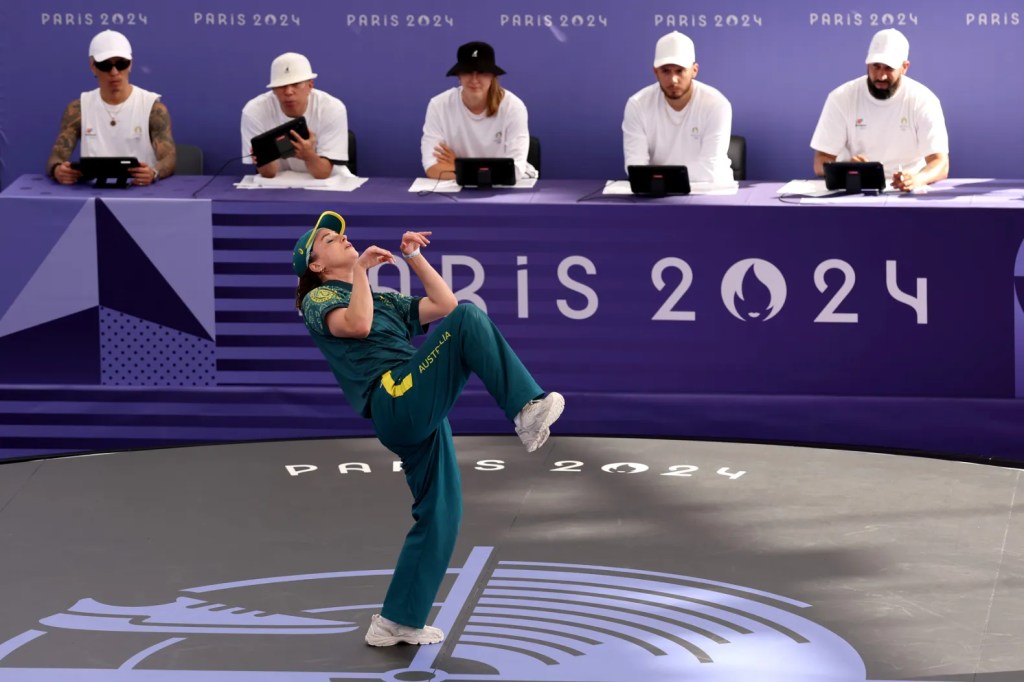
Also victimized by poor judging was Rachael Gunn of Australia’s entertaining performance in breaking. Raygun, as she is better known, received zero points from the judges for her highly individualistic routine. In addition, she has become the target of hatred from more “conservative” breakers, if there can be said to be such a thing.
Has breaking suddenly become so wrapped up in tradition that anything that smacks of innovation is pilloried by judges and social media trolls?
Hey, Australia did a great job in these Olympics, winning a disproportionate number of medals considering the size of its population.
Read the BBC’s story about the controversy, and give this talented, gutsy breaker the support she deserves.
Simone Biles and Jotdan Chiles Bowing to Rebeca Andrade
This viral photo from the recently concluded Olympics has been spoiled by the decision of some fusty Eurocrat to deprive Jordan Chiles of her bronze medal. For the complete story, check out CNN’s coverage of the story. There was a one-minute deadline for the U.S. gymnastics coach to protest the awarding of the bronze to a Romanian contestant (whose floor exercise was, in fact, quite excellent)’ and the U.S. was four seconds late (?!) in filing the protest.
Time to Introduce New Sports for the Next Olympics
The 2024 Paris Olympics were a smashing success. The Chinese continued their domination of track and field, while the Americans took medal after medal in platform diving. For the next Olympics in my home town of Los Angeles, it’s time to consider some new events to mix things up a bit:
SYNCHRONIZED PIZZA DOUGH TOSSING. Let’s face it: Pizza has become an international food and is due for some recognition by the Olympics.
THREE-LEGGED MARATHON RACE. I’ve always thought that Marathon runners had it too easy. I mean the only difficult thing about the 42.195 kilometer (26.219 mile) course is doing all the decimal math in your head while running.
FACEBOOK FACEPLANT. Let’s acknowledge the role of social media in our lives by having a race during which the participants must complete a series of responses to social media posts while running.
UNDERWATER GYMNASTICS. On one hand, you have greater buoyancy in the water; on the other hand, you don’t want to stretch out your routine too long.
CLIFF DIVING. For lemmings only. You dive off a cliff into a net. You can have a number of heights: 100 meters, 200 meters … the sky’s the limit.
555827 19.07.1980 Вынос олимпийского флага на торжественной церемонии открытия Игр XXII Олимпиады. Центральный стадион имени В.И. Ленина 19 июля 1980 года. Сергей Гунеев/РИА Новости
Remember the 1980 Moscow Olympics? We weren’t represented because Jimmy Carter pulled us out after the Soviets invaded Afghanistan in 1979. In 1984, the Russians got back at us by not sending anyone to the Los Angeles games.
It was a different world back then. It seems the Olympic contests were always being interpreted as Free World vs. Communists. Maybe that was mostly the news media’s doing, but not entirely. For instance, I remember the euphoria in the air when the U.S. hockey team defeated the Russians at the Lake Placid Olympics in February 1980 (that was when both Olympics were held the same year) by a score of 4-3. That despite the fact that the frantic Russians outshot the Americans 39-16.
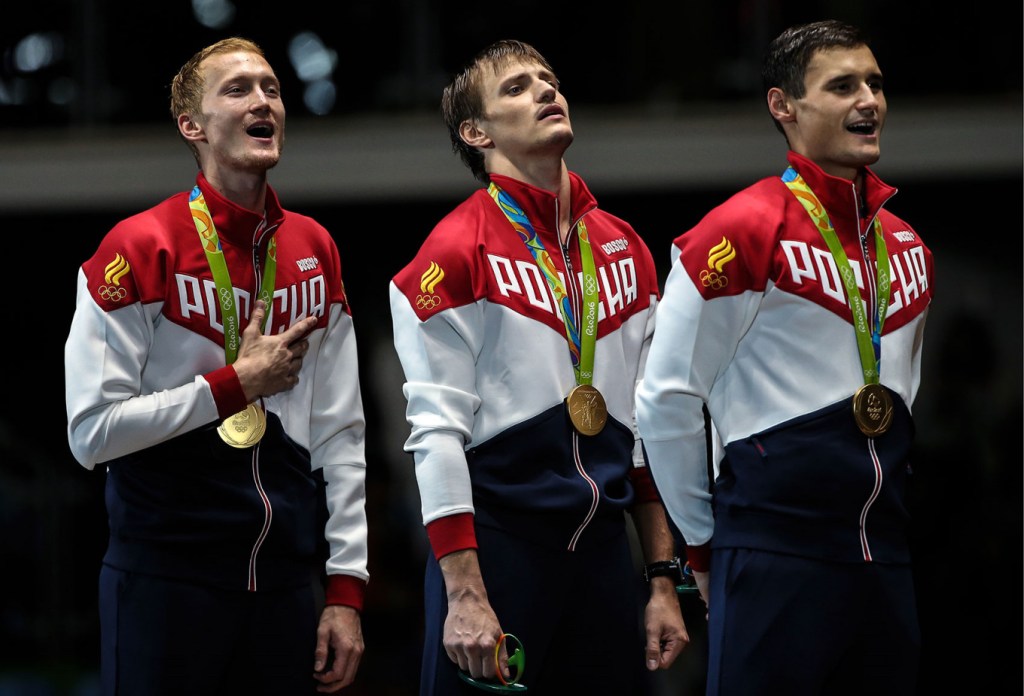
Soviet Russian Athletes on the Award Stand
But after the fall of Communism things changed. It’s no longer just the Free World vs. the Communists. The rest of the world got better, across the board it seems. Early this afternoon, I watched three Caribbean island democracies medal: St. Lucia, Dominica, and Grenada.
Of course, Russia and Belarus are not represented because Vladimir Putin decided to invade Ukraine, with his assistance of his willing stooge Alexander Lukashenko of Belarus.
Gone are the lovely Russian women gymnasts. No more “White Swan of Belarus.” A few Russian and Belarussian athletes are participating under the Olympic equivalent of the Skull and Crossbones—and probably facing the ire of Putin and Lukashenko. It’s a pity, because they have some splendid athletes there, but the Olympics is nothing if not political.
I used to always root for the Free World. Then, I just rooted for the U.S. Now I’m just happy to see the rest of the world catch up.
Of course, China is developing an impressive sports machine, but at least they haven’t invaded anybody since they got their wings clipped in 1979 in Viet Nam by Vo Nguyen Giap.
The first Olympics I watched to any extent were the 1976 games of the Montreal Summer Olympics. The heroine of those games was the 14-year-old Nadia Comăneci of Romania. She made Olympics history by being the first gymnast to score a perfect 10—and not once, but seven times. That netted her three gold metals, a silver, and a bronze, which she is seen wearing in the above photo.
Nadia started the whole gymnastics mania that has grown up around the Summer Olympics, and that continued with Svetlana Boginskaya, nicknamed “The White Swan of Belarus” in 1988 and 1992, and with Simone Biles today.
What ever happened to Nadia? Actually, she was in the opening day ceremonies of the 2024 Paris Olympiad. Today, she is an American citizen, having hightailed it out of Romania before the fall of the Ceauşescus in 1989.
Today she is 62 years old, being some 48 years removed from the svelte little girl who enchanted all of us way back when.
The term was much discussed during the last Tokyo Olympiad (2021), when U.S. gymnast Simone Biles withdrew from competition after suffering an attack of “the twisties.”
At that time, the BBC discussed the phenomenon:
So what are the “twisties”?
Gymnasts have described the twisties as a kind of mental block.
In some sports a sudden mental block – like the “yips” in golf – may cost you a missed putt, or a lost game.
In gymnastics, it can cause a person to lose their sense of space and dimension as they’re in the air, causing them to lose control of their body and do extra twists or flips that they hadn’t intended. In the worst cases, they can find themselves suddenly unable to land safely.
The twisties can happen to a gymnast even if they’ve done the same manoeuvre for years without problems.
Biles – one of the sport’s all-time greatest athletes – appeared to become disorientated while performing a vault on Tuesday and stumbled as she landed.
It was a moment that struck an instant chord with those who suspected what she might be going through.
I have been watching the U.S. women gymnasts on the balance beam earlier this evening, and the subject came up on an NBC interview with Simone Biles before her routine was televised. Now Simone is a very grounded person with clear perception and first-hand knowledge of the demons that can assail a performer in the spotlight. And, like few other participants in the Olympics, Simone is definitely in the spotlight. All. The. Time.
As it turned out, Simone’s balance beam routine in Paris 2024 was spot on. Afterwards, NBC showed another gymnast in the process of suffering a major case of the twisties. It was Melanie de Jesus Dos Santos of Martinique, who was competing for France.
A stunningly beautiful young woman, Dos Santos is shown muffing spectacularly all the major gymnastic events. In between gaffes, she was almost perfect; but she was in the throes of the twisties.
Whatever we do in life, we can suddenly lose our way. We could drive a chef’s knife into our fingers while chopping onions; or slip and fall in the bathroom while getting out of the tub; or turn the steering wheel the wrong way when backing out of a parking space; or any of a thousand other missteps.
When we are in the twisties, we should do what Simone Biles did: Drop out momentarily from any high performance activities. It’s not cowardice. It’s what we have to do to survive when we momentarily lose our way.
Messi and Teammates Celebrating After World Cup Victory
I woke up too late on Sunday morning to watch all of the Argentina-France World Cup Final. But I did see the second half, followed by the two overtime periods and the penalty kicks. And that hour and a half or so was the most exciting sports event I ever saw on television.
Now that pretty much everyone has weighed in on the game and Lionel Messi’s triumph and Kylian Mbappé’s stoic loss, I thought I would say a few words about the act of watching sports event. I am uniquely qualified inasmuch as I rarely watch sports events and have no clearcut team identification in any sport. Moreover, when I was growing up, my father would get so teed off when one of the Cleveland teams lost—and in those years they lost with amazing frequency—that I would have to go into hiding to avoid the paternal wrath.
It is only recently that I have come to love watching two types of sports events which, coincidentally, occur at four-year intervals. I am referring to World Cup Football (men and women) and the Summer Olympics. (The Winter Olympics—Meh!.) I have little interest in baseball, which typically involves a few minutes (if any) of intense action stretched out over several hours. American football, to me, is characterized by lots of starts and stops, followed after the so-called two-minute warning, by another hour or so of play.
Basketball has a lot of action, but there’s a lot of starts and stops there, too, as if the sport were devised with advertisers in mind. As for hockey, I find it too hard to follow the puck across the ice. All I see is the mayhem.
Only soccer football has continuous action, except for times when a player is injured or pretends to be injured. The final on Sunday built up to a pitch of excitement such that I have never experienced with any other sport. There was so much skill spread among so many players that it was a pity that someone had to lose. I would have been equally happy for either France or Argentina to win the game.
Argentine Footballers Celebrating After Scoring Against Poland
Yesterday, I watched the World Cup match between Argentina and Poland. Unlike most viewers, there are a whole lot of teams I like. I realize that the United States is still new at this game and can be upset by the likes of Liechtenstein or Moldova. A generation from now, I suspect that what we call soccer will be more prevalent, if for no other reason that parents won‘t want their sons growing up brain-damaged like Herschel Walker.
In yesterday’s game, I liked both Argentina (as I’ve visited their country three times) and Poland (because I’m Eastern European myself). Argentina won the game 2-0, but both Argentina and Poland advanced to the quarter finals. I think it was because the sum of the team members’ jersey sizes was a prime number.
The announcers kept talking about how surreal the end of the game was because so many teams were still in play, irrespective of their win/loss standings. Also considered in the standings were scores for remembering to say “please” and “thank you”; the number of syllables in the first stanza of their respective national anthems; the teams’ overall dental hygiene; and how well the teams could pronounce the name of the country they were in. (I think the latter is something like “Catarrh”, no?)
Argentina dominated the game, but the poles had one real hero in their goalie, Wojciech Szczesny. (Gesundheit!) For the entire first half, he batted away everything the Argentinians could throw at him, including soccer balls, off-color epithets, and one extremely rusted steam locomotive. Only in the second period did two goals get by him.
The Star of the Polish Team: Goalkeeper Wojciech Szczesny
Although soccer football does have its problems, such as the higher mathematics involved in calculating who gets to move on to the quarter finals and the treatment of draws. In American sports, there are a lot of stops and starts to allow for advertisers to plug their products and services. Soccer football games stop only for injuries, and then they add a mysterious number of make-up minutes after the regulation ninety minutes. I guess Americans will just have to get used to all that intensity and uncertainty. The rest of the world seems to have.







 Tarnmoor
You must be logged in to post a comment.