The first Olympics I watched to any extent were the 1976 games of the Montreal Summer Olympics. The heroine of those games was the 14-year-old Nadia Comăneci of Romania. She made Olympics history by being the first gymnast to score a perfect 10—and not once, but seven times. That netted her three gold metals, a silver, and a bronze, which she is seen wearing in the above photo.
Nadia started the whole gymnastics mania that has grown up around the Summer Olympics, and that continued with Svetlana Boginskaya, nicknamed “The White Swan of Belarus” in 1988 and 1992, and with Simone Biles today.
What ever happened to Nadia? Actually, she was in the opening day ceremonies of the 2024 Paris Olympiad. Today, she is an American citizen, having hightailed it out of Romania before the fall of the Ceauşescus in 1989.
Today she is 62 years old, being some 48 years removed from the svelte little girl who enchanted all of us way back when.
The term was much discussed during the last Tokyo Olympiad (2021), when U.S. gymnast Simone Biles withdrew from competition after suffering an attack of “the twisties.”
At that time, the BBC discussed the phenomenon:
So what are the “twisties”?
Gymnasts have described the twisties as a kind of mental block.
In some sports a sudden mental block – like the “yips” in golf – may cost you a missed putt, or a lost game.
In gymnastics, it can cause a person to lose their sense of space and dimension as they’re in the air, causing them to lose control of their body and do extra twists or flips that they hadn’t intended. In the worst cases, they can find themselves suddenly unable to land safely.
The twisties can happen to a gymnast even if they’ve done the same manoeuvre for years without problems.
Biles – one of the sport’s all-time greatest athletes – appeared to become disorientated while performing a vault on Tuesday and stumbled as she landed.
It was a moment that struck an instant chord with those who suspected what she might be going through.
I have been watching the U.S. women gymnasts on the balance beam earlier this evening, and the subject came up on an NBC interview with Simone Biles before her routine was televised. Now Simone is a very grounded person with clear perception and first-hand knowledge of the demons that can assail a performer in the spotlight. And, like few other participants in the Olympics, Simone is definitely in the spotlight. All. The. Time.
As it turned out, Simone’s balance beam routine in Paris 2024 was spot on. Afterwards, NBC showed another gymnast in the process of suffering a major case of the twisties. It was Melanie de Jesus Dos Santos of Martinique, who was competing for France.
A stunningly beautiful young woman, Dos Santos is shown muffing spectacularly all the major gymnastic events. In between gaffes, she was almost perfect; but she was in the throes of the twisties.
Whatever we do in life, we can suddenly lose our way. We could drive a chef’s knife into our fingers while chopping onions; or slip and fall in the bathroom while getting out of the tub; or turn the steering wheel the wrong way when backing out of a parking space; or any of a thousand other missteps.
When we are in the twisties, we should do what Simone Biles did: Drop out momentarily from any high performance activities. It’s not cowardice. It’s what we have to do to survive when we momentarily lose our way.
Messi and Teammates Celebrating After World Cup Victory
I woke up too late on Sunday morning to watch all of the Argentina-France World Cup Final. But I did see the second half, followed by the two overtime periods and the penalty kicks. And that hour and a half or so was the most exciting sports event I ever saw on television.
Now that pretty much everyone has weighed in on the game and Lionel Messi’s triumph and Kylian Mbappé’s stoic loss, I thought I would say a few words about the act of watching sports event. I am uniquely qualified inasmuch as I rarely watch sports events and have no clearcut team identification in any sport. Moreover, when I was growing up, my father would get so teed off when one of the Cleveland teams lost—and in those years they lost with amazing frequency—that I would have to go into hiding to avoid the paternal wrath.
It is only recently that I have come to love watching two types of sports events which, coincidentally, occur at four-year intervals. I am referring to World Cup Football (men and women) and the Summer Olympics. (The Winter Olympics—Meh!.) I have little interest in baseball, which typically involves a few minutes (if any) of intense action stretched out over several hours. American football, to me, is characterized by lots of starts and stops, followed after the so-called two-minute warning, by another hour or so of play.
Basketball has a lot of action, but there’s a lot of starts and stops there, too, as if the sport were devised with advertisers in mind. As for hockey, I find it too hard to follow the puck across the ice. All I see is the mayhem.
Only soccer football has continuous action, except for times when a player is injured or pretends to be injured. The final on Sunday built up to a pitch of excitement such that I have never experienced with any other sport. There was so much skill spread among so many players that it was a pity that someone had to lose. I would have been equally happy for either France or Argentina to win the game.
Argentine Footballers Celebrating After Scoring Against Poland
Yesterday, I watched the World Cup match between Argentina and Poland. Unlike most viewers, there are a whole lot of teams I like. I realize that the United States is still new at this game and can be upset by the likes of Liechtenstein or Moldova. A generation from now, I suspect that what we call soccer will be more prevalent, if for no other reason that parents won‘t want their sons growing up brain-damaged like Herschel Walker.
In yesterday’s game, I liked both Argentina (as I’ve visited their country three times) and Poland (because I’m Eastern European myself). Argentina won the game 2-0, but both Argentina and Poland advanced to the quarter finals. I think it was because the sum of the team members’ jersey sizes was a prime number.
The announcers kept talking about how surreal the end of the game was because so many teams were still in play, irrespective of their win/loss standings. Also considered in the standings were scores for remembering to say “please” and “thank you”; the number of syllables in the first stanza of their respective national anthems; the teams’ overall dental hygiene; and how well the teams could pronounce the name of the country they were in. (I think the latter is something like “Catarrh”, no?)
Argentina dominated the game, but the poles had one real hero in their goalie, Wojciech Szczesny. (Gesundheit!) For the entire first half, he batted away everything the Argentinians could throw at him, including soccer balls, off-color epithets, and one extremely rusted steam locomotive. Only in the second period did two goals get by him.
The Star of the Polish Team: Goalkeeper Wojciech Szczesny
Although soccer football does have its problems, such as the higher mathematics involved in calculating who gets to move on to the quarter finals and the treatment of draws. In American sports, there are a lot of stops and starts to allow for advertisers to plug their products and services. Soccer football games stop only for injuries, and then they add a mysterious number of make-up minutes after the regulation ninety minutes. I guess Americans will just have to get used to all that intensity and uncertainty. The rest of the world seems to have.
It was Mark Twain who said, “Golf is a good walk spoiled.” All across the United States, Europe, and the world there are some 40,000 golf courses, The average 18-hole golf course covers some 150 acres. At 640 acres in a square mile, that means that some 9,375 square miles (24,281 square kilometers) across the planet are dedicated to golf courses—approximately the area of the State of Massachusetts.
That’s a fair-sized piece of land. What makes the statistic interesting is that golf is on the decline, at least in the United States. According to one source, “The number of core American golfers (those playing eight rounds or more per year) has fallen between three and 4.5 percent every year since 2006.”
The Three Stooges at the Golf Course
If that trend continues, I see a giant land rush forming to convert golf courses into expensive subdivided real estate.
In fact, in the news there is a big kerfuffle about a dispute between the PGA and Saudi Arabia’s LIV, which is making inroads on the PGA’s monopoly. You can read about it here.
So don’t spend too much money on golf clubs and golf fashions. They may not be around much longer.
I am not known as a big football fan, but nonetheless I decided to watch today’s Superbowl LVI between the Cincinnati Bengals and the Los Angeles Rams. After all, the game was being held in L.A. and featured the home team.
While it was nice that the Rams won, I was very conscious of the physical pain that is an inevitable part of the game. In the Second Quarter, Rams receiver Odell Beckham Jr had a non-contact misstep which injured his left knee and sidelined him for the rest of the game—leading to additional defensive coverage on Cooper Kupp that made things rough on QB Matthew Stafford until the fourth quarter.
What particularly caught my eye was the sacking of Bengals QB Joe Burrow by Rams linebacker Von Miller early in the Fourth Quarter (above). For several seconds, Burrow lay on the field with his face contorted in pain. Fortunately for his team, he was able to recover, though I felt there will be something to pay for that takedown.
There was a lot of meaningless commentary by all the sports pundits, but only once did the truth come out when one of them said, “Nothing is easy.” No truer words were ever spoken in sport.
Opening Ceremony of the 2020 Tokyo Olympiad—in 2021!
Japan was put in an untenable position by the International Olympic Committee (IOC). At a time when Covid-19 was surging through the island nation, the IOC said the Olympic Games had to go on nonetheless. Of course, we won’t know for a week or two whether Japan will pay the price by putting on the games during an epidemic.
I must say, however, that Japan reacted with competence and grace and managed to put on a memorable event. Even if the stands were mostly empty, these games were an utter delight, even if NBC’s televising was at times ham-fisted and soap-opera-ish.
My favorite events were the team competitions, such as men’s and women’s basketball, women’s indoor and beach volleyball, women’s water polo, and some of track and field events. I didn’t much care for golf, canoeing/kayaking, swimming and diving. Never before have I spent so much time glued to the television set watching sporting events. It was worth it, and I feel bereft now that the Games are over.
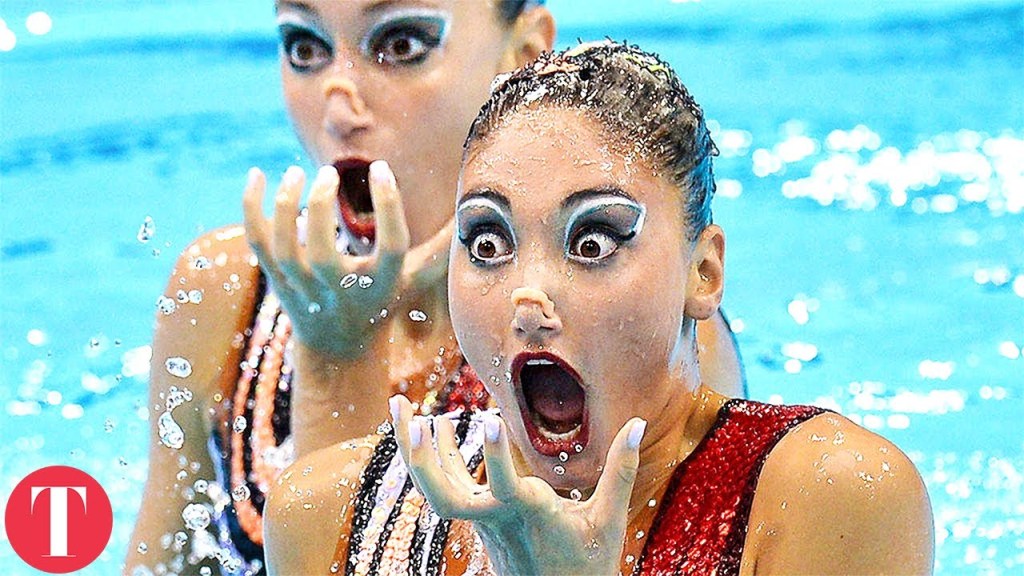
In the above picture, Moldovan women athletes are synchronously showing amazement at a random consonant, in this case the letter “T.” Below, however, are some actual events planned for the next summer Olympics:
Team Parcheesi. Expect the Chinese to win gold here.
Underwater Track Cycling. Canada and New Zealand are already gearing up for this event.
Low-Jump. Exactly what it sounds like: medalists must leave the ground, but only for a few millimeters. The world record is currently held by Burkina Faso at 11.68 mm.
Ballroom Balance Beam. Ballroom dancing with a man and a woman as partners atop a balance beam. Both are expected to stick the landing … but exactly where I am not at liberty to say.
Dog Walking. Contestants must walk a pack of at least ten dogs and are downgraded for the dogs’ disobedience, toilet, and sniffing stops.
Sand Kayaking. How fast can contestants be when they have to paddle on sand dunes of various heights?
Dumpster Diving. Exactly what it sounds like. The dumpsters are filled with plastic detritus from the Pacific Garbage Patch, from heights of 10, 20, and 30 meters.
Women’s Cubic Beach Volleyball. The same as beach volleyball, but the “ball” is an inflatable cube. What matters most, however, is the skimpiness of the bikinis worn.
Blind Man’s Buff. Played on a 10-acre obstacle course.
Weight Watchers Watch Party. Judges will look for the most vapid and overweight participants in home watch parties. The U.S. is expected to win the Lead Medal at this event during most Olympics.
Athletes’ Families Back Home Rejoicing in Family Member Medal Performances
If you’ve been watching the 2020 (2021?) Tokyo Olympics on TV, you’ve seen it a hundred times. Cut from the proud medalist to his or her family back in the states howling and dancing like a bunch of Yahoos. NBC is using Microsoft Teams software to show the family response to the winners. And the result is usually pretty nauseating.
They are usually packed in large rooms as big as dance halls in groups of several dozen, usually wearing T-shirts or sweatshirts emblazoned with the name of their boy or girl in Tokyo. My usual response is to say to myself, addressing the athletes, “So those are the clowns you’ve managed to give the slip to. Time to stay far away from Podunk: Find a life for yourself away from these people.”
Oh, you can telephone them once every few months, but now it’s time to live your own life.
I imagine that some people get pretty weepy about showing the families of the athletes. My reaction can be summarized in one word: Flee! That’s what I did when I went 600 miles away from home to go to college, and then moved to the opposite side of the country to go to graduate school and begin a life of my own.
All of us eventually have to weaken those family ties in order to live our own lives. I find that the ones who don’t wind up leading stunted, dissatisfied lives. Seeing those T-shirted family mobs on NBC make me glad that I did what I did back in the 1960s. Not that I didn’t love my family, but I didn’t want to live as the college boy who never left home.
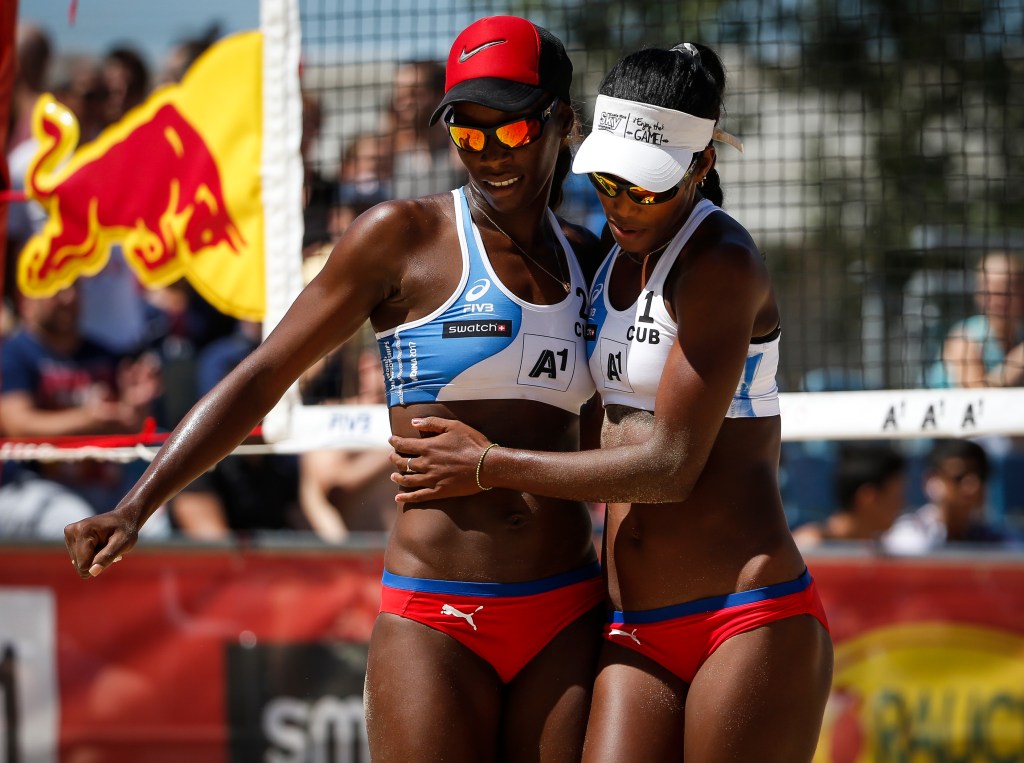
Cuban Volleyballers Lidianny Echevarria Benitez and Leila Consuelo Martinez Ortega
I do not think this was the intention of the Olympic organizers, but one thing the 2020 Tokyo Games has done for me is to make me appreciate the beauty of young black women athletes. Especially those competing in 2×2 beach volleyball and the various track and field events.
Frankly, I prefer watching women’s events more than the all-male ones, and I have a sneaking suspicion that I am not alone in this. When the U.S. team shut down the Cuban volleyball team of of Lidy and Leila—who had previously defeated Australia, Russia, Italy, and the Netherlands—I felt saddened. Not that April and Alix on the U.S. team weren’t cuties, but in that department they did not come close to the Cuban women.
U.S. Track & Field’s Dalilah Muhammad
Just to show that I am not unpatriotic in my morose delectation of young black women, I also am partial to such U.S. track stars as Dalilah Muhammad.
Now all these women are impossibly young, but that’s no bar to a dirty old man like myself.






You must be logged in to post a comment.