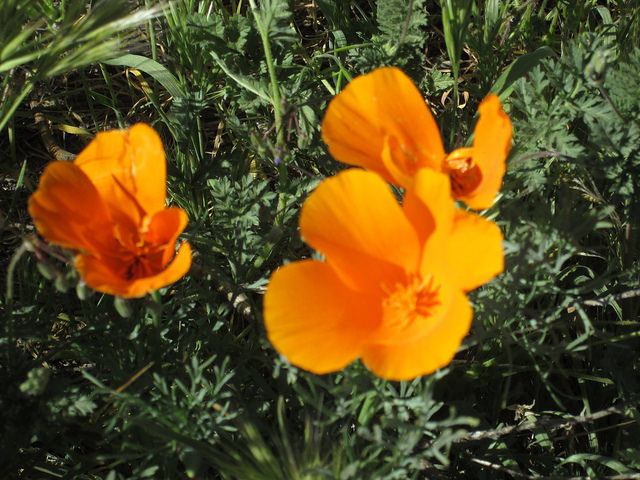
Eschscholzia californica

A

Field of California Poppies

After a wet winter, such as this has been, there is a brief explosion of bright orange for a few weeks in the Spring. Don’t worry: It’s not Donald J. Trumpf. It is the California Poppy (Eschscholzia californica) in all its glory. Today, my friend Bill Korn and I went to the Antelope Valley California Poppy Reserve in the high desert valley running east and west between I-5 and California 14. We took separate routes and arrived there within fifteen minutes of each other.

The California Poppy is the official state flower of California: It is considered an offense to pick any of them. They are truly lovely, though, and the Poppy Preserve was crawling with thousands of people who came out to wander in fields of flowers. There were one-hour lines outside the bathrooms and the portable toilets.

We took several trails and saw the pointillist dots of bright orange extending in several directions.

Poppy Fields with San Gabriel Mountains in Background

I’m happy that I was able to work only half a day doing taxes before making my getaway. It was a good day!

Art and Inequality

Glass Hood Ornament on 1930s Automobile

Glass Hood Ornament on 1930s Automobile

Why is it that the most beautifully designed automobiles ever made came from the 1930s, a decade that was very good for the very rich, but not so good for everyone else?

On Saturday, Martine and I decided to risk going to visit the Nethercutt Collection despite the threat of an approaching rainstorm. We had a great afternoon looking at classic automobiles and got onto the freeway for the homeward trip just when the raindrops started to fall.

This particular visit raised that question about 1930s auto design. It appears that, sometimes, the greatest art comes during bad times. Going back as far as Ancient Greece, the Age of Pericles with its great tragedians was also the time of the horrible Peloponnesian War. John Milton did his best work under Oliver Cromwell’s Protectorate. Marcel Proust wrote just as France was sliding toward the Great War of 1914-1918.

Does this mean that America may produce great art during the dictatorship of Donald J. Trump? Maybe not: There was little of note produced during the Bubonic Plague.

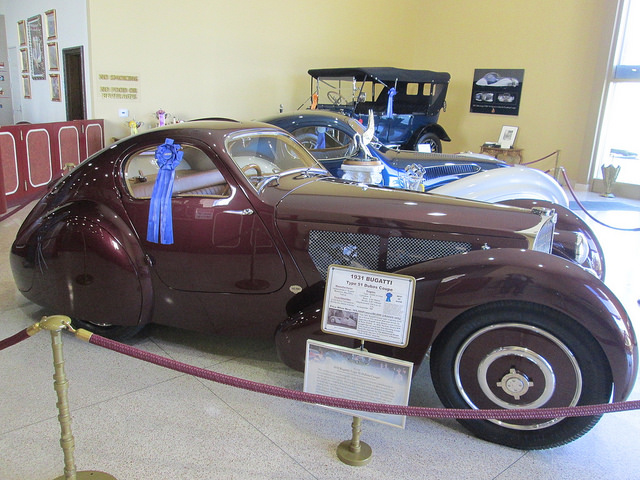
Prize-Winning 1932 Bugatti

Prize-Winning 1932 Bugatti

I guess it takes more than widespread misery to create a period of great art. We’ll just have to see what emerges in the years to come.

(Not) In Praise of Education

My Classes Were Better Managed Than This

My Classes Were Better Managed Than This

From today’s Futility Closet posting comes this attack on education in the form of four quotes, three from England and one from Poland. I mention this because nothing I experienced was anywhere near as negative, despite the fact that I began my schooling speaking only Hungarian. Of course, everything I’ve read about an English Public School (really, Private School) education sounded rather like Dotheboys Hall in Dickens’s Nicholas Nickleby, with the possible addition of homosexual rape.

Anyway, here are the quotes:

“There is, on the whole, nothing on earth intended for innocent people so horrible as a school.” — George Bernard Shaw

“I sometimes think it would be better to drown children than to lock them up in present-day schools.” — Marie Curie

“Nearly 12 years of school … form not only the least agreeable, but the only barren and unhappy period of my life. … It was an unending spell of worries that did not then seem petty, of toil uncheered by fruition; a time of discomfort, restriction and purposeless monotony. … I would far rather have been apprenticed as a bricklayer’s mate, or run errands as a messenger boy, or helped my father to dress the front windows of a grocer’s shop. It would have been real; it would have been natural; it would have taught me more; and I should have done it much better.” — Winston Churchill

“Not one of you sitting round this table could run a fish-and-chip shop.” — Howard Florey, 1945 Nobel laureate in medicine, to the governing body of Queen’s College, Oxford, of which he was provost

In the Cloud Forest

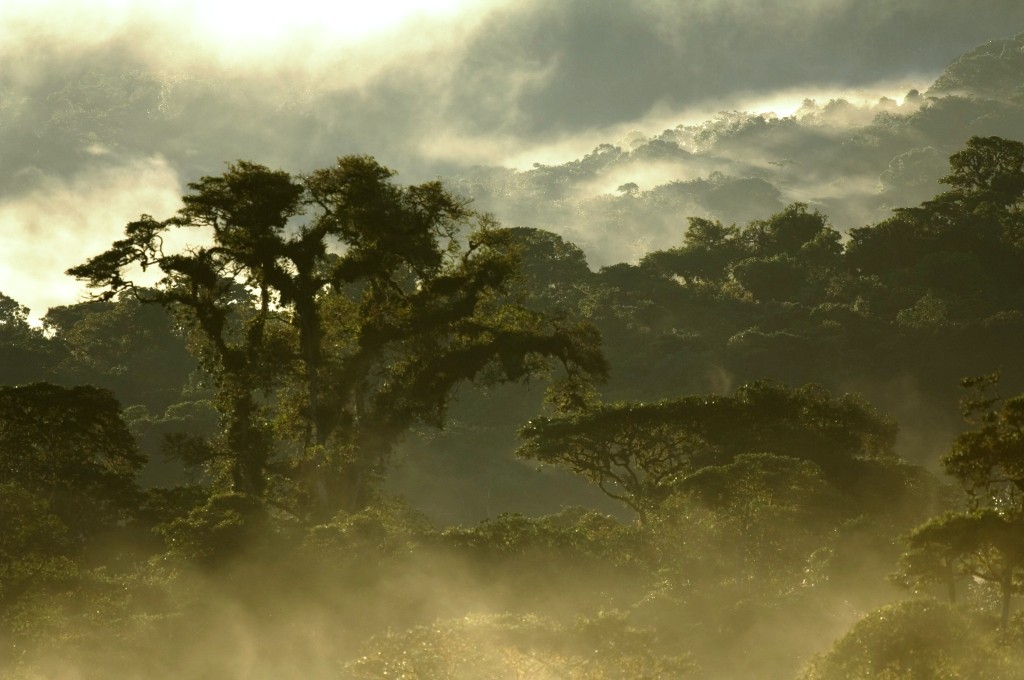
The Cloud Forest Around Bellavista

The Cloud Forest Around Bellavista

All through this horrible tax season Easter Week, my mind has been floating free, dreaming of the things I want to see on my next vacation. I have already written about Quito, the Quechua crafts market at Otavalo, and the tourist railroads of Ecuador. Today my dreams are turning toward the high cloud forests of the Andes, over a mile in altitude, with their exotic birds such as the lemon-spectacled tanager, the pale-browed tinamou, the fasciated tiger-heron, and thousands more.

If my brother agrees, I’d like to spend a few days at a lodge in the cloud forest, perhaps such as the Tandayapa Bird Lodge west of Quito. A few days hiking in the misty forests and looking for exotic multi-colored birds would be soothing to my soul.

Mountain Tanager

Mountain Tanager

There are several patches of cloud forest in the Ecuadorian Andes. It would be fun to choose from among them. The trip is months away, but it is at times like this, when otherwise I would be under heavy stress, that I let my thoughts fly south.


My Christmas Place

Reykjavik

Reykjavik

At Christmas time, my thoughts turn to Reykjavik, Iceland. I always think of the small city—the world’s northernmost capital—as my special Christmas place.

Not that I have ever been there at Christmas, which at that latitude is dark twenty-two hours a day around the winter solstice. No, like most of the other tourists, I have only been here in the summer. Then why do I think of Reykjavik when I think of Christmas? Is it the warmth of its people in that freezing seasonal darkness? Is it the thirteen Yule Lads of Icelandic lore that have woven their spell on me?

Here is a photo of the port of Reykjavik taken by Páll Stefánsson of The Iceland Review. His photographs have a way of keeping his little land foremost in my mind.

As for the “real” meaning of Christmas, I give you this comic strip by Berkeley Breathed:

A Merry Christmas to All!

A Merry Christmas to All!

A City I Love

Buenos Aires

Buenos Aires, Plaza de Mayo

In front of Retiro Train Station, a serious attempt was made to pick my pockets at a time I was carrying several thousand dollars in cash. A couple came up behind me and squirted me with a mixture of steak sauce and mustard while “helpfully” attempting to clean me off with paper towels (which they just happened to have in their hands) and steering me to a nearby bathroom where their accomplices would finish the job. But I was on to that dodge, so I took a sharp right and stopped a cab.

While walking the streets, I had to be careful not to trip on the array of broken sidewalk tiles. (This particularly bothered Martine in 2011.)

Subways, trains, and buses are so crowded that it can take your breath away. One day I took a ride on Subte A to the end of the line at San Pedrito and back in hopes of riding the old subway cars, which supposedly are stuill in use. The cars were all new, and standing room only.

So why do I love Buenos Aires?

There is something about the city’s faded splendor that reminds one of Europe again and again. I think there was a conscious attempt to imitate Paris and Madrid back when Argentina was riding high as the main supplier of canned meat to both sides in the First World War. But then hard times came, but the splendor still shone through—not everywhere, but sometimes in surprising places. The Galeria Pacifico on Calle Florida is probably one of the most gorgeous indoor shopping centers anywhere.

There are dozens of old cafés, many dating back to the late 1800s—places where you can get a good meal, attentive service, and sit and read a book or newspaper without being rousted out. Places like La Biela in Recoleta, and La Puerto Rico and the Palacio Español in Monserrat. These places are usually crowded with older men, and I felt that I fit right in.

I don’t know how many more times I can walk the streets of this fabled old city, but I hope the gods allow me the chance to return at least once or twice.


The Folk Singer

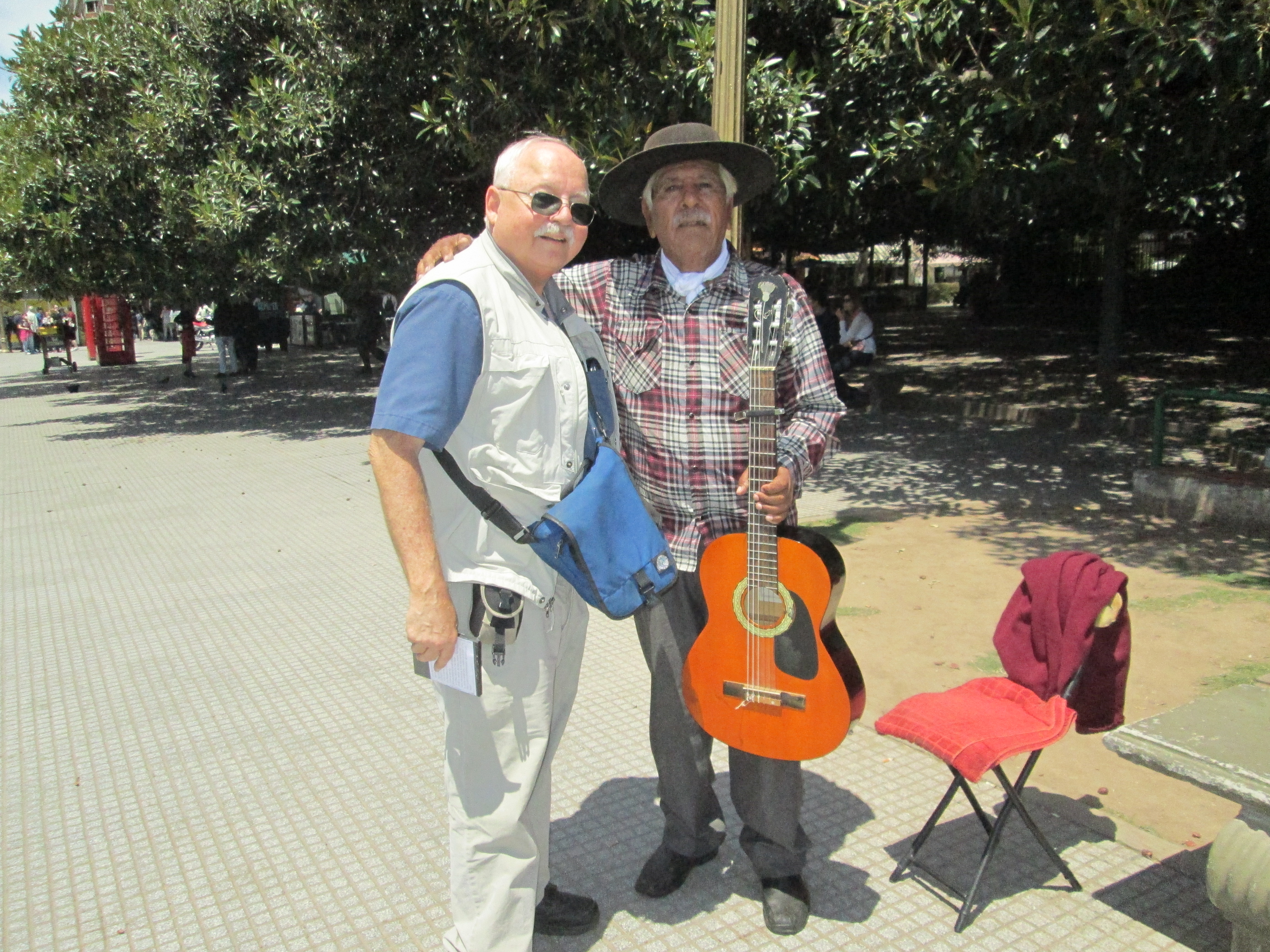
With Folk Singer Juan Carlos Balvidares, “El Caminante Argentino”

With Folk Singer Juan Carlos Balvidares, “El Caminante Argentino”

In 2011, Martine and I encountered a folk singer in front of the Café La Biela, sitting in the shade of an Ombú tree. I remember his singing vividly and so was delighted to encounter him again at the same place on the day after I landed in Buenos Aires. Señor Balvidares is the author of numerous tangos, milongas, zambas, vals, and chacareras. He has traveled around the world singing his songs.

This time, I bought a CD of his music. You can get some idea of his style by looking at this YouTube site. Click here for him performing in the barrio of San Telmo.

I have written previously about the late Carlos Gardel and his great tangos of the 1920s and 1930s. Balvanera may not have Gardel’s dulcet tones, but his music is an authentic and living link to the songs of the gauchos of the Argentine and Uruguayan pampas. Although he plays largely for tourists today, I enjoyed listening to his music—then and now.


Going South

My Mind Is Already in South America

My Mind Is Already in South America

Although I am still here, pretty much all my free time is involved with resolving loose ends and packing. Depending on the availability of computers, I may post a few unillustrated blogs from South America, but the next time you hear from me is likely to be around Thanksgiving.

Under Four Flags

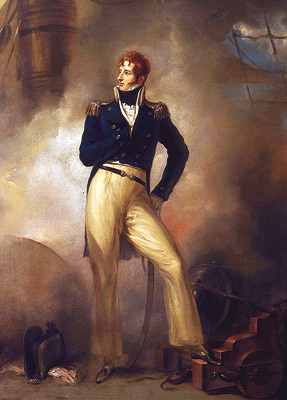
Lord Thomas Cochrane (1775-1860)

Lord Thomas Cochrane (1775-1860)

He must have been an amazing sight to his enemies, towering over six feet with red hair. Lord Thomas Cochrane, 10th Earl of Dundonald, was an impoverished Scot of noble birth who was a brilliant attacking sea captain. Because of various circumstances, mostly relating to his problems with authority, he was perhaps the most brilliant naval strategist who did not actually command a fleet. Had the Admiralty not been so venal and corrupt, he could have shortened the Napoleonic Wars by incursions against the mainland of France, forcing Napoleon back from Russia ahead of schedule. But that was not to be.

Some people are not meant to get along well with politicians. (I am one such myself, though not with one thousandth the talent of the Scotsman.) Cochrane developed a whole slew of enemies, hobnobbing as he did with Radicals as William Cobbett and Sir Francis Burdett. He even spent time at King’s Bench Prison for stock fraud—a mostly bogus charge cobbled together by his enemies with a complaisant and corrupt judge on the bench.

Stripped of his Order of the Bath and drummed out of the Navy, Cochrane accepted an offer the command the navy of the emerging Republic of Chile. He fought a number of sharp naval actions until the Spanish Pacific Fleet was driven off. Then he assisted Dom Pedro I of Brazil fight for that country’s independence from Brazil.

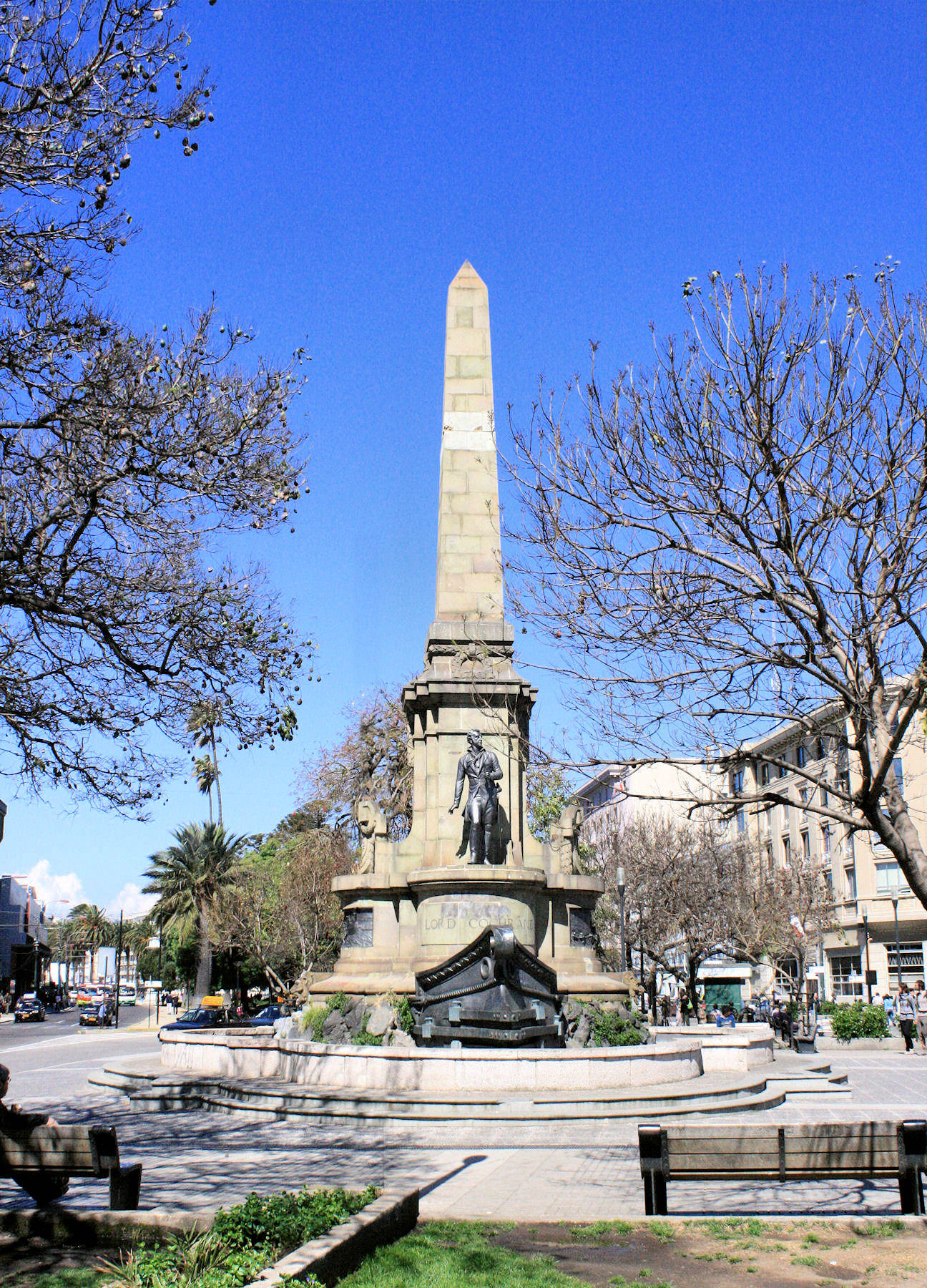
Memorial to Cochrane in Valparaiso, Chile

Memorial to Cochrane in Valparaiso, Chile

Finally, he ended up commanding the fleet of the Greeks who were then fighting to free themselves from the Ottomans. Here he was least effective, largely because of the rampant factionalism of the Greeks. According to Donald Thomas in his excellent biography Cochrane, “he wrote to the Chevalier Eynard of the Philhellenic Committee in Paris, describing the government of Greece as depending on ‘bands of undisciplined, ignorant, and lawless savages.’” This was a far cry from the well-trained British and Chilean sailors he had commanded.

Eventually, Greece won her independence, but only after the British, Russians, and French combined to dictate terms against the Turks.

Cochrane reminds me of General George Patton, another brilliant military leader who paid a heavy price for refusing to kiss the butts of military administrators.

The West Cork Flying Column

IRA Re-Enactors 2014

IRA Re-Enactors 2014 at Old Fort MacArthur

At the Old Fort MacArthur Days military re-enactments, I always enjoyed stopping over to visit with the West Cork Flying Column, named after one of the most active and successful Irish Republican Army (IRA) units during the struggle for independence between 1919 and 1921. For one thing, they always had the best music; for another, this era has always been one of the biggest gaps in my historical knowledge.

This time, I picked up a list of recommended books from the group and proceeded to read Tom Brady’s Guerilla Days in Ireland about his command of the actual West Cork Flying Column in combating British regular army units, as well as the Auxiliary Division and the much-hated Black and Tan mercenaries.

Tom Brady During the Troubles

Tom Brady During “The Troubles”

Brady’s unit was perhaps the largest, most active, and most successful unit of the IRA fighting against the British-led units. Where many other parts of Ireland were relatively quiescent, the West Cork Flying Column conducted large scale attacks on barracks, burning houses of British loyalists in retaliation for British burnings of IRA sympathizer houses, attacks on patrols, as well as sabotage of railroads and bridges. And this with a maximum armed strength of approximately 150 men against the thousands fighting under the Union Jack.

Unlike many guerrilla leaders today, Brady cared deeply for the welfare of his men. He was always careful to identify and praise the fallen both in the description of the action fought and in a lengthy Appendix at the back of the book where he lists them alphabetically and identifies their origin.

Now my appetite for more background on recent Irish history has been whetted, and I plan to read more.