Rio Bec

The Ruins of Calakmul in the Rio Bec Region

What with all my visits to the Maya ruins in Yucatan, Chiapas, Guatemala, and Honduras, you would think I would be getting tired of the endless ruins. Well, not yet! One incredibly dense region of Maya ruins is in the southeast corner of the state of Campeche, known as the Rio Bec region. Included are such archeological sites as:

  • Calakmul, with Tikal in the Petén region of Guatemala, perhaps one of the largest Maya cities at its height 1,500 years ago
  • Xpuhil (pronounced shpoo-HEEL)
  • Balamku
  • Chicanna
  • El Hormiguero (“The Anthill”)
  • Rio Bec
  • Becán

And these are only the better known ones, and even some of these are difficult to get to because they are at the end of dirt tracks in the jungles of the region.

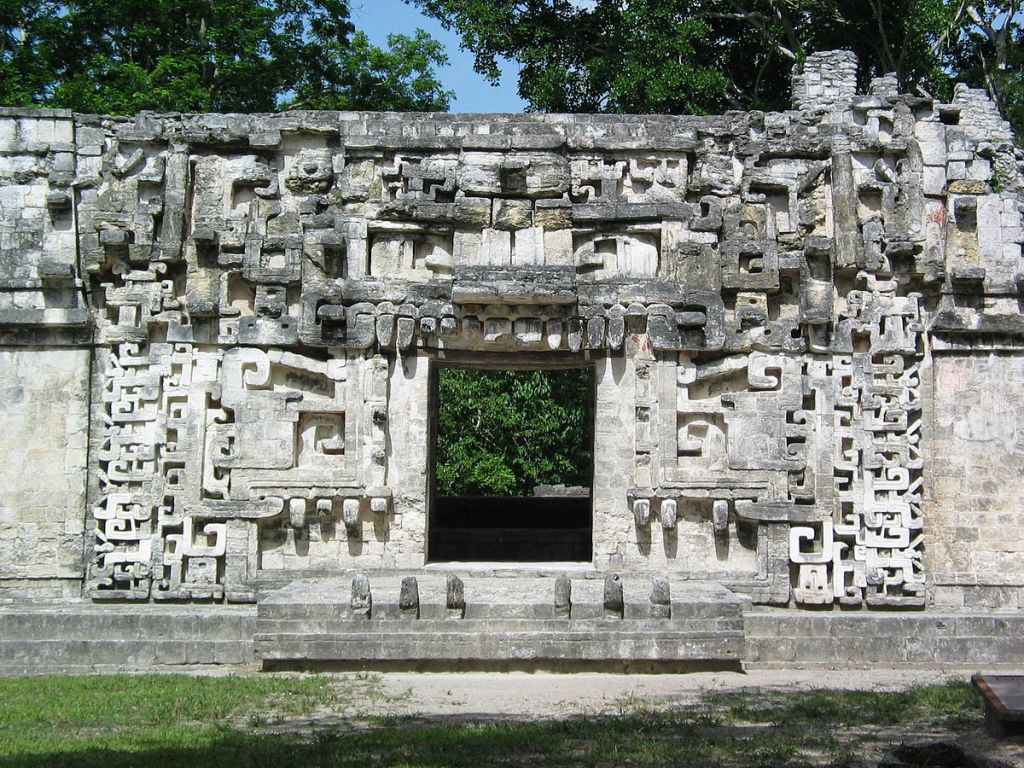
Maya Ruins at Chicanna

Unlike many of the better known ruins in the state of Yucatán, those of the Rio Bec region are in steaming monkey jungles. The only town of any size is Xpujil near the eponymous ruins, and it’s only a blip on the long road between Francisco Escarcéga and Chetumal. To visit any of these ruins requires reserving a chunk of time, from three days to a week. Public transportation is virtually nonexistent, and the only places to stay (and not a large selection at that) are clustered around Xpujil.

To do the Rio Bec area any justice, I would have to rent a four-wheel-drive vehicle. Still, I would love to go. I would have to pack a lot of insect repellent (like 100% DEET) and be prepared for some really dicey shit. Hey, if it’s on my travel bucket list, you can bet it’s no cakewalk.

The Bungle Bungles

Purnululu National Park. Photo by Sean Scott Photography.

This is one of a series of posts about places I would love to visit, but probably never will for lack of time and money. I first heard about the Bungle Bungles from Bill Bryson’s excellent travel book In a Sunburned Country:

The Bungle Bungles are an isolated sandstone massif where eons of harsh, dry winds have carved the landscape into weird shapes—spindly pinnacles, acres of plump domes, wave walls. The whole extends to about a thousand square miles, yet, according to [his source] “were not generally known until the 1980s.”

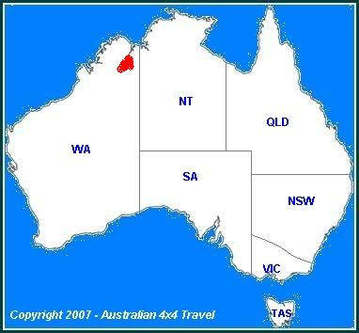
The area is now within the boundaries of Purnululu National Park in a remote part of Western Australia midway between Broome and Darwin. Bryson wanted to see it, but didn’t have the time, as it would have involved several thousand miles of hard driving on a desert two-lane highway.

Location of the Bungle Bungles

Expedia is currently running a series of TV ads about how we never regret the things we didn’t buy nearly so much as the places we never got to visit. I tend to agree. That’s why I plan to use some of my posts to dream about places that look fascinating. What with Covid-19, advancing age, and the high cost of travel, I will dream in print about visiting certain destinations. You might say it’s my travel bucket list.

The Little White Chapel

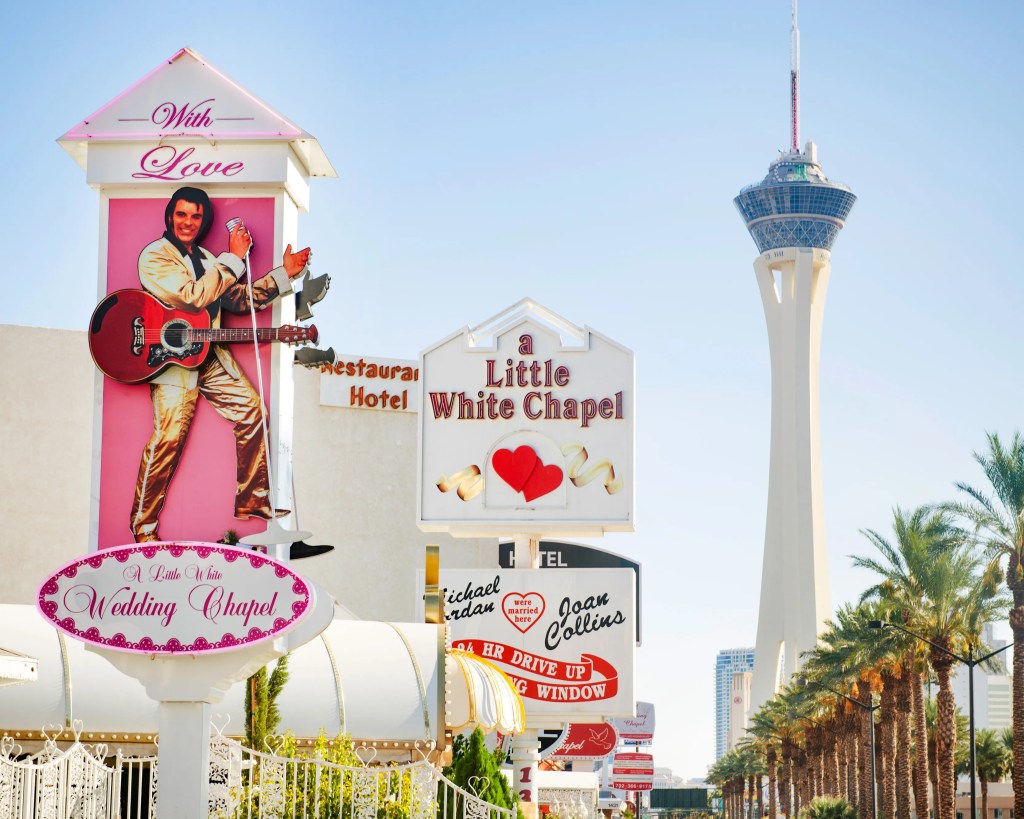
This is my last posting until I return from Las Vegas, probably on Thursday. I will leave you with a poem by Brenda McGrath entitled “Little White Chapel”:

Little White Chapel

When my husband and I were in Las Vegas, I had a great suggestion,
To go to the Little White Chapel, and renew our vows in celebration.
I thought it would be such a lark we wouldn’t forget.
Having Elvis perform the ceremony would be the best thing yet!

However we never made it to the chapel, he refused.
To do such a silly thing did not leave him amused.
Maybe that was an indication of what was to come.
Divorce ensued, and sorrow beat its drum.

I want to go to the Little White Chapel with a new man.
We would have so much fun before our life began!
We could play a slot machine on our way out.
Then we would be man and wife with a payout!

When the Outfit Controlled Vegas

One of the places on our upcoming Vegas trip that I am most eager to see is the Mob Museum, more fully known as the National Museum of Organized Crime and Law Enforcement.

Back in the 1970s and 1980s, much of Las Vegas was controlled by “The Outfit,” also known as the Mafia. Probably the best introduction to that history is Michael Scorsese’s film Casino (1995), starring Robert De Niro, Joe Pesci, and Sharon Stone. It in turn was based on Nicholas Pileggi’s Casino: Love and Honor in Las Vegas, which I read with pleasure. There is also an excellent work of reportage by Dennis N. Griffin which goes over the same territory, but with more of a law enforcement point of view. The book that I read was titles The Battle for Las Vegas: The Law vs. the Mob.

All three sources follow the story of Lefty Rosenthal (called Ace Rothstein in the Scorsese film) and Tony “The Ant” Spilotro (Nicky Santoro in the movie). It took years to bring down the mob. In 1986, Tony Spilotro and his brother Michael were murdered by the mob bosses, who were tired of all the attention that was being focused on them, and buried in a Midwestern cornfield. According to some sources, they were first beaten and buried alive.

Since the mob days, Vegas has been Disneyfied. Big time real estate developers moved in and made it into a family destination—though there are still pockets of naughtiness around the edges.

Chiloe: A Near Miss

Palafitos on the Shore of Castro on Chiloé

In 2014, I was within a mile of the ferry from Puerto Montt, Chile, to Ancud on the island of Chiloé. Chiloé is one of two places in South America that lay claim to the first cultivation of potatoes, the other being Peru. Why didn’t I go? Because of a 1963 documentary by Joris Ivens entitled À Valparaíso, I was dead set on spending several days in the port of Valparaíso before returning to Los Angeles via Santiago. You can see this documentary by clicking here. Even though it has a French soundtrack with Spanish subtitles, you can see why I wanted to see the city.

And so, Chiloé is one of those places I almost but not quite visited. The island is famous for its palafitos, brightly colored buildings clinging to the shore on wooden stilts, and also for its wooden churches, built without benefit of nails and frequently covered with wooden shingles. The climate is a humid, cool temperate climate; and the island is covered with rare temperate rain forests.

Church of San Francisco in Castro

Back in 2000, the wooden churches of Chiloé were collectively named as a UNESCO World Heritage Site.

Chilotes have a unique stew called curanto, which includes seafood, meat, potatoes, and vegetables. The dish is buried in a deep hole filled with hot coals and covered with stones.

I would love to spend a week in Chiloé sometime, “Had we but world enough and time.”

Zzyzx

On the road to Las Vegas, straight through the heart of the Mojave Desert, are strange turnoffs leading to even stranger places. Just before Baker is Exit 239, Zzyzx (pronounced ZYE-zix) Road, which supposedly leads to a former clinic run by a sharpster named Curtis Howe Springer. Then there’s Kelbaker Road, which runs south from the I-15 to Kelso, where there is an old Union Pacific railroad station and railway workers’ dormitory, near the Kelso Dunes. It continues south to Amboy, one of the most hellacious towns in the California desert.

Another route from Baker takes you 100 miles north to Death Valley on Highway 127, past Death Valley Junction with its Amargosa Opera House, where Marta Becker used to give regular performances.

In that vast agglomeration of dry lakes, mountains, Joshua Trees, and creosote bushes there are strange little gems waiting to be discovered. I wish I could live long enough to take the time and discover them.

Viva Las Vegas

A Christmas tree is shown on Fremont Street in downtown Las Vegas on Dec. 12, 2017. CREDIT: Bill Hughes/Las Vegas News Bureau

In a little more than a week, Martine and I are going to Las Vegas for a few days. We have no intention of gambling, as we both feel that is tantamount to throwing money down the drain. For me, what Las Vegas stands for is a kind of Petri dish of American Culture, emphasizing what Americans find pleasurable. In fact, I see it as the American equivalent of Pleasure Island from Pinocchio, where little boys go to be turned into jackasses.

Think about it: food, gambling, sex, sports, lavish entertainment—all the things that float the boats of typical Americans. It is probably one of the best places in this country for people watching. Just take the Heart Attack Grill, for example:

The Heart Attack Grill on Fremont Street in Downtown Las Vegas is a truly unique restaurant, where gluttony and obesity reigns supreme. Where else can you go to eat a 9,982 calorie burger, served by a buxom waitress dressed as a nurse, listen to karaoke, and wash it back with a shot of liquor served in a prescription bottle?

As the sign says, diners weighing in over 350 pounds (159 kilograms) eat for free.

I doubt that even Imperial Rome had nothing that could compare with that. I can see myself looking for an unobtrusive place to sit down and wait for things to happen so that I can photograph them.

On previous visits, Martine and I confined ourselves to the Strip on Las Vegas Boulevard. This time, we’ll be in downtown Las Vegas, near the center of the action on Fremont Street. Needless to say, I’m looking forward to the trip.

Halászbástya

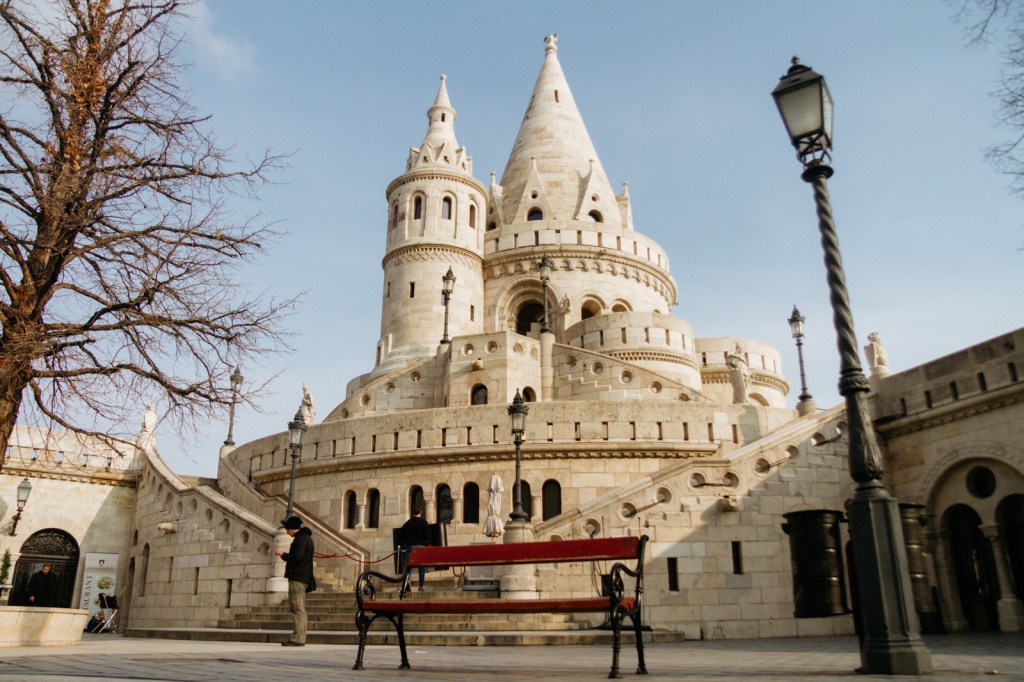
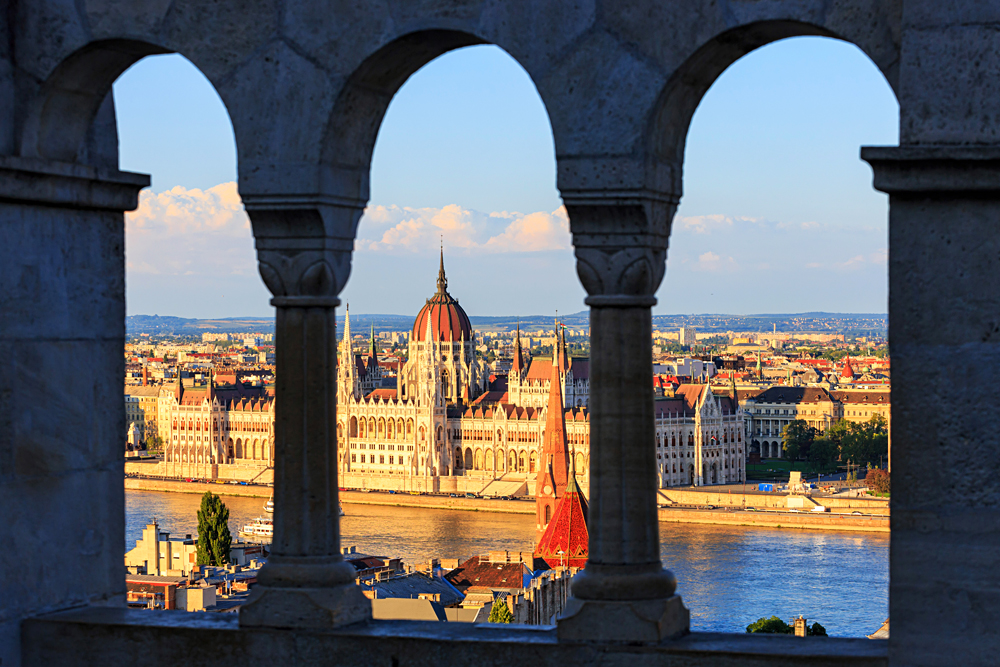
It looks as impressive as all get-out, but the Fisherman’s Bastion (Halászbástya) on Budapest’s Buda bank was actually built between 1895 and 1902 to serve as a viewpoint over the Danube. The myth behind it is that during the Middle Ages, it was the role of the Fishermen’s (Halász) Guild, located in the general vicinity, to protect that reach of the river from invaders.

Sitting across the Danube from the Bastion is the Hungarian Parliament, built around the same time. There was a lot of construction in Budapest around that time because 1896 was the thousandth anniversary of the settlement of the Magyar peoples under Arpad in the plain that was to become Hungary.

And here is the view of Parliament from the arches of the Bastion.

I was in Hungary and Czechoslovakia with my parents in 1977 and saw the sights with my cousin Vörös Ilona, who worked for the Hungarian State Railways (MÁV). It was an interesting trip. In addition to Budapest, we hung out at Lake Balaton, visited a huge opera festival in Szeged (where, to stay in a railway workers’ hostel, I had to pretend to be a Hungarian railway worker), and travel to where my father was born in the present day Slovak Republic.

Like Poland, Hungary was on one of the main invasion paths into Europe. Its history was a tragic one, fighting off (not always successfully) the Mongols, the Austrians, the Germans, and the Russians. Now it’s ruled by a rightist dictator named Viktor Orbán, who is smarter than Donald J. Trump, but in the same political ballpark.

To the Hebrides

If you go to Scotland, the best thing to see are the islands. The concession for RORO (Roll On Roll Off) car ferries to the Hebrides is run by Caledonian MacBrayne. They include longer trips to Stornoway in the Outer Hebrides, as well as a 5-minute sail between Mull and the Sacred Isle of Iona, where the ancient kings of Scotland are buried.

Martine and I have ridden the Caledonian MacBrayne ferries to Mull, Iona, and Islay. In the Middle Ages, the Hebrides were ruled from Islay by the Lord of the Isles, the best known of whom was Somerled (1113-1164). At their height the Lords of the Isles were the greatest landowners and most powerful lords after the Kings of England and Scotland. Today, the Lord of the Isles is Charles, Prince of Wales—though the title is now purely ceremonial.

Above is Kildalton Cross on Islay, where my favorite Scotches are distilled: Laphraoig, Bowmore, Ardbeg, Lagavulin, Bruichladdich, Bunnahabhain, and Caol Ila. They are known for their peat smoke aroma.

When it is safe to travel again, and if I had the money, I would love to go to Scotland and hop aboard Caledonian MacBrayne, going from island to island.

If you are ever interested in seeing a classic British film set in the Hebrides, I highly recommend Alexander Mackendrick’s Whisky Galore! (1949), based on Compton Mackenzie’s novel of the same name. It’s a classic.

Lost in the Mayle

Pick a place, imply that it is a paradise, write several best-selling books about it, maybe invest in real estate there for the inevitable onrush of rich twits—and you could be said to have wrecked the place for good. I am referring here to Peter Mayle’s A Year in Provence and its 10,000 sequels.

Some thirty years before Mayle started in on his demolition quest, M F K Fischer spent some time with her two daughters in Aix-en-Provence and wrote a far better (though not so well-known) a book with her Map of Another Town: A Memoir of Provence (1964). Fisher obviously loved Provence, but she (M F K stands for Mary Frances Kennedy) was not afraid of presenting it warts and all.

When she first visited Aix, France was still suffering from the war. The town was full of misshapen beggars, many of whom were from Poland and other places that suffered the brunt of Nazi invasion. She tells one story of a French pianist whose house quartered several German officers. Her expensive piano was not to be touched by the pianist, but she was expected to appreciate the musical efforts of her tenants.

I have always loved books about travel, but I have always preferred books which were honest. There are thousands of puff pieces about the four corners of the earth, but they pall rather quickly. To give one example, Jonathan Raban’s excellent Passage to Juneau: A Sea and Its Meanings was not only about travel, but about its author’s life coming apart in the process. The following quote from a review in The Guardian explains it all:

“Journeys,” says Raban, somewhere towards the end of Passage to Juneau, “hardly ever disclose their true meaning until after – and sometimes years after – they’re over.” This book was conceived of as a piece of work, but the professional project is, in the end, wholly subsumed by a floodtide of personal crises that leave the author gasping for air. Did he contemplate keeping them off stage and sticking to the route he’d blithely plotted, back in his Seattle study? Perhaps – but like any good captain, Raban elects in the end to go down with his ship. Passage to Juneau is not the book Raban set out to write. It’s richer, rawer and far, far more rewarding than that.

For this reason, I’ll take M F K Fischer over Peter Mayle any day of the week. I highly recommend her book.