Where is the world’s largest pyramid located? You’re looking at it, in this photograph of the pyramid at Cholula near Puebla, Mexico. You can walk up to the pyramid, and it just looks like a hill, on top of which the Spanish built the church of Nuestra Señora de los Remedios. The base is four times the size of the Great Pyramid of Giza in Egypt.
Cholula is just a few minutes west of Puebla and is famous for the number of churches in a city of its size. The legend is that there are 365 churches in the city of approximately 100,000, one for each day of the year. Actually, there are about 37, which is quite enough.
As I recall, there are some very claustrophobia-inducing tunnels that cut through the pyramid, which I decided to skip. They were used by archeologists to determine how many layers of pyramid there were on the inside.
Funerary Tower (Chullpa) on the Shores of Peru’s Lake Umayo
In the lands around Lake Titicaca in Peru and Bolivia, the native cultures believed in building funerary towers called chullpas to house their dead. Even under Incan rule, the Aymara-speaking Colla people continued this practice.
In 2015, I visited Sillustani, which contained the most impressive collections of chullpas situated on a nearby hill. Unfortunately, one cannot always guarantee good weather on a vacation outing, and the weather at Sillustani was vile that day. Consequently, I not only took no pictures but decided not to climb the hill in the rain (and at 12,000 feet or 3,700 meters altitude). So I took none of the pictures shown on this page.
Funerary Towers at Sillustani
I paid dearly for my trip to Sillustani, which included sampling some quinoa soup at a local resident’s kitchen. The next day, I was struck with a horrible need to go to the bathroom while on a lancha plying Lake Titicaca. I must have looked green in the face as I soldiered on in search of some toilet somewhere. Finally, on Isla Taquile, I found one; though I can’t say I got much from that day’s journey other than incredible discomfort.
“Mitch the Witch II” with Two Confirmed Japanese Warship Victims
The Coachella Valley means a lot more to me than giant rock concerts. There’s Mount San Jacinto brooding over the valley, the Living Desert Zoo and gardens in Palm Desert, delicious Deglet Noor dates, and, of course, the Palm Springs Air Museum.
Apparently, a lot of WW2 pilots found their way to the Coachella Valley and contributed their efforts to making the Palm Springs Air Museum one of the best in the United States. While they are still walking the earth, these are the best and most learned docents on the subject that you can find anywhere.
“Bunny”—Is She African-American?
The Museum is located on Gene Autry Trail on the east side of the Palm Springs Airport. As you see the exhibits parked outside, you can watch passenger jets take off and land just a few hundred feet away.
You can even climb up on one of the WW2 bombers and walk through it, marveling at how lightweight and flimsy it appears to be.
“King of the Cats”
I find I can spend hours wandering among the hundred or so aircraft, stores inside and out, and dreaming what it must have been like to fight two enemies on opposite sides of the globe.
Wherever your beliefs may lie on the subject, I recommend you visit the UFO Museum in Roswell, New Mexico. First of all, it is entertaining in its depiction of widespread beliefs of space alien visits. Secondly, it’s not so earnest that it doesn’t have a bit of fun with its visitors. It’s all here, both the deadpan reportage of sightings and references to sci-fi classic films.
Oh, and thirdly, the souvenir shop is not to be missed. As I write this post, I am wearing my Roswell UFO Museum T-Shirt.
Klatu Berada Nikto
Roswell is not really on the way to anywhere, unless you count Carlsbad Canyons National Park. And from there to Interstate 40 is a long and relatively featureless drive. The only other nearby tourist attractions are the town of Lincoln (of Billy the Kid fame), Fort Stanton, and Fort Sumner (where Billy the Kid is buried).
If you’re looking for a road trip to the Southwest this fall (but please, wait for the heat of summer to die down), Roswell is a fun stop and clearly worth two or three hours of your time.
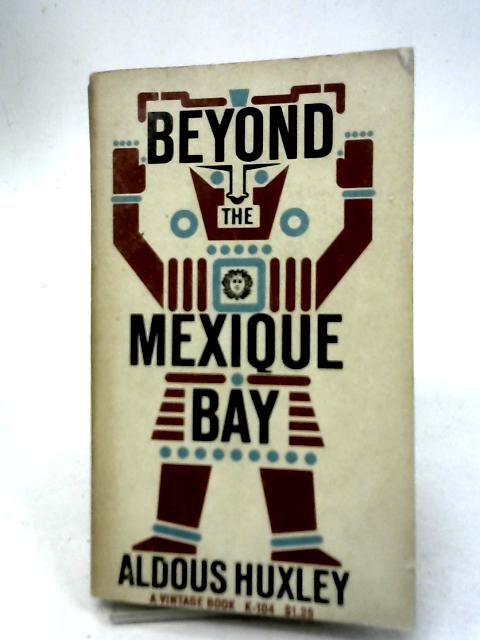
Two writers who influenced my travels in Mexico are Aldous Huxley, who wrote Beyond the Mexique Bay in 1934, and Graham Greene, who wrote The Lawless Roads in 1939. Both writers were there during a rough time. The Mexican Revolution was theoretically over in 1920, but there were not only widespread disturbances, but there were not, as there are today, a safe system of intercity roads. Plus Huxley spent most of his book on his travels in Guatemala and Honduras.
Greene’s book was my guide to a trip my brother and I took to Mexico in 1979. We flew to Mexico City and transferred to a flight to Villahermosa, which at the time impressed me as the armpit of the republic. Greene then then made his way to the Maya ruins at Palenque. From there to San Cristóbal de las Casas was lengthy journey over the Sierra Madre on muleback. For Dan and me, it was an all-day journey by second class bus during which we passed a bus from the same company (Lacandonia) that had run off the road and encountered an army inspection just outside of Ocosingo. From there we visited Oaxaca and rode an all-night bus back to the Mexico City airport.
Old Penguin Cover for The Lawless Roads
Greene had considerably worse experiences during his trip over forty years earlier. In the middle of his journey, he broke his glasses:
Just short of our destination a sudden blast of wind caught my helmet and the noise of cracking cardboard as I saved it scared the mule. It took fright and in the short furious gallop which followed I lost my only glasses. I mention this because strained eyes may have been one cause for my growing depression, the almost pathological hatred I began to feel for Mexico. Indeed, when I try to think back to those days, they lie under the entrancing light of chance encounters, small endurances, unfamiliarity, and I cannot remember why at the time they seemed so grim and hopeless.
Why the author went to Mexico with a single pair of glasses is a mystery to me. Fortunately, I never felt any pathological hatred for Mexico, based on the many subsequent journeys I took there.
The Edition of Huxley’s Book That I Own
I have also been to most of the places that Aldous Huxley described in Beyond the Mexique Bay during my trip to Guatemala and Honduras in 2019. Unlike Greene who saw only the Maya ruins at Palenque, Huxley traveled to Copán in Honduras and Quirigua in Guatemala.
Like Greene, Huxley also had a problem with the people of Central America. At one point, he lets it all hang out: “Frankly, try how I may, I cannot very much like primitive people. They make me feel uncomfortable. ‘La bêtise n’est pas mon fort.’” The French expression could be translated thus: Stupidity isn’t my strong point.
These two civilized and (perhaps) sticky Englishmen did manage to write interesting books which engaged my interest through multiple readings over a period of more than four decades.
Now why would you want to read books written almost a century ago when there are more current books on the subject? My answer is a simple one: The best recent books were written with a knowledge of what went before. And when it comes to Mexico, one could easily go back to the books of John Lloyd Stephens written in the 1840s. (In fact, I will do just that in a follow-up post.)
My 2019 vacation in Guatemala started out on a promising note. Instead of staying in Guatemala City, I immediately took a van to Antigua Guatemala, a beautiful city a scant thirty minutes from the capital that is surrounded by active volcanoes and the ruins of churches which collapsed during the disastrous 18th century, which required the city to move several times in its history:
The San Miguel Earthquake of 1717
The San Casimiro Earthquake of 1751
The Santa Marta Earthquake of 1773
When I was in Antigua in January 2019, I spent most of my time visiting ruined churches.
Ruined Church with Collapsed Roof
In the end, I got as much fun from visiting the ruins of Spanish Catholicism as I did the Maya cities like Copán in Honduras, and Quiriguá and Tikál in Guatemala’s Petén jungle.
Although Guatemala is not known for its cuisine, the food I had was uniformly good, particularly the beans. I wouldn’t mind going again, if that is in the cards for me.
It was January 1980. My brother and I were traveling in an arc across southern Mexico along a route taken by Graham Greene in the 1930s, when he was doing his research for The Power and the Glory, which he described in his travel book The Lawless Roads.
Dan and I flew to Mexico City, transferring there to a flight to Villahermosa, which was the least hermosa (beautiful) city either of us had seen in all of Mexico. From there, we went to Palenque, San Cristóbal de las Casas, Oaxaca, and back to Mexico City via all-night bus.
While we were in Oaxaca, we took a side trip to see the Mixtec ruins at Mitla, which consisted of numerous geometric motifs such as are shown in the above photo. Seeing ruins in the desert makes one hungry and thirsty, so we repaired to a little restaurant within shouting distance of the ruins.
We were the only customers in the place. After a few minutes, a little girl raced out of the kitchen and stopped dead in her tracks, seeing two large and hairy gringos seated at a table. She did a quick U-turn and ran back to the kitchen shouting ¡Mamacíta! Within a couple of minutes, her mother appeared at our table with a notepad asking in Spanish what we wanted. Dan and I both ordered chicken enchiladas, rice, and beans.
There followed a long delay of several minutes which was punctuated with what Dan and I recognized as the death squawk of a chicken whose neck was being wrung. (Our great grandmother, old Hungarian farm woman that she was, liked to buy live poultry and butcher them and pluck their feathers herself.)
In time, about thirty minutes in all, our lunches were served. The chicken which had given its all for us turned out to be old and tough, with a decidedly stringy texture. It had been old, but by God it was fresh! We did our level best to eat as much as we could before thanking the proprietor and her daughter and making our way to the bus terminal.
That was a fun trip which gave us dozens of funny stories to remember for the long years to come.
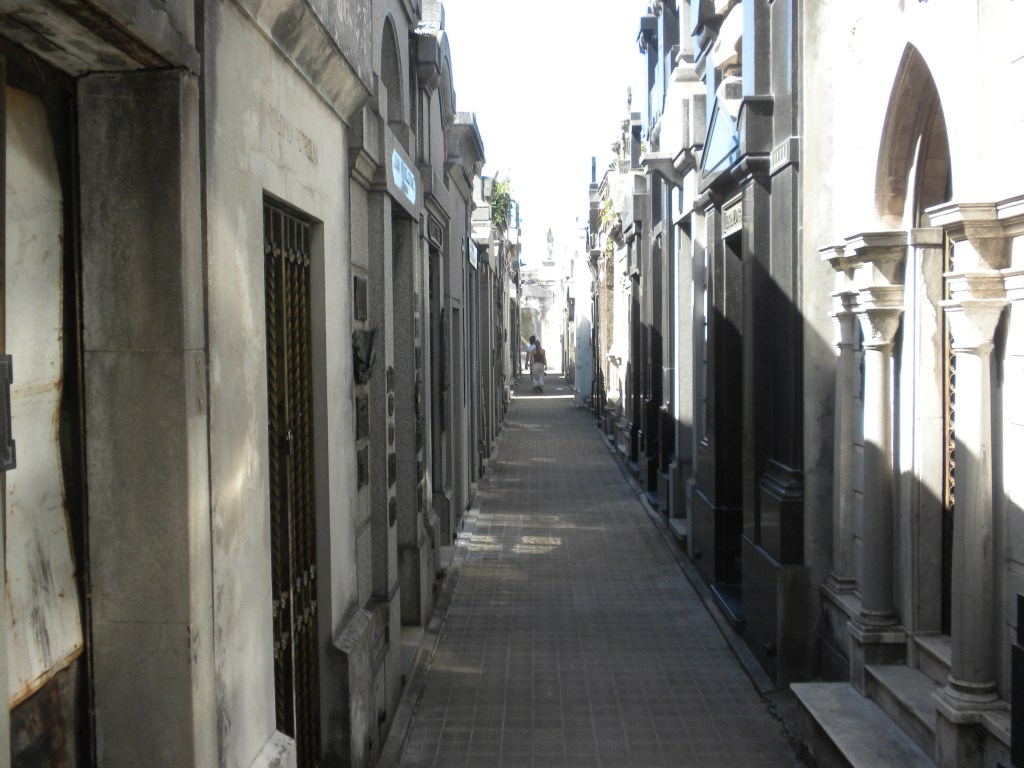
When former military dictator of Argentina Juan Perón died in 1974, he couldn’t be buried at Buenos Aires’s exclusive Recoleta Cemetery. It was most galling to his followers that his widow Evita did manage to be buried there with the rest of her family (née Duarte). Eventually, his body was moved to the grounds of his estate in the exclusive barrio of Olivos.
I have visited Recoleta during each of my three trips to Argentina. Why? It is actually the number one tourist destination in Buenos Aires—and it’s free. Just about everyone of note in Argentine history and culture is buried there. Adolfo Bioy Casares the writer is buried there, but the Argentina’s greatest writer, his friend Jorge Luis Borges, is buried in Geneva, Switzerland, where he died in 1986.
One of Many Bronze Commemorative Plaques Marking the Grave of Evita Perón
Among other famous denizens are past presidents such as Agustín Pedro Justo, Bartolomé Mitre, Domingo Faustino Sarmiento, Hipólito Yrigoyen, Julio Argentino Roca, Pedro Eugenio Aramburu, and Raúl Alfonsín. There’s famous boxer Luis Firpo; Isabelle Walewski, a granddaughter of Napoleon Bonaparte; warlord Facundo Quiroga; writer Silvina Ocampo and her sister, publisher Victoria Ocampo; and William Brown, Irish-born founder of the Argentinean Navy (widely known as Almirante Brown).
The Narrow Streets of Argentina’s Notable Dead
In fact, the last time I stayed in Buenos Aires, I stayed at a hotel right across the street from the west wall of the cemetery.
This is a repost from Multiply.Com which I wrote some ten years ago:
Oh, oh! I’ve been thinking about Argentina again, and that means you’re going to hear about some more really obscure (but, IMHO fascinating) stuff.
To begin with, Argentina is such a Catholic country that it had to create additional saints native to its own soil. Let’s begin with La Difunta Correa, which means, literally, the Dead Correa:
According to popular legend, Deolinda Correa was a woman whose husband was forcibly recruited around the year 1840, during the Argentine civil wars. Becoming sick, he was then abandoned by the Montoneras [partisans]. In an attempt to reach her sick husband, Deolinda took her baby child and followed the tracks of the Montoneras through the desert of San Juan Province. When her supplies ran out, she died. Her body was found days later by gauchos that were driving cattle through, and to their astonishment found the baby still alive, feeding from the deceased woman’s “miraculously” ever-full breast. The men buried the body in present-day Vallecito, and took the baby with them. [from Wikipedia] All over the country, there are roadside shrines to La Difunta Correa, many surrounded by gifts left by truck drivers and travelers in a hope for a safe journey to their destination. Remember that Argentina is the eighth largest country on earth, and that distances can be farther than one ever imagines, especially on unpaved ripio roads.
There are two other popular saints with shrines all across the nation: Gauchito Gil (“Little Gaucho Gil”) and El Ángelito Milagroso, a.k.a. Miguel Ángel Gaitán.
Gauchito Gil hails from the state of La Rioja. A farmworker, Gil was seduced by a wealthy widow. When the police chief, who also had a thing for the widow, and her brothers came after Gil, he joined the army in the War of the Triple Alliance against Paraguay (perhaps the bloodiest war ever fought in the Americas, with the exception of our own Civil War). When he returned home, the Army came after him to join in one of Argentina’s many civil wars. Not to put too fine a point on it, the Gauchito deserted. He was discovered by the police, who wanted to execute him. Whereupon Gil prophesied to the head of the police detail that if he were merciful, the officer’s child, who was gravely ill, would get better. Instead of being shown mercy, Gil was executed.
When he returned home, the police officer found that his son was indeed very ill. So he prayed to Gauchito Gil, and his son got better. It was this police officer who returned to the scene of the execution, gave Gil a proper burial, and built a shrine in his memory. Today there are hundreds of such shrines scattered throughout the country.
By the way, the Gauchito is not the only deserter hero in Argentina’s past. Perhaps the national epic is Martin Fierro by José Hernández, about a gaucho who deserts from the so-called “Conquest of the Desert”—really a war of genocide against the native tribes of the Pampas—and is pursued by the police militia.
The Nineteenth Century in Argentina was unusually bloody, what with civil war, wars against the native peoples, and wars against other countries such as Paraguay and Brazil. So it is not unusual to find deserters as heroes, which is unthinkable in Europe and North America.
Finally, there is another La Rioja “saint” named Miguel Ángel Gaitán, El Ángelito Milagroso, who died at the tender age of one in 1967. When his body didn’t rot, the locals thought that meant it was supposed to be exposed for veneration—and so it was.
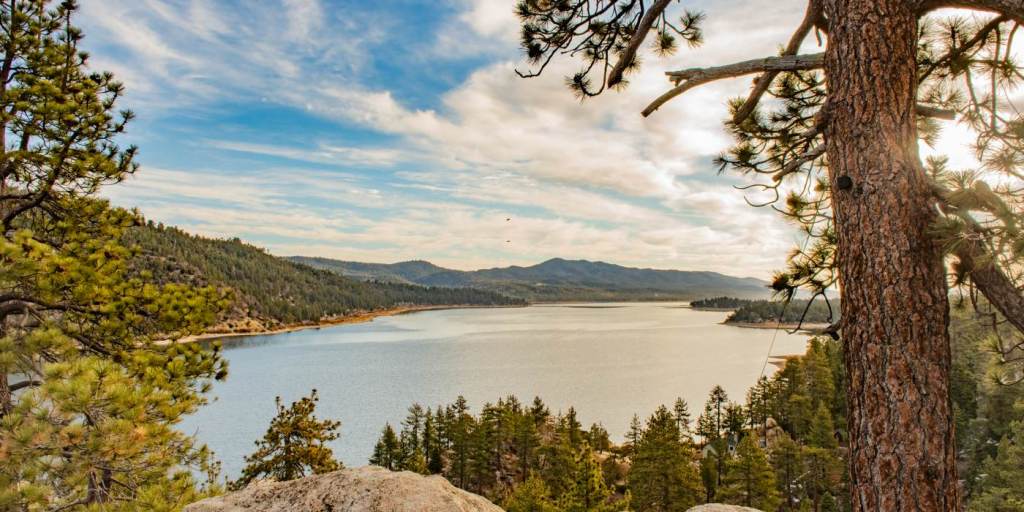
Big Bear Lake Is Located 25 Miles Northeast of San Bernardino
I am itching to get out of Los Angeles for a 2-3 day road trip. One place I have never been in Big Bear Lake, which is about a two plus hour drive from where I live. Most of that drive would be fighting my way through the City of Los Angeles. Then I would cut north around San Bernardino and ascend to 6,752 feet (2,058 meters) above sea level. It is a major resort area with restaurants, accommodation, and numerous activities. It’s probably best known for skiing, but that is not what interests me.
My interests are more in the line of looking around and taking pictures. I’m thinking of taking some time off after my numerous medical appointments between now and the middle of June.
Archway Welcoming Guests to Big Bear Village, with Tall Ghost on Right
I know it’ll cost a few shekels, but then everything does.













 Tarnmoor
You must be logged in to post a comment.