Ganging Aft Agley

I Seem to Have Miscalculated...

I Seem to Have Miscalculated…

A couple of weeks ago, I wrote a post entitled “From Chile Peppers to High Mountain Passes” in which I proposed  flying into El Paso, renting a car, driving in a more or less straight line without having to double back, and delivering the rental car in another city, say Denver or Salt Lake City.

But funny things happen when one doesn’t think things through. Can you imagine all the rental cars from an agency in Peoria disappearing down south and suddenly showing up in Miami or Houston or Chattanooga? How would the agency get the cars back? Would they ship them by rail or UPS or even truck? The cost would be prohibitive.

And the cost was prohibitive. Both Hertz and Enterprise would have charged an additional fee of over $1,500 for delivering the car to another city.

I immediately scrapped the idea and resolved instead to fly in and out of Albuquerque. To avoid doubling back, I would take a series of loops: For instance, I would drive to Chama to take the Cumbres & Tolec Railroad, Durango, Colorado, to take the Durango & Silverton, and return via Gallup and New Mexico Route 53 to see the El Morro National Monument, and on I-40, Acoma Pueblo, or “Sky City” on the way back to home base.

A second loop would take us south of Albuquerque to see Roswell, Capitan, and Alamagordo, with its great space museum.

The best laid plans of mice and men gang aft agley, or something like that.

Trinity

The First Atomic Bomb Blast at the Trinity Site

The First Atomic Bomb Blast at the Trinity Site

I was born a few months before it all happened: On July 16, 1945, the first atomic bomb was exploded at the north end of the Jornada del Muerto, that desolate extension of the Chihuahan Desert that forms the south central portion of New Mexico. This summer, I will be driving on U.S. 380 just north of the Trinity Site, which is open only two days a year. I’m surprised that it is open even that much given that there is still a lot of radioactivity lingering in the area.

According to Alan Boye in Tales from the Journey of the Dead: Ten Thousand Years on an American Desert (Lincoln: University of Nebraska Press, 2006), some 15,000 people in the vicinity died of cancer from the radioactivity, and some 20,000 people suffered non-fatal forms of cancer.

Trinitite Sample

Trinitite

Much of the area around the blast is covered with a green glass-like mineral called Trinitite, which in many cases still makes Geiger Counters tick, though samples for sale can be found in rock shops around the area.

When J. Robert Oppenheimer was interviewed about the blast, he quoted from the Bhagavad Gita: “Now I am become Death, the destroyer of worlds.” Now that power is in the hands of Donald J. Trump. Doesn’t that make you feel safe?

The OTHER El Camino Real

This Camino Real Was Nowhere Near the Ocean

This Camino Real Was Nowhere Near the Ocean

If you drive north on U.S. 101, you will see scads of quaint mission bell markers identifying it as El Camino Real—and so it was! But it was not the only one. There is another one, every bit as picturesque but far deadlier, through the heart of New Mexico. It is called El Camino Real de Tierra Adentro, “The Royal Road to the Interior Lands.” These interior lands consisted primarily of the city of Santa Fe together with its constellation of pueblos.

Picture New Mexico as being divided into six roughly equal size vertical rectangles, three in the north and three in the south. The south central one is the northern reach of the Chihuahuan Desert, usually referred to as the Jornada del Muerto, the Journey of the Dead. The Chihuahuan Desert proper extends for 1,200 miles south to the Mexican State of Zacatecas. The rightmost two-thirds of the rectangle is occupied by the White Sands Missile Range.

The leftmost one-third of that rectangle includes the Rio Grande River, the El Camino Real de Tierra Adentro, and a lot of desolate, searing nothingness.

The Jornada del Muerto

The Jornada del Muerto

Martine and I will probably intersect the Jornada del Muerto from East to West as we travel along U.S. 380, right past where the first atomic bomb explosion occurred at the now (mostly) closed Trinity Site. We will be leaving Capitan, New Mexico, and heading northwest to Albuquerque, where we will stay for a few days.

I am now reading Alan Boye’s Tales from the Journey of the Dead: Ten Thousand Years of an American Desert (Lincoln: University of Nebraska Press, 2006), which examines the route along the Rio Grande to Mexico throughout history from Clovis and Folsom Man through to the Manhattan Project. In addition, the author describes his own jaunts through the Jornada today in an effort to give a feeling for the fierceness and beauty of the land.

Unfinished Business

Accordion Player in Downtown Buenos Aires

Accordion Player in Downtown Buenos Aires

I always say I have unfinished business with the people, places, and things that I love. Take Argentina, for instance. I have been there in 2006, 2011, and 2015. The first time, I broke my shoulder by slipping on the ice in Tierra Del Fuego; the second time (the best), I went with Martine and saw a good chunk of the Patagonia; the third time was mostly just fill-in, with visits to Iguazu Falls and Sar Carlos Bariloche. But I am by no means finished with Argentina, nor Argentina with me.

There is a broad stretch of the South Atlantic I’d love to see between Rio Gallegos and Carmen de Patagones. I would not mind taking long bus rides to God-forsaken ports like Puerto San Julian, Puerto Deseado, Caleta Olivia, Comodoro Rivadavia, and Bahia Blanca. I don’t even care if there aren’t that many notable tourist sights. I could easily put up with some slow time, especially as I would have two Kindle readers with me, and some 3,000 different titles to read. At my side will be my pocket digital rangefinder camera to catch people and places in the process of being something special.

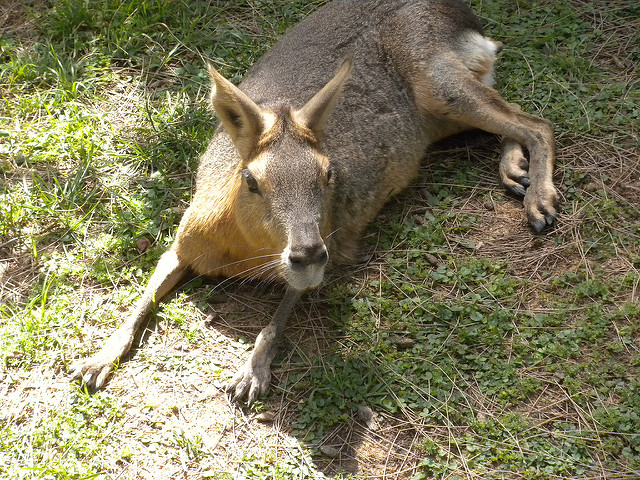
Guanaco in the Buenos Aires Zoo

Guanaco in the Buenos Aires Zoo

Argentina isn’t the only place I’d like to see again. I wouldn’t mind spending more time at the English Bookshop in Quito, Ecuador. And Iceland will continue to be a lifelong love of mine. I only wish I could get Martine to come with me. She has some idea that she would have to dress like an Eskimo amid huge snowdrifts. Far from it! Iceland will be one of the few countries to benefit from global warming. My favorite destinations in Europe are on hold for now, because I suspect that mass immigration will change that continent forever. I also want to see more of the American Southwest, and Martine and I are planning one such trip right now that will take up large swaths of New Mexico, Colorado, and possibly Utah.

As Lao Tzu wrote, “From wonder, into wonder, existence opens.”


From Chile Peppers to High Mountain Passes

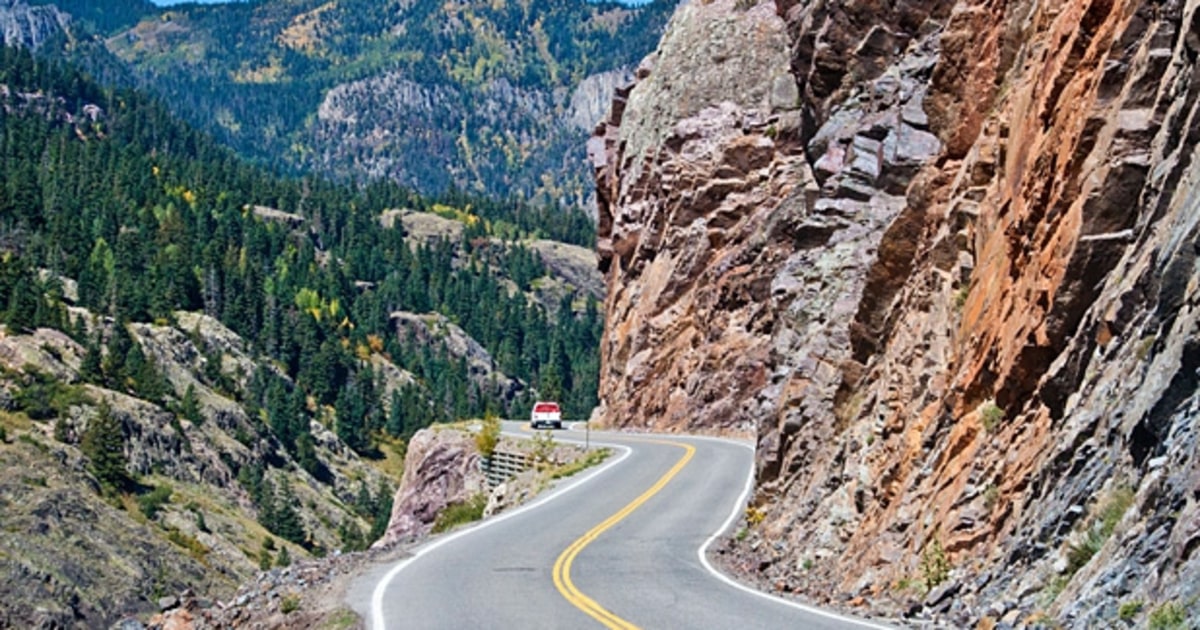
A Stretch of the Million Dollar Highway in Colorado

A Stretch of the Million Dollar Highway in Colorado

Is it too early to start planning my next vacation? Not at all—especially since Martine agreed to come with me this time, but only if I limited it to two weeks. “I could do this,” I thought. Some years ago, we traveled through Arizona, New Mexico, and bits of Utah and Colorado. I thought we could take a shorter version, timewise, at least.

I thought we could fly into El Paso, rent a car, and drive north to Alamogordo with its space museum and Capitan, a village dedicated to its most famous resident, Smokey Bear. There we will stay at the Smoky Bear Motel, dine at the Smokey Bear Restaurant, and certainly visit the Smokey Bear Museum. (Martine loves Smokey Bear.)

Then it’s north to Albuquerque, where we’ll stay for several days and maybe take side trips to Acoma, one of the two oldest continuously inhabited places in North America (the other is Old Oraibi on the Hopi Reservation in Arizona) and El Morro National Monument. Perhaps we will also re-visit the Wild Spirit Wolf Sanctuary in nearby Ramah. And while in Albuquerque, I will drink deep of the smoldering juices of red and green chiles—the best in the world.

From Albuquerque, we head north to Chimayo to visit its famous Sanctuary and on to Chama. Thereupon, we will take a ride on the Cumbres & Toltec Scenic Railroad, which runs between Chama, NM and Antonito, CO. Next on the roster will be a ride on the Durango & Silverton Narrow Gauge Railroad. Yes, I am a railroad fanatic

From Silverton we drive north on one of the most dangerous stretches of roadway in the United States, the Million Dollar Highway to Ouray, CO.

Finally, we’ll make our way to Denver, from where we fly back to Los Angeles.

One of the nice things about so-called “open jaws” flights is that you do not have to spend any time backtracking. Originally, I thought of flying to and from Albuquerque, a city I dearly love; but half the time we would be backtracking from side trips. This way, it’s all on a more or less straight line from El Paso to Denver.

“What about White Sands, Santa Fe, Chaco Canyon, Taos, and Mesa Verde?” you might ask. Martine and I have been there, and we are concentrating on places we haven’t visited.

No Beach Paradises for Me

Actually, Not My Idea of a Fun Trip

Actually, Not My Idea of a Fun Trip

Once again, I find myself in he minority. I live two and a half miles from Santa Monica Beach and about four miles from Venice Beach. If I wanted to go to the beach, I could walk there. The fact of the matter, however, is that beaches are not my idea of fun. The water is full of garbage and strange parasitic bacteria, the sun is usually too hot, and it’s virtually impossible to read there.

Back in the 1980s, I visited a number of beaches in Mexico at Mazatlán, Puerto Vallarta, and Cozumel; and I went with Martine to Cabo San Lucas two years ago this month. I thought they were very nice, but I don’t do the usual things that people do at the beach. If I go into the water at all, it’s to slosh around as I take a short walk. I’m not into swimming, I don’t snorkel or water surf. At Cabo, my sole water activity was a boat ride to see the arch pictured below.

Harbor Cruise to See the Arch at Cabo

Harbor Cruise to See the Arch at Cabo

When I Travel, I’m usually not interested in staying in one place: I like to move around and look around. Instead of brightly colored tropical drinks, I’ll settle for an ice cold beer after a hard day’s touring. The next trip I am planning—to New Mexico with Martin—is far from any beach. But there’s a lot to see, and some good food to be had seasoned with the local hot chiles.

Leaving Tabasco

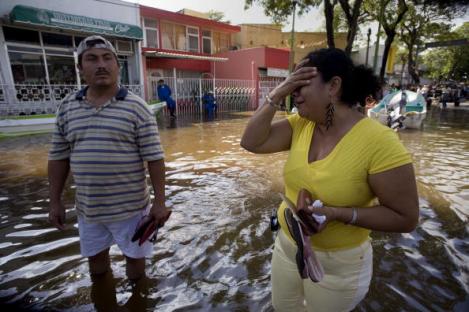
Flooding in the Streets of Villahermosa

Flooding in the Streets of Villahermosa

To begin with, you can forget the vinegary hot sauce from McIlhenny Company. I’m talking about the State of Tabasco in Southeastern Mexico. I have had four encounters with this state, two by visiting its inappropriately named capital of Villahermosa in 1979 and sometime in the 1980s, and two from literature.

Tabasco first entered my thoughts when reading Graham Greene’s The Power and the Glory back in High School, and subsequently reading the same author’s book about his travels there in The Lawless Roads. From around 1920 to 1935, Tomás Garrido Canabal was virtual dictator of the State of Tabasco. A devout anti-Catholic, he persecuted the church and executed many priests and religious. So Greene went there and investigated for himself, writing his two books. (The Power and the Glory was later made into a film called The Fugitive, directed by John Ford and starring Henry Fonda.)

My first visit to Tabasco was in 1979 with my brother. We planned to overnight in Villahermosa before visiting the Mayan reuins at Palenque in nearby Chiapas. We were stunned to find that Pemex, the Mexican petroleum monopoly, was block-booking all the hotels for its employees and suppliers, leaving us nothing but the down-at-heels Casa de Hospedaje Mary (which my brother christened the “Casa de Hopes-You-Die Mary”), where we were awakened every 15 minutes from our damp and fitful sleep by roosters crowing on the roof and church bells tolling the quarter hour. That was after a dreadful meal of shrimp coated with tar and two hours spent looking for a bus terminal that wasn’t where the guidebook said it was.

Olmec Head at Parque La Venta

Olmec Head at Parque La Venta

The second visit was by myself several years later. I visited the giant Olmec heads at the Parque-Museo de la Venta, taking advantage of a long plane delay flying between Mérida, Yucatán, and Tuxtla Gutiérrez, Chiapas. I was smart enough not to try to spend the night in Villahermosa, which struck me as a jungle shit-pit which was at the confluence of Mexico’s two largest (and oft-flooded rivers), the Grijalva and the Usumacinta.

Finally, I just finished reading a novel called Leaving Tabasco by the talented Carmen Boullosa. Here was an authentic voice from rural Tabasco who uses magical realism to signal her disillusionment with her character Delmira Ulloa’s childhood in the village of Agustini.

Carmen Boullosa

Carmen Boullosa

Safely ensconced in Europe, Delmira muses about her origins:

For three decades I didn’t sleep in a hammock, I saw no strange objects floating in water. No albino crocodile popped into my room, no army of Indians came by sucking voluptuously on juicy insects, no legion of toads exploded against my balcony, there were no imposing witches hawking fake merchandise, no rainstorms purchased for cash. I’ve spent six times five years here without hearing once the nightly tale of my grandmother. I came here in search of a world that obeyed the laws of physics; it is now all around me, but I can’t say I’ve come to terms with it.

Leaving Tabasco ends with a lot of questions, but no answers. That’s all right with me, because I don’t believe too much in answers—and I have a lot of questions of my own. One thing for sure: After reading Boullosa, I want to read more by her … and maybe … just maybe … I’d like to give Tabasco another chance.

Long Ago and Far Away

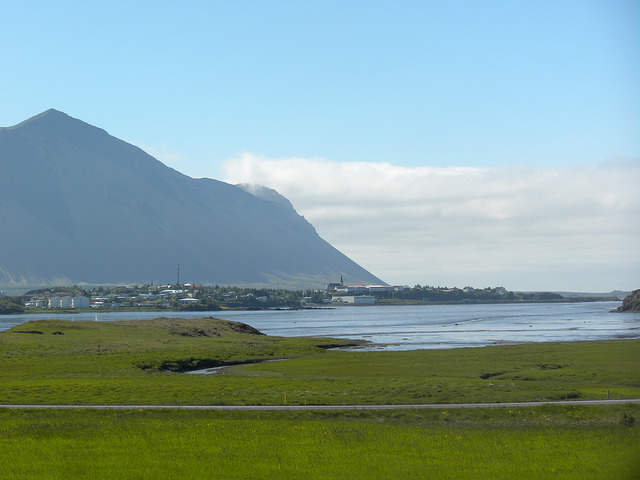
Borgarnes, Iceland, As Seen from Borg á Mýrum

Borgarnes, Iceland, As Seen from Borg á Mýrum

Today is the first day of Winter, and my mind goes back to that land I associate most closely with Winter, namely: Iceland. When I took this picture in 2013, I was at Borg á Mýrum, the historical farmstead of Egill Skallagrimsson, poet and hero of the 13th century Egill’s Saga, which was thought to be written by Snorri Sturlusson, perhaps the greatest writer of his time.

About Iceland, I will say about every place I’ve visited that I’ve loved deeply: I have unfinished business with the place. I still want to see the Northeast of Iceland, from Seyðisfjördur to Raufarhöfn, and the national parks around Þórsmörk and Skaftafell. And I hope to take Martine with me. My last two visits to Iceland were by myself, and I hope to share the places I love with the woman I love.

Alone or accompanied, I plan to return to Iceland—had I but world enough and time.

Xmas Treacle

Some Things About Christmas I Could Definitely Do Without

Some Things About Christmas I Could Definitely Do Without

The following is from Patrick Smith’s excellent blog entitled Ask the Pilot. I don’t do this sort of thing very often, but I find myself in such substantial agreement with Patrick that I couldn’t have expressed it better myself:

I don’t much like Christmas, if you must know. The phoniness and thunderous commercialism of it all. Plus, I never get any presents. Typically I work over the holiday. Last year it was Paris. The year before that it was Ghana. This year I’ll be in Scotland. But while I can run, I can’t really hide. Nobody, not even a sourpuss likes me, escapes this grotesque juggernaut of make-believe goodwill and endless consumption. In some ways, maybe, this is for the better. Certainly an author and website curator….

Do not, ever, make the mistake that I once made and attempt to enjoy Christmas at a small hotel in Ghana called the Hans Cottage “Botel,” located on a lagoon just outside the city of Cape Coast. They love their Christmas music at the Hans Botel, and the compound is rigged end-to-end with speakers that blare it around the clock.

Although you can count among those people able to tolerate Christmas music — in moderation, in context, and so long as it isn’t Sufjan Stevens — there is one blood-curdling exception. That exception is the song, “Little Drummer Boy,” which is without argument the most cruelly awful piece of music ever written. [Italics mine] It was that way before Joan Jett or David Bowie got hold of it.

It’s a traumatic enough song in any rendition. And at the Hans Cottage Botel they have chosen to make it the only — only! — song on their Christmastime tape loop. Over and over it plays, ceaselessly, day and night. It’s there are breakfast, it’s there again at dinner, and at every moment between. I’m not sure who the artist is, but it’s an especially treacly version with lots of high notes to set one’s skull ringing.

“Ba-ruppa-pum-pum;ruppa-pum-pum…” as I hear it today and forever, that stammering chorus is like the thump-thump of chopper blades in the wounded mind of a Vietnam vet who Can’t Forget What He Saw. There I am, pinned down at the Botel bar, jittery and covered in sweat, my nails clattering against a bottle of Star lager while the infernal Drummer Boy warbles into the buggy air.

“Barkeep!” I grab Kwame by the wrist. “For the love of god, man, can’t somebody make it stop?”

Kwame just smiles. “So lovely, yes.”

Going Whole Hog

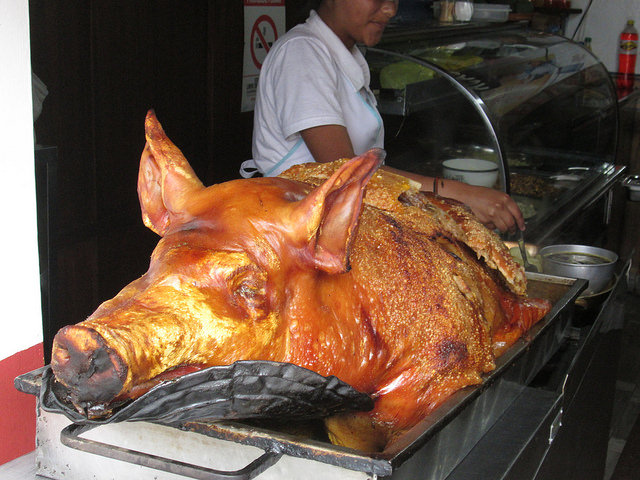
Go Ahead, Pig Out!

Go Ahead, Pig Out!

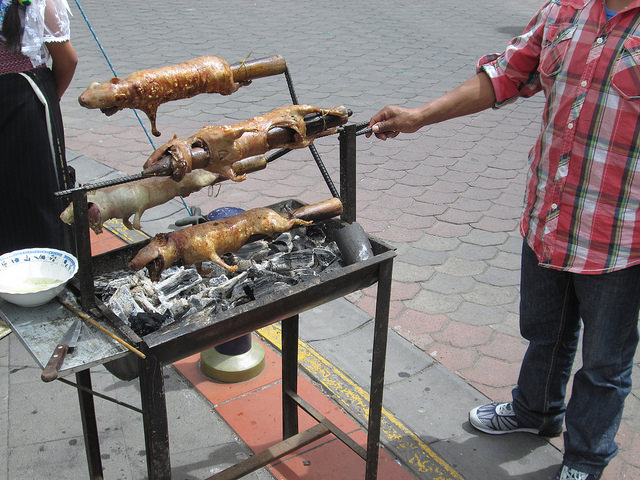
Dan and I were in Otavalo, two hours north of Quito. Famous for its textile and other handicrafts, the town of some 90,000 inhabitants is also famous for fiestas. In addition to the Ecuadoran equivalent of carnitas (shown above), there are other local meat specialties, such as cuy, or guinea pigs (shown below). In both Peru and Ecuador, I have seen paintings in cathedrals of the Last Supper in which Christ and his apostles were dining on cuy. (I’ll try to post one of them at some point in the future.)

Cooking Cuy, or Guinea Pigs

Cooking Cuy, or Guinea Pigs

Dan resolved to try some cuy, but I guess he didn’t have the heart for it. I guess it reminded him too much of the hamster named Mutzi that we had as a pet when we were kids. Also, they are famous for their paucity of meat combined with a plethora of tiny bones.