Flateyri Will Get You Nowhere

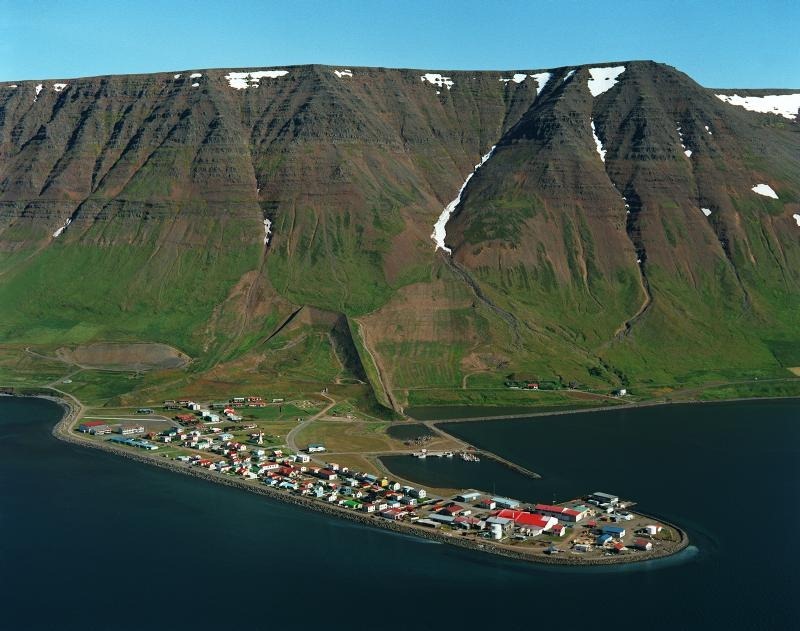
The Town of Flateyri in Iceland’s Westfjords

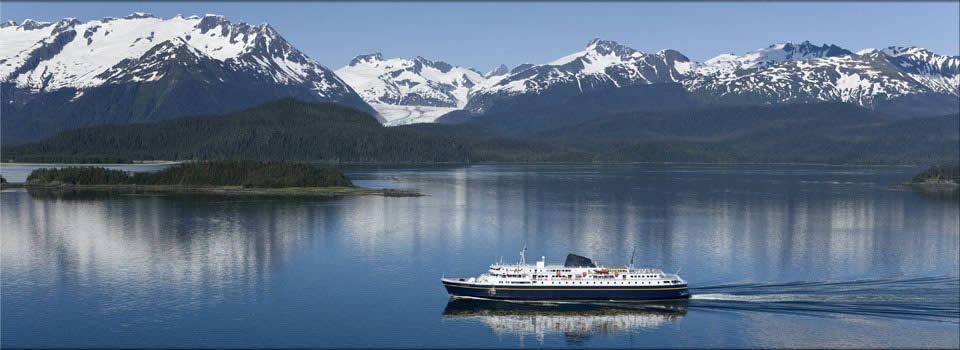
One of the most picturesque parts of Iceland is its northwest, usually called the Westfjords. Here the mountains come close to the coast, and distances between towns are magnified by roads that laboriously travel around the shores of the long fjords that characterize the region. One town I went through in 2013 was Flateyri on the shores of Önundarfjördur, scene of a disastrous avalanche in October 1995. The town had a small population to begin with; and, after twenty people died in the avalanche, many of the survivors pulled up stakes and moved to other parts of Iceland which were not as susceptible to avalanches.

There is still an active fish processing industry in Flateyri, so guest workers from Poland and the Philippines were invited to take up the slack. This caused some problems, as the town fractured on cultural fault lines, with the native Icelanders not mixing well with the Poles and Filipinos, and the latter not making much of an effort to mix with the natives. You can read about this in a 2006 article from the Reykjavík Grapevine. I imagine that, over the last eleven years, the situation as changed for the better. For one thing, there is now a tunnel connecting Önundarfjördur with Isafjördur, the largest town in the Westfjords, taking hours off the trip by highway. I took this tunnel, called the Bolungarvíkurgöng, and it is quite an achievement—17,717 feet in length,

To protect against future avalanches, the Icelanders built a retaining wall (visible in the above photo, shaped like an upside-down “v”). The local restaurant, Vagninn, has re-opened; and a cultural center has been built.

Small towns in Iceland have had a difficult time surviving, especially when there are no large local projects such as aluminum smelters to act as an employment draw. Meanwhile Reykjavík continues to grow at the expense of rural Iceland. One possibility is that global warming will benefit rural Iceland, with more cash crops being grown outside of greenhouses.

John Wayne Never Fought Them

Old Photo of Jemez Pueblo Architecture

The Indians we know most about are the ones that appeared in the old Westerns: The Navajo, Apaches, Comanches, and Sioux. There are some twenty Indian tribes in New Mexico and Arizona that, insofar as I know, never appeared in any. John Wayne never fought them, nor did Randolph Scott or Jimmy Stewart or Audie Murphy. I am referring to the Pueblo Indians, most of which are located around Albuquerque and Santa Fe, New Mexico.

We know that the Navajo, Apaches, Comanches, and Sioux have been warlike. But did you know that the only successful Indian revolt against Western colonization was fought by an alliance of Pueblos in 1680. It was not until twelve years later that the Spanish reconquered the territory, but even then with difficulty. Many of the most warlike Pueblos simply united with the Hopis and Navajos.

I have just finished reading The Pueblo Revolt: The Secret Rebellion That Drove the Spaniards Out of the Southwest by David Roberts (New York: Simon & Schuster, 2004). The key word in the title is “secret.” To this day, the Pueblos do not choose to discuss the conflict—even one that occurred over four centuries ago. Consequently, most people do not know about it.

Pueblo Revolt Scene Painted on a Hide

Why the secrecy? I think it is a cultural trait. Years ago, Martine and I spent the night on the Zuñi Reservation at a time when most of the town and surrounding areas were off limits to non-Zuñis because some tourist had misbehaved at a ceremonial in the distant past. One cannot just waltz into a Puebloan reservation and have the run of the place. You will be referred to the tribal authorities, who most likely will ignore your request as a matter of course. It’s not that they are unfriendly: For them survival involves buttoning their lips, even if it involves a 450-year-old secret that just happens to be none of your beeswax.

Its Own Culture

The Zia, Symbol of New Mexico

Not too many states can be said to have their own culture. I, for one, couldn’t say anything about the state in which I was born—Ohio—except that it’s mostly featureless with some rolling hills. And as for distinguishing it from Michigan, Indiana, or Pennsylvania, forget about it! Even California doesn’t quite have its own culture: It has several of them coexisting within its 164,000 square miles. But New Mexico is a different story altogether. Its capital, Santa Fe, was settled in 1610 and is the highest state capital in the U.S.

When I used to visit New Mexico in the 1980s (with Chaco Canyon my main destination), I was told by residents never to refer to the Hispanic people as Mexicans, but as Spanish. They claim descent not from the people south of the Rio Grande so much as from the conquistadores who quelled them. Their cuisine resembles Mexican food only in certain dishes, most of their cuisine being unique to the region.

Now, as I prepare for my trip there next month, I am beginning to discover it has its own literature. Both Rudolfo Anaya’s Bless Me, Ultima and John Nichols’s The Milagro Beanfield War (and no, I never saw the movie) are set in the northeastern part of the state among the rural Spanish population. I am reading the latter book now, and find it marvelously entertaining, as in this passage about the local sheriff and his wife:

The one real fight Bernabé and Carolina had had in their life together occurred because of the saints. It had been an abnormally dry year (every other year in Milagro was an abnormally dry year, alternating with all those abnormally wet years), and so one day, during the Death of the Fruit ree blossoms time, Carolina carried their San Isidro out into the back field asking it to rain on their cucumbers. Well, sure enough, it raines all right, then the rain turned to snow, and the snow turned into a blizzard, so Carolina ran outside with their Santo Niño de Atocha, begging him to queer the blizzard before the cucumbers and the fruit trees were destroyed, and so the blizzard stopped and it began to rain again and the rain froze and tree branches fell down onto everything, and some cows Bernabé had up in the canyon froze to death. Whereupon suddenly, gnashing his teeth so hard little pieces of porcelain literally spewed from his mouth, the sheriff jumped up and grabbed an armload of her saints and threw them into the holocaust. Carolina shrieked, plunged into the storm, retrieved her precious little statues, and cried for three days.

I have been laughing since I started reading The Milagro Beanfield War and look forward to four more days of guffawing.

Walking Into History

The Original House of the Seven Gables

I have been looking back at some of my older digital pictures. The first vacation I took with a digital camera was to Massachusetts, New Hampshire, Vermont, and a little piece of Maine in the fall of 2005. Although I had been there before, none of my destinations struck me the way Salem did. Not only for its history of witchcraft, though there was plenty there. Not only for its literary history, what with Nathaniel Hawthorne’s Customs House and the actual House of the Seven Gables. And not only for its Federalist architecture, what with whole streets with houses built before 1800. Probably what struck me about Salem was the density of its historical sights, almost as if I were in parts of London or Paris.

There was no doubt about it: Salem, Massachusetts, played an outsize role in American history.  Its ships ranged the seas to China, as shown in the Peabody Essex Museum. In fact, I found it to be better than Boston for its highly concentrated slice of early American history.

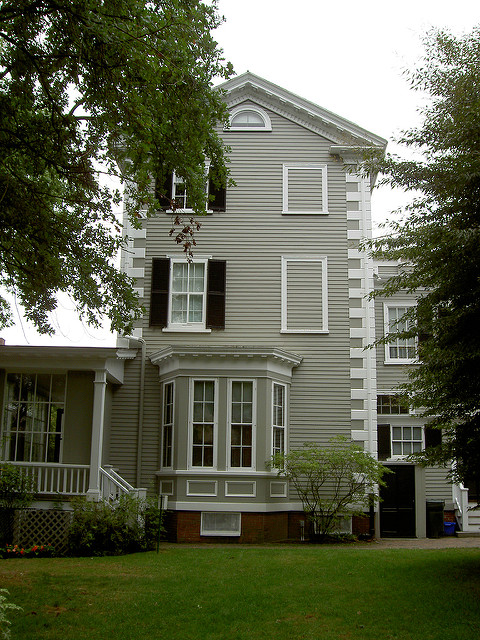
Federalist Era House in Salem

Only a short train ride from Boston, I found Salem to be a better place to base oneself than Boston. And a whole lot less crowded! There seems to be several hundred colleges in the Boston area, and the students always seemed to be using the same public transit that Martine and I were.

At Banff

Snowcapped Rockies in Banff National Park

Few places in North America are as drop-dead stunning as Banff National Park in Alberta. In September 2010 Martine and I rented a car in Spokane, WA and took a grand loop that encompassed Banff, Yoho, and Jasper National Parks in Alberta and Glacier, Yellowstone, and Teton National Parks in the U.S.before returning to Spokane.

There was a period around then that Martine just couldn’t get enough of Canada. We had already visited Victoria and Vancouver and were to go twice to Eastern Canada, including Montreal, Quebec, New Brunswick, and Nova Scotia. She developed a taste for lobster rolls that she can’t satisfy in Southern California because of the substandard quality of the shellfish here.

Canoe on Lake Louise

Perhaps the best hike we took was the trail that went around the northern bank of Lake Louise, where we saw the canoe in the above photo. The emerald shade of the water comes from glacial melt and the silt called “rock flour” that is constantly being deposited in the lake below. We saw this same phenomenon several other times that trip, at Emerald Lake in Yoho National Park, as well as Peyto and Maligne Lakes in Jasper National Park.


The Cube from Outer Space

The New Mexico Museum of Space History in Alamogordo

Not too many people think of outer space when you mention that State of New Mexico. Yet, in many ways, New Mexico is where much of the future came together. First there was the Manhattan Project at Los Alamos, followed by the first atomic blast in the Jornada del Muerto, code-named Trinity. Then there was the nearby White Sands Missile Range. And don’t forget the Karl G. Janski Very Large Array (VLA) of the National Radio Astronomy Observatory (NRAO) just west of Socorro.

When Martine and I last visited New Mexico, we stopped in at the New Mexico Museum of Space History in Alamogordo to view their four floors of exhibits ranging from the early days of rocketry to NASA, the moon, and beyond. The mirrored glass cube seemed to us like a visitor from outer space and put us in the right frame of mind for the two or three hours we spent there.

If we keep to our tentative itinerary, the museum will be our last stop before returning to Albuquerque and flying back to Los Angeles.

A Look Back at Ecuador

Native Otavaleños Entering Church

There are few places I have visited to which I would not like to return. I am speaking particularly of my travels in Europe, Canada, Mexico, and South America. There are a fairly large number of cities in the United States that, I hope, will never see my shadow again. On the other hand, there are parts of the U.S., particularly in the Southwest, that I love. New Mexico, for instance. My mouth is watering for those red and green chile peppers, the best in the world.

Last year at this time, I was planning for the trip that my brother and I took to Ecuador. I loved the places that we chose to visit, particularly Quito, Otavalo, Mindo, and Cuenca. The only problem was that traveling by automobile through the larger Ecuadoran cities required the tracking skills of a scout: Street signs around the periphery of every city were practically nonexistent. We finally got into the habit of following what looked to us like intercity buses, which were pretty easy to distinguish from the local rat-traps.

Otavalo was perhaps my favorite place. That was mostly because the inhabitants were mostly Otavaleños. Gringos stood out like sore thumbs. That’s okay, because sometimes it’s fun to be lost in a crowd of indigenous people, even if they didn’t speak a word of Spanish. (Their language was mostly Quechua.) Just taking a walk through their marketplace was like being in another world.

My problem is a simple one. If I were to go back to all the places I loved, I would be alive for several more decades—and no man knows how much time is left to him.

You Can Start Celebrating Now!

Mark April 25 on Your Calendar!

I love penguins. So much so that I traveled over 6,000 miles to see them in Argentina. Oh, not the big Emperor Penguins of Antarctica—though they were only about 600 miles farther south. No, Martine and I visited with the Magellanic Penguins (Spheniscus magellanicus) in two places the Isla Martillo in Tierra del Fuego, and Punta Tombo in the State of Chubut.

Why do I like penguins so much? They lead such strange lives. Months at a time in the icy waters of the South Atlantic, then return to the same old rookery to find a mate and try to raise a family of little penguins. As it happens, we were at Punta Tombo in November 2011, right when their eggs were hatching. We saw the penguins look on helplessly while ravenous gulls pushed them aside and devoured their progeny. Their wings were great for swimming, but helpless to defend their eggs against more aggressive shore birds.

Penguins on Isla Martillo in Tierro del Fuego’s Beagle Channel

In the above picture by Berkeley Breathed for World Penguin Day, the middle penguin is my hero, Opus. You can see his adventures by going to Breathed’s Facebook page at Bloom County.

Here are some facts about my friends, the Magellanic Penguins:

  • Magellanic Penguins can reach 24 to 28 inches in height and 9 to 11 pounds of weight.
  • They have black plumage on the back and white plumage with broad, black, horseshoe-like marking on the breast. They have a white band on the head that stretches from the eyes to the throat. Skin around the the eyes and bill become featherless and intensely pink during the breeding season.
  • The diet of Magellanic Penguins concentrates on small fish, crustaceans, and squid.
  • They are excellent swimmers. They can travel 620 miles from shore and dive to a depth of over 150 feet to find food. They usually hunt in groups.
  • Natural enemies of the Magellanic Penguin are sea lions, leopard seals, killer whales, and patagonian foxes.
  • Magellanic Penguins are monogamous birds. The male circles around the female and pats her with his flippers during the courtship. Formed couples last for a lifetime.

If you’re interested and want to read more, click here.

What Ever Became of Them?

The Anasazi Ruins of Pueblo Bonito at Chaco Canyon

You’re familiar with the patter: These ancient people had an advanced civilization, and they suddenly disappeared. What ever happened to them? Actually, they didn’t go very far: You can find their descendants among the Hopi and the twenty-three tribes of Pueblo Indians in New Mexico, ranging from Taos to Acoma to Zuñi. What made them move from Chaco Canyon and the other Anasazi communities of the Four Corners, such as the ones at Mesa Verde, Betatakin, Chimney Rock, and Keet Seel? Some time around the 13th century, many of the local rivers dried up; and the Anasazi were forced to move.

I ran into the same type of “mystery journalism” in Mexico. What ever happened to the Mayans? These brilliant peoples inherited all those wonderful ruins such as the ones at Chichén Itzá and Uxmal—and now they’re all gone, or are they? All I know is that there are millions of Maya still inhabiting Yucatán, Chiapas, and much of Central America—and many of them still speak Mayan.

One of the reasons I want to go to New Mexico is to see Anasazi ruins. The best site is Chaco Canyon, of course, but I’ll be traveling this time with Martine, who doesn’t like long washboarded dirt roads and sleeping in campgrounds. So I will try to see some of the more peripheral Anasazi cities such as Chimney Rock, Salmon, or Aztec. (No, they are not related to the Aztecs of Mexico.)

No doubt I will be seeing thousands of Anasazi, or at least their descendants.


The Flip Side of Gallup

The Gallup Inter-Tribal Indian Ceremonial

Gallup, New Mexico, in the 21st century would be nowhere without the Indians. Window Rock, Arizona, the capital of the Navajo Nation, is a short hop away across the state line. Yet, at the same time, Gallup is a dangerous place for Indians. The problem is that, with only 22,000 inhabitants, Gallup has 39 liquor licenses, or about 19 per 10,000 people—much larger than most big cities.

The Indians come to Gallup, get drunk, and frequently die. According to a 2015 article from the Indian Country Media Network:

In 2014, 36 unnatural deaths were recorded for Natives in or around the Gallup area. Almost all were alcohol related or caused from being homeless. Seventeen of those deaths were caused by motorists killing pedestrians attempting to cross major thoroughfares or I-40. Nearly all the victims were Native. This winter, too, has begun with record-setting deaths from exposure in McKinley County—12 so far; all the victims were Native.

Another lethal practice is for drunks in cold weather to lie down on the warmer asphalt highway, fall asleep, and get run over.

I have always seen Indians of the Southwest as a national treasure. Alas, it is a treasure that we have compromised by destroying their culture and leaving them to fend for themselves in the cold cruel world of contemporary America.