The Ghost in the Machine

Lou Lopez, Coordinator of Old Fort MacArthur Days

Lou Lopez, Coordinator of Old Fort MacArthur Days

Everyone liked making fun of him, but he ran a tight ship at Old Fort MacArthur Days. Lou Lopez had been in charge of the event since 2000, and Martine and I were expecting to see him again yesterday behind the microphone trying to keep the straggling event together.

Only, we did not see him this time. Apparently, last month, he—such a lover of history—had himself passed into history on the morning of June 18.

I did not know him personally, and he certainly did not know Martine or me. He was one of those little guys that people joked about, but always with a feeling of affection and grudging respect.

It became evident yesterday at the parade of military units, always a feature at these events. It always began with the ancient Roman legions and ended with units from the Korean and Vietnamese conflicts. The public address system was haunted. It was used to conveying Lou Lopez’s voice over the air, but didn’t quite acknowledge his replacement.

In the meantime, Lou, in his traditional garb of the U.S. forces in Cuba, was off somewhere charging up San Juan Hill with Teddy Roosevelt.


Tributes: Maya Angelou (1928-2014)

The Young Poetess Half a Lifetime Ago

The Young Poetess Half a Lifetime Ago

Losing a poet is a serious thing. They tend not to get replaced often enough with others who are as good. Or maybe we have gotten too used to their voices to hear newer voices emerging from the mass.

I was saddened to hear of Maya Angelou’s death this morning. She had been in poor health and slipped away from us quietly. Fortunately, her voice remains behind to remind us of what we are missing. Such as these brief lines entitled “Awaking in New York”:

Curtains forcing their will
against the wind,
children sleep,
exchanging dreams with
seraphim. The city
drags itself awake on
subway straps; and
I, an alarm, awake as a
rumor of war,
lie stretching into dawn,
unasked and unheeded.

I love that image of children sleeping while exchanging dreams with seraphim.

To one interviewer who asked in 1984 about how she wrote her poems, Miss Angelou had a quick retort:

I also wear a hat or a very tightly pulled head tie when I write. I suppose I hope by doing that I will keep my brains from seeping out of my scalp and running in great gray blobs down my neck, into my ears, and over my face.

Maybe that’s what I should do when I write these blogs!


Ice

Gabriel Garcia Marquez

Gabriel Garcia Marquez

Many years later, as he faced the firing squad, Colonel Aureliano Buendía was to remember that distant afternoon when his father took him to discover ice. At that time, Macondo was a village of twenty adobe houses, built on the bank of a river of clear water that ran along a bed of polished stones, which were white and enormous, like prehistoric eggs. The world was so recent that many things lacked names, and in order to indicate them it was necessary to point. Every year during the month of march, a family of ragged gypsies would set up their tents near the village, and with a great uproar of pipes and kettledrums they would display new inventions. First they brought the magnet. A heavy gypsy with an untamed beard and sparrow hands, who introduced himself as Melquíades, put on a bold public demonstration of what he himself called the eighth wonder of the learned alchemists of Macedonia. He went from house to house dragging two metal ingots and everybody was amazed to see pots, pans, tongs, and braziers tumble down from their places and beams creak from the desperation of nails and screws trying to emerge, and even objects that had been lost for a long time appeared from where they had been searched for most and went dragging along in turbulent confusion behind Melquíades’ magic irons. “Things have a life of their own,” the gypsy proclaimed with a harsh accent. “It’s simply a matter of waking up their souls.”—Gabriel García Marquez, the opening lines of One Hundred Years of Solitude

Gabo

Gabriel Garcia Marquez with Shiner

Gabriel García Márquez with Shiner

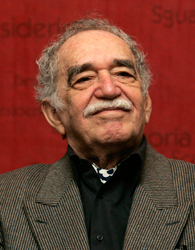
Here’s a question for you: Which two winners of the Nobel Prize for Literature had a fist fight with each other? The above picture is a clue to the identity of one of them: The other is Mario Vargas Llosa of Peru, who felt that “Gabo” had been paying undue attentions to his wife. You can find all the gory details at this New York Times website from 2007.

I first discovered García Márquez’s One Hundred Years of Solitude in November 1975 while I was in Yucatán. There I was at the ruins of Chichén Itzá at an open air souvenir stand with a thatched roof looking for a book to read. On the rack was a UK Penguin paperback edition of the book not for sale in the United States. I picked it up, started reading it, and found myself entranced. First at Chichén, then at the majestic old Gran Hotel in Mérida, and then at Uxmal, I pored through the pages and fell in love with Macondo (the fictionalized birthplace of the author in Aracataca, Colombia) and its weird history.

Ironically, it was in Mexico City that García Márquez died today of infection and dehydration. I will miss him the way I miss Jorge Luis Borges of Argentina and a handful of other greats who died in my time, such as John Ford, Orson Welles, and Howard Hawks.

Since that 1975 trip that changed my life in so many ways, I have read more than a dozen of Gabo’s books and expect to finish the rest within the next year or so.

If you’d like to read a Paris Review interview with the author, click here.

Pacheco and the Dogs

Another Great Poet Leaves Us

Another Great Poet Leaves Us

It is a well-known fact that poets don’t grow on trees. Belatedly, I am recognizing the death of José Emilio Pacheco, the Mexican poet who just recently died after a fall at the age of seventy-four. I am not familiar enough with Pacheco’s poetry—to be honest, I am not nearly familiar enough with poetry in general. I should read more, even though there is nothing that is more demanding—or rewarding. Take this simple example, called “A Dog’s Life”:

A Dog’s Life

We despise dogs for letting themselves
be trained, for learning to obey.
We fill the noun dog with rancor
to insult each other.
And it’s a miserable death
to die like a dog.

Yet dogs watch and listen
to what we can’t see or hear.
Lacking language
(or so we believe),
they have a talent we certainly lack.
And no doubt they think and know.

And so
they probably despise us
for our need to find masters,
for our pledge of allegiance to the strongest.

Thanks to Fred Runk, here is the Spanish text of the poem:

Despreciamos al perro dejarse
domesticar y ser obediente.
Llenamos de rencor sustanivo perro
para insultarmnos.
Y una muerte indigna
es morir como un perro.

Sin embargo los perros miran y eschucan
lo que no vemos ni escucharmos.
A falta de lenguaje
(o eso creemos)
poseen un don que ciertamente nos falta .
Y sin duda piensan y saben.

Asi pues,
resulta muy probable que nos desprecien
por nuestra necesidad de buscar amos,
poe nuestro voto de obediencia al mas fuerte.

The Waxman Goeth

Henry Waxman (D-CA)

Henry A. Waxman (D-CA)

He may not be much to look at, but Henry Arnold Waxman has been my congressional representative since 1975 and one of the few members of the House of Representatives whom I would NOT grind into dog food to feed to rabid dogs. Eschewing the limelight, he has been an exemplary hard worker dedicated to  passing legislation that actually helped people. Because of the demographic make-up of California’s 33rd district, I don’t expect we’ll be seeing him replaced by some tea party type who aims to collect $174,000 a year to sabotage everything near and dear to the voters who elected him, her, or it.

Probably best known for his contributions to health and environmental issues, Waxman will be sorely missed by people who care.

Over the last four years, the House of Representatives has been justly reviled for the white trash that has taken over, using the Congress as a bully pulpit to make stupid statements, such as the recent campaign by Darrell Issa (R-CA) to gut the U.S. Postal Service. I still think most Republican Congressman should be made to don orange jumpsuits and be hauled off to Guantanamo. Now that Waxman, won’t be there, the IQ of Congress has dropped by several whole percentage points.


One Man Can Save a Nation

Nelson Mandela (1918-2013)

Nelson Mandela (1918-2013)

I was saddened by news of the death of Nelson Mandela today.

Except, he continues to live in a way that few men live. He almost single-handedly saved his people from massive bloodshed when Apartheid came to a sudden end in 1994. There were voices in the African National Congress for revenge, but there was a strong hand at the helm of the ANC—a hand that the people of South Africa trusted. Where the rest of the continent suffers under the yoke of dictatorship or anarchy, South Africa has a future. And that is because of one man.

Just imagine what the world would have been like without Adolph Hitler, Saddam Hussein, Kim Il Sung, Pol Pot, Muammar Qaddafi, Slobodan Milosevich, and any number of national leaders who took the other path, the path of power watered by the blood of their own people. No one misses those people.

The whole world will miss Nelson Mandela.


Loss

Norm at a Cinecon Show in Hollywood

Norm at a Cinecon Show in Hollywood

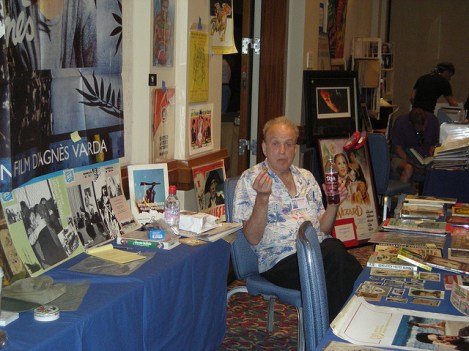
I knew that I was reaching the endgame, but not until today did I realize the suddenness and the finality with which a life can be snuffed out. Norman Witty has been a friend of mine for almost half a century, ever since he picked me up while I was hitchhiking on Wilshire Boulevard. He was a couple of years older than me, a chain smoker of unfiltered Camels, and—like me—a film freak. At the time I was a grad student in the UCLA film department, and Norm—well, he just watched a lot of movies. I had the feeling he had a trust fund or some other family income source that obviated the need for a job.

After a while, we parted ways for a while. I dropped out of the Masters degree program at UCLA because of faculty politics and went into the computer industry so that I could make a living. Norm, on the other hand, moved back East (he was originally from Massachusetts) and opened a comic book and film poster store in Northampton, Mass.

We re-established our friendship when he started coming out to Los Angeles for the Cinecon shows around Labor Day Weekend. By this time, Norm was fast approaching the point of total deafness. He offered Martine some money to help him interact with potential clients in the Cinecon dealer rooms. Martine and Norm communicated by way of a notepad, and Martine usually took the helm when Norm took a smoking break. This worked out well for both, and for me because I got to see a lot of free old movies at the Egyptian Theater down the street. We would go out to dinner together and have one of our annual food fights: Like many people who know nothing about preparing food, Norm had some curious requirements. He hated the ethnic restaurants I would “drag” him to, and Martine and I hated the white tablecloth joints with mediocre Euro food that he patronized.

This Labor Day, Norm did not come out for Cinecon. I have been in touch with him only by e-mail, and through a joint friend who visited him at his New York cooperative apartment on West 57th Street. Several New Yorkers whom we knew in common were concerned about Norm not seeing any of his friends and acquaintances any more.

Then the bombshell hit when I received an e-mail from Norman’s sister announcing that he had died early this morning of an aortic aneurism. Fortunately, she had been visiting with him and, in fact, was with him when he fell ill last night. He was able to get fast access to the medical care he needed, but his luck had run out.

I’ve written about Norm before, though not by name. You can see my blog from September 4, 2012 entitled “A Prickly Individual,” in which I expressed growing concern about his health.

In truth, Norm was prickly, but he was also generous and funny. He also had a store of knowledge about films which only began to wane as his hearing disappeared. At that point, he switched to silent movies and would buy and sell at the silent film festival in Pordenone, Italy.

You Need to Breathe and You Need to Be

French Writer Albert Camus, Born 100 Years Ago Today

French Writer Albert Camus, Born 100 Years Ago Today

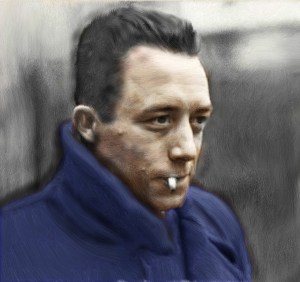
Find meaning. Distinguish melancholy from sadness. Go out for a walk. It doesn’t have to be a romantic walk in the park, spring at its most spectacular moment, flowers and smells and outstanding poetical imagery smoothly transferring you into another world. It doesn’t have to be a walk during which you’ll have multiple life epiphanies and discover meanings no other brain ever managed to encounter. Do not be afraid of spending quality time by yourself. Find meaning or don’t find meaning but ‘steal’ some time and give it freely and exclusively to your own self. Opt for privacy and solitude. That doesn’t make you antisocial or cause you to reject the rest of the world. But you need to breathe. And you need to be.—Albert Camus, Notebooks 1951-1959