Mindalae – A Museum of Ecuadorian Handicrafts

Ceramic Snake

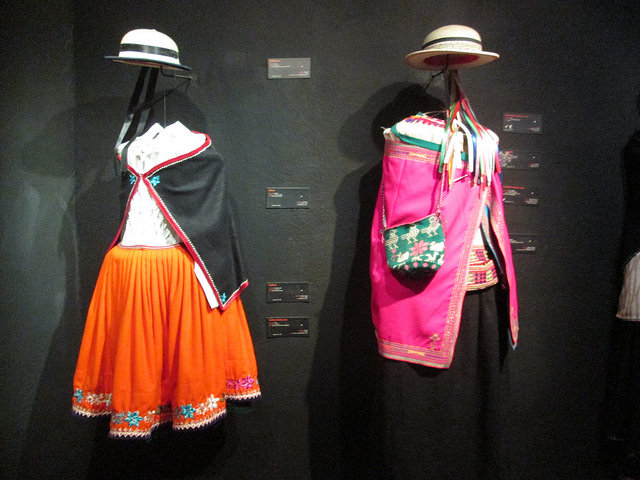
My brother and I were staying on La Niña in the tourist suburb of Mariscal at the Viejo Cuba. On our first day in Ecuador, we were tired out by the 9,000 foot (3,000 meter) altitude, but we had a few hours before vegging out for the night. Right down the street, at the intersection with Reina Victoria, was a fantastic folk museum called the Mindalae. Both of us were interested in purchasing some folk art: The Mindalae provided a guide to the best of what was produced around the country.

We took the elevator to the top floor and proceeded to walk down looking at the exhibits, many of them based on pre-Columbian originals. Included were ceramics, textiles, ceremonial objects, basketry, and other crafts. Adjoining the museum is a craft store with an excellent selection of items paralleling the exhibits, and offered at a fair price.

Costumes

The displays at the museum were in both Spanish and English. If you are interested in Andean handicrafts, it is a good idea to visit a museum like the Mindalae before visiting the various local markets. You will have a better idea of what is available in every region of the country.

Dan and I enjoyed the Mindalae so much that, after Dan left to return to the U.S., I visited it a second time.

Pioneer Life in the Old West

Figure on Three Hours of Fun

One of our favorite types of museums is the outdoor museum concentrating on life as it was lived in former times. In Bishop, California, there is the Laws Railroad Museum and Historical Village. In Dearborn, Michigan, there is the Henry Ford Museum and Greenfield Village, which I saw as a kid with my parents. And it’s not just an American phenomenon: Martine and I loved Enkhuizen in the Netherlands, and in Iceland I enjoyed visiting Reykjavík’s Arbær Open Air Museum. Finally, last month, Martine and I spent an enjoyable afternoon touring the Aztec Museum and Pioneer Village in Aztec, New Mexico.

After visiting the Anasazi ruins at Aztec Ruins National Monument, we drove down the street and checked out the Aztec Museum. The more we looked, the more we were drawn into the vortex of pioneer life in northwestern New Mexico. There were toys, costumes, minerals, three barber chairs, agricultural implements, and, in the back, a whole pioneer village consisting of small-sized schools, stores, doctor’s office, pharmacy, blacksmith—you name it.

One of the strangest exhibits was the Pecos West Cyclorama, a labor of love by Valenty Zaharek which “features over 100 hand carved woodcarvings of people, animals, plants, buildings, vehicles and the high mesas and mountains of the desert Southwest. The cyclorama measures eighteen feet in diameter and slowly rotates as old west cowboy music plays in the background.” I spent over half an hour admiring the attempt to summarize the Old West in a rotating wooden display, with music no less.

Aztec Pioneer Schoolhouse

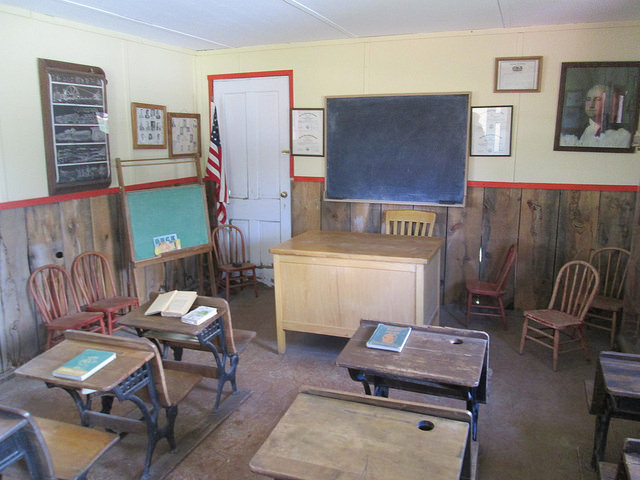
Martine and I also went into the Pioneer Village outbuiildings, which are built to approximately half scale. Above is a photo of the little one-room schoolhouse, complete with teacher’s and students’ desks, blackboard, and typical textbooks and wall displays. The same attention to detail appears in all the other buildings as well.

Originally we didn’t plan on coming to Aztec. Instead, we were going to go on to Durango, Colorado. When we were in Chama taking the Cumbres & Toltec Narrow Gauge Railroad, however, Martine was showing signs of discomfort from the altitude, so we changed our plans and went to Aztec instead. We had no reason to regret our decision.


A Fort from the Apache Wars

Porch at Fort Stanton, New Mexico

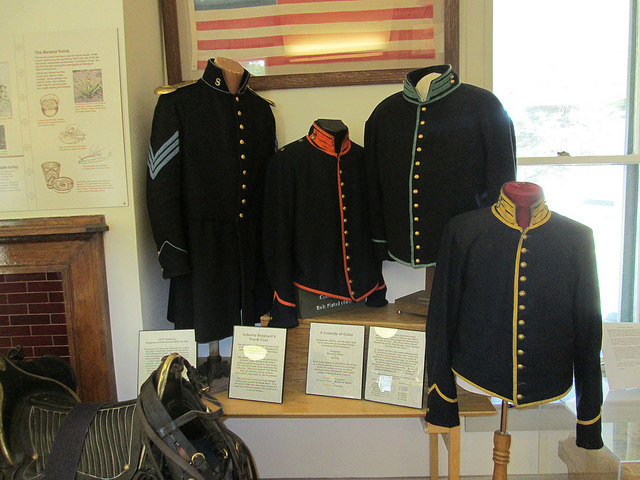
Not far from Lincoln, New Mexico, which saw the Lincoln County War in which Billy the Kid was involved, lies a U.S. Cavalry fort from the days of the Apache Wars. In fact, it also played a role in the Lincoln County War—on the side of the Dolan/Murphy cabal. Most U.S. Cavalry forts in the Old West were constructed of adobe and so were eroded to nothingness by the rains. Fort Stanton, on the other hand, was built of stone and faced with whitewashed stucco, and so has come down to us more or less intact.

In fact, after the Indian Wars, the fort was used for various other purposes, such as a tuberculosis hospital and a prison camp for Nazi POWs. It is now in the New Mexico State Park system and has a museum and a number of outbuildings which are open to visitors.

Cavalry Tunics in the Fort Stanton Museum

Martine and I saw Fort Stanton the same day we visited the town of Lincoln, which is only about a quarter of an hour away. The museum and outbuildings can be visited in about two hours is one is thorough, and an hour if one just wants a quick look at the museum. It’s an unusually pleasant place, with the Rio Bonito running through the grounds, and a helpful docent managing the welcome desk.

The Anasazi Moment

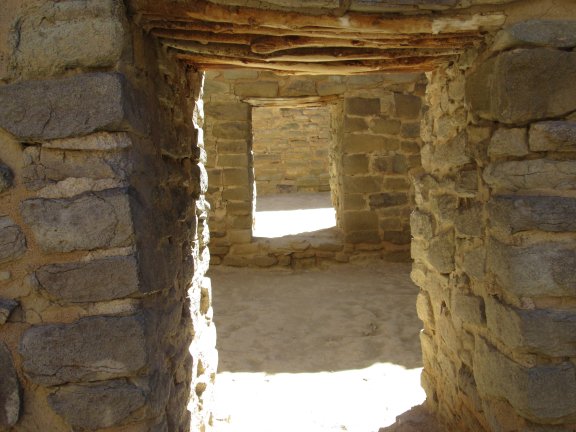
Doorway in Aztec Ruins

The ruins don’t have anything to do with the Aztecs. It was a common 19th century misconception, like the one about the Egyptians building the Mayan pyramids because, somehow, the Mayans weren’t smart enough to build piles of rubble and put a smooth face on them. No, the ruins at Aztec, New Mexico, are one of the settlements of the Anasazi Indians, as they made their way through the Four Corners region some nine hundred years ago.

Chaco Canyon holds the most spectacular ruins, but there are numerous outliers, such as the ruins at Aztec, Salmon, Chimney Rock, Pueblo Pintado, and elsewhere. It looks as if the area went through a period of protracted drought, sending the Anasazi southeast to the valley of the Rio Grande River, to the Hopi Mesas in Arizona, and to Zuñi. There they became the twenty-odd Pueblo Indian tribes, which still exist today.

They entered history abruptly in 1680, when they forcibly expelled the Spanish from New Mexico under a leader called Popé—the only North American peoples to successfully revolt—though they were reconquered some twelve years later. After that, when the United States marched in, they became more docile and did not require any army forts to keep them in line.

The ruins at Aztec are quite spectacular. A large kiva has been restored and even today looks very church-like in a Protestant sort of way. The Pueblo tribes still visit the ruins as they think of the paths their various peoples took to find a place where they could thrive.

Restored Kiva at Aztec Ruins National Monument

Some day I would like to return to New Mexico and spend more time at Chaco Canyon, which at one time supported a large population before the waters dried up. In the meantime, it was interesting to see Aztec Ruins National Monument and nearby Salmon Ruins just outside of Bloomfield.

Riding the Cumbres & Toltec RR

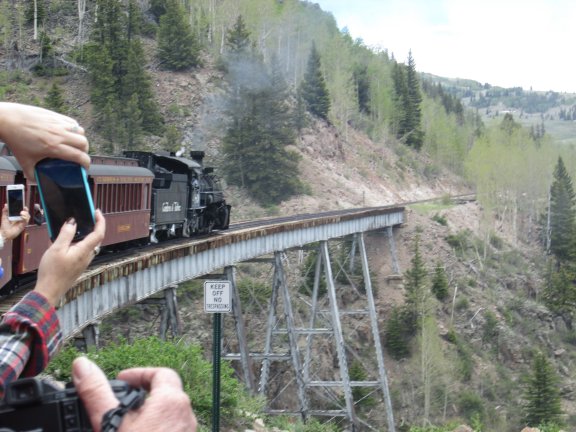
Our Train Going Over a Trestle

There are two narrow gauge steam trains relatively close to each other, both once part of the Denver & Rio Grande Western. One runs in Colorado between Durango and Silverton and is, in fact, called the Durango & Silverton. The other runs between Chama, New Mexico, and Antonito, Colorado. That is the Cumbres & Toltec—named after Cumbres Pass and the Toltec Gorge, two of the scenic highlights along the route.

Martine and I went on the Cumbres & Toltec, and had planned on also taking the Durango & Silverton. Unfortunately, Martine came down with a headache from the high altitude and was afraid of aggravating it by taking both trains. In addition, the pinched nerve in her back was irritated by the constant lurching of the cars as the train went downhill. So, after our ride on the Cumbres & Toltec, we sought lower ground, even if it was to put us back in the middle of the desert heat we were hoping to avoid.

So it goes.

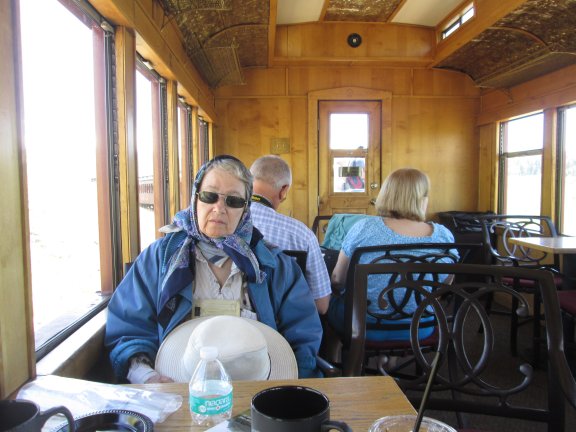
Martine on the Cumbres & Toltec Narrow Gauge Railroad

The Cumbres & Toltec ascended to the snow level at around 10,000 feet at its highest point, before going back down 2,000 feet to Antonito. At Antonito, we took a bus back to Chama. The ride took only one hour, whereas the train, on a parallel route, took five hours.

At Osier, Colorado, we were unloaded from the train to have a substantial free buffet lunch before continuing to the end.

Hopefully, some day I may yet take the Durango & Silverton, though without Martine who is puzzled by my love of trains. That love goes way back to my scouting days, when we took the Erie Railroad to Ashtabula, Ohio. Then, in college, I road the New York Central from Cleveland to Albany, New York, from where I took the Vermont Transit bus to Rutland, Vermont, and the White River Coach bus to Hanover, New Hampshire.

I love trains so much that I even enjoy taking the light rail to downtown Los Angeles.


Getting Sick While Traveling

The Acoma Cañoncito Laguna Service Unit of the Indian Health Service

Not for the first time, I came down sick on my travels. In 2006, I broke my right shoulder in Tierra del Fuego and received care for it at a clinic in Ushuaia. In 2015, I got food poisoning and had simultaneous diarrhea and vomiting: That time, I cured myself by taking extra Prednisone and managing to keep it down. On this trip, I got food poisoning in Acoma at the tribal Sky City Casino. It was the same diarrhea and vomiting with the addition of chills (though unaccompanied by fever). I wasn’t going to mess around this time. I asked Martine to drive me to the nearest hospital.

The front desk of the Cassino hotel directed us to the Acoma Cañoncito Laguna Service Unit of the Indian Health Service, which, luckily, was just down the street. I was very fortunate that the doctors who interviewed me listened to me and put me on an IV with Solu-Cortef and sulfur (to relieve the nausea). Within two or three hours, I was as good as new. Martine, however, was worried as she sat in the waiting room.

My guess is that I was seriously dehydrated, and that brought on an Addisonian Crisis. As I have no pituitary gland, I had to have an infusion of ACTH with the IV. Once that happened, recovery was quick. The ACL Service Unit did not have any beds, but offered to have me driven to one of the big Albuquerque hospitals an hour east. I thanked them, but refused their offer. Once they get me in a hospital, doctors like to prod and poke me for several days because of my interesting mix of endocrinological issues. I did not want to give them the opportunity, perhaps coming down with a super infection in the process.

The Indian Health Service personnel were very competent, which made me feel good that the Indians—together with one stray traveler—were getting good care.

Home of the Atomic Bomb

Albuquerque’s National Museum of Nuclear Science & History

The atomic bomb was born in the State of New Mexico. It was created by the Manhattan Project at Los Alamos in the northern part of the state and tested at the Trinity Site in the Jornada del Muerto Desert 35 mile southeast of Socorro. To commemorate the state’s role in our country’s nuclear history, there is a superb museum near Kirtland Air Force Base detailing that history and discussing both the wartime and peacetime uses of the atom.

We had visited the same museum in 2003, when it was located in Albuquerque’s Old Town, near the present site of the city’s Natural History Museum. Now it is even larger and deals with many more ancillary subjects, such as nuclear medicine and nano technology.

Replica of the “Fat Man” A-Bomb That Leveled Nagasaki

Probably what interested me the most was a demonstration of the different kinds of radiation (electromagnetic, particle, acoustic, and gravitational) and how much shielding is required for each. We also had the opportunity to see Trinitite, which was formed by the A-Test at the Trinity Site when the sand was formed into a radioactive green glass-like mineral.

The last time we were in New Mexico, we also visited Los Alamos and its world-class Bradbury Science Museum. We were appalled at the time to see the destruction of so many thousands of trees surrounding it by a wicked pine bark beetle infestation.

Two Weeks of Triple-Digit Heat

Restaurant in Old Town Albuquerque

There was a good chance that this was going to happen—and it did! Each day we were in New Mexico, the thermometer went over 100º (Celsius 38º). I had been hoping that the summer thunderstorms would have started, but they couldn’t because of a gigantic and persistent high-pressure area over the Southwest. It didn’t exactly ruin our vacation, but it made us change our plans frequently. We tended to visit outdoor sights in the cool of the morning, reserving the afternoons for air-conditioned museums, if possible. Thus we couldn’t see the Very Large Array west of Socorro because it involved a 120-mile detour through the dread Jornada del Muerto (Journey of the Dead Man) Desert on a particularly fiery day.

But then, one should always take chance into account. I remember one trip to Yucatán in the 1980s when the temperature in Mérida was super hot and humid, such that I came down with some fever and chills. I called in a local doctor, who made a house call and cured me within a few hours. At that point, I resolved to get out of Mérida and fly to San Cristóbal de las Casas in the Sierra Madre Mountains, where the temp was quite bearable.

Another complication is that the one thing we could have done—namely, to seek higher ground in Colorado—was not an option because Martine started coming down with altitude sickness at around 7,500 feet altitude. So we had to go down to a lower elevation and higher temperatures.

Even so, I had a good time. I cannot say that Martine did. She continues to have a problem with a punched nerve in her back (which first manifested itself four years ago) and cannot get a good night’s sleep on a soft hotel mattress. We took an air mattress with us, but it turned out it could not hold air as one of the valves was broken.

The whole vacation was an exercise in how to survive in difficult situations without falling prey to negativity. The high points were our visits to the Smokey Bear village of Capitan; the UFO Museum in Roswell; the old cavalry station at Fort Stanton; and the town of Lincoln with its Billy the Kid associations. The low point was the steam train ride on the Cumbres & Toltec Railroad, during which the lurching of the cars led to spasms of pain affecting Martine’s pinched nerve.

Off to New Mexico

Ship Rock in Northwest New Mexico

This is my last post until I return a little more than two weeks from now. New Mexico is a wonderful state to visit, as it has its own cuisine (and the best chiles in the world), its own culture (Spanish, not Mexican), fascinating Indian tribes (Navaho, Zuñi, Acoma, plus 20+ other pueblos), fascinating recent history (the A-Bomb), steam trains (the Cumbres & Toltec Railroad), the tomb of Smokey Bear (Capitan) and Billy the Kid (Fort Sumner), and any number of good things.

So I’m signing off for now. Wishing all of you good luck, and don’t let Trumpf bite you!

El Ombú

The Ombú Outside the La Biela Café in Buenos Aires’s Plaza Francia

One of the most spectacular trees to be encountered in Argentina is the Ombú. The one in the above picture is in front of my favorite Buenos Aires café, La Biela, where Jorge Luis Borges frequently dined with Adolfo Bioy-Casares. Also, it reminds me of the tree described by W. H. Hudson in his first story in Tales of the Pampas (1916):

IN ALL THIS DISTRICT, though you should go twenty leagues to this way and that, you will not find a tree as big as this ombú, standing solitary, where there is no house; therefore it is known to all as “the ombú,” as if but one existed; and the name of all this estate, which is now ownerless and ruined, is El Ombú. From one of the higher branches, if you can climb, you will see the lake of Chascomus, two thirds of a league away, from shore to shore, and the village on its banks. Even smaller things will you see on a clear day; perhaps a red line moving across the water—a flock of flamingos flying in their usual way. A great tree standing alone, with no house near it; only the old brick foundations of a house, so overgrown with grass and weeds that you have to look closely to find them. When I am out with my flock in the summer time, I often come here to sit in the shade. It is near the main road; travellers, droves of cattle, the diligence, and bullock-carts pass in sight. Sometimes, at noon, I find a traveller resting in the shade, and if he is not sleeping we talk and he tells me the news of that great world my eyes have never seen.

They say that sorrow and at last ruin comes upon the house on whose roof the shadow of the ombú tree falls; and on that house which now is not, the shadow of this tree came every summer day when the sun was low. They say, too, that those who sit much in the ombú shade become crazed. Perhaps, sir, the bone of my skull is thicker than in most men, since I have been accustomed to sit here all my life, and though now an old man I have not yet lost my reason. It is true that evil fortune came to the old house in the end; but into every door sorrow must enter—sorrow and death that comes to all men; and every house must fall at last.

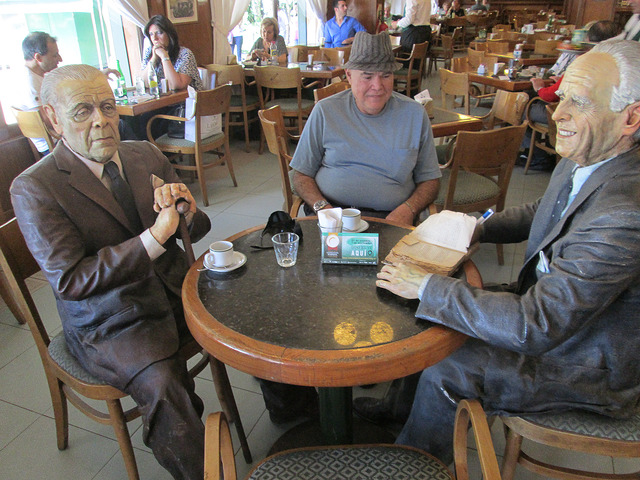
But my memories of this Ombú are all happy ones. I have eaten at the café there twice, both times having excellent meals. The first time was with Martine in 2011. In 2015, I met with my friend David Benesty there. Below is a picture of David sitting between Borges and Bioy-Casares at what was once their favorite table:

Jore Luis Borges, David Benesty, and Adolfo Bioy-Casares


I would love to go to La Biela again and have a cool bottle of Imperial beer on a hot Buenos Aires afternoon.