Death by Charging Sheep?

Bad Dog!

Bad Dog!

Yesterday, Martine and I went to a large Irish Fair held at El Dorado Park in Long Beach. Thanks to an extremely fine perception of space, I was missed by a fraction of an inch by a charging sheep during the sheepherder dog demonstration.There I was, standing on the sidelines between two tents when, suddenly, someone let the Bouvier des Flandres out of his cage (above), and he charged the sheep, sending them scattering at top speed in all directions. Although the Bouvier was at the show, he was not yet trained to herd sheep without representing a threat to them. The upshot was, I saw my life pass in front of my eyes while being charged by one of the sheep. Before I knew it, all of them had disappeared behind a line of port-a-potties.

Within ten minutes, however, the real trained sheep dogs had rounded up the miscreant lambchops (see photo below) and brought them back to the demonstration area. The Bouvier was likewise found and promptly caged.

One of These Sheep Came Close to Head-Butting Me into the Next World

One of These Sheep Came Close to Head-Butting Me into the Next World

In the end, I found the sheepherding demonstration so interesting that I forgot my former peril. The music at the fair was great (more about that later). The only thing I didn’t like was the food. I never thought of cajun franks, funnel cakes, and kettle corn as being particularly Irish. There wasn’t a trace of lamb stew in evidence, nor even baked tatties. But that’s to be expected when there was a single caterer who brought along a fleet of highly miscellaneous food trucks.

With the Warbirds

Warbirds

At the Estrella Warbirds Museum in Paso Robles

At various points across the United States, there are little flying museums usually tended to by retired military aviators and their families. One such is the Estrella Warbirds Museum in Paso Robles, which is located along the south edge of the local general aviation airport. In addition to the old fighter jets and prop planes, helicopters, jeeps, and ammo, there is adjoining all the weaponry a car exhibit called the Woodland Auto Display.

After leaving my brother and sister-in-law in Paso, Martine and I headed east on Route 46, stopping first for a couple of hours to see the displays. We weren’t able to give much time to the exhibits parked outside, largely because the temperature was 106° Fahrenheit (or 41° Celsius). Martine loves to visit these old military museums (including the one at Palm Springs, by the Santa Monica Airport, and the Torrance airport). It’s sad to think that the vets who flew these aircraft are beginning their own inexorable journey toward the setting sun. Very likely many of these museums won’t be around in a few years.

Considering the news from Iraq, the bomb photographed below might well become more topical:

Leftover Bomb from 2003 Invasion of Iraq

Leftover Bomb from 2003 Invasion of Iraq


After our visit to see the warbirds, Martine and I headed further east on 46 and 41 until we joined Interstate 5 around Kettleman City. Our destination for the night was the Harris Ranch Inn at Coalinga, where we spent the night in air conditioned comfort and gorged ourselves on prime beef.

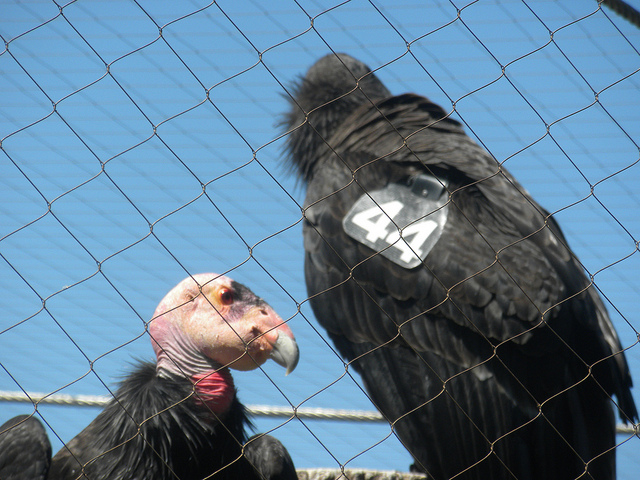
Ugly But Magnificent

Andean Condor

Andean Condor

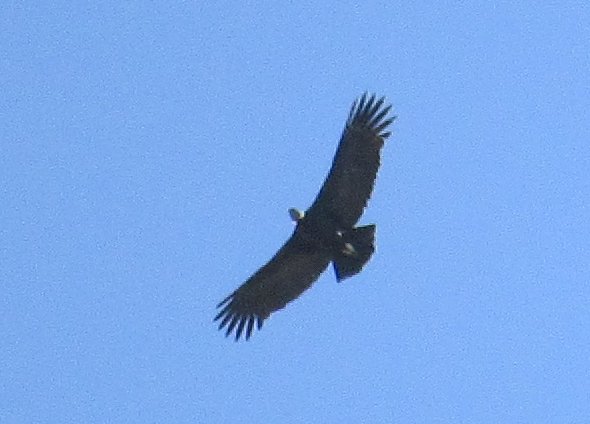
Andean Condors, like all members of the vulture family, are not exactly cute; but with their 10-foot wingspans, they are awe-inspiring. The only time I ever saw Vultur gryphus was on in Argentinian Patagonia, on my way to the dock to take a cruise to see the glaciers that feed into Lago Argentino. There were two of them a few miles out of El Calafate visible from the left side of the bus. Of course, by the time I got my camera out, they had swooped around the hill and out of sight.

In Peru, I hope to photograph them at Colca Canyon, about a hundred miles northwest of Arequipa. The Canyon has a depth of 13,650 feet (4,160 meters), making it twice as deep as the Grand Canyon in Arizona. I will try to take a tour that stops at Cruz del Condor, where they tend to glide in large numbers past a viewing point looking for their favorite carrion. I hope I can get a few pictures to bring back and post on this blog site.

Colca Canyon is probably the third most popular tourist destination in Peru, after Machu Picchu and Lake Titicaca.


The Real Reason Cantor Lost

Read On for My Peerless Analysis

Read On for My Peerless Analysis

This may strike you as being unscientific, but the reason Eric Cantor lost his seat in Virginia is that no one liked him. He was always a whiny presence on the Washington scene.

Of course, the fact that he may be replaced by an even more dangerous Tea-Party-type is certainly no cause for celebration. The fact is that people who live in Confederate sh*thole districts are not likely to vote for anyone who will do anything but attempt to govern by hijacking or obstructionism. We live in the Disunited States of America and will continue to do so for the foreseeable future.

You may recall the whole “Left Behind” Evangelical myth that, in the End Times, the saved are wafted to Paradise while everyone else has to suffer the various beasts of the Apocalypse while the saved are eating Corn Nuts and drinking Duff Beer while fluffing their wings and cheering on the Four Horsemen. I think that the people who vote for insufferable right-wing nutjobs have been “left behind” by science, the economy, technology, and everything associated with good sense. All they’re left with is Jesus and their guns.

God help the rest of us!


Beats Greyhound Hands Down

Cruz Del Sur (Southern Cross) Is One of Peru’s Premier Bus Lines

Cruz Del Sur (Southern Cross) Is One of Peru’s Premier Bus Lines

For some reason I cannot quite fathom, Martine likes to go to Sacramento via Greyhound. (Perhaps it’s because the airport is many miles north of the city.) Today I was doing some research on returning to Lima from Cusco. Originally, I planned to fly; but then I realized that I would not only have to pony up for the flight, but also I’d have to book a hotel for the night. Then I looked at Cruz Del Sur’s website, and my eyes popped out.

I had some good feelings about South American buses from my experiences in Argentina, but some of the the long-distance Peruvian lines look really good. Probably the best of the bunch are Cruz Del Sur, Ormeño (which has a 6,002 mile route—the longest in the world—between Caracas, Venezuela and Buenos Aires, Argentina), and Oltursa. Many have what are called Executivo or Cama services, which include seats that recline from 160-180º, plus a lot of other extras. The Crucero Suite service includes these, plus meals (included in the price), stewards/stewardesses, entertainment with personal headphones and screens, two restrooms per bus, air conditioning and heating, reading lamps, a kit including blanket and pillow, and bingo. Check out this Cruz Del Sur website in English and compare it to the increasingly trashy public transportation services on offer in the United States.

Of course, nothing is perfect in this world. In the summer of 2013, a Cruz Del Sur bus full of American, European, and Asian tourists was held up outside of Ayacucho by eight armed bandits in the middle of the night. They pulled the bus off the road and proceeded to rob the passengers of over $50,000 in cash and personal goods. You can read the story in Peru This Week. Ayacucho is a dangerous place that served as the center of the Sendero Luminoso (“Shining Path”) guerrilla insurgency in the 1980s and early 1990s.

Peru is a deceptively large country: From Cusco to Lima is a 21-22 hour bus ride with a single stop on the way. I kind of hope it isn’t Ayacucho.


Getting Off Our High Horse

Miniature Mare and Her Foal

Miniature Mare and Her Foal

While we were in Solvang last week, Martine made a request to visit the Quicksilver Ranch, where miniature horses are raised for sale. Huell Howser had done one of his famous “California’s Gold” episodes about the place.) We chose a good time to go because all the mares and their foals that were between six and eight weeks old were herded into a pen, from where they had their hooves cut back and their manes trimmed. According to one of the ranch hands, all the foals had already been sold and were being taken care of until they were old enough to be separated from their very protective mothers.

Wherever the foals went, the mares followed closely, as in the above photograph. Although signs were posted all over the fence warning of what could happen if someone tried to pet the horses (their fingers could be chomped), Martine couldn’t resist petting the foals on the back, as in the photo below.

Martine Petting Foal

Martine Petting Foal

In fact, Martine was so intent on looking at all the little horses that, after two and a half hours, I finally convinced her to leave the ranch without sneaking one or more of them away with her. (After all, I had planned to visit the Book Loft, which always had a few titles that beckoned to me.)

I wondered what kind of people bought the little colts. According to the hands, they were scattered all over Southern California. Although I didn’t say, I had the feeling that most of them went to the spoiled rotten kids of super-rich families. I can’t imagine the horses liking that very much. I am sure that they would love having Martine to play with them and take care of them, but I’m afraid that a horse wouldn’t go well with our two-bedroom apartment in West Los Angeles. Maybe, when we buy ourselves a ranch….

In the Land of the Bakery Vikings

Martine, Bloodthirsty Viking, and Me

Martine, Bloodthirsty Viking, and Me in Solvang

As I mentioned in my last post, Martine and I left town last Thursday for my niece Hilary’s wedding in Paso Robles. There will be plenty of wedding photos later, but we let my brother Dan’s neighbor Dennis take all the wedding pics: By the time I was ready (I was the officiant), the lighting was starting to go. Whenever we visit my brother in Paso, we usually like to break our trip in Solvang, a hundred plus year old Danish colony in Santa Barbara County. The town is crawling with bakeries (see the cookie tubs in the window to Martine’s left in the above photo. It also has a great bookstore called the Solvang Book Loft, where I bought two Gabriel Garcia Marquez novels. For Martine, it is also the site of the Quicksilver Ranch, where miniature horses are raised for sale.

In the next week or so, I’ll show you some of the pictures I took of the miniature horses and their colts. They were incredibly cute—and they let Martine pet them (even though she wasn’t supposed to!).

We got back to Los Angeles this afternoon. Our feeling was one of relief, because after we left Solvang, the temperature shot up to over a hundred degrees Fahrenheit and stayed that way until we approached our coastal area, where the temperature is twenty-five degrees cooler.


Wedding Break

Vineyards Around Paso Robles

Vineyards Around Paso Robles

I will be away from my computer for a few days while I attend the wedding of my niece Hilary in Paso Robles, where my brother Dan lives. The ceremony will be held at a B&B in nearby Templeton. Martine and I will also be spending some time at Solvang and Coalinga.My next post will probably come on Monday afternoon or evening.

How I Survived 7 Years with the Penguins

The Former Saint Henry Church and Elementary School

The Former Saint Henry Church and Elementary School

To begin with, I have a terrible admission to make: I never finished First Grade. As my birthday is in January, I started kindergarten at Cleveland’s Harvey Rice Elementary School on East 116th Street in January 1950. I was not a huge success, as I did not speak a word of English. Mrs. Idell sent me home with a note pinned to my shirt that said, “What language is this child speaking?” Duh! She was teaching kids in a Hungarian neighborhood, so she should have guessed. But in 1950, people didn’t think that way.

Halfway through First Grade, my parents moved to the suburbs in what was then called the Lee-Harvard area. After half a year of First Grade at Harvey Rice, I started in immediately with Second Grade at the newly opened Saint Henry School on Harvard Avenue. Please don’t tell the authorities at the Cleveland School District that I didn’t complete First Grade, or they might come looking for me and make me sit for six months at one of those tiny school desks in which my adult posture would become stunted.

Dominican Sisters

Dominican Sisters (a.k.a. Penguins)

For the next seven years, I was a prisoner of a mixture of Dominican nuns (whom we referred to as penguins because of the color of their habits) and lay teachers. They included:

  1. Sister Francis Martin (Second Grade). She pulled my ears and called me Cabbagehead.
  2. Sister Marjorie (Third Grade). She was not a full sister yet, just a postulant; but she was rather cute as I recall.
  3. Mrs. McCaffery (Fourth Grade). A nice, warm-hearted Irish woman.
  4. Miss Cunningham (Fifth Grade). Something of a cold fish, looked vaguely like Tippi Hedren.
  5. Mrs. Joyce (Sixth Grade). Friendly and knowledgeable.
  6. Sister Beatrice (Seventh Grade). In her eighties, but with no diminution of her abilities.
  7. Sister Rose Thomas (Eighth Grade). A short martinet, but very capable.

I started Saint Henry with a rudimentary knowledge of English and ended up something of a whiz kid—with a specialty in English. In my younger years, I took a lot of guff because of my foreignness, so I deliberately set about becoming something of a specialist in the language. I could still diagram a sentence. (Do they do that any more?)


Peru, Here I Come …

I Am Flying LAN Down to Lima

I Am Flying LAN Down to Lima

… but not just yet.

Yesterday evening I book my flight to Peru via Kayak. I got a nice nonstop from LAX to Lima (LIM) on LAN Airlines. Formerly LAN Chile, it is now part of the Latam Group, after having merged with TAM of Brazil—a South American aviation giant. And yet, while airlines in the United States are cutting back on service, LAN provides meals on real plates with real cutlery and free wine. Would I fly a U.S. airline out of the country? Uh, no.

When Martine and I took LAN to Buenos Aires in 2011, we enjoyed our flight as much as possible considering how long we were in the air. The LAX to Buenos Aires run is just about one of the farthest trips one can take in the Western Hemisphere. We both felt that the airline was well managed, especially as compared to Argentina’s own national airlines, Aerolineas Argentinas, which once landed us at the wrong airport—not bothering to tell us until we were in the air. That cost us a $60 cab ride from Ezeiza, as opposed to nearby Aeroparque.

How do I feel about my upcoming trip three months from now? Let’s ask Herbie the Magical llama:

Cool

Cool