Cooking with the Kumeyaay

Morteros at Kumeyaay Village Site in the Blair Valley

Morteros at Kumeyaay Village Site in the Blair Valley

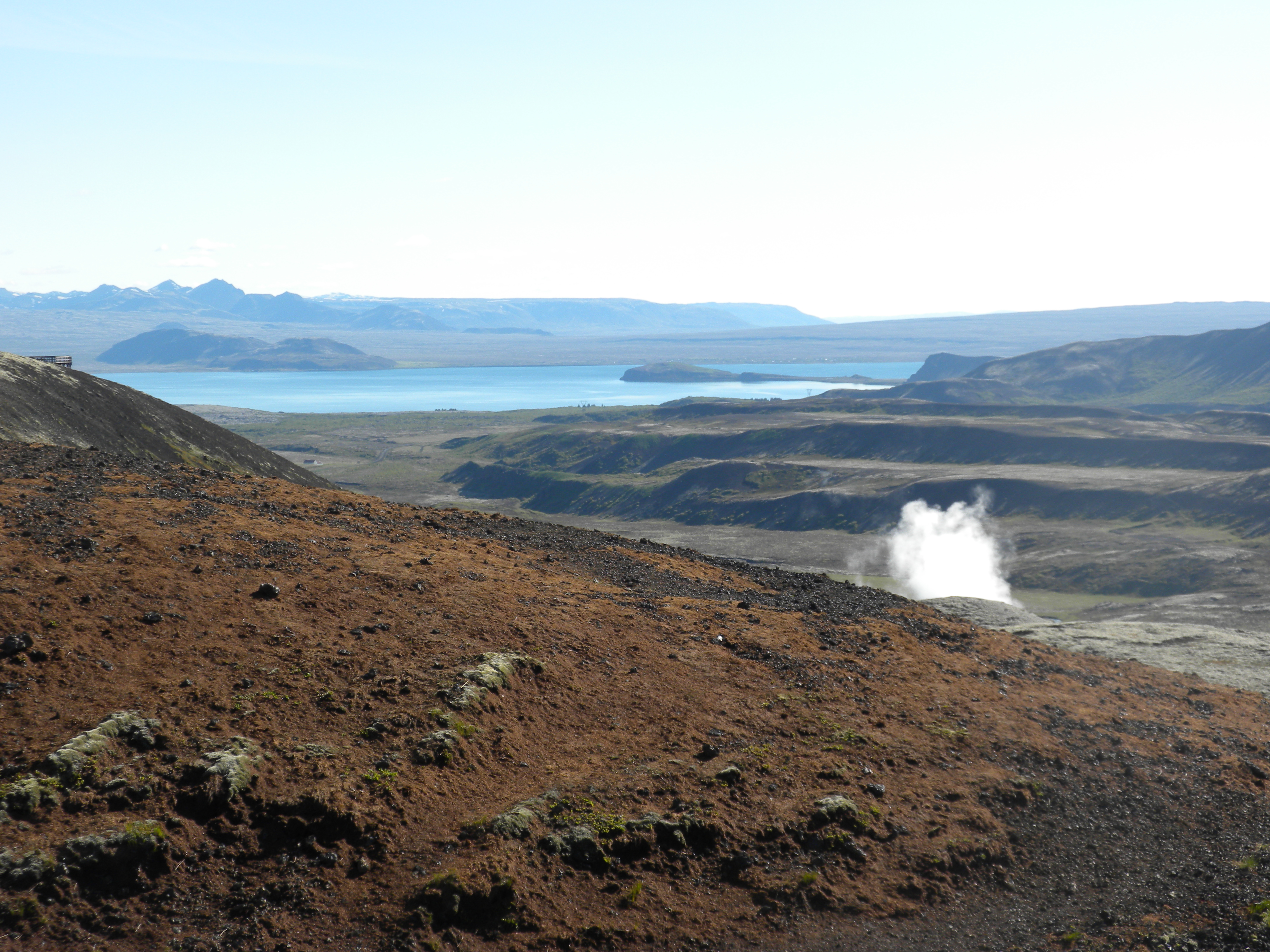
It’s maybe not what you or I would like to eat, but the Kumeyaay Indians of the Anza Borrego Desert managed to survive in a highly hostile environment eating roasted yucca leaves, cakes made with the flour of ground piñon pines, and whatever else they could concoct with the highly limited plant life of the area. The Blair Valley about four miles in from Highway S22 contains an unusual concentration of plant life (see photo below).

Kumeyaay women would find a rock to use as a mano (grindstone) and grind various edible cactus and juniper parts against rocks until depressions formed in them. These depressions (as shown above) were referred to as morteros. The Mortero Trail in the Blair Valley leads to a nicely sheltered “kitchen” area where there are numerous morteros and cupules (vertical morteros, probably for ceremonial purposes).

Lush Hillside in the Immediate Vicinity of the Kumeyaay Village Site

Lush Hillside in the Immediate Vicinity of the Kumeyaay Village Site

Sometimes I wonder what use the tribe made of the creosote bushes and cholla cacti that seem to predominate in the area, but my knowledge only goes so far. Suffice it to say that the Kumeyaay still survives as a tribe in several reservations in California and Mexico’s State of Baja California.

Martine did not like the trail very much, because the pamphlet describing sights along the way was incomplete due to vandalism or some other reason. I loved it and felt that the Kumeyaay village site was probably the most beautiful corner of the whole Anza Borrego desert region.


Reading in the Desert

Our Patio at the Borrego Valley Inn

Our Patio at the Borrego Valley Inn

Martine and I have just returned from four days in the Anza Borrego Desert, the largest contiguous state park in the United States. Compared to the larger National Parks, it is something of a poor orphan; but there is much to be seen. The only problem is it’s very much a do-it-yourself experience. The trails are not very well marked. On Friday, we took what we thought was the Narrows Trail off State Route 78, only to find that there was no clearly defined trailhead, no clearly defined trail, and a plethora of steps leading off in every direction. On Saturday we had better luck. Nonetheless, I even enjoyed our missteps.

Because she lived in Twenty Nine Palms for three years working at the Naval Hospital there, Martine does not value the desert as much as I do: I would not live there, but I find that a visit there helps clarify my mind and brings a sense of peace.

Shown above is our private patio at the Borrego Valley Inn in Borrego Springs. On the table are my two Kindles and a tall glass of ice water. I finally managed to finish reading Tony Judt’s massive Postwar: A History of Europe Since 1945, and I made a large dent in Junot Diaz’s The Brief Wondrous Life of Oscar Wao. While Martine watched television, I read hundreds of pages after returning from our day trips. The combination of exercise and reading concentrates the mind nicely.

In the days to follow, I will write several postings about our desert experiences.


Desert Interlude

Sunset in the Anza-Borrego Desert

Sunset in the Anza-Borrego Desert

Before tax season gets too intense, Martine and I will spend a four-day weekend in Southern California’s Anza-Borrego Desert. Occupying the eastern third of San Diego County and stretching roughly from just south of Mount San Jacinto to the Mexican Border, the Anza-Borrego Desert State Park is the largest state park in the United States, and also one of the least known. And, for all its desolation, it is a place of surpassing beauty. Here one can actually sees stars at night—by the million.

If one goes at the right time of year, the desert can be a healing place. What is the right time of year? I would say from late October to late May. During the summer, temperatures can rise to 130 degrees Fahrenheit (or 54.5 degrees Celsius). Only emergency workers and German tourists try to brave the blast furnace heat of a desert summer.

As I do not have a notebook computer (nor do I want access to one at this time), I will not be blogging again until Sunday or Monday.


Bunny Love

Russian Boy with Bunny

Russian Boy with Bunny

Quite by chance, I ran into a website showing selected photographs from Elena Shumilova at today.com. Her pictures were a revelation to me: Imagine the most beautiful scenes of Russian farm life, children, and animals—and take it to the power of ten! You can see more of her work at 500px.com, along with a portrait of the photographer.

There is something so warm and tactile about Shumilova’s photographs that I could not even imagine anything better on the theme. Having read Ivan Turgenev’s Sketches from a Hunter’s Notebook, Anton Chekhov’s The Steppe, and Nikolai Leskov’s The Enchanted Wanderer, I have long marveled at the Russians’ love of their countryside. It is as if Shumilova’s photographs opened a window into these authors’ hearts.


Back to Bedlam

Title Shot of Val Lewton’s Bedlam (1946)

Title Shot of Val Lewton’s Bedlam (1946)

Originally, it was called Bethlem Royal Hospital or St. Mary Bethlehem. Over the years, the British mental hospital has moved from Bishopsgate to Moorfields to Southwark, where it is now, a reputable institution associated with Kings College London. From its period of notoriety in the 18th century, where the glitterati paid admission to see loonies chained to the wall, it was better known as Bedlam.

There is a wonderful Val Lewton film of the same name, starring Boris Karloff, that was released by RKO in 1946 (see above). In it, a sane young woman is forcibly admitted to the insane asylum when she refuses to odious attentions of a powerful rake. Like almost of all of the Lewton films I have seen, it is a delight. It includes a rebellion of the inmates against the infamous Boris Karloff, who plays the head physician at Bedlam.

Poster for Val Lewton’s Bedlam

Lobby Card for Val Lewton’s Bedlam

The reason that Bedlam the movie comes to mind is my realization that we have little progressed from those bad old eighteenth century days when the mentally ill were mistreated for the amusement of visitors. Now, things are almost worse. Ever since the 1980s, the mentally ill have been on their own.When they receive any attention at all, it is usually by the police and prison guards. Instead of getting the medication that helps keep them on an even keel, the mentally ill are mistreated by guards who punish them for their non-normative behavior.

Recently, several Orange County, California police beat up and killed a mental patient named Kelly Thomas who was living on the street. In their various police academies, the police are trained to deal with malefactors, and not with persons who have a tenuous grip on reality. The police were tried and acquitted by an Orange County jury.

The outlook for the mentally ill who are loose on the streets is not a good one. Perhaps even the old Bedlam would have been an improvement.

The Light of Civilization

Traditionally, Chinese scholars, men of letters, artists would give an inspiring name to their residences, hermitages, libraries and studios. Sometimes they did not actually possess residences, hermitages, libraries or studios—not even a roof over their heads—but the existence or non-existence of a material support for a name never appeared to them a very relevant issue. And I wonder if one of the deepest seductions of Chinese culture is not related to this conjuring power with which it vests the Written Word. I am not dealing here with esoteric abstractions, but with a living reality. Let me give you just one modest example, which hit me long ago, when I was an ignorant young student.

In Singapore, I often patronized a small movie theatre which showed old films of Peking operas. The theatre itself was a flimsy open-air structure planted in a paddock by the side of the road (at that time, Singapore still had a countryside): a wooden fence enclosed two dozen rows of seats—long planks resting on trestles. In the rainy season, towards the end of the afternoon, there was always a short heavy downpour, and when the show started, just after dark, the planks often had not yet had time to dry; thus, at the box-office, with our ticket, you received a thick old newspaper to cushion your posterior against the humidity. Everything in the theatre was shoddy and ramshackle—everything except the signpost with the theatre’s name hanging above the entrance: two characters written in a huge and generous calligraphy, Wen Guang—which could be translated as “Light of Civilization” or “Light of the Written-Word” (it is the same thing). However, later on in the show, sitting under the starry sky and watching on screen Ma Liangliang give his sublime interpretation of the part of the wisest minister of the Three Kingdoms (third century AD), you realized that—after all—this “Light of Civilization” was no hollow boast.—Simon Leys, Introduction to The Hall of Uselessness: Collected Essays

TSF, or Starbucks Nation

The Most Emblematic Beverage Stop for the Thirty-Something Generation

The Most Emblematic Beverage Stop for the Thirty-Something Generation

It’s finally beginning to happen: The next generation is beginning to make its mark on restaurants and supermarkets/ Today, at Albertson’s Supermarket, I saw a large display of cold beverages featuring Red Bull and Starbucks drinks at $3-4 a pop. I noted to Martine that I pay about $8-10 for a pound of loose Indian black tea that will last me for upwards of eight months, for both cold and hot beverages.

Before going to Albertson’s, we had lunch at Truxton’s American Bistro. Perhaps a more appropriate name would be TSF: “Thirty-Something Food.” The new foodies love to mess around with the menu and its ingredients. Their iced tea was flavored with some chemical extract meant to imitate passion fruit—whatever that tastes like! But you better believe it was called organic, as if that made it taste like tea, which it does not. In fact, it obliterates the taste of the tea, such that I wonder why they bother adding any tea at all. The pizza had fresh basil, but I guess the chef thought it needed salt, a lot more salt. I felt that they were trying just a little too hard to appear unique.

It takes many years of experience to learn how to cook, especially when it comes to herbs and spices. We’ve all seen little kids at self-service soda machines: they try to mix Coke with Seven-Up with Root Beer with Mr. Pibb, with maybe a dash of raspberry iced tea for good measure. The end result of this type of experimentation is usually deplorable. I’m not saying that young chefs are quite in the same category, but sometimes it seems that way.

As the generations change, it is inevitable that the type of foods on offer will change as well. There will be a lot of dishes I will never try because the ingredients fight with one another more than complement one another. On the other hand, there are some successes, such as California Pizza Kitchen. Their chopped salads are superb, and some of their pizzas are excellent (especially the Sicilian). Martine refuses to go there because the menu contains too many of what she considers “experimental” combinations.

I suppose that the ultimate thirty-something places are Starbucks and Jamba Juice and their imitators, neither of which I patronize. I don’t drink coffee; and juice is verboten for all diabetes sufferers (juices concentrate the sugars and carbs and throw out the fiber).


A 2,000 Year Old Painting

Fresco of a Young Woman on a Balcony

Fresco Fragment of a Young Woman on a Balcony

We don’t think of painting as having begun until the Middle Ages. There isn’t much that survives from Ancient Greece and Rome, but there are some, such as the above fresco fragment showing a young woman with a turban on a balcony. The original is to be found at Malibu’s Getty Villa. She appears to be drinking something from a shallow bowl and petting a dog or cat with her left hand. While there were no oil paintings as such—not as we think of them—there were frequent wall paintings in homes, temples, and other public buildings.

If we widen our definition of painting to include mosaics, then there are some even more spectacular works such as were found at the ruins of Pompeii and Herculaneum. I have seen mosaics that have solved problems of perspective that were not seen again for over a thousand years. Take, for example, the mosaic of one of the battles of Alexander the Great below:

Alexander the Great at the Battle of Issus Against the Persians

Alexander the Great at the Battle of Issus Against the Persians

It has always been my belief that most people feel that the Greeks and Romans were too ancient to be bothered with, and that art really sprang into existence during the Renaissance. Not so. A visit to Italy or such excellent museums as the Getty Villa in Malibu help redress the balance. For some background, see the excellent web page on Ancient Roman Art and Art Objects. Compare this with the Bayeux Tapestry and other Medieval battle scenes, which look relatively primitive in comparison.

The Art of Dust

Dust Magnified by an Electron Mkicroscope

Common Household Dust Magnified by an Electron Microscope

One would not think that regular household dust, when magnified by an electronic microscope, could look so artistic. In fact, if I saw a painting like this hanging in an art museum, I would think that here was a painter who had considerable promise.

But then I think of this stuff being sucked into my lungs and down my throat and wonder how I can survive. After all, things are being manufactured with ever more exotic materials; and the detritus from these materials is being sucked into our bodies. Maybe I should look for an electron microscope photograph of our lungs or our bloodstream.

This photo comes from The Guardian’s website, which directs you to other examples of microphotography. Happy hunting!


Laser Light

Extreme Brightness

Extreme Brightness

The month of January is Southern California’s rainiest month. Usually. But not this year. So far, we have been treated to an endless round of Santa Ana winds and low humidity (around 10%). Right now, it’s about 85° Fahrenheit (that’s about 30° Celsius). If the temperature didn’t drop sharply at night, we would all be sweltering.

I just got back from lunch. The heat in this arid weather isn’t quite so uncomfortable as the laserlike light of the sun. It makes me wish I wore my baseball hat or some other brimmed headgear to protect my eyes. Although I wear photo optic glasses, they don’t provide sufficient protection from the sun’s fierceness. Years ago, I used to have super-dark prescription sunglasses. I’m beginning to think I should see my optometrist for another pair of those.