If You’re Attacked by a Lion …

Poet and Comic Spike Milligan (1918-2002)

Born in British India, Spike Milligan was a comedian, writer, musician, poet, playwright and actor. He is probably best remembered for his role in “The Goon Show,” the British radio program that spawned much of British comedy for decades to come.

Here is a little sample of his work which I hope will make you laugh. He was a very funny man.

The Lion

If you’re attacked by a Lion
Find fresh underpants to try on
Lay on the ground quite still
Pretend you are very ill
Keep like that day after day
Perhaps the lion will go away.

Selfie With Barbie

Yours Truly with Barbie

Who is that skeptical-looking muckenfuss with lovely Barbie? Oh, that’s me. I must have been making that sour face because both Margot Robbie and director Greta Gerwig were unfairly denied Oscars for their part in making what, to my mind, is the best film of 2023. Why should I be surprised? Awards, particularly in show biz, reflect the petty hatreds of professionals. Rarely have I agreed wholeheartedly with the Academy’s choices.

Now that I am on my way with Barbie to the Real World, I’d better check my bright yellow inline roller blades and my rad duds for making the scene on Venice Beach.

I guess I loved Barbie because it was so refreshing to see a purely feminine viewpoint unmarred by crass mansplaining. Mattel actively participated in the film even though its 100& white male Board of Directors in the film is actually pretty evenly split between six men and five women.

Barbie and Ken on Venice Beach

What struck me is that both Barbie and Ken were totally naive and un-selfconscious about their roles. It was like the story of Pinocchio, with both characters striving to become real people, or at least contented to be themselves. I felt for Ken and his attempt to set up the patriarchy in Barbieland, to be renamed Kenland. The Barbies ultimately win, but then the Kens accept their second-string status.

In a way, it was a pity to see the Mojo Dojo Casa House disinfected and returned to Barbie. Some, like Bill Maher, see the film as ultimately a man-hating product. I did not.

Before the Incas

Moche Pottery at Lima’s Museo Larco

As powerful as the Incas were, they were Johnny-Come-Latelies on the Peruvian scene, much as the Aztecs were in Mexico. It was only in the early 15th century that they formed an empire with its capital in Cuzco. Less than a hundred years later, two invaders put an end to the Incas: First there was measles, which spread like wildfire from the Spanish in the Caribbean. Then there were the Spanish conquistadores themselves led by Francisco Pizarro.

The Incas were only the last chapter in the Pre-Columbian world of Peru. Before them came the Huaca Prieta, Chavin, Moche, Sicán, Chimu, Wari, Chachapoyas, Paracas, Tiwanaku, Nazca, and Cajamarca—to name just a few. And that excludes the various peoples of the Peruvian Jungle.

Except for the archeologists, we seem to have forgotten all the peoples who preceded the Inca. Visit Peru, and you will see the ruins of the cities all the Inca predecessors left behind, cities like Pachacamac, Chan Chan, Kuélap, Chavin de Huantar, Huaca Pucllana, Sipán, and Sillustani.

Paracas Culture Funerary Bundle

Although I am getting a bit long in the tooth, I conceived this idea of heading north from Lima to view many of these ancient ruins. It would involve a couple of trips to high ground to visit the ruins around Huaraz and Chachapoyas, including some scary mountain bus rides; but it would prove that there is a good deal more to Peru than Machu Picchu.

Live Content

No, It Doesn’t Have To Be This Picturesque

The title of this post is deliberately misleading. I could mean the adjective “live” with a long “i” followed by the noun “CONtent,” with the accent on the first syllable; but what I really mean is the verb “live” with a short “i” followed by the adjective “conTENT,” with the accent on the second syllable. English is a very confusing language, but then life is confusing, too.

If you look at the images related to contentment in Google, you get a lot of nice scenery with people assuming various yoga-like pastures. If I were to sit like the woman in the above picture, I would be in considerable pain within two minutes. At my advanced age, I just don’t have the flexibility.

Besides, I’m not talking about contentment as seen by the chief gurus of our culture. I am thinking more of what G. K. Chesterton had in mind when he wrote his essay entitled “The Spice of Life”:

But it is much more important to remember that I have been intensely and imaginatively happy in the queerest because the quietest places. I have been filled with life from within a cold waiting room in a deserted railway junction. I have been completely alive sitting on an iron seat under an ugly lamppost at a third-rate watering place. In short, I have experienced the mere excitement of existence in places that would commonly be called as dull as ditch-water.

That I think, is the right idea. I rather like the idea of being content in a doctor’s office or at a bus stop or in a supermarket line. It actually doesn’t matter where, and it doesn’t have to be pretty. And it’s cheap: You don’t even need to buy a special wardrobe to practice it.

“Alas, Alas for England”

In this election year, I came across a short poem by G. K. Chesterton (1874-1936) that expressed exactly what I feel about politicians.

Elegy in a Country Churchyard

The men that worked for England
They have their graves at home:
And birds and bees of England
About the cross can roam.

But they that fought for England,
Following a falling star,
Alas, alas for England
They have their graves afar.

And they that rule in England,

In stately conclave met,

Alas, alas for England

They have no graves as yet.

Report: Januarius 2024

Havana Street Scene

As I mentioned at the beginning of January, I typically read books in this first month of the year written by authors I have not read before. Well, last month’s total was eleven books:

  • Maxim Osipov: Rock, Paper, Scissors and Other Stories (Russia)
  • Dorothy Parker: “Men I’m Not Married To” (USA) – short story
  • Llewelyn Powys: Earth Memories (Britain)
  • George MacDonald: The Princess and Curdie (Scotland)
  • Alejo Carpentier: Explosion in a Cathedral (Cuba)
  • Olga Tokarczuk: House of Day, House of Night (Poland)
  • Joseph Joubert: Notebooks of Joseph Joubert (France)
  • Pedro Juan Gutiérrez: Dirty Havana Trilogy (Cuba)
  • Fleur Jaeggy: Sweet Days of Discipline (Switzerland)
  • Luis Vaz de Camoens: The Lusiads (Portugal)
  • Leonardo Padura: Havana Red (Cuba)

Three of the books were by Cuban authors, and I enjoyed all three of them. Only three were originally published in English. Three of the authors were women, most particularly Olga Tokarczuk, whose House of Day, House of Night was by far the best book I read last month. Second best was Carpentier’s Explosion in a Cathedral, followed by Powys’s Earth Memories.

Were there any clunkers? I am pleased to say “No, not a one!”

Horse and Rider from Albania

What survives from the ancient Greeks and Romans? There are certainly architectural ruins, statuary, funerary monuments, steles, coins, jewels, and even glassware. But everything made of paper, wood, and other materials that disintegrate over time are gone without a trace. And so much that has survived has been damaged.

One of the surprises of my visit yesterday to the Getty Villa in Pacific Palisades was a whole gallery dedicated to a small bronze statuette of a horse and rider that was discovered in Babunjë, Albania, in 1939. At the time, that part of what is now Albania was a Greek colony. Although the lower legs of the horse are lost, the statuette is an almost perfect expression of the Greek élan in horseback riding.

Here is an even better view of the figure:

It’s a pity that the exhibition has closed—yesterday was the last day—because I would have loved to study it some more. Oh well, ars longa vita brevis.

The Good Emperor

Marcus Aurelius Antoninus (AD 121-180)

When Edward Gibbon came to write The Decline and Fall of the Roman Empire, he began with what he regarded as a golden age in the affairs of men, namely, the reign of the five “good” Antonine emperors. These were Nerva (AD 96-98), Trajan (AD 98-117), Hadrian (AD 117-138), Antoninus Pius (AD 138-161), and Marcus Aurelius (AD 161-180).

Among all the Roman emperors, it was only Marcus Aurelius who, in his Meditations, published a work of Stoic philosophy that is read to this day. It was he who wrote:

When you first rise in the morning tell yourself: I will encounter busybodies, ingrates, egomaniacs, liars, the jealous and cranks. They are all stricken with these afflictions because they don’t know the difference between good and evil. Because I have understood the beauty of good and the ugliness of evil, I know that these wrong-doers are still akin to me . . . and that none can do me harm, or implicate me in ugliness—nor can I be angry at my relatives or hate them. For we are made for cooperation.

Today was the last day at the Getty Villa in Pacific Palisades for a 3½-pound gold head of the emperor to be on display, so I felt I just had to see it. So I drove out to the Villa with my 90-year-old neighbor Luis to see it and check out the permanent collections as well.

It was well worth seeing, even though I developed a bad case of museum legs which tired me out after five hours. I visit the museum two or three times a year, and i love it more each time. And now I feel I should re-read the Meditations. I mean, how many world leaders ever wrote a major work of philosophy that still has worth in today’s world?

Earthquake-Proof

Inca Stonework on Calle Hatunrumiyoc in Cuzco, Peru

The Inca were, to my mind, most eminent for their stonework. Look at this wall in Cuzco. It was built almost 700 years ago, before a number of major earthquakes, particularly the ones of 1650 and 1950, shook most of the Spanish buildings to rubble. The remaining Inca walls did not budge. Interestingly, they were constructed without mortar, with each block trimmed to fit exactly atop the stones beneath it and to either side.

Best-known is the famous Twelve-Angle stone, not more than a few feet away from the above view:

The Famous Twelve Angle Stone

Now imagine trying to get a modern-day stonemason to do something like that. This stone is so revered that it is forbidden by law to even touch it. Yet it has withstood centuries of tremors and hard usage.

Today this wall forms part of the Archbishop’s Palace, which the Spanish wisely incorporated into the present structure.

Below is an image of some of the damage after the 1950 earthquake:

Cuzco After the 1950 Earthquake

As good as the Inca were at being stonemasons, it is amazing to think that:

  1. They had no system of writing, though they did have a system of saving numerical data using a system of knotted cords known as quipu.
  2. They did not have the wheel to help them move all those heavy stones. But then they had no draft animals that could pull heavy carts, either,

Beatitudes Visuales Mexicanas

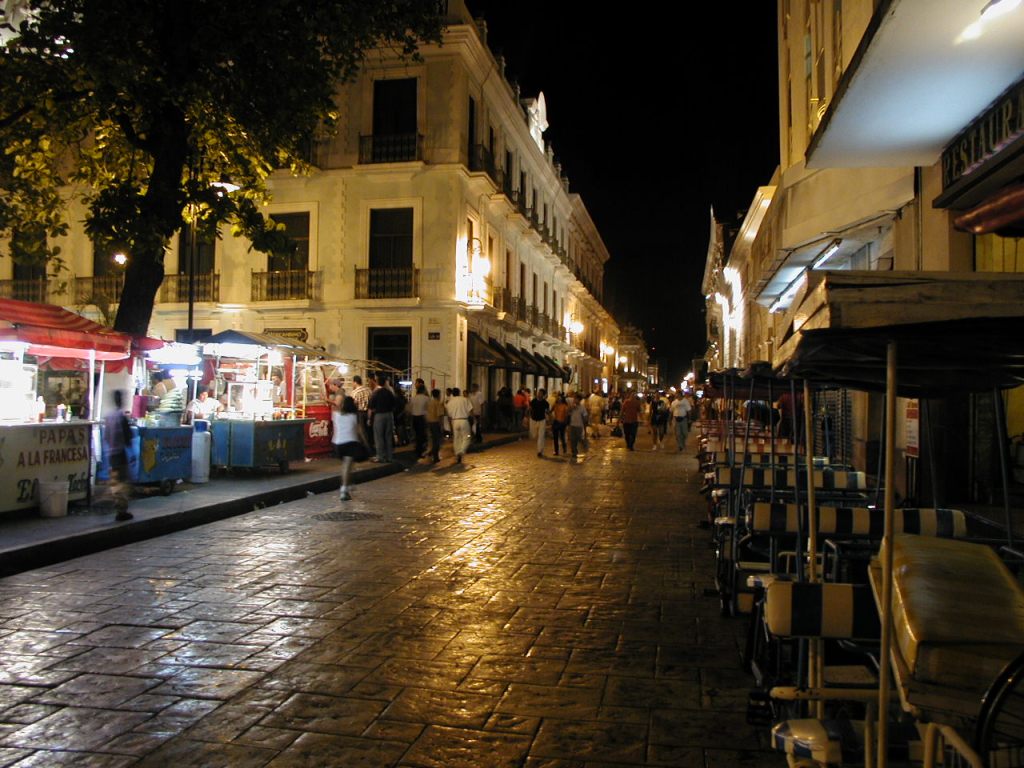
Street Scene: Xalapa, Mexico

Here is a prose poem from Lawrence Ferlinghetti (1919-2021). I remember going to a poetry reading which he gave at Dartmouth during my freshman year. He impressed me mostly because he was so clever at handling questions from smart-asses like Richard J. Dellamora, who was the teacher’s pet of the English Department.

This is a prose poem which was dated right at the time of my first trip to Mexico in November 1975. Ferlinghetti, however, was west of me in Mexico City and the State of Veracruz. I was in Yucatán. Later I was to visit all the places mentioned in his poem.

Beatitudes Visuales Mexicanas

October–November 1975

Autobus on Paseo de la Reforma with destination signs: bellas artes insurgentes. Exactamente. Just what’s needed: Insurgent Arts. Poesía Insurgente. This is not it …

1

Bus to Veracruz via Puebla + Xalapa … Adobe house by highway, with no roof and one wall, covered with words: la luz del mundo.

2

Passing through Puebla late Sunday afternoon. A band concert in a plaza next to a Ferris wheel — I have passed through many places like this, I have seen the toy trains in many amusement parks. When you’ve seen them all you’ve seen One.

3

Halfway to Xalapa a great white volcano snow peak looms up above the hot altiplano — White god haunting Indian dreams.

4

A boy and three burros run across a stubble field, away from the white mountain. He holds a stick. There is no other way.

5

Deep yellow flowers in the dusk by the road, beds of them stretching away into darkness. A moon the same color comes up.

6

As the bus turns + turns down the winding hill, moon swings wildly from side to side. It has had too many pathetic phallusies written about it to stand still for one more.

7

In Xalapa I am a head taller than anyone else in town — A foot of flesh and two languages separate us.

8

At a stand in the park at the center of Xalapa I eat white corn on the cob with a stick in the end, sprinkled with salt, butter, grated cheese + hot sauce. The dark stone Indian who hands it to me has been standing there three thousand years.

9

I’m taking this trip from Mexico City to the Gulf of Mexico and back without any bag or person — only what I can carry in my pockets. The need for baggage is a form of insecurity.

10

Two hours in this town and I feel I might live forever (foreign places affect me that way). The tall church tower tolls its antique sign: pray.

11

In early morning in the great garden of Xalapa, with its terraces and immense jacaranda trees, pines + palms, there are black birds with cries like bells, and others with hollow wooden voices like gourds knocked together. The great white volcano shimmers far off, unreached by the rising sun.

12

Brown men in white palmetto cowboy hats stand about the fountains in groups of three or four, their voices lost to the hollow-sounding birds. Along a sunlit white stone balustrade, student lovers are studying each other, novios awaiting the day. The sun beats down hot and melts not the mountain.

13

On the bus again to Veracruz, dropping down fast to flat coast. A tropical feeling — suddenly coffee plantation + palms — everything small except the landscape, horses the size of burros, small black avocados, small strong men with machetes — each still saying to himself Me llamo yo.